Focusing on the theme of warriorhood, Sidney Littlefield Kasfir weaves a complex history of how colonial influence forever changed artistic practice, objects, and their meaning. Looking at two widely diverse cultures, the Idoma in Nigeria and the Samburu in Kenya, Kasfir makes a bold statement about the links between colonialism, the Europeans' image of Africans, Africans' changing self representation, and the impact of global trade on cultural artifacts and the making of art. This intriguing history of the interaction between peoples, aesthetics, morals, artistic objects and practices, and the global trade in African art challenges current ideas about artistic production and representation.
eBook - ePub
African Art and the Colonial Encounter
Inventing a Global Commodity
- 408 pages
- English
- ePUB (mobile friendly)
- Available on iOS & Android
eBook - ePub
About this book
Information
Part 1
WARRIORS
1
MAA WARRIORHOOD AND BRITISH COLONIAL DISCOURSE
If ever the dreams of European colonists are realised in Central Africa it will, without doubt, be on those portions of the Leikipia and Kenia [Kenya] plateau which are between 5,000 and 7,000 feet above the sea-level.
—LUDWIG VON HÖHNEL, Discovery of Lakes Rudolf and Stefanie (1894)
The vultures are dropping on the Pinguan to eat one loved by the people of Nairobi.
—Song of Samburu warriors after the Powys murder, quoted in Atieno Odhiambo “‘The Song of the Vultures’: Concepts of Kenyan Nationalism Revisited” (1973)
The Samburu (Lokop)1 are Maa-speaking pastoralists who herd cattle, sheep, goats, and sometimes camels in the remote mountain fastnesses, temperate highlands, and hot dry lowlands of the Great Rift Valley corridor and its surrounding ranges south and east of Lake Turkana in northern Kenya.2 Their social relations are structured and mediated by an age-grade system in which formal warriorhood occupies an extended period of up to fourteen years between the major life-cycle transitions of circumcision and marriage.3 It is a stage of life that is not only ritually marked but sharply focused on body arts and weaponry as highly visible and volatile metaphors for virility and bravery. Admired by their girlfriends and indulged by their mothers, these young moran4 exist in a state of tension and rivalry with both the warriors of unallied Samburu sections and the older age-sets of men who have left warrior status for a more sober and powerful (but considerably less glamorous) elderhood.
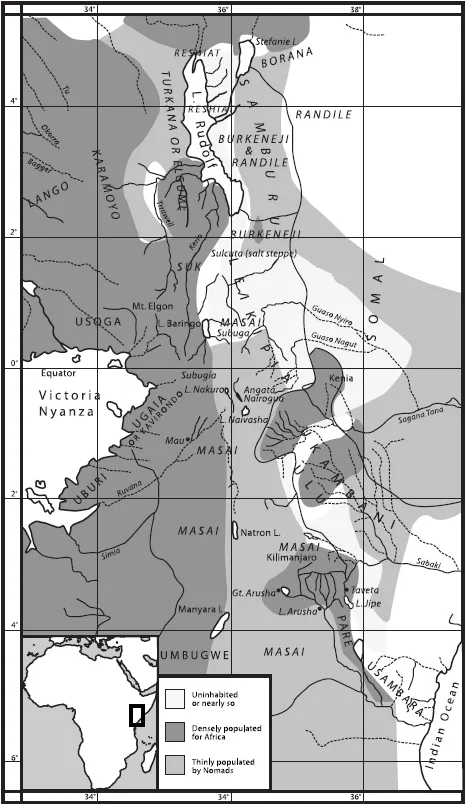
FIGURE 1.1A. Route of the Teleki Expedition through the Rift Valley, East Africa, 1887–1888. Source: Ludwig von Höhnel, Discovery of Lakes Rudolf and Stefanie (1894).
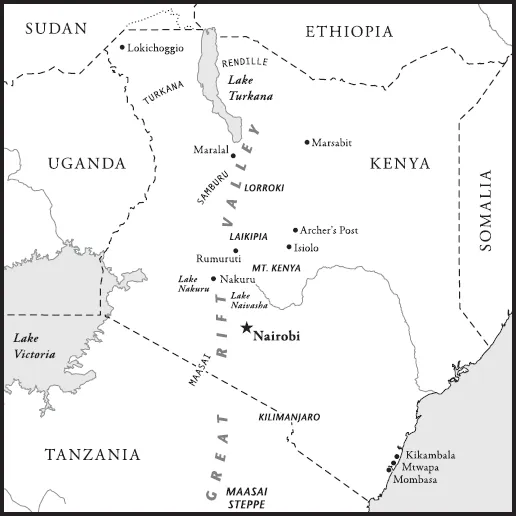
FIGURE 1.1B. The Rift Valley, Kenya, ca. 1970.
In this chapter, I excavate the nineteenth-century and colonial-period literature on Maa-speaking pastoralists, first through travelers’ and settlers’ accounts meant for a popular readership and then through the 1950s Hollywood safari film genre. To show the effects of these representations on colonial policy, I focus on a case study of the Samburu spear ban (1934–1956) and its consequences that is contained in colonial government documents and interpretations by historians (Odhiambo 1973) and anthropologists (Spencer 1965). The events that precipitated the ban took place in 1931, when a group of Samburu warriors were implicated in a homicide. It was unusual in two ways: the victim was a white man and (contrary to Samburu practice) they took the head. What followed was a long investigation in which the accused killers eventually were allowed to go free. Comparing these official and popular narratives, I try to demonstrate the colonial ambivalence concerning Samburu warriorhood that on the one hand romanticized the Maa-speaking pastoralists as disappearing signs of an aristocratic primordial Africa and on the other saw “spear-blooding” as unruly and unacceptable adolescent behavior that needed to be contained. In the next chapter I will contrast this with the unequivocally harsh British policy toward “headhunting” in Nigeria during the same period; the terms themselves mirror very different colonial perceptions of what were actually similar fighting practices.
AN OPEN LANDSCAPE
East Africa, blessed with higher altitudes and a more temperate climate than West Africa except along the coast, was vast, mountainous, and sparsely populated. Kenya—especially the central highlands—was depicted as a kind of paradise: astride the equator yet with a healthy and bracing climate and fertile uplands that were favorable to European settlement. There are no elevations in West Africa with permanent snowfields like Mt. Kilimanjaro, Mt. Kenya, and the Rwenzoris, nor is there anything comparable to the Great Rift Valley. “We have in East Africa,” intoned Sir Charles Eliot, governor of the East Africa Protectorate, “the rare experience of dealing with a tabula rasa, an almost untouched and sparsely inhabited country, where we can do as we will” (Eliot 1905, 103). An important subtext in this landscape was the presence of wild game that was impervious to tsetse fly and roamed the savanna in huge numbers. This allowed great scope for the aristocratic pastime of hunting and made of the hunter an actor on the stage of this seemingly primordial and limitless space.
The vastness and emptiness of Kenya’s Northern Frontier District also gave rise to a rhetoric of heroism and endurance in which the colonial administrator could participate: by framing Samburuland, which was far from the outposts of “civilization,” as a part of the wild, he made not only the Samburu but also himself an adventurer within it. In his annual report for 1936, a district commissioner compared the typical daily routine in Rumuruti, the administrative center for Laikipia and its white settler community, with that of the district’s newer administrative outpost in Maralal, farther north in the Samburu highlands:
Rumuruti. A ride round the prison shamba and the swamp draining work in the early morning. A meeting of the European School Committee at 9:30 a.m. Court 10:30 a.m. to noon, chiefly masters and servants, petty thefts and trespass cases. Noon to 1 p.m.: interviews with settlers re various matters. Afternoon: a few native “shauris.”
[versus]
Samburu (Maralal). With the morning tea the boy reports a leopard has eaten the tame cheetah. As one leaves the bath, the head syce [groom] reports that two elephants have broken into the cattle boma and spent part of the night there. They have not molested the Government stock however. After breakfast a headman reports that lions have killed a bullock and mauled a man in his village. The cattle boma is inspected and ordered to be mended, a gun-trap is set for the leopard and then the day’s work begins.5
There was much to dine out on here when recounting stories back home in England. Whereas West Africa produced a litany of complaints, administering the Northern Frontier District of Kenya was heroic and exhilarating. The danger there was not a sudden and ignominious death from blackwater fever but being killed by a lion. There was wild game in Nigeria too, of course (and there still is), but the very high population density even in the early colonial period precluded the possibility of large herds occupying vast uninhabited tracts of land. In Kenya, the combination of wild game in great numbers, the dramatic landscape of montane forests and wide valleys, and the domination of the landscape by warrior-pastoralists allowed the development of a colonial discourse that contrasted sharply with the discourse on West Africa.
INSCRIPTIONS OF FEARSOME NOBILITY AND CANNIBAL JOKES
The reading of Maasai superiority into the nineteenth-century record of European exploration can be traced initially to missionary J. Lewis [Ludwig] Krapf’s brief account, which was first published in German in 1858. The twin discourses on Maasai beauty and fearlessness begin here. On Maasai military reputation, Krapf reported that “they are dreaded as warriors, laying all waste with fire and sword, so that the weaker tribes do not venture to resist them in the open field, but leave them in possession of their herds, and seek only to save themselves by the quickest possible flight…. [They] do not make slaves of their prisoners, but kill men and women alike in cold blood” (1860/1968, 359, 364). Of their physical beauty, Krapf had less to say than writers who followed him and noted only that “their forms are tall and slender, with handsome and rather light-complexioned features” (361).
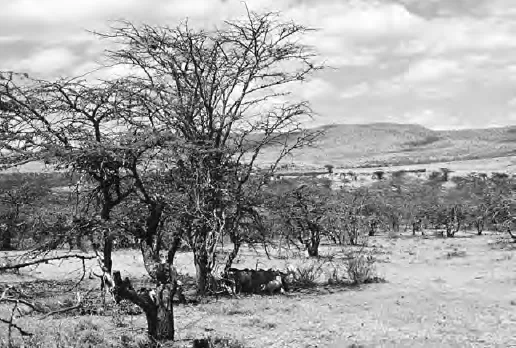
FIGURE 1.2. Dry season in Ldoinyo Lorroki, Samburu District, Kenya. Photo by author.
The more detailed description of Maasai physicality, which has been repeated in only slightly varied form by innumerable writers up to the present day, was laid out in Joseph Thomson’s Through Masai Land a generation later:
Spendidly built young savages—indeed the most magnificently modelled men conceivable…. They show little of the knotted and brawny muscle characteristic of the ideal Hercules or typical athlete. The Apollo type is the more characteristic form, presenting a smoothness of outline which might be called almost effeminate. In most cases the nose is well raised and straight, frequently as good as any European’s. (1887, 250)
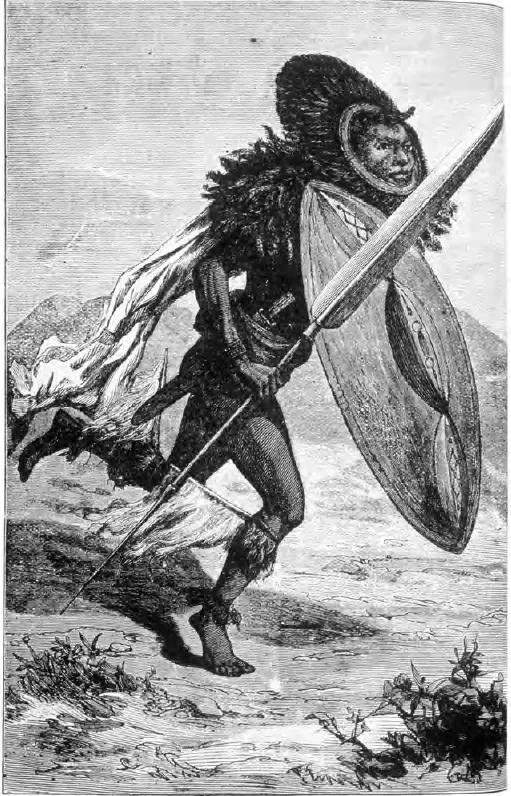
FIGURE 1.3. Maasai warrior running. Source: Joseph Thomson, Through Masai Land (1885).
Elsewhere in the book Thomson praised their “aristocratic dignity” and natural fluency, composure, and grace while speaking (1887, 90). This combination of beauty and self-assured comportment was a heady mix for Europeans expecting either vile savages or easily intimidated natives before whom it was effortless to feel superior. In 1885, the same year as the initial publication of Through Masai Land, the young Thomson was invited to visit Nigeria, which left him with a lasting distaste for West Africa and its supposed barbarisms. With reference to the cannibal tales popular in Victorian circles, he quipped, “The only circumstance which serves to maintain an air of romance about the Niger negro is the knowledge we possess that he still loves his neighbor, to the extent of becoming at times literally one flesh with him” (quoted in Johnston 1897, 182–183).
Thomson was only in his twenties when he met the Maasai and when he went to Nigeria. To be generous, some of his attempts at witty irreverence (and they abound in Through Masai Land also) could be attributed to callow ideas of Oxbridge humor.6 Some of this was inserted, perhaps at the publisher’s urging, into the 1887 revised edition, a part of the series known as Low’s Popular Library of Travel and Adventure along with titles such as Stanley’s How I Found Livingstone and H. H. Johnston’s The River Congo from Its Mouth to Bôlóbò. Still, it is perhaps revealing that cannibal jokes about Nigeria were a part of the British explorer/imperialist repertory in the 1880s and 1890s.
Cannibals also appeared simultaneously—not as jokes but as serious representations—in the more romantic accounts of Niger and Benue river exploration such as Adolphe Burdo’s. After traveling through their country, Burdo wrote that the Akpotos (Idoma) and Mitshi (Tiv) were “utterly barbarous, practice idol-worship, offer human sacrifices, and cannibalism flourishes among them” (1880, 246). By the turn of the century these contrasting narratives on war-riorhood in Africa were established literary genres for describing the Maasai and the people of the Lower Niger and Benue regions—one celebrating the warrior as a fearless but elegant Apollo and the other reviling him as an idol-worshipping barbarian.
A third major element entered Maasai literary representation in 1901 with the publication of Sidney and Hildegarde Hinde’s The Last of the Masai. This was nostalgia: the sense that not only were the Maasai unique in their “Hamitic” beauty and proud culture but that it was fast disappearing. Sidney Hinde wrote, “By the ‘Last of the Masai’ I do not mean the last individuals of the race, but rather the last of the rapidly decreasing band of pure blood, whose tendencies, traditions, customs and beliefs remain uncontaminated by admixture with Bantu elements and contact with civilization” (1901, xiii). This narrative of purity and pollution, or uniqueness unmarred through assimilation, forms the final recurrent theme in Maasai representation.
Hinde’s argument that it was only with the pacification of the country under British administration that the Maasai began to absorb “outside influences” is an exaggeration. Nineteenth-century accounts make it clear that the Maasai not only confiscated the cattle of but routinely traded with other East African people.7 In the colonial period, they frequently took Kikuyu wives to offset the lower fertility of Maasai women or to satisfy the demands of polygyny. In fact, Maasai and Samburu social theory maintains an ideology of assimilation while at the same time professing social distinctiveness from non-Maa, nonpastoralist “others”—what Hinde saw as the “contaminating” Bantu elements.8
Krapf was a Basel-trained missionary with the evangelical Church Missionary Society, Thomson a Scottish geologist sponsored by the Royal Geographic Society, and Sidney Hinde a collector for the British East Africa Protectorate. Together they wrote the Maasai into the early colonial imagination. This inscription had three parts: the Maasai were fearless (Krapf), self-assured and magnificent-looking (Thomson), and the last vestige of a disappearing noble race (Hinde). Such an elegiac representation carried its own Rousseauian corollary in the minds of the educated classes: the Maasai perforce led a happy and contented life, devoid of stress, all of which is introduced through the process of civilization. Although it contains only a stereotypical fragment of truth, this widely held conviction has survived colonialism and is still heard in the 1990s from those seeking an authenticating experience with the Maasai or Samburu.
There was another much more calculated and less idealized side to British indulgence toward the Maasai, however. This was their cynical use of them as collaborators in the early conquest of Kenya. In a “fragile regional economy set on edge by rinderpest and famine,” the British formed an alliance with the Rift Valley Maasai against the Gikuyu, Nandi, Luyia, Luo, Kamba, and many others (Lonsdale 1992, 26–28). From 1893 to 1906, nearly all the small pacification campaigns led by a company or two of the East African Rifles were supported by several hundred Maasai auxiliaries. The policy was to destroy houses and crops and capture livestock so as to enforce submission. The Maasai were awarded much of the stock they captured, enabling them to recover from their earlier losses from rinderpest and reclaim some of their old grazing lands (27).9
But once these campaigns were nearly over and white settlement became an urgent political consideration, the Maasai were removed from the Rift Valley in 1904 and then forcibly removed from Laikipia in 1911 through a series of maneuvers by three successive governors. Sir Charles Eliot, Sir Donald Stewart, and Sir Percy Girouard all conspired in various ways with their senior officers to make it appear to the Foreign Office that the Maasai were “willing and anxious to move” (Sorrenson 1968, 192–209). This was far from the truth, and stories persisted well into the 1940s of the ruthlessness of the government in confiscating and publicly burning the shields and spears of the Maasai warriors to prevent opposition to the relocation (Hanley 1971, 297). Legalishu, one of the two main representatives of the northern Maasai and an opponent of the second move, engaged a Mombasa barrister to challenge the legality of the second treaty. But after two years of petty obstructions by the gove...
Table of contents
- Cover
- Title Page
- Copyright
- Dedication
- Contents
- Preface
- Acknowledgments
- Introduction: Colonial Power and Aesthetic Practice
- Part 1. Warriors
- Part 2. Sculptors and Smiths
- Part 3. Masks, Spears, the Body
- Part 4. Commodities
- Reprise: The Three C’s: Colonialism, Commodities, and Complex Representations
- Coda: From Spears to Guns in the North Rift
- Notes
- Bibliography
- Index
Trusted by 375,005 students
Access to over 1.5 million titles for a fair monthly price.
Study more efficiently using our study tools.
Frequently asked questions
Yes, you can cancel anytime from the Subscription tab in your account settings on the Perlego website. Your subscription will stay active until the end of your current billing period. Learn how to cancel your subscription
No, books cannot be downloaded as external files, such as PDFs, for use outside of Perlego. However, you can download books within the Perlego app for offline reading on mobile or tablet. Learn how to download books offline
We are an online textbook subscription service, where you can get access to an entire online library for less than the price of a single book per month. With over 1.5 million books across 990+ topics, we’ve got you covered! Learn about our mission
Look out for the read-aloud symbol on your next book to see if you can listen to it. The read-aloud tool reads text aloud for you, highlighting the text as it is being read. You can pause it, speed it up and slow it down. Learn more about Read Aloud
Yes! You can use the Perlego app on both iOS and Android devices to read anytime, anywhere — even offline. Perfect for commutes or when you’re on the go.
Please note we cannot support devices running on iOS 13 and Android 7 or earlier. Learn more about using the app
Please note we cannot support devices running on iOS 13 and Android 7 or earlier. Learn more about using the app
Yes, you can access African Art and the Colonial Encounter by Sidney Littlefield Kasfir in PDF and/or ePUB format, as well as other popular books in History & African History. We have over 1.5 million books available in our catalogue for you to explore.