A study of how the state has used documentary films to create historical and political narratives in the Soviet Union and Cuba.
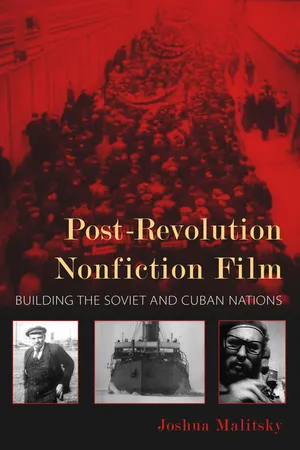
In the charged atmosphere of post-revolution, artistic and political forces often join in the effort to reimagine a new national space for a liberated people. Joshua Malitsky examines nonfiction film and nation building to better understand documentary film as a tool used by the state to create powerful historical and political narratives. Drawing on newsreels and documentaries produced in the aftermath of the Russian revolution of 1917 and the Cuban revolution of 1959, Malitsky demonstrates the ability of nonfiction film to help shape the new citizen and unify, edify, and modernize society as a whole.
Post-Revolution Nonfiction Film not only presents a critical historical view of the politics, rhetoric, and aesthetics shaping post-revolution Soviet and Cuban culture but also provides a framework for understanding the larger political and cultural implications of documentary and nonfiction film.
"A splendid and highly readable book which imbues a suggestive comparison of cinema in the early years of the Soviet and Cuban revolutions with fresh insights." —Michael Chanan, author of
Cuban Cinema
"Joshua Malitsky here mines a rich seam. By closely comparing Vertov and Alvarez he uncovers "post-revolutionary nonfiction film" as a discernible entity with commonalities shared across time and cultures. The extensive—indeed vast—archive of newsreels from both filmmakers is well worth the thorough attention he gives it, suggesting a context for their better-known documentaries. And his situating of Esfir Shub's compilations as not so much an alternative to Vertov but rather a wholesale replacement approach to agitprop is also compelling. All in all, Malitsky offers a crucial corrective to much received thinking on 20th century radical film." —Brian Winston, University of Lincoln, UK
- 290 pages
- English
- ePUB (mobile friendly)
- Available on iOS & Android
eBook - ePub
About this book
Information
Subtopic
Film & VideoPART ONE

ONE
Kino-Nedelia, Early Documentary, and the Performance of a New Collective, 1917–1921
TAKE ONE
The Red Star Literary-Instructional Agit-Steamer of the All-Russia Central Executive Committee was a propaganda ship that traveled down the Volga River in 1919. It was also the name (without question a most unwieldy one!) of a two-reel film that Dziga Vertov made in accordance with its voyage. Red Star is a political travelogue that follows the ship as it spreads propaganda in towns and villages along the river. The ship itself was a multipurpose vessel: it carried movie-barge; it was equipped with a radio station tuned to the national news service; it exchanged goods made in Moscow for peasants’ grain; and it handed out propagandistic literature. Moreover, the ship was itself a piece of propaganda, as it was covered in banners and marquees championing political slogans.
To emphasize the importance of the mission, the Red Star bore celebrity leaders who would speak to citizens gathered along the way. Among the figures were Nadezhda Krupskaia (Lenin’s wife) and Viatcheslav Molotov (Stalin’s future minister of foreign affairs). The film captures the leaders in private moments—writing speeches, enjoying the sights, or conversing with comrades—and in public moments as they deliver speeches to crowds. In these latter cases, the emphasis is less on the individual speaking than on the crowd gathered. Close-ups of the speakers focusing on gestures quickly give way to long shots from the vantage point of, and covering, the crowd. The speech coverage, the handing out of propagandistic literature, and the political slogans marking the vessel contribute to the notion that the film is actually less about the content of the agit-prop than it is celebrating the propagandistic effort itself. It does not celebrate a speech; it celebrates speechmaking. It does not highlight a propagandistic message; it highlights propaganda.
But the film also visualizes the impact of the steamer on the populations it encounters. Two sequences in particular aim to demonstrate growing support for the Bolsheviks. The first is a striking scene of the ship leaving a large village. As it pulls away from shore, it appears that the Red Star has amassed hordes of new passengers. It is not clear why. Perhaps the captain agreed to transport locals down the river? Perhaps they just wanted to watch a film on board? Whatever the reason, the ship has apparently increased in population and energy. People wave good-bye, chat, and laugh. The vessel is full of vivacity and is reminiscent of a traveling show bringing joy to a town and moving on after its brief stay. It has a carnivalesque feel. Bolshevik propaganda appears not as a tedious thing but as an inevitable and pleasurable force sweeping the nation.
If this first sequence indicates the energy and optimism the film hopes to associate with Bolshevism, an additional example points to the organizational unity of the masses. Following a speech to a large crowd of people gathered on a hillside, we see a long shot of the group descending the hill. The shot is framed so that we see them gradually coming together as they make their way in organized yet urgent fashion between two obstacles (perhaps boulders, it is unclear), that cover the bottom left-hand and right-hand sides of the frame. Had Vertov immediately cut away from the scene, we would probably not have paid the sequence any attention. Instead, after slightly reframing, he cuts back to the same shot as the crowd has increased in density. Finally, he cuts to another slightly reframed image of the remnants of the crowd as the lingerers hustle to make their way down the bottom of the hill and along the path. In each instance, the condensed space does not have a suffocating effect on the crowd. The people convene in an organized fashion, with purpose and discipline. They adjust their personal positions to accommodate others. The cumulative effect of the three shots, like the previous scene of the people on the ship, is a sense of the inevitability of this national-ideological movement. It comes across not as an oppressive force but as an invitation, offering people a place on board, promising pleasure, excitement, and camaraderie, even as it requires a level of discipline and organization required for its efficacy. But it also implies a warning not to get left behind.
SHORT TAKE TWO
A complementary example comes in a sequence from a Swedish compilation film titled Rysk Journal (Russian newsreel). It may have been taken from another Vertov travelogue—the 1921 one-reel film The Agit-Train of the All-Russia Central Executive Committee—but this is not clear.1 The film shows revolutionary leaders on a “kino-train,” an agit-train equipped with a film camera and projector, arriving at a small village, handing out propagandistic literature, and speaking to the assembled crowds. Peasants peruse the literature, gaze at the train, and stare at the camera. When the train departs, newspapers are tossed from the window. The cameraman leans out the window, capturing on film the newspapers, which appear to have sprouted wings, as they float gently in the air. Peasants chase the train, reaching for the newspapers. One man snatches an issue out of the air.
The urgency with which the peasants pursue the newspapers speaks to nonfiction cinema’s typical and unique role in the Russian/Soviet nation-building project. Like other nation-building endeavors, these films are examples of efforts by nonfiction filmmakers to communicate the transformation of life under the new Bolshevik leadership. They point to new peasant/worker, rural/urban, and national/transnational/global alliances. They communicate core agitational messages to a wide population. And they aim to create the new idea of a national collective—the kino-train film isolates the newspaper, which Benedict Anderson has demonstrated is the archetypal symbol of national belonging. In other words, they attempt the neat trick of showing that the nation has emerged while simultaneously calling it into being.
These two films—Red Star and Rysk Journal—highlight nonfiction film’s uniqueness within the nation-building project. The peasants in these films are not static exemplars of new citizenries. Rather, their eager pursuit of the newspaper and longing to be on board the Red Star underscore twin aspects of the immediate post-revolutionary nonfiction film period. First, they call attention to an active effort to publicly perform citizenship. That is not to claim these performances as falsifications but to recognize—as the films themselves make plain—that acts of citizenship are increasingly visualized and visualizable. Second, they are not bland descriptions of participating in a collective. These films articulate the sensible impact of becoming part of a collective and participating in the effort to newly shape political, economic, social, and cultural life.2
How, then, are we to understand them as films with specific political purposes? Georgi Plekhanov distinguishes agitation from propaganda by claiming that propaganda is an attempt to communicate comprehensive explanations, often understandable only by a select portion of the population. At the turn of the century (and at the time of the Russian Revolution), it was associated with the written word and seen as a long-term process. In contrast, agitation presented a few ideas to a much wider population with the goal of rousing them to action.3 It was associated with the spoken word and seen as a short-term process. Within this framework, the Russian/Soviet nonfiction films of the first period are more agitational than propagandistic. Vertov and other filmmakers had not yet developed the language to communicate cinematically the more sophisticated political, social, and even scientific concepts they eventually would. In fact, the most common way of describing the difference between Vertov’s early work (the Kino-Nedelia series and his early documentaries from the late 1910s and early 1920s) and his more mature efforts (beginning with issues of Kino-Pravda and moving through his silent feature documentaries) is to locate the shift from reportage to documentary, or, as Jeremy Hicks describes it, from recording an already existing causal relation to creating it through editing.4 From the vantage of the later films, these early films are described by scholars as striking in their lack of inventiveness and their passivity in relation to the material world.5 But even if scholars are correct in claiming that this is the period “before Vertov became the Vertov we now know,” as Philip Rosen has described it,6 I want to argue that marking these early films simply as reportage forecloses consideration of some of the productive capacities of the films, namely their effort to shape subjectivities and, in turn, build citizenries by projecting, modeling, and instilling new visions of collectivity.
The topics of these films and the rhetorics they employ seek to provide a foundation for the development of change in a socialist society. In this chapter, I argue that the films of the first period (1917–1921), conditioned by the circulatory practices and political-industrial context, sought to activate a collective imagination by forging a cinematic space for the imagination of collective action. Whereas the kino-train and agit-steamer are metonyms of these imaginary collective spaces, not all of the films are so explicit in their effort to bring Soviet ideology to consciousness. But even if agitation is understood as a limited intellectual engagement and thought to be valuable only for short-term practical goals, its effects on the imagination are far more lasting than Plekhanov’s framework allows. The accumulation of moving images of a new Russian/Soviet citizenry, with transformed alignments and purposes, collecting and moving anew through urban spaces, wrought a powerful impact on the viewing subject’s imagination. Combined with exhibition contexts in which these films were explicitly framed by a leadership both on display and available to reflection, they sought simultaneously to visualize the collectivity and to instill a desire for membership in that collectivity while making the effort itself an object of constant reflection.
PRE-REVOLUTIONARY NONFICTION FILM
The first regularly produced and distributed Russian newsreel was launched in 1908 by the State Duma’s official photographer, Alexander Drankov. Only fragments of two issues remain. The material gives the impression that, like most foreign newsreel production the world over, many of the events were faked. Russian audiences displayed an immediate affinity for nonfiction film, and production increased accordingly. Most of the 1,800 newsreel films that were issued between 1907 and 1914 (the beginning of World War I) captured everyday life and official events throughout the empire. Considerable attention was paid to the grand occasions of the imperial state, notably the Romanovs’ jubilee celebrations in the spring of 1913.7
During the war (1914–1917), the Skobelev Committee was appointed by the tsar to produce and distribute newsreels that reported on the fighting. The films focused on the Western Front in an attempt to rouse support for the war. However, there was little firsthand material to work with, and films regularly contained inserted dramatic footage.8 But there were also numerous examples of films primarily concerned with identifying people, places, and events without drama or extensive description. The evidentiary capacity of nonfiction film was seemingly sufficient to attain the producers’ objectives.9
While the Skobelev Committee did not cover the events of the February Revolution that overthrew the tsar, the Provisional Government immediately employed the committee to produce the newly established newsreel series Free Russia, with the hopes of using nonfiction film as a propaganda tool. By May, the series had become an aggressive vehicle for pro-Provisional Government propaganda, highlighting demonstrations against the Bolsheviks, solidarity with foreign governments, and Aleksandr Kerensky’s military and civilian support. But owing to the combination of labor disputes, poor organization, and power shortages, there was little officially sponsored production, and private companies continued to profit from nonfiction film production.10
Upon seizing power, the Bolsheviks immediately sought to exploit the propagandistic potential of nonfiction film. Krupskaia was appointed the first head of the cinema subsection of the People’s Commissariat (Narkompros), demonstrating the party’s commitment to the medium. The commissariat did not immediately nationalize the industry for fear that doing so would alienate private industry and further contribute to the stock, equipment, and expertise shortage. Under the leadership of Grigory Boltiansky, a cameraman sympathetic to the Bolsheviks who worked during the Provisional Government’s stint in power, the Skobelev Committee shifted Free Russia to a pro-Bolshevik stance. The importance of the series was short-lived, however. As the center of power shifted from Petrograd to Moscow, Anatoli Lunacharsky, head of the Commissariat of Enlightenment, established a newsreel section of the newly founded Moscow Cinema Committee. He appointed Mikhail Koltsov to lead the division and create a weekly newsreel titled Kino-Nedelia. It was Koltsov who gave a young Dziga Vertov his first job in the cinema, offering him a position as a clerk in the spring of 1918.
BEGINNING TO SPIN
Dziga Vertov was born Denis Arkadievich Kaufman in Bialystok, Poland, then part of Russia, on January 2, 1896. He had two brothers, Mikhail (Moisei) and Boris Kaufman. His father was a bookstore owner, his mother a librarian. By the age of ten, Vertov began writing poetry and novels. He loved music, attending the Bialystok music school from 1912 to 1915, and was fascinated by science. In 1915, Vertov fled with his family to Moscow in order to escape the German onslaught in Poland. Boris was sent to France, Mikhail was drafted, and Dziga, exempted from military duty due to his chronic lung disease, studied law in Moscow and then psychoneurology in Petrograd.
It was in Petrograd that Vertov first connected with the Russian avant-garde that included such figures as Osip Brik, Aleksandr Rodchenko, and Vladimir Mayakovsky. The Russian Futurists, Vertov included, would have been familiar with the writings of the Italian Futurists. Filippo Marinetti’s manifestos were distributed widely in Russia prior to his controversial visit in 1914. How Russian Futurism differed from Italian Futurism is cause for considerable debate. What seems clear is that both movements were interested in speed, youth, dynamism, and action. They were fascinated with the effects of motion and rejected conventional confines of space and time and any sort of contained or closed forms. They sought to shock bourgeois sensibilities by bringing the street into poetry, painting, and cinema. They were interested in the urban and the everyday, the formally experimental, and the use of mathematical and musical symbols. While absorbed with the energy of the contemporary moment, the Russians maintained links to the past and perhaps possessed more insight into the relation between aesthetic theory and radical politics than did the Italians. Rather than abandoning the past with its images, icons, and myths, they sought to transform them. The notion that producing anything new required working through the old undergirds most modernist Russian aesthetic thinking. Constructing new meaning in art required transforming older and deeply embedded epistemologies and habits. Politically, for the Italian Futurists, the revolutionary essence led to a reactionary politics linked to fascism and aggressive nationalism, while Russian Futurism immediately became linked with communism.
By 1917, the year of Vertov’s arrival in Petrograd, the Russian Futurist movement had splintered into a number of factions. One of the dominant blocs was the Cubo-Futurist movement, led by David Burliuk and the two leading Russian modernist poets, Vladimir Mayakovsky and Velimir Khlebnikov. Cubo-Futurists sought to challenge the boundaries established by older...
Table of contents
- Cover
- Title
- Copyright
- Dedication
- Contents
- Acknowledgments
- Introduction: Revolutionary Rupture and National Stability
- Part One
- Part Two
- Part Three
- Notes
- Bibliography
- Filmography
- Index
- About the Author
Trusted by 375,005 students
Access to over 1.5 million titles for a fair monthly price.
Study more efficiently using our study tools.
Frequently asked questions
Yes, you can cancel anytime from the Subscription tab in your account settings on the Perlego website. Your subscription will stay active until the end of your current billing period. Learn how to cancel your subscription
No, books cannot be downloaded as external files, such as PDFs, for use outside of Perlego. However, you can download books within the Perlego app for offline reading on mobile or tablet. Learn how to download books offline
Perlego offers two plans: Essential and Complete
- Essential is ideal for learners and professionals who enjoy exploring a wide range of subjects. Access the Essential Library with 800,000+ trusted titles and best-sellers across business, personal growth, and the humanities. Includes unlimited reading time and Standard Read Aloud voice.
- Complete: Perfect for advanced learners and researchers needing full, unrestricted access. Unlock 1.5M+ books across hundreds of subjects, including academic and specialized titles. The Complete Plan also includes advanced features like Premium Read Aloud and Research Assistant.
We are an online textbook subscription service, where you can get access to an entire online library for less than the price of a single book per month. With over 1.5 million books across 990+ topics, we’ve got you covered! Learn about our mission
Look out for the read-aloud symbol on your next book to see if you can listen to it. The read-aloud tool reads text aloud for you, highlighting the text as it is being read. You can pause it, speed it up and slow it down. Learn more about Read Aloud
Yes! You can use the Perlego app on both iOS and Android devices to read anytime, anywhere — even offline. Perfect for commutes or when you’re on the go.
Please note we cannot support devices running on iOS 13 and Android 7 or earlier. Learn more about using the app
Please note we cannot support devices running on iOS 13 and Android 7 or earlier. Learn more about using the app
Yes, you can access Post-Revolution Nonfiction Film by Joshua Malitsky in PDF and/or ePUB format, as well as other popular books in Media & Performing Arts & Film & Video. We have over 1.5 million books available in our catalogue for you to explore.