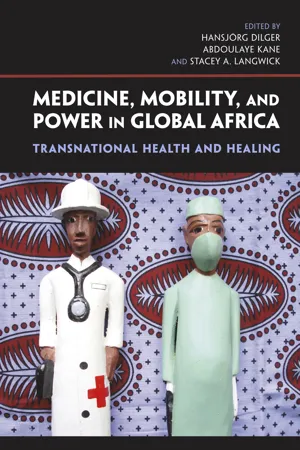
Recent political, social, and economic changes in Africa have provoked radical shifts in the landscape of health and healthcare. Medicine, Mobility, and Power in Global Africa captures the multiple dynamics of a globalized world and its impact on medicine, health, and the delivery of healthcare in Africa—and beyond. Essays by an international group of contributors take on intractable problems such as HIV/AIDS, malaria, and insufficient access to healthcare, drugs, resources, hospitals, and technologies. The movements of people and resources described here expose the growing challenges of poverty and public health, but they also show how new opportunities have been created for transforming healthcare and promoting care and healing.
eBook - ePub
Medicine, Mobility, and Power in Global Africa
Transnational Health and Healing
- 358 pages
- English
- ePUB (mobile friendly)
- Available on iOS & Android
eBook - ePub
Medicine, Mobility, and Power in Global Africa
Transnational Health and Healing
About this book
Information
Topic
MedicineSubtopic
African HistoryPART 1
Scale as an Effect of Power
ONE
The Choreography of Global Subjection: The Traditional Birth Attendant in Contemporary Configurations of World Health
Stacey A. Langwick
This chapter is about how transnational collaborations elicit a global subject. It takes the Traditional Birth Attendant (TBA) as the site for unraveling the movements critical to an African globality. The TBA, as it was forged in the health crises of the second half of the twentieth century, is both a radically localized figure and a completely global product. Anthropologists have recognized that health development and humanitarianism are powerfully evocative spaces from which to examine the forms of violence as well as the kinds of liberation tied up in the obligations and ethics of medical interventions (Fassin 2008; Nguyen 2005; Peterson forthcoming; Redfield 2005, 2006, 2008). The marginality of the TBA within biomedical discourse—the suspicions as well as the hopes it generates, the controversies as well as the solutions it sustains—leads our attention in a different direction than ethnographies of other global medical interventions do, however (for example, in this volume see chapter 4 by John Janzen). The TBA recasts how we think about global subjectivity. As global health governance elicits the world as a set of nested administrative units—the global, the regional, the national, and the local—the subject is formulated as one more level of administration.
The imagined TBA profiled in the international health development documents of the World Health Organization (WHO) maps neatly over the iconic “Third World woman” of the feminist texts examined by Mohanty (1986) in her classic essay “Under Western Eyes.” Mohanty argues that the Third World woman depicted in “Western” feminist scholarship is distinct in her homogeneity from the flesh-and-blood historical women who live varied lives in Africa, Asia, and Latin and South America. The average Third World woman emerges through the universalizing methodologies of cross-cultural analyses. By formulating women as a stable category and marking only the “Third World difference” these studies maintain the West as a privileged referent or norm. The TBA who peoples the pages of the policy documents, public health guidelines, training manuals, and other texts that comprise so much of international health development work is a specialized version of the Third World woman. She is generated through the intersection of two sets of universalizing knowledge practices concerning gender and medicine. She illustrates how the differences central to Mohanty’s “gendered worldings” both enable and are enabled by distinctions between biomedical knowledge and other forms of knowledge about bodies, health, and healing.
Stacy Leigh Pigg (1997a, 1997b) takes up a similarly discursive argument when she accounts for both TBAs and Traditional Medical Practitioners (TMPs) as products of international health development discourse. The concept of tradition, as it is unpacked by Pigg, does work similar to Mohanty’s Third World difference. In the United States or Western Europe there may be homebirth midwives, even direct entry midwives, but there are, in the current framework, no longer TBAs. Even the process of identifying TBAs marks an area as the Third World. Pigg examines development agency reports and policy statements in Nepal in order to describe the translations that render a range of birthing practices in Nepal as “traditional.” The documents Pigg examines articulate TBAs as practitioners “found in most societies” who are trusted custodians of cultural knowledge. In so doing, they establish a binary division of reproductive knowledge—traditional and modern—that is implicitly ranked. Pigg argues that this conceptual move “position[s] development institutions as the locus of authoritative knowledge while devaluing other, local forms of knowledge” (1997a: 233).
In this chapter, I build on these textual analyses by exploring the institutional work that generated the materials grounding the WHO’s concept of the TBA, and the effects of the circulation of these materials. The genesis and movement of these documents reveal more than biomedicine’s role in the “discursive colonization” of women’s bodies in the developing world; they also reveal the constitution of a particular vision of the world itself. Literature is central to the practices of development organizations that render the world as scalar and thereby manageable. This effect of literature is less evident inside of texts, however, and more evident in the consequences of their production and circulation. The making of TBAs serves as one example of the ways in which development’s iterative bureaucratic processes—and the letters, minutes, reports, and manuals they involve—conceive a world that can be apprehended as a collection of regions, which are themselves collections of nation-states, which are themselves collections of communities, which are themselves collections of individuals. Diverse areas and peoples become parts of wholes.
The evocation of and training of TBAs illustrates how “world health” is continually formulated as a practical framework for articulating problems and imagining solutions.1 Within these programs the global appears to be common sense, and international development appears to be a necessary, even ethical, intervention. While the effectiveness of programs involving TBAs has been hotly debated (especially as effectiveness is often defined strictly in terms of maternal mortality statistics)2, the work to develop these programs generates effects outside the realm of reproductive health care. For this reason, I argue, controversies over the value of the TBA in health programs have not seemed to reduce programming related to the TBA. If anything, with the outbreak of AIDS, international interest in and training for TBAs has increased.
While international development literature depicts TBAs as an already always-available resource to be tapped, in truth the making of the TBA as an articulate global subject has required an enormous amount of work. While I approach the making of the TBA as a global actor through the WHO, their records make it clear that the TBA makes sense only within a specific assemblage of actors. For instance, the background document for the 1973 Consultation compiled reports from over 40 ministries of health as well as both the published work of scholars and personal communications concerning their research. The meeting itself included observers from UNICEF, the United Nations Population Fund (UNFPA), the Population Council, the International Planned Parenthood Federation (IPPF), the International Council of Nurses (ICN), the International Confederation of Midwives (ICM) / International Federation of Gynaecology and Obstetrics (FIGO) Joint Study Group, and a consultant from the London School of Hygiene and Tropical Medicine (N2/180/3 130B3). Collier and Ong (2005: 14) argue that one “function of the study of assemblages is to gain analytical and critical insight into global forms.” This is a study of assemblage both to account for the TBA as a global actor in health development and to explore how the global itself—what Tsing (2005) has called “globality”—is constituted.
The WHO is an ideal site to examine what the work of gathering data, assembling experts, establishing linkages, and coordinating commitments generates. The WHO describes itself as “the directing and coordinating authority for health within the United Nations system.”4 It facilitates, motivates, and shapes the work of others. In short, it generates the institutional collaborations and the technical, ethical, and political assemblages necessary for the world health that it purports to address. WHO initiatives concerning TBAs reveal the forms of difference most relevant to constructions of world health, as well as the techniques of managing difference within administrative scales. The history of the TBA, with its explicit marking of the traditional, throws into particularly strong relief frictions between local specificity and universal categories of behavior, practice, and experience. I examined WHO archival files from the late 1960s, when traditional birth attendants and traditional medicine became organizing concepts within the WHO, until 1987, when efforts concerning TBAs were solidified as part of the Safe Motherhood Project. I read the findings of my archival research through my experience conducting ethnographic research on traditional healing, including the work of TBAs, in Tanzania since 1998.
Discerning TBAs
Women who specialized in assisting other women with birth caught the attention of the WHO as early as 1955. At this time, participants in the Technical Discussions of the Sixth Session for the WHO Regional Committee for the Western Pacific Region debated the potential contributions of “domiciliary midwifery.” They reached no consensus, however, as “almost diametrically opposite conclusions were arrived at by the participants with respect to the importance of domiciliary midwifery in the development of rural health services and whether or not efforts should be made to give training to unqualified midwives while undertaking at the same time the preparation of qualified midwives” (quoted in WHO 1973: 2 file N2/180/3 Jkt 2).
Two years later the topic of training “indigenous midwives” appeared on the agenda of the Tenth Session of the WHO Regional Committee for South East Asia. A paper presented at this meeting reflected the continued ambivalence of the biomedical personnel and policy makers working with the WHO. While noting that “with the development of scientific knowledge and the acceptance of more advanced obstetrical services, the indigenous midwife has, in many countries, gradually lost her place,” regional health policy makers felt that “[t]he countries of South East Asia . . . with their vast populations, the variations in the cultural development of their many communities, and their present inability to train a sufficient number of fully qualified midwives, are obliged, for the time being, to look to the indigenous midwives for service to women in childbirth in wide areas of their rural communities” (quoted in WHO 1973: 2 file N2/180/3 Jkt 2). In 1972, during the planning meetings for the first WHO conference to focus on non-biomedically-trained midwives, a definition of the TBA was initially hammered out. This definition has remained basically unchanged: “a person who assists the mother during childbirth and initially acquired her skills by delivering babies herself or through apprenticeship to other traditional birth attendants” (WHO 1992).
These early records of the WHO reveal the problem of describing a TBA in the abstract to be no less challenging than identifying one in the field (N2/180/3). During the Planning Committee meeting for the “Studies of the Activities of the Traditional Birth Attendant,” which would be one of the foundational pieces of research for WHO work with TBAs, members debated who might be included under the rubric of the TBA.
From material already examined, it is obvious that there will be a problem of defining exactly who is a TBA. Dr. Rosa [Chief Medical Officier, Maternal and Child Health, World Health Organization] suggested her as one who has practiced before being trained, as opposed to auxiliary nurses and midwives. Another criteria [sic] might be to identify TBAs as those who are self-employed. A clear definition and delineation will have to be established to avoid confusion with other personnel. Should the category also include all those who deliver members of their own families? (June 27, 1972. N2/180/3 71A)
Despite these difficulties, for the publication of the WHO’s first guide to the training of Traditional Birth Attendants the authors managed to develop a profile of a TBA. She came to be:
. . . an older woman, almost always past menopause, and who must have borne one or more children herself. She lives in the [most often rural] community in which she practices. She operates in a relatively restricted zone. . . . Many of her beliefs and practices pertaining to the reproductive cycle are dependent upon religious and mystic sanctions. . . . The Traditional Birth Attendant is often an accomplished herbalist, whose knowledge and use of herbs, roots, and barks may be quite extensive. . . . Typically, [she] is illiterate and has no formal training. (Verdersese and Turnbull 1975: 7)
A functional, if at times contentious, description of the TBA emerged though these and other regional meetings and the resulting documents. By the late 1970s, TBAs appeared as part of WHO guidelines for achieving “health for all by the year 2000,” a call that animated their focus on primary health care (WHO 1978a, 1978b). TBAs had come to be seen as a cadre of community leaders who could address the perceived need for rapid expansion of health care services in economically constrained countries. They held a particularly hopeful role, promising “better” birth assistance to rural women and thereby reducing maternal mortality rates.
Training Distinctions
October 19, 1998. The Maternal and Child Health Coordinator, Mama Chikawe, and Assistant Coordinator, Mama Chibwana, travel from the district hospital in Newala to a Rural Health Center in Kitangari, a village about 30 kilometers north across the Makonde Plateau in southeastern Tanzania. They intend to supervise a training session for TBAs. The session will continue for five days. These two nurses from Newala, however, will only be able to supervise the first two days of the training because the district hospital has only one vehicle and there are a number of different projects that compete for the use of it.
Familiar with this Health Center after years of supervisory visits, they walk directly into a large white room with a cement floor. Along the far wall under the only windows in the room is a long low bench on which sit seven village leaders who hold official positions in the political structure. To their right, along an adjacent wall, a number of women squat on the floor. Each of them has arrived this morning from one of five different villages in the area to participate in the training workshop. These women look up to a table and four chairs. The Newala guests and I are shown to the chairs, and the Health Center nurses who are conducting the training stand next to the table to begin their introductions.
After introductions, the trainers dismiss the women who will be trained as TBAs, asking them to return the following day. The midwives gather together outside and prepare lunch for themselves on charcoal stoves. Meanwhile, the remainder of this first day of training is addressed to the village leaders. The District Maternal and Child Health Coordinator stands up and lectures, emphasizing that the maternal mortality rate in Tanzania, particularly in the southern part of the country where we are, is distressingly high. She then stresses the importance of keeping accurate records. The local leaders still perching on the bench under the windows respond by expressing their concerns about transportation and the difficulties of getting a woman in labor to a health facility for assistance.
Later the same day, a series of pictures is held up by the nurses and shown to the village leaders. While walking back and forth in front of her attentive audience, one of the nurses makes explicit the lessons to be drawn from each of the pictures. In the first picture, the important points, according to the nurse-trainer, are that the family illustrated has only two children; the mother is pre...
Table of contents
- Cover
- Half title
- Title
- Copyright
- Contents
- Acknowledgments
- Introduction: Transnational Medicine, Mobile Experts
- Part 1. Scale as an Effect of Power
- Part 2. Alternative Forms of Globality
- Part 3. Moving Through the Gaps
- Contributors
- Index
Trusted by 375,005 students
Access to over 1.5 million titles for a fair monthly price.
Study more efficiently using our study tools.
Frequently asked questions
Yes, you can cancel anytime from the Subscription tab in your account settings on the Perlego website. Your subscription will stay active until the end of your current billing period. Learn how to cancel your subscription
No, books cannot be downloaded as external files, such as PDFs, for use outside of Perlego. However, you can download books within the Perlego app for offline reading on mobile or tablet. Learn how to download books offline
Perlego offers two plans: Essential and Complete
- Essential is ideal for learners and professionals who enjoy exploring a wide range of subjects. Access the Essential Library with 800,000+ trusted titles and best-sellers across business, personal growth, and the humanities. Includes unlimited reading time and Standard Read Aloud voice.
- Complete: Perfect for advanced learners and researchers needing full, unrestricted access. Unlock 1.5M+ books across hundreds of subjects, including academic and specialized titles. The Complete Plan also includes advanced features like Premium Read Aloud and Research Assistant.
We are an online textbook subscription service, where you can get access to an entire online library for less than the price of a single book per month. With over 1.5 million books across 990+ topics, we’ve got you covered! Learn about our mission
Look out for the read-aloud symbol on your next book to see if you can listen to it. The read-aloud tool reads text aloud for you, highlighting the text as it is being read. You can pause it, speed it up and slow it down. Learn more about Read Aloud
Yes! You can use the Perlego app on both iOS and Android devices to read anytime, anywhere — even offline. Perfect for commutes or when you’re on the go.
Please note we cannot support devices running on iOS 13 and Android 7 or earlier. Learn more about using the app
Please note we cannot support devices running on iOS 13 and Android 7 or earlier. Learn more about using the app
Yes, you can access Medicine, Mobility, and Power in Global Africa by Hansjörg Dilger, Abdoulaye Kane, Stacey A. Langwick, Hansjörg Dilger,Abdoulaye Kane,Stacey A. Langwick, HANSJORG DILGER, ABDOULAYE KANE, STACEY LANGWICK in PDF and/or ePUB format, as well as other popular books in Medicine & African History. We have over 1.5 million books available in our catalogue for you to explore.