The Igbo are one of the most populous ethnic groups in Nigeria and are perhaps best known and celebrated in the work of Chinua Achebe. In this landmark collection on Igbo society and arts, Toyin Falola and Raphael Chijioke Njoku have compiled a detailed and innovative examination of the Igbo experience in Africa and in the diaspora. Focusing on institutions and cultural practices, the volume covers the enslavement, middle passage, and American experience of the Igbo as well as their return to Africa and aspects of Igbo language, society, and cultural arts. By employing a variety of disciplinary perspectives, this volume presents a comprehensive view of how the Igbo were integrated into the Atlantic world through the slave trade and slavery, the transformations of Igbo identities and culture, and the strategies for resistance employed by the Igbo in the New World. Moving beyond descriptions of generic African experiences, this collection includes 21 essays by prominent scholars throughout the world.
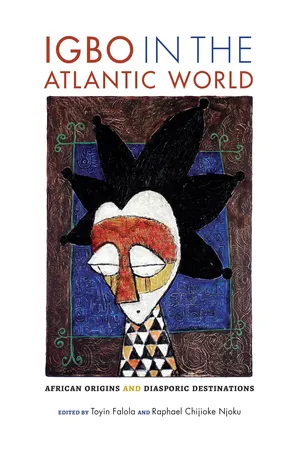
eBook - ePub
Igbo in the Atlantic World
African Origins and Diasporic Destinations
- 370 pages
- English
- ePUB (mobile friendly)
- Available on iOS & Android
eBook - ePub
Igbo in the Atlantic World
African Origins and Diasporic Destinations
About this book
Information
1
INTRODUCTION
Raphael Chijioke Njoku and Toyin Falola
This book is about the Igbo (anglicized Ibo) people of southeastern Nigeria and their diasporic connections through the trans-Atlantic slave trade that began in Africa around the mid-fifteenth century. This endeavor followed the expanded Portuguese quest for trade commodities beyond the original attraction to gold, which by then was becoming increasingly scarce. Covering a wide range of topics from the timeless precolonial era through the colonial period and to the present, the various chapters approach the study of Igbo and Igbo/African Diaspora connections from a multidisciplinary perspective. Collectively, the authors provide the most detailed examination to date of the Igbo experience, focusing on indigenous institutions and cultural practices, the Igbo role and agency in the trans-Atlantic slave trade originating from the Bight of Biafra emporium,1 the sojourns of slavery victims in the Americas, and the return to Africa by those recaptives and émigrés who welcomed the idea of resettling in different parts of nineteenth-century West Africa. Also covered is the impact of the Atlantic exchanges between Africa, Europe, and the Americas (including commerce, missionary evangelism, and colonial rule) on Igbo ways of life in the modern Nigerian setting.
The Igbo are one of the most dynamic and courageous groups in Africa. In particular, their enterprising and entrepreneurial character, resilient spirit, and contradictory reports of their stubbornness and malleability demand further consideration by scholars. The Igbo constituted one of the most predominant ethnic/linguistic groups sucked into the trans-Atlantic slave trade and slavery between the 1650s and the 1800s. Over the past four decades, the fields of Africana studies, African-American studies, Latin-American studies, slave studies, and Atlantic history have attracted a significant amount of scholarly interest as innovative research approaches continue to enhance our knowledge of the multiple and complex processes that created the African Diaspora. Perceptively, Igbo in the Atlantic World: African Origins and Diasporic Destinations builds on the insights provided by the methodology and approach of Linda Heywood and coauthors in Central Africans and Cultural Transformations in the American Diaspora as well as The Yoruba Diaspora in the Atlantic World, edited by Toyin Falola and Matt D. Childs. These works, respectively, focus on the Kongo/Angolan and Yoruba contributions to diasporic cultures by exploring in most part the dynamics of cultural continuities.2 Similarly, the various chapters here place emphasis on the importance of the Igbo, tracing their historical and cultural contributions in Africa and the African Diaspora from both the perspectives of their Old World origins and the New World destinations.
Until recently, most scholarship interpreted and explained the African Diaspora by using generic descriptions such as “Africa,” “Africans,” and “Blacks.”3 To cite but a few examples, in 1941, the doyen of modern African studies, Melville Herskovits, fired the cannon of contemporary African and African Diaspora studies with his The Myth of the Negro Past, which was widely discussed and debated by scholars across diverse disciplinary divides. Herskovits aimed to counter the erroneous notion that the African slaves arrived in the Americas without their inherited cultural practices.4 Another study that broadened scholarly debate was Van Sertima’s They Came Before Columbus,5 which focused on the earliest mention of Africans and their cultural footprints on the ancient American soil. This was followed by Graham W. Irvin’s Africans Abroad, which offered a pictorial history of the African presence across different continents. Within the established trend, subsequent works such as Michael L. Conniff and Thomas J. Davis’s Africans in the Americas: A History of the African Diaspora and Diasporic Africa, edited by Michael A. Gomez, focused on African slaves and their descendants from slavery to emancipation in the United States, the Caribbean, and Latin America.6
While the extant studies substantially covered the African injection of new cultures in the New World, not all have paid attention to the specific ethnic communities in Africa from where certain observed cultural practices came to the Americas. Consequently, diasporic studies have, by and large, tended to emphasize the universal and common elements of African culture in the Americas and elsewhere rather than underlining the significant cultural, social, and historical diversity that characterized different regions of Africa during the slave trade era.
This study addresses longstanding historiographical lacunae by employing a multidisciplinary perspective from scholars of history, gender studies, anthropology, sociology, religion, literature, and cultural studies to examine both diverse and common experiences of the Igbo in West Africa and the Americas. The volume thus contributes both to the general literature on the diaspora and the specific one of the Igbo ethnic group. By studying in detail how the Igbo became integrated into the Atlantic world through the trans-Atlantic slave trade, this volume highlights the emergence and transformation of Igbo identities and cultures, and how the Igbo and their descendants resiliently adapted, recreated, and reasserted their culture in Africa and the Americas as a strategy of resistance.
Igbo in the Atlantic World is among the first studies to trace the Igbo as a single cultural group from Africa to the New World destinations, and there is no comparable study in English known to the authors at this time. The 2010 award-wining study by G. Ugo Nwokeji, The Slave Trade and Culture in the Bight of Biafra, primarily analyzed the internal organization and the aftershocks of the Igbo slave trade on the Bight of Biafra point of embarkation without comparable benefits of a multiple African Diaspora treatment extended to diverse regions of the Caribbean and the Americas.7 Previous other studies have focused on the Igbo through a single disciplinary lens, and as such, scholars have not been able to gain deeper insights in the manner, for instance, that some Africanists like William Bascom have connected indigenous Yoruba system of divination in Nigeria with its Diaspora adaptations in Haiti and Cuba.8 Most notably in the field of literature, the Igbo experience in Africa has been covered through Chinua Achebe’s writings.9 Scholars in other disciplines such as history and anthropology have further examined the Igbo in the Bight of Biafra during the era of the trans-Atlantic slave trade.10 These studies have focused analysis by specialization customary of the academic monograph without accounting for the Igbo people’s historical, political, cultural, and economic experiences from about the mid-seventeenth century to the twentieth century. From multiple angles, the present study explores in detail the specific contributions the Igbo have made to the rise of cultures in Africa and the African Diaspora in the Atlantic world. As such, Igbo in the Atlantic World is a book on cultural inventions as a by-product of human exchanges in diverse settings. By according agency to the Igbo, the various contributors demonstrate the significant insights gained from focusing historical scholarship on a single cultural group and tracing the Igbo dispersion and influence throughout the Americas.
Several important themes, among them the question of identity, are treated in depth. From their diverse disciplinary expertise, the authors tackled the slippery concept of identity, whether defined as race consciousness, ethnic belonging, common spoken language, material cultural productions, or mannerisms (assumed or real) with uncommon intellectual acuity. This is a positive departure from the familiar culturalist school of thought that has dominated previous studies, a good example of which is Marvin Lewis’s Ethnicity and Identity in Contemporary Afro-Venezuelan Literature, which explores the concept of Blackness in the African Diaspora as a homogenous ethnic category.11
In the present study, the various authors emphasize the heterogeneous nature of Blackness in the African Diaspora, while confirming the long-established nature of identity as a fluid category. In relation to the field, scholars disagree over the relationship of the ethnic label “Igbo” to their shifting social locations. There is no consensus, for instance, over whether the Igbo were a cohesive people in terms of manners and customs prior to the colonial era.12 This is despite the existence of such philological terms as “Eboe” “Hackbu,” or “Heebo” (i.e., Igbo) as encountered in the writings of early European traders and visitors to the Bight of Biafra. In confirming Stephen Cornell and Douglas Hartmann’s sociological interpretation of race, ethnicity, and identity, the findings herein lend credence to the fact that the Igbo identity question, like other similar identities appropriated on group belongingness, is fluid and often articulated and claimed when the particular group is confronted with an external threat.13 An overwhelming body of evidence has revealed that for the Igbo, whereas the preconditions for the rise of an Igbo consciousness were in existence during precolonial times, Igbo elements in the African Diaspora struggled to assert a priori Igbo ethnic identity within the constraints imposed on them by their captivity and enslavement. In similar terms, the Igbo in Africa reacted to the threat posed by British colonial rule and the new sociopolitical and economic order brought by the Europeans with a new spirit staked on a shared history, language, culture, and even skin color.
The identity discourse highlights another important subject of debate: the population of Igbo-speaking people among slave exports from the Bight of Biafra. We are reminded of Philip D. Curtin’s 1969 study on the African trans-Atlantic slave trade census, which inspired similar groundbreaking works.14 The present study advances this kind of thinking. While scholars are in agreement that the precolonial Igbo society kept slaves and that a large proportion of captives that departed to the New World from the eastern Niger Delta came from the Igbo hinterland, there is no consensus over the numbers of Igbo slaves.15 Using statistics available in 1956, the eminent historian Kenneth O. Dike concluded that Igbo speakers made up the greater part of the American-bound captives dispatched from the Bight of Biafra.16 This optimism was founded on a source from the 1780s showing that 80 percent of the slaves exported from Bonny, one of the major trading ports in the Niger Delta, were Igbo.17 In the three decades following the British prohibition of the trans-Atlantic slave trade in 1807 and their effort at policing the seas with Her Majesty’s Naval patrols, Sierra Leone registers of rescued slaves reveal that the Igbo composed 60 percent of the captives on ships departing from the Bight of Biafra.18 If the slave statistics from the eighteenth and nineteenth centuries should serve as a guide, the high proportion of the Igbo slave exports supposes that non-Igbos in their midst would have picked up some of the philology and cultural inventions of the dominant group. In other words, one may therefore hold the assumption that the Igbo influence over slave cargoes from this West African coastal region would have been profound. This book advances this pattern of thinking but cautions that the dynamics of cultural dominance do not always follow the simple logic of majority-versus-minority equations. Otherwise, European cultural imperialism would not have succeeded to the degree observed across the world.
Additionally, Igbo in the Atlantic World is important in relation to the wider historiographical debate on the significance of the inherited cultures that enslaved Africans brought to the Americas. In recent years, this issue has polarized scholars into two schools of African and African Diaspora studies at a time when an “Africanist” interpretation that emphasizes the importance of the cultures that enslaved people carried with them to the Americas gains momentum. One of these studies includes Colin Palmer’s The First Passage: Blacks in Americas, 1520–1617. This engaging social history of early African ethnic groups employed indexes of religion, language, and material culture to account for their landings and promotion of new cultural trends in the Americas.19 As Northrup noted in a related study, anyone very “familiar with other revisionist movements in history” knows that the passion of Africanists has sometimes led to theoretical and factual errors. Expectedly, “while some have sought to defend their school’s position” by attacking those who express doubts over the potency of African slave cultural exports to the Diaspora, the more dexterous Africanists have asserted more nuanced conclusions.20 For instance, Linda Heywood characterizes the Africanist position as “the view that African ethnicity and identity were important and influenced the process of creolization in the Americas.” The insightful nuances of this statement are difficult to dispute. Heywood also correctly observes that another group of scholars “argues that African societies were so fragmented, and the toll of the slave trade and plantation agriculture so destructive, that they precluded the continuation of African culture in the Americas,” ascribing such views to Sidney W. Mintz and Richard Price.21 In line with Heywood, this book moderates between the two extreme polarities with the assertion that no child was born in a state of cultural tabula rasa. Thus, in contrast to John Locke’s 1694 theoretical entreaty that gave rise to this thinking,22 the findings in this book follow Michel Foucault’s poststructuralist genealogical investigative approach23 in showing that culture and identity formation is like a flowing river that creates diverse ecosystems in relation to the environment in diverse settings. In other words, the specific nature that the identity of African elements in the Americas assumed was a function of the nature of politics and exercise of power, mode of production, prevalent religious practices, and the racial/ethnic compositions of the population in that host community, among other determinants.
CHAPTER OUTLINE
This volume consists of twenty-one chapters divided into three parts. Part I, “Igbo Institutions and Customs as Baseline,” is composed of three chapters that broadly explore enduring issues of political organization, gender, and values that have been transferred across the Atlantic. In other words, chapters in this part account for the political and socioeconomic climate in the Igbo homeland to better understand their common diasporic origins and adaptations. ...
Table of contents
- Cover
- Title Page
- Copyright
- Dedication
- Contents
- List of Abbreviations
- Preface and Acknowledgments
- 1. Introduction
- Part I: Igbo Institutions and Customs as Baseline
- Part II: The Igbo in the African Diaspora: The Mechanics and Patterns of Migrations, Settlements, and Demographics
- Part III: Cultural Crosscurrents: Dimensions of the Igbo Experience in the Atlantic World
- Selected Bibliography
- List of Contributors
- Index
Trusted by 375,005 students
Access to over 1.5 million titles for a fair monthly price.
Study more efficiently using our study tools.
Frequently asked questions
Yes, you can cancel anytime from the Subscription tab in your account settings on the Perlego website. Your subscription will stay active until the end of your current billing period. Learn how to cancel your subscription
No, books cannot be downloaded as external files, such as PDFs, for use outside of Perlego. However, you can download books within the Perlego app for offline reading on mobile or tablet. Learn how to download books offline
Perlego offers two plans: Essential and Complete
- Essential is ideal for learners and professionals who enjoy exploring a wide range of subjects. Access the Essential Library with 800,000+ trusted titles and best-sellers across business, personal growth, and the humanities. Includes unlimited reading time and Standard Read Aloud voice.
- Complete: Perfect for advanced learners and researchers needing full, unrestricted access. Unlock 1.5M+ books across hundreds of subjects, including academic and specialized titles. The Complete Plan also includes advanced features like Premium Read Aloud and Research Assistant.
We are an online textbook subscription service, where you can get access to an entire online library for less than the price of a single book per month. With over 1.5 million books across 990+ topics, we’ve got you covered! Learn about our mission
Look out for the read-aloud symbol on your next book to see if you can listen to it. The read-aloud tool reads text aloud for you, highlighting the text as it is being read. You can pause it, speed it up and slow it down. Learn more about Read Aloud
Yes! You can use the Perlego app on both iOS and Android devices to read anytime, anywhere — even offline. Perfect for commutes or when you’re on the go.
Please note we cannot support devices running on iOS 13 and Android 7 or earlier. Learn more about using the app
Please note we cannot support devices running on iOS 13 and Android 7 or earlier. Learn more about using the app
Yes, you can access Igbo in the Atlantic World by Toyin Falola, Raphael Chijioke Njoku, Toyin Falola,Raphael Chijioke Njoku in PDF and/or ePUB format, as well as other popular books in History & African History. We have over 1.5 million books available in our catalogue for you to explore.