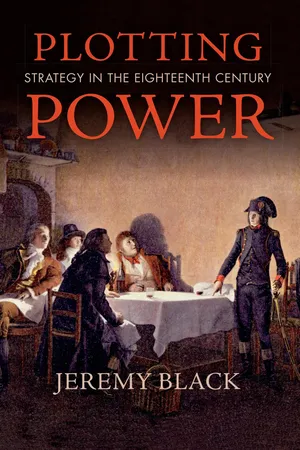
An examination of strategy in war and international relations that links military ideas and practice, political concepts, diplomacy, and geopolitics.
Military strategy takes place as much on broad national and international stages as on battlefields. In a brilliant reimagining of the impetus and scope of eighteenth-century warfare, historian Jeremy Black takes us far and wide, from the battlefields and global maneuvers in North America and Europe to the military machinations and plotting of such Asian powers as China, Japan, Burma, Vietnam, and Siam. Europeans coined the term "strategy" only two centuries ago, but strategy as a concept has been practiced globally throughout history. Taking issue with traditional military historians, Black argues persuasively that strategy was as much political as battlefield tactics and that plotting power did not always involve outright warfare but also global considerations of alliance building, trade agreements, and intimidation.
"This is both an overview of eighteenth-century warfare and an interpretation of how war was made; a polemical contribution to a debate on the nature of strategy; and a contribution to global history." —Alan Forrest, author of
Napoleon: Life, Legacy, and Image: A Biography
"A refreshing new look at how meanings behind these terms [strategy and strategic culture] were understood and employed in the eighteenth century. With his vast knowledge and insights of the period, he is able to take us on a wide-ranging exploration that provides stimulating food for thought for historians of all periods." —Richard Harding, author of
The Emergence of Britain's Global Naval Supremacy: The War of 1739-1748
- 336 pages
- English
- ePUB (mobile friendly)
- Available on iOS & Android
eBook - ePub
About this book
Information
ONE
THE STRUGGLE FOR POWER
STRATEGY IS THE WAYS BY WHICH NATIONS, STATES, RULERS, elites, and others seek to shape their situation, producing international and domestic systems that provide security and that safeguard and pursue interests. The key element is the contest for power, but power takes different forms, has varied uses, and is not understood in a uniform fashion. In assessing strategy and strategic culture, it is necessary to consider how states, or rather their elites and leaderships, seeking to maintain and increase power, pursue internal as well as external agendas, and do so knowing that it will make them better able to wage war. The relationship between the two agendas is crucial and also affects both. Linked to this were (and are) the perennial questions of who directed strategy and to what ends.
Across the world, most strategy in the eighteenth century occurred in a monarchical context and was made by the rulers themselves. This situation scarcely produced any uniformity, not least to the diversity of contexts and the inherent differences between rulers. Nevertheless, there were common elements in terms of the rationales of dynasties and the inherent dynamics of royal courts. The two combined to produce strategic cultures focused in particular on dynastic aggrandizement and gloire. The alternative means of shaping the situation are worth considering, notably republics and elective monarchies, such as Poland, but the monarchs of the latter also had dynastic agendas.
A moral tone, one that picked up long-standing religious and political themes, was offered by the Monitor, then the most influential London newspaper, in its issue of April 5, 1760, which appeared in the midst of a major European war. The anonymous article argued that aggressive wars
arise from the heart of the mighty; who envious of another’s glory, covetous of another’s riches or country, or aspiring to universal empire; seek all occasions to quarrel, to oppress, to ruin, to subdue that object of their envoy, covetousness and ambition; and never consents to a cessation of arms, except he finds himself unable to accomplish his destructive intentions, and in need of further time and leisure to recruit, and to carry his project more effectually into execution.
Unpredictability was also a major element. In September 1733, William Cayley, the British consul in Cádiz, commenting on Spanish naval preparations in the developing international crisis, preparations on which he provided intelligence information, wrote:
the season of the year is now so far advanced, that one would naturally imagine, form the least further delay, they would find it too late to go upon any enterprise of consequence. Though it is certain, at the same time, that no judgment can be formed of the conduct which may be held by this Court, or of what they may or may not undertake from the common rules of reason and prudence by which other people generally act, there being, as your Grace is very sensible, nothing so wild, extravagant or destructive to the real interests of the kingdom, that they are not capable of, when it will afford the least gratification to the passions of the Queen.1
The significance of rulers was captured by the Marquis de Silva, a Sardinian (Piedmontese), in his Pensées sur la tactique, et la strategique ou la vrais principes de la science militaire (1778), a work in which he sought to locate politics and the military:
Le plan general de la guerre renferme deux sortes d’objets. Les uns qui sont du resort de la politique, et les autres qui dependent immédiement et totalement de la science militaire. Lorsqu’un Souverain est lui même le Général de ses armées . . . il embrasse et combine tous ces différens objets. La machine n’a pour lors qu’un seul principe de movement, et ce movement n’est bien plus parfait.2
An emphasis on rulers as conservative figures obsessed with gloire leads to the assumption that a developing interest in strategy from the late eighteenth century in some respect reflected a new and different public age linked to more intensive conflict, in short was an aspect and product of a modernization of war. However, alongside this approach can come a very different location of the eighteenth-century discussion of war-making. In this location, it can be argued that in the pre-Revolutionary West (i.e., the West prior to the French Revolution), there was less stress than hitherto on the themes and idioms of sacral monarchy and more on the monarch as a governing ruler characterized by competence and open to advice accordingly.
This contrast in emphasis, which was not one that suddenly emerged but, instead, one that can be long traced, can be related, for the eighteenth century, to a shift in sensibility, one from the attitudes, themes, and tropes summarized as Baroque to those summarized as Neoclassical. Such a shift took a number of forms, and there were a number of separate chronologies at stake. These included developments in international relations and in attitudes toward them. For example, concern about the supposed threat of universal monarchy, a threat attributed to the Habsburgs in the sixteenth and early seventeenth centuries and to Louis XIV of France in the late seventeenth century, was seen in 1733 as an “old prejudice”3 but was to be revived in response to Napoleon’s expansionism.
The development from the Baroque sensibility to the Neoclassical was present from the outset of the eighteenth century4 but gathered pace in the period of enlightened despotism, the term generally employed to describe many of the Western monarchies in the second half of the century. The Enlightenment impulse in government was linked to this turn from sacral to utilitarian and instrumentalist functions of government, a development that was especially pertinent as new territories were brought under control. The organization of ministries became more bureaucratic and specialized, and information played a key role in the conduct of government, international relations, and war.5 However, by later standards, there was a general lack of administrative support for the rulers and ministers who balanced demands and assessed resources, albeit often not planning individual operations.6 Significantly, the image of Western monarchs and ministers changed in the second half of the century and notably with the final abandonment of Baroque themes. An emphasis on information and rationality was suggested with their depiction as indicating maps.7
The focus on ruling individuals and groups helps explain why the later matrix of strategy, that of general staffs, a matrix that helped drive the process of defining strategy, is not, however, readily or sensibly applicable to the earlier period. A focus on the court context of the earlier period ironically, however, also directs renewed attention to strategy during the last quarter millennium as a whole, the period when the word has been used. In particular, the leaders of the last quarter millennium frequently operated in a fashion that would not have been out of character or, indeed, context for their predecessors. Thus, there are elements of decision making under Napoleon or Hitler that would not have been totally out of place for Louis XIV and, in many cases, the comparison was closer or deliberately sought, as with Mussolini and his attempt to strike a resonance using reference to the Roman emperor Augustus. This continuity is more especially the case if the focus is on strategic culture or strategic process, rather than strategic content or broader international context.
In particular, there is the question of how far gloire, the search for prestige and the use of the resulting reputation to secure international and domestic goals, are particularly attractive and important in monarchical systems, indeed providing them with their prime strategic purpose, tone, and drive. This approach understandably works in a diachronic fashion—in other words, across time. An emphasis on the value of prestige and reputation adopts a cultural functionalism that is linked to a psychological approach to image and competition. In part, a competition for prestige can enhance all the powers involved. More commonly, however, the competition was necessarily at the expense of other powers, and was very much desired and affirmed in these terms. Dynastic rivalry, whether of Habsburgs and Bourbons or of Ottomans and Safavids, can be approached in these terms. In part, this was because of the wide-ranging dynamics of prestige and space involved in dynastic considerations.8
It has been argued that dynasticism functioned as a moderating norm by limited claims, containing stakes, and requiring the regulation of shifts in sovereignty.9 As such, it was an aspect of a rule-based system, one that could be described in terms of “the law of nations and the usages commonly acknowledged and practised among all nations in Europe.”10 Moreover, this system was capable of development and expansion, as with the idea for maritime leagues to protect neutral trade from blockades, a measure designed to counter Britain’s dominant position at sea.11
However, such systems did not cope well with relations between different cultures and did not usually work well within an individual culture. Indeed, the dynastic drive was generally competitive and also, as with Austria in the 1690s–1730s, could take precedence over other elements.12 Dynastic politics set very difficult tasks for strategy. The protection of Hanover for Britain after the accession of the Hanoverian dynasty in 1714 was one of the striking examples, but even more so was the Austrian attempt to incorporate the Spanish empire. Wars of succession of one sort or another were the outcome of strategic marriage alliances but with a greater element of chance involved than for many nineteenth-century expansionist schemes.
In addition to competition among the dynasties of different states, the search for status within dynasties, as rulers confronted the reputation of their predecessors, and also between successive dynasties ruling the same state can be approached in part in terms of a necessary drive for gloire. This search was very much set by the emphasis on the value of reputation and by the focus on the glory of predecessors. Thus, the rulers of Sardinia struggled with making themselves worthy of the reputation and example of Victor Amadeus II (r. 1675–1730), the victor of the dramatic and decisive battle of Turin in 1706, and those of Prussia with that of Frederick William I, the “Great Elector” (r. 1640–88). Visual images of past success were to the fore. Frederick William commissioned Andreas Schlüter to design an equestrian statue depicting him as a commander in armor and holding a field marshal’s baton.13 Philip V of Spain (r. 1700–46) spent time in his palace in Seville where tapestries that are still in place depicted the success of the expeditions of Charles V (Charles I of Spain) in the early sixteenth century. Philip himself was with the army that invaded Portugal in 1704. Louis XV and Louis XVI struggled with the need to match themselves with the image created by Louis XIV, although Louis XV did campaign in the mid-1740s: at the siege of Freiburg in 1744 and the battle of Fontenoy in 1745. Louis XVI never did so. France helped the Thirteen Colonies win independence from Britain, but this brought no benefit to Louis XVI in terms of personal prestige. The strong association between monarchical prestige and military success was demonstrated by the Qianlong emperor in his treatise Yuzhi shiquan ji (In Commemoration of the Ten Complete Military Victories), composed in 1792, a treatise that claimed the Chinese failures against Myanmar and Vietnam as successes.
That rulers tended, when they could, to command forces in battle, an integration of political and military leadership that could help ensure decisiveness, contributed greatly to this competition with one another and with the past. This was not only the case in the first half of the century where it was seen, for example, with George II of Britain at Dettingen in 1743. In 1788, the emperor (ruler of Austria) Joseph II rejected advice from his chancellor, Count Kaunitz, that he not lead his forces in person. The direct interest and personal commitment of rulers was highly significant to the strategic culture, as was the idea of trial by battle in a form of almost-ritualized conflict.14
Royal splendor served, moreover, as the basis of noble splendor. The cult of valorous conflict helped define honor and fame, whether individual, family, or collective. A stress on these themes directs attention away from the idea of bureaucratization. In 1734, Philip V, the surviving grandson of Louis XIV, claimed that war was necessary for the political stability of the French monarchy....
Table of contents
- Cover
- Half title
- Title
- Copyright
- Dedication
- Contents
- · Preface
- · List of Abbreviations
- Introduction
- 1 The Struggle for Power
- 2 The Reach for World Empire: Britain, 1700–83
- 3 The Strategy of the Ancien Régime: France, 1700–89
- 4 The Flow of Ideas
- 5 The Strategy of Continental Empires
- 6 The Strategy of the “Barbarians”
- 7 The Rise of Republican Strategies, 1775–1800
- 8 Imperial Imaginings, 1783–1800
- 9 Conclusions
- 10 Postscript: Strategy and Military History
- · Selected Further Reading
- · Index
Trusted by 375,005 students
Access to over 1.5 million titles for a fair monthly price.
Study more efficiently using our study tools.
Frequently asked questions
Yes, you can cancel anytime from the Subscription tab in your account settings on the Perlego website. Your subscription will stay active until the end of your current billing period. Learn how to cancel your subscription
No, books cannot be downloaded as external files, such as PDFs, for use outside of Perlego. However, you can download books within the Perlego app for offline reading on mobile or tablet. Learn how to download books offline
We are an online textbook subscription service, where you can get access to an entire online library for less than the price of a single book per month. With over 1.5 million books across 990+ topics, we’ve got you covered! Learn about our mission
Look out for the read-aloud symbol on your next book to see if you can listen to it. The read-aloud tool reads text aloud for you, highlighting the text as it is being read. You can pause it, speed it up and slow it down. Learn more about Read Aloud
Yes! You can use the Perlego app on both iOS and Android devices to read anytime, anywhere — even offline. Perfect for commutes or when you’re on the go.
Please note we cannot support devices running on iOS 13 and Android 7 or earlier. Learn more about using the app
Please note we cannot support devices running on iOS 13 and Android 7 or earlier. Learn more about using the app
Yes, you can access Plotting Power by Jeremy Black in PDF and/or ePUB format, as well as other popular books in History & Early Modern History. We have over 1.5 million books available in our catalogue for you to explore.