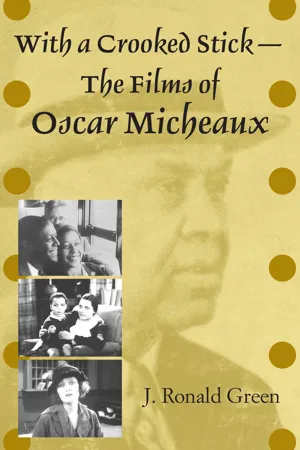
With a "crooked stick," filmmaker Oscar Micheaux (1884–1951) sought to hit a "straight lick" by stressing the strategic importance of class mobility, or "uplift," for African Americans. A theme in all of his more than 40 feature-length, black-produced, black-directed, black-cast, and black-audience films, uplift would allow for the better things in life: fast cars and fancy clothes, freedom of belief, financial security, and an unencumbered intellectual life. Although racism was an impediment to uplift for Micheaux and other African Americans, race as a category was of a secondary order for him in the larger game of class. In With a Crooked Stick, J. Ronald Green pursues this seeming contradiction in a detailed analysis of each of Micheaux's 15 surviving films. He presents critical commentary on each film's plot and action and its contribution to the overall theme of uplift. Readers will also find this an invaluable guide to the preoccupations and features of Micheaux's remarkable career and the insight it provides into the African American experience of the 1920s and 30s.
- 328 pages
- English
- ePUB (mobile friendly)
- Available on iOS & Android
eBook - ePub
With a Crooked Stick—The Films of Oscar Micheaux
About this book
Trusted by 375,005 students
Access to over 1.5 million titles for a fair monthly price.
Study more efficiently using our study tools.
Information
Subtopic
Film History & Criticism1 Biographical Backstory
Oscar Micheaux was born into a rural working-class African-American family in mid-America in 1884. He was not formally educated beyond the most modest and basic public schooling and he was subjected all his life to race and class prejudice, yet he created an impressive legacy in one of the most sophisticated, expensive, and fragile cultural endeavors of the twentieth century—commercial cinema. In the process of making himself into the first African-American film auteur, without the slightest help from the huge film industries on either coast of the United States, Micheaux lived in two of the most sophisticated and competitive cities in the world, Chicago and New York; he (probably) traveled to Latin America and Europe to establish his own business connections; and he circulated continuously through the great black communities of America’s northern cities and throughout the American South. During that time, 1913 to 1951, he wrote, published, and distributed his seven novels and he wrote, produced, directed, and distributed his forty-some feature films, more than any other black filmmaker in the world. How did this improbable narrative unfold?
Most accounts of Micheaux’s career begin with his homesteading on the newly opened Rosebud Indian Reservation in South Dakota soon after the turn of the twentieth century. Micheaux’s first novel, The Conquest: The Story of a Negro Pioneer, the first of his many accounts of his life, was written and published in 1913, shortly after his homesteading venture failed. There are good reasons, however, for the purposes of analysis and assessment of Micheaux’s films, to begin the story earlier, as Micheaux himself does in The Conquest.
As a member of a large farming family near the Ohio River in southern Illinois in 1884, Micheaux showed an early talent for selling his family’s produce in the nearby town of Metropolis. He learned to resent black ministers because they monopolized his mother’s (and other women’s) attentions and because they were given the best cuts of meat at Sunday dinners.1 He also somehow grew to be what the elders of the church called “worldly, a free thinker, and a dangerous associate for young Christian folks.” At sixteen he was “fairly disgusted with it all and took no pains to keep [his] disgust concealed.” Already thick-skinned enough not to care what people thought of him, Micheaux characterized his own outspokenness and his unpopular ideas at that “tender” age in what is still a good description of his reputation and his attitude throughout his life:
Another thing that added to my unpopularity, perhaps, was my persistent declarations that there were not enough competent colored people to grasp the many opportunities that presented themselves, and that if white people could possess such nice homes, wealth and luxuries, so in time, could the colored people. “You’re a fool,” I would be told, and then would follow a lecture describing the time-worn long and cruel slavery, and after the emancipation, the prejudice and hatred of the white race, whose chief object was to prevent the progress and betterment of the negro. This excuse for the negro’s lack of ambition was constantly dinned into my ears from the Kagle corner loafer to the minister in the pulpit, and I became so tired of it all that I declared that if I could ever leave M—pls [Metropolis] I would never return. More, I would disprove such a theory and in the following chapters I hope to show that what I believed fourteen years ago was true.2
Even today, long after his death, this position is still held by many intellectually respectable African-Americans, and it is still resented by many others. For example, at the celebration at Oscar Micheaux’s gravesite in Great Bend, Kansas, in March of 2001—marking the semi-centennial of Micheaux’s death—one of Micheaux’s relatives, Marcia L. Lewis, a Creedmore, North Carolina, dentist, told me that she felt that if she had listened to all the protest rhetoric she heard growing up, she would never have amounted to anything. This is still a controversial, but not uncommon, attitude.
Controversial as a sixteen-year-old in his home town in 1900, Micheaux could write thirteen years later with continuing pride about his teenage arrogance; and today, twenty years after the centennial of his birth, not much has changed—Micheaux has as many enemies as friends, and even some of his friends are divided in their loyalty.
The passage above from Micheaux’s novel suggests that at sixteen he was conscious of class in a way that some critics found, and will still find, problematic for racial politics. His emphasis on individual competence and initiative, on the attainment of wealth and luxuries, and his disdain for the rhetoric of protest, or what he called “excuse,” places him squarely in the midst of issues of race and class today. That and the complexity and thoughtfulness of his vision are what make him perennially fascinating. Micheaux’s proclivity for using class as a larger paradigm than race seems to have been fully developed in his adolescence, was not fundamentally altered during his career, was bound to stir debate in his time, and is just as likely to stir debate today.
Micheaux’s first novel is a good guide to his first three decades because it is a thinly disguised biography. Though critics have been careful to call The Conquest a fictionalized account of Micheaux’s first twenty-nine years, the biographical and historical accuracy of the book should not be underemphasized. This study has not made a thorough comparison of Micheaux’s books with known or discoverable corroborating facts of history, but there is enough documentation from primary and secondary sources to suggest that The Conquest is fundamentally trustworthy as autobiography and as history. One must work out the name changes and other substitutions of a virtual roman à clef—scholars Henry Sampson, Joseph Young, Charles Fontenot, Janis Hebert, Learthen Dorsey, Pearl Bowser, Louise Spence, and Betti Carol VanEpps-Taylor have made crucial contributions here—but The Conquest may be taken as autobiography. Micheaux suggested as much in this key passage:
I was born twenty-nine years ago near the Ohio River, about forty miles above Cairo, the fourth son and fifth child of a family of thirteen, by the name of Devereaux—which, of course, is not my name but we will call it that for this sketch. It is a peculiar name that ends with an “eaux,” however, and is considered an odd name for a colored man to have, unless he is from Louisiana where the French crossed with the Indians and slaves, causing many Louisiana negroes to have the French names and many speak the French language also. My father, however, came from Kentucky and inherited the name from his father who was sold off into Texas during the slavery period and is said to be living there today.3
Important details of this account can be confirmed. For example, the family record of the obituary for Oscar’s mother that appeared in the Great Bend (Kansas) Tribune reports that: “Mrs. Belle Williamham Michaux [sic] was born in Graves county, Kentucky, June 11, 1856, and was married to C. S. Michaux [sic] in Metropolis, Ills, [sic], Jan. 7, 1872. To the union eleven children were born, five boys and six girls, of whom nine are still living.” Such information suggests, though does not prove, that details in Micheaux’s novel—that he was born in 1884 (stated elsewhere in the family record) in Metropolis, Illinois, on the Ohio and that he was the “fourth son and fifth child of a family of thirteen”— are based closely on facts of his life. The “eaux” spelling of his name is contradicted by the “aux” spelling in this entry of the family record, but the heading on that same page of that record spells Micheaux with the familiar “eaux.” Many other of Micheaux’s fictional details can be similarly and consistently confirmed as historically accurate. For example, the family record shows that Oscar’s parents were indeed from Kentucky and that Micheaux married an Orlean E. McCracken of Chicago on April 21, 1910, a fact that conforms substantially with Micheaux’s account in The Conquest. The troubled progress and the eventual dissolution of the marriage as described in The Conquest is corroborated by a story in the Chicago Defender of April 29, 1911: “Mr. Micheaux in City: Seemed to Be in Family Mix-Up” (cited below). Micheaux reconfirms from time to time that he is writing actual history with a thin veneer: “‘Oris-town,’ the white man spoke up,... ‘is about two hundred and fifty miles northwest of [Council Bluffs, Iowa] in southern South Dakota, on the edge of the Little Crow Reservation, to be opened this summer.’ This is not the right name, but the name of an Indian chief living near where this is written.”4 Micheaux was writing in a frankly documentary mode here and may have been staying at that time in Winner, Dallas, or Gregory, South Dakota; or in Omaha, Nebraska, or Council Bluffs, Iowa, both of which he often visited; or in Sioux City, Iowa, as reported by the Micheaux family record’s account of an obituary for Micheaux’s mother in the Great Bend (Kansas) Tribune on December 23, 1918.5 Though precisely where Micheaux was writing is not always known, each of these places is near the territory in Minnesota that was commanded by the chief of the eastern Sioux, Little Crow, the name Micheaux explains he chose as a substitute for what common knowledge tells us is in reality the Rosebud Indian Reservation 250 miles northwest of Council Bluffs, just as Micheaux reports in The Conquest.
What these complex algebras of historical substitution consistently imply is that The Conquest truly is reportage; therefore, happily, a detailed history of Micheaux’s life before he turned to filmmaking is on the record.6 The historical and biographical reliability of Micheaux’s later novels, and of his films, is less certain and certainly more fictionalized. For one thing, his third novel, The Homesteader (1917), retells the same story of his homestead experience, including his troubled love life. He retold that story again much later in his fourth novel, The Wind from Nowhere (1941). New details are provided in each of these versions, some of which may be biographically based; but there are also significant differences. It will be a rewarding though tedious job for historians to determine the historical reliability of the later books. In the meantime, all seven of Micheaux’s novels remain crucial to the interpretation and appreciation of his films, if somewhat ambiguously so. They are also, in their own right, a minor legacy of American letters and are worthy of less-apologetic scholarly attention than they have received so far.
The Conquest describes Micheaux’s early fortune-seeking in and around Chicago. He tries part-time work in the stockyards; rough unskilled work “with a lot of jabbering foreigners”7 around the Joliet steel mills, “cracking and heaving coal,” for which he was paid by the ton; shining shoes in the suburbs; laboring in fields on nearby farms; and finally and most significantly, portering on a Pullman railroad car. It was through Pullman portering that Micheaux began to see the country; to meet a successful class of people, especially western landowners and eastern businessmen; and to expand his vision of opportunity and “empire.” His career on the railroad, along with assiduous personal and financial management, plus a little “graft,” which the narrator explains was traditional and justifiable on grounds of labor injustice, allowed Micheaux to save enough money to take advantage of one of the business opportunities he learned about on his regular runs from Chicago to the Pacific Northwest—the purchase of a “relinquishment” of a homestead on the newly opened Rosebud Indian Reservation in southern South Dakota. When homesteaders failed to “prove up,” to make good on their land according to government requirements, which called for certain improvements and for a minimum time of physical residency on the land, the homesteads could be sold as “relinquishments” to other would-be homesteaders. That is how Micheaux got his first land.8
This was a happy time in Micheaux’s life; in his second novel, The Forged Note, Micheaux refers to the Rosebud country in South Dakota as his favorite place to live and work because of the relative lack of racial prejudice and because of the respect he earned as a successful large-scale farmer on the prairie. In The Conquest, Micheaux describes in great detail, with humor and occasional anger, the life of a black homesteader on the Great Plains. Some of the home-steading stories from The Conquest recur later in his films. A version of the chapter “The Oklahoma Grafter,” for example—in which Micheaux’s surrogate, Devereaux, gets bilked by a crooked horse trader—appears in the film Symbol of the Unconquered (1920). The town in which this “graft” occurs, in both the book and the film, is “Oristown” (in reality, Bonesteel, South Dakota).
More significant for an understanding of Micheaux’s films is the second half of The Conquest, which deals with Micheaux’s problems in love and marriage. Aspects of this story also form the main action of three of Micheaux’s seven novels and several of his films, including his first and last films, The Homesteader and The Betrayal (1919 and 1948, respectively; both now lost), and his first full-length sound film, The Exile (1931; extant). As told in The Conquest, Micheaux fell in love with a young white woman, whom he refers to as “the Scotch girl,” the daughter of a neighboring widower farmer in South Dakota. Their relationship developed because Micheaux was boarding with the Scottish family and because Micheaux had hired one of the Scottish farmer’s sons as a farmhand. Micheaux began informally tutoring the “Scotch girl,” who was intellectually curious but undereducated. Their mutual respect and need, their loneliness and isolated proximity, led to attraction, affection, and probably to mature love; and, more or less against their better judgment, it led to some degree of physical lovemaking. The following passage indicates the nature of Micheaux’s struggle with the dilemma of powerful personal attraction and more powerful racial consciousness:
To love is life—love lives to seek reply—but I would contend with myself as to whether or not it was right to fall in love with this poor little white girl. I contended with myself that there were good girls in my race and coincident with this I quit boarding with them and went to batching [bacheloring] again, to try to successfully combat my emotions. I continued to send her papers and books to read—I could hardly restrain the inclinations to be kind. Then one day I went to the house to settle with her father for the boy’s work and found her alone. I could see she had been crying, and her very expression was one of unhappiness. Well, what is a fellow going to do. What I did was to take her into my arms and in spite of all the custom, loyalty, or the dignity of either Ethiopian or the Caucasian race, loved her like a lover.9
An effective transition follows immediately after this passage, when the narrator begins a story that appears to be entirely different from the theme of the Scotch girl; in cinema it would be a cut to another scene. Gradually, however, it becomes clear that Micheaux is telling the story of a family of light-skinned African Americans living in the Little Crow (Rosebud) territory who are so ashamed of their racial h...
Table of contents
- Cover
- Half Title
- Title Page
- Copyright Page
- Dedication
- Table of Contents
- Acknowledgments
- Introduction
- 1. Biographical Backstory
- 2. Within Our Gates (1920; second film)
- 3. Symbol of the Unconquered (1920; fourth film)
- 4. Body and Soul (1925; fourteenth film)
- 5. The Sound Era: Signifying with Music
- 6. The Exile (1931; twenty-fourth film)
- 7. The Darktown Revue (1931; twenty-fifth film)
- 8. Veiled Aristocrats (1932; twenty-sixth film)
- 9. Ten Minutes to Live (1932; twenty-seventh film)
- 10. The Girl from Chicago (1932; twenty-eighth film)
- 11. Murder in Harlem (1935; thirty-first film)
- 12. Underworld (1937; thirty-third film)
- 13. God’s Step Children (1938; thirty-fourth film)
- 14. Birthright (1938–1939; thirty-fifth film)
- 15. Swing! (1938; thirty-sixth film)
- 16. Lying Lips (1939; thirty-seventh film)
- 17. The Notorious Elinor Lee (1940; thirty-eighth film)
- 18. Conclusion
- Appendix 1. A Short Filmography
- Appendix 2. Jubilee: African-American Spirituals
- Appendix 3. Sources for Obtaining Micheaux’s Films
- Appendix 4. Comment on Selected Web Sites
- Bibliography
- Index
Frequently asked questions
Yes, you can cancel anytime from the Subscription tab in your account settings on the Perlego website. Your subscription will stay active until the end of your current billing period. Learn how to cancel your subscription
No, books cannot be downloaded as external files, such as PDFs, for use outside of Perlego. However, you can download books within the Perlego app for offline reading on mobile or tablet. Learn how to download books offline
Perlego offers two plans: Essential and Complete
- Essential is ideal for learners and professionals who enjoy exploring a wide range of subjects. Access the Essential Library with 800,000+ trusted titles and best-sellers across business, personal growth, and the humanities. Includes unlimited reading time and Standard Read Aloud voice.
- Complete: Perfect for advanced learners and researchers needing full, unrestricted access. Unlock 1.5M+ books across hundreds of subjects, including academic and specialized titles. The Complete Plan also includes advanced features like Premium Read Aloud and Research Assistant.
We are an online textbook subscription service, where you can get access to an entire online library for less than the price of a single book per month. With over 1.5 million books across 990+ topics, we’ve got you covered! Learn about our mission
Look out for the read-aloud symbol on your next book to see if you can listen to it. The read-aloud tool reads text aloud for you, highlighting the text as it is being read. You can pause it, speed it up and slow it down. Learn more about Read Aloud
Yes! You can use the Perlego app on both iOS and Android devices to read anytime, anywhere — even offline. Perfect for commutes or when you’re on the go.
Please note we cannot support devices running on iOS 13 and Android 7 or earlier. Learn more about using the app
Please note we cannot support devices running on iOS 13 and Android 7 or earlier. Learn more about using the app
Yes, you can access With a Crooked Stick—The Films of Oscar Micheaux by J. Ronald Green in PDF and/or ePUB format, as well as other popular books in Media & Performing Arts & Film History & Criticism. We have over 1.5 million books available in our catalogue for you to explore.