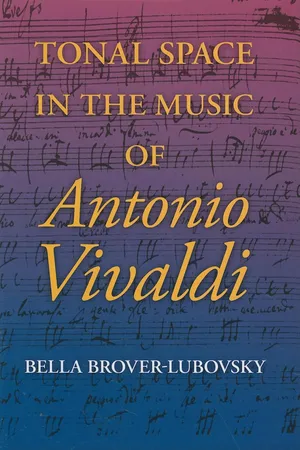
Tonal Space in the Music of Antonio Vivaldi incorporates an analytical study of Vivaldi's style into a more general exploration of harmonic and tonal organization in the music of the late Italian Baroque. The harmonic and tonal language of Vivaldi and his contemporaries, full of curious links between traditional modal thinking and what would later be considered common-practice major-minor tonality, directly reflects the historical circumstances of the shifting attitude toward the conceptualization of tonal space so crucial to Western art music. Vivaldi is examined in a completely new context, allowing both his prosaic and idiosyncratic sides to emerge clearly. This book contributes to a better understanding of Vivaldi's individual style, while illuminating wider processes of stylistic development and the diffusion of artistic ideas in the 18th century.
- 384 pages
- English
- ePUB (mobile friendly)
- Available on iOS & Android
eBook - ePub
Tonal Space in the Music of Antonio Vivaldi
About this book
Trusted by 375,005 students
Access to over 1.5 million titles for a fair monthly price.
Study more efficiently using our study tools.
Information
Subtopic
Music Theory & AppreciationPART ONE
________________________
Estro armonico
1
________________________
Vivaldi’s “Harmony” and the Paradox of Historical Recognition
This science, which consists in the simultaneous employment of sounds, is the same throughout Europe; it is perhaps that part of the art on the foundations of which all nations best agree, notwithstanding the diversity of language; but the choice of instruments, and consequently the effects, differ in every nation.1—Alexandre-Étienne Choron
Le quattro regioni
Nowadays, Antonio Vivaldi is considered the most prominent Italian composer of his generation. At the same time, an exploration of the vicissitudes of Vivaldi’s life, the enigmatic circumstances of his death, and the reception accorded his works throughout the eighteenth and nineteenth centuries reveal striking and paradoxical characteristics. Despite his stature as a leading figure in the first decades of the Settecento—as virtuoso-violinist, teacher, impresario, and composer of far-ranging influence—Vivaldi still appears to have dropped far behind the mainstream during the last years of his life.
This drastic decline in renown was brought about through younger contemporaries. Charles de Brosses reported that Vivaldi’s music had fallen out of vogue in his native Venice as early as 1739: “To my great astonishment I discovered that he is not as highly regarded as he deserves to be in this country, where everything has to be up-to-the-minute, where his works have been heard for too long, and where last year’s music no longer brings in money.”2 This evidence was later reinforced by Johann Joachim Quantz, previously reckoned one of Vivaldi’s most fervent German admirers. After many years of support, Quantz claimed that Vivaldi’s performances and compositions had lapsed into carelessness and presumption: “As a result of excessive daily composing, and especially after he had begun to write theatrical vocal pieces, he sank into frivolity and eccentricity both in composition and in performance; in consequence his late concertos did not gain as much approbation as his first.”3 Vivaldi’s extensive correspondence with Guido Bentivoglio elucidates the misfortunes he faced with his last operas, reflecting the extent to which his music had fallen from favor.4 As a result, Vivaldi lost his position in the Ospedale della Pietà, with which he had been affiliated since 1703. At sixty-one, he was forced to leave Venice in search of new commissions and patronage, both of which were to prove elusive. His death in 1741 in Vienna, center of the newly emerging modern instrumental style, passed almost unnoticed in musical circles.5
Posthumous reception accorded Vivaldi’s music in the second half of the eighteenth and early nineteenth centuries continued this pattern, revealing his gradual disappearance from the musical-intellectual scene. Despite widespread emulation of his structural models and textural techniques, Vivaldi’s music was plunged into oblivion, and his colorful personal reputation as eccentric priest-violinist threatened to overshadow his illustriousness as a composer.
The fading of a composer’s fame after his death was not uncommon in the eighteenth century, when each musician was personally responsible for his own promotion and dissemination as music director, performer, impresario, teacher, and possibly even publisher. (Under these circumstances, even retirement from musical activity entailed a real risk that one’s music might disappear from the repertory!) Thus the reception history of Vivaldi’s music delineates the “fame-oblivion-revival” curve so typical of eighteenth-century composers. Vivaldi’s eclipse may also have been accelerated by social and cultural factors such as the decline in the musical activity of the Pietà and other ospedali, as well as the general decay of Serenissima Repubblka—and of its patronage system in particular. Also crucial might have been the typical Venetian’s appetite for the music of foreigners.6 Vivaldi’s decline might also have been related to his low social status, his scandalous personal history, and his commercial decision to sell manuscript copies instead of publishing his compositions.
Nevertheless, Vivaldi’s swift fall from grace still appears surprising when compared to the relative situation of his slightly older concittaddino, Tomaso Albinoni. Albinoni (or dilettante veneto, as he preferred to style himself) was not generally considered a true professional. He was less prolific, did not enjoy as international a career, and to a great extent was overtly influenced by his more plebeian colleague. Yet music amateurs in Europe still remained much more familiar with Albinoni than with his more exuberantly endowed compatriot. A glance at the title page of one of the theoretical sources of the period, The Modern Musick-Master or the Universal Musician by Peter Prelleur, provides eloquent illustration. Prelleur supplements his compendium with “a large collection of Airs, and Lessons, adapted for several Instruments, extracted from the works of Mr. Handel, Bononcini, Albinoni and other eminent masters.”7 Vivaldi’s pieces do not appear—not even under the “eminent masters”—even though the collection includes a great number of illustrations from music by Mattheson, Bonporti, Torelli, Tibaldi, and Pepusch. Equally, the printing history of Vivaldi’s works in London can bear no comparison with that of Albinoni: thirteen collections and separate works by Vivaldi were printed by John Walsh during the period 1715–32 against twenty-two of Albinoni’s (1703–32.)8
Modern scholars tend to blame Vivaldi’s comparative eclipse on his stubborn individualism, his long-lasting stylistic immutability, and his failure to keep abreast of fickle taste and changing fashion. However, an attempt to take account of the intellectual history of the period should contribute to a more comprehensive understanding of the factors behind Vivaldi’s obscurity.
To begin with, a reassessment of the reception history of Vivaldi’s music and personality in the eighteenth and early nineteenth centuries reveals strong national-cultural differences. The oblivion to which he was relegated in his native Venice and other Italian centers, along with the castigation of his harmonic practices common in writings by British men of letters, stands in sharp contrast to those sporadic flashes of interest in his music that emerged in France and to the all-embracing adoption of his style by German musicians.
The latter observation goes against the generally accepted belief that Vivaldi disappeared from the collective memory of younger contemporaries throughout Europe. Talbot considers mid-eighteenth-century critics fairly uniform in their disdain, although there were certainly a few who saw further: “The great English music historians and aestheticians and the great German critics and lexicographers of his century concur in relegating him to the margins. Only Burney in the first group and Mattheson in the second seem to have had an inkling of his full talent as a composer.”9
Taking crude national distinctions and preferences as a starting point, an exploration of the ambivalence of Vivaldi’s reception may shed some light both on the cultural and purely musical aspects of this phenomenon.
Italy
Many connoisseurs claimed that he was deficient in counterpoint and did not compose basses correctly.10—Carlo Goldoni
Venetians repeatedly ridiculed Vivaldi for his lack of formal training and for careless composit ional procedures. Even after his music became ubiquitous, his reputation and prestige hardly matched the incontestable authority of “learned” composers such as the musicians affiliated with the chapel San Marco or such noble dilettanti as Albinoni or the Marcello brothers. In Il teatro alla moda Benedetto Marcello clamorously attacked Vivaldi (nicknamed Aldiviva) and satirized his professional ignorance: “Every modern composer should drop an occasional remark that he writes in a rather popular style and violates the rules frequently.”11 Marcello was equally contemptuous of Vivaldi’s allegedly oversimplified tonal vision, as will be shown later. In addition, Carlo Goldoni, Marcello’s younger compatriot, quoted contemporaries who considered Vivaldi a mediocre composer. Goldoni’s amusing description of his meeting with il Prete rosso in 1735 appears to be the ultimate comment on someone once termed il famoso Veneto.12
The intriguing history of Vivaldi’s (recently discovered) late sacred works (Psalms Nisi Dominus RV 803 and Dixit Dominus RV 807) reveals the extent to which Vivaldi’s music came to be discounted in his native city. The manuscript copies of these psalm settings, which are believed to date from 1739, were intentionally wrongly ascribed to Baldassare Galuppi, Vivaldi’s younger fellow-countryman.13 This deliberate slip of the pen was apparently motivated by the fact that Vivaldi was an almost forgotten figure by midcentury, and testifies to the oblivion to which he was subjected even in Venice.
By the turn of the nineteenth century, Vivaldi’s name appears more and more fleetingly A brief entry in Dizionario della musica sacra e profana by Pietro Gianelli, which was published in Venice in 1801, may be the last allusion to its author’s formerly distinguished concittaddino. Though extolling Vivaldi as a “celebrated Italian musician… a famous player on violin and an excellent composer,” Gianelli assumes the roughest distortions of biographical detail: Vivaldi’s death is reported to be “about 1760”!14 The conciseness and casualness of such an entry eloquently reflects Vivaldi’s perceived lack of importance at the time.
Equally, Vivaldi’s name is absent from Giuseppe Bertini’s Dizionario, a substantial work in four volumes containing a detailed chronological table of composers. (This deficiency appears especially flagrant in light of Bertini’s stated purpose of filling in the gaps regarding musical activity in his native Italy).15 The collective memory lapse of Vivaldi’s successors becomes still more glaring upon perusing Pietro Lichtenthal’s comprehensive Italian lexicon. This author manages to avoid mentioning Vivaldi even when describing the celebrated Italian violin school, while Albinoni remains Venice’s sole representative.16
Evidence of Vivaldi’s reception in Italy is eventually exhausted with Francesco Caffi’s seminal study of sacred music in Venice, written slightly more than a century after Vivaldi’s death.17 Caffi mentions Vivaldi as a son of the violin player at the San Marco:
Among these, I will name, in particular, to give them their just honor, in the first place as the most celebrated violinist Francesco Veraccini, then D. Antonio Vivaldi (son of the instrumental player Giambatista), who shone also as an excellent theatrical composer, and as maestro of the girls of the choir at the Pietà, of whom I will ...
Table of contents
- Cover
- Half Title
- Title Page
- Copyright Page
- Table of Contents
- Preface and Acknowledgments
- Editorial Conventions and Abbreviations
- Introduction
- Part One | Estro armonico
- Part Two | Key and Mode
- Part Three | Harmony and Syntax
- Part Four | Tonal Structure
- Conclusion
- Notes
- Bibliography
- General Index
- Index of Works
Frequently asked questions
Yes, you can cancel anytime from the Subscription tab in your account settings on the Perlego website. Your subscription will stay active until the end of your current billing period. Learn how to cancel your subscription
No, books cannot be downloaded as external files, such as PDFs, for use outside of Perlego. However, you can download books within the Perlego app for offline reading on mobile or tablet. Learn how to download books offline
Perlego offers two plans: Essential and Complete
- Essential is ideal for learners and professionals who enjoy exploring a wide range of subjects. Access the Essential Library with 800,000+ trusted titles and best-sellers across business, personal growth, and the humanities. Includes unlimited reading time and Standard Read Aloud voice.
- Complete: Perfect for advanced learners and researchers needing full, unrestricted access. Unlock 1.5M+ books across hundreds of subjects, including academic and specialized titles. The Complete Plan also includes advanced features like Premium Read Aloud and Research Assistant.
We are an online textbook subscription service, where you can get access to an entire online library for less than the price of a single book per month. With over 1.5 million books across 990+ topics, we’ve got you covered! Learn about our mission
Look out for the read-aloud symbol on your next book to see if you can listen to it. The read-aloud tool reads text aloud for you, highlighting the text as it is being read. You can pause it, speed it up and slow it down. Learn more about Read Aloud
Yes! You can use the Perlego app on both iOS and Android devices to read anytime, anywhere — even offline. Perfect for commutes or when you’re on the go.
Please note we cannot support devices running on iOS 13 and Android 7 or earlier. Learn more about using the app
Please note we cannot support devices running on iOS 13 and Android 7 or earlier. Learn more about using the app
Yes, you can access Tonal Space in the Music of Antonio Vivaldi by Bella Brover-Lubovsky in PDF and/or ePUB format, as well as other popular books in Media & Performing Arts & Music Theory & Appreciation. We have over 1.5 million books available in our catalogue for you to explore.