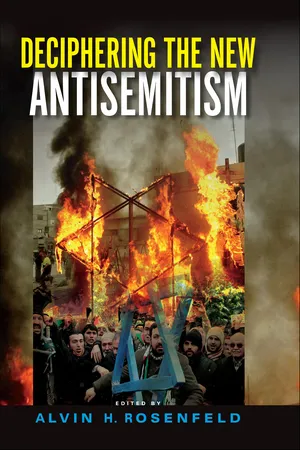
Deciphering the New Antisemitism addresses the increasing prevalence of antisemitism on a global scale. Antisemitism takes on various forms in all parts of the world, and the essays in this wide-ranging volume deal with many of them: European antisemitism, antisemitism and Islamophobia, antisemitism and anti-Zionism, and efforts to demonize and delegitimize Israel. Contributors are an international group of scholars who clarify the cultural, intellectual, political, and religious conditions that give rise to antisemitic words and deeds. These landmark essays are noteworthy for their timeliness and ability to grapple effectively with the serious issues at hand.
- 584 pages
- English
- ePUB (mobile friendly)
- Available on iOS & Android
eBook - ePub
Deciphering the New Antisemitism
About this book
Trusted by 375,005 students
Access to over 1.5 million titles for a fair monthly price.
Study more efficiently using our study tools.
Information
PART I
Defining and Assessing Antisemitism
ONE

Antisemitism and Islamophobia
The Inversion of the Debt
Something new was happening here: the
growth of a new intolerance.
It was spreading across the surface of the
earth, but nobody wanted to know.
A new word had been created to help the
blind remain blind: Islamophobia.
To criticize the militant stridency of this religion in its
contemporary incarnation was to be a bigot.
A phobic person was extreme and irrational in his views,
and so the fault lay with such persons
and not with the belief system that boasted
over one billion followers worldwide.
IN 1910, a French drafter for the Ministry of the Colonies, Alain Quellien, published Muslim Politics in Western Africa (La Politique musulmane dans l’Afrique occidentale].1 Aimed at a specialist audience, it offered temperate praise of Koranic religion, regarded as “practical and permissive” and best suited to the natives, whereas Christianity was considered “too complicated, too abstract, too austere for the primitive and materialistic mentality of the Negro.” Observing that Islam, through its civilizing influence, contributed to European penetration, that it “dragg[ed] populations out of fetishism and degrading practices,” the author urged his readers to abandon the prejudices that equated that faith with barbarism and fanaticism. He denounced the “islamophobia” rampant among colonial personnel: as he put it, “to sing the praises of Islam is as unfair as unjustly denigrating it.” On the contrary, the religion should be treated impartially. In that instance, Quellien spoke as an administrator concerned with public order: he blamed the desire of Europeans to demonize a religion that maintained peace in the Empire, whatever were the various kinds of abuse—slavery, polygamy—it gave rise to. Since Islam was the best ally of colonialism, its followers had to be protected from the nefarious influence of modern ideas and their ways of life respected. Another colonial official, serving in Dakar, Maurice Delafosse, wrote around the same time that “no matter what those who endorse Islamophobia as a principle of colonial administration may claim, France has nothing more to fear from Muslims in Western Africa than from non-Muslims [ . . . ]. There is no justification for Islamophobia in Western Africa, whereas Islamophilia, understood as a preference granted to Muslims, might create a sense of mistrust in non-Muslim populations, which happen to be the most numerous.”2 However, the terms Islamophobia and Islamophilia remained scarcely used, except by scholars, until the beginning of the 1980s. At that point, the term Islamophobia began to gain use as a political tool in the aftermath of the 1979 Islamic Revolution in Teheran. A floating signifier in search of meaning, the term Islamophobia can indeed refer to two different things: either the criticism of Islam or discrimination exerted against the followers of the Koran. A word is not the property of the person who first used it but of those who have reinvented it so as to popularize its use. A newcomer in the semantic field of antiracism, that term is governed by three principles I dwell on here: the inviolability principle, the equivalence principle, and the substitution principle.
THE INVIOLABILITY PRINCIPLE
In October 2013, in Istanbul, the Organisation of Islamic Cooperation (OIC), which is funded by several dozen Muslim countries that shamelessly persecute Jews and Christians at home, addressed a call to Western countries in the persons of Hillary Rodham Clinton and Catherine Ashton, demanding that freedom of expression, that fundamental right, be restrained when dealing with Islam, since it resulted in far too negative a representation of that religion as oppressive to women and bent on an aggressive proselytism.3 The petitioners were willing to turn the criticism of Islam into an international crime, recognized as such by the highest authorities. Such a call, already formulated in Durban as early as 2001, has been repeated almost every year since. Doudou Diène, the UN special rapporteur on racism, in his September 14, 2007, address to the Human Rights Council in Geneva, branded Islamophobia as “constitut[ing] the most serious form of religious defamation.”4 Six months earlier, the very same Human Rights Council had likened that kind of defamation to outright racism and demanded a ban on any kind of gibe directed at prophets and religious symbols, while condemning Zionism as a form of racial discrimination and apartheid. The goal of the council’s March 2007 statement was twofold: First, to silence Western countries, which were held guilty of three capital sins, namely colonialism, secularism, and sexual equality. Second, to forge a domestic policing instrument that can be leveled at those enlightened Muslims who dare to criticize their faith, denounce fundamentalism, or call for certain reforms: reform of family law, instituting gender equality, the right to apostasy and/or conversion, the right not to believe in God, the right not to observe Ramadan, and the right not to follow religious rules. This action by the council made it necessary to stigmatize young women who want to free themselves from the veil and go about in public without shame, their heads uncovered; to blast the French, the Germans, and the British with family backgrounds in Turkey, the Maghreb, or Africa who claim the right not to care about religion and who do not automatically feel themselves to be Muslims because they are of Pakistani, Moroccan, Algerian, or Malian descent. To block any hope of a change in the land of Islam, these renegades, these alleged traitors, have to be exposed to public condemnation of their coreligionists, silenced, and admonished for being imbued with colonial ideology. And all this with the approval of the useful idiots of both left and right, who are always on the lookout for a new racism and who are deeply convinced that Islam is the last oppressed subject in history. We are witnessing the fabrication on a global scale of a new crime of opinion analogous to the crime that used to be perpetrated by “enemies of the people” in the Soviet Union. It is a crime that silences contradictors and shifts the question from the intellectual or theological level to the penal level, every objection, mockery, or reservation being subject to prosecution.
But a mystery remains: that of the transubstantiation of religion into race. That is the trickiest part of the operation, although it seems to be on the verge of success: as everyone knows, a great, universal religion like Islam or Christianity gathers a wide array of populations and thus cannot be reduced to a specific race. To talk of Islamophobia, then, amounts to generating serious confusion between a distinctive set of beliefs and those who adhere to it. Criticizing or attacking Islam or Christianity would therefore result in smearing Muslims and Christians. Now, the denunciation of a creed, or the rejection of dogmas one judges absurd or false, is the very foundation of intellectual life: does it make any sense to talk of anticapitalist racism, antiliberal racism, or anti-Marxist racism? In a democracy, one has a right to reject all religious denominations, to regard them as fallacious, backward, or stultifying. Here is a clear counterexample: whereas Christian minorities living in some of the lands of Islam are persecuted, killed, or forced into exile, the word Christianophobia, which was coined by UN drafters, has not been widely adopted. Such a terminological dearth seems strange: we have a hard time picturing Christianity as other than a conquering and intolerant religion, although in the Near East and as far as Pakistan it is today a martyred religion. In France, a country with an anticlerical tradition, one can make fun of Judeo-Christianity, mock the pope or the Dalai Lama, and represent Jesus and the prophets in all sorts of postures, including the most obscene, but one must never laugh at Islam, on pain of being accused of discrimination. Why does one and only one religion escape the climate of raillery and irony that is normal for the others?
At this juncture, there appears the strangest element of this story: the enlistment of a part of the U.S. left in the defense of Islam. That is what one might call the neo-Bolshevik bigotry of Marxism’s lost zealots. The left, which has forsaken everything it once believed in—the working class, the third world—clings to this last illusion: Islam, considered the ultimate religion of the poor, represents, for a certain number of disenchanted activists, the last utopia, after the fall of communism and the fiasco of Third Worldism. In the gallery populated by the exemplary characters of history, the Muslim has replaced the Prole, the Wretched of the Earth, the Guerillero. He is now the one figure embodying hope for justice on this planet, transcending borders and parochialism, the only champion, according to his supporters, of social justice. What Marx considered the “opium of the people” has become the indispensable viaticum. Feminism, equality between men and women, the intellectually vivifying effect of doubt, the spirit of inquiry, all that has been traditionally associated with a progressive position, is trampled upon. Such a political stance leads to an uncompromising worship of any Muslim ritual or practice, most notably the Islamic veil, which has been literally glorified and exalted to such an extent that, for some commentators, an unveiled Muslim woman who claims her right not be veiled can only be a traitor, a Harki, or a knave bought by colonial authorities. Here, it would be appropriate to dwell further on what has been called Islamo Leftism, the hope, entertained by a revolutionary fringe, of seeing Islam become the spearhead of a new insurrection, engaged in a “Holy War” against global capitalism, something reminiscent of what happened in Baku in 1920, when Bolshevik leaders, including Zinoviev, called, alongside Pan-Islamists, for a Jihad against Western imperialism. As an illustration of such a trend, one may refer to the following reflection of the philosopher Pierre Tevanian, who seriously maintained that “it has been statistically established that racist, xenophobic, Islamophobic opinions are more common among Whites than among non-Whites. [ . . . ] One must also acknowledge that the panels of Muslim respondents are clearly more progressive than the rest of the population with respect to questions relating to social welfare, redistribution of wealth, racism and xenophobia” and, finally, that 93 percent of Muslims in France voted for the socialist candidate in May 2012.5 That is a very strange claim, inasmuch as it racializes the whole issue to the extent that it links political opinions to skin color or religious denomination.
THE EQUIVALENCE PRINCIPLE
Edward Said, in Orientalism, recalls that in the cartoons that appeared after the 1973 war, the Arabs, depicted with hook noses, standing near a gas pump, “were clearly Semitic”: “The transference of a popular anti-Semitic animus from a Jewish to an Arab target was made smoothly, since the figure was essentially the same.”6 In short, according to Said, in the Western Christian world, hostility toward Islam went hand in hand with antisemitism, and it thrived coming from the same source. Philosopher Enzo Traverso explains that “Islamophobia, for the new racism, plays the role that once was that of Anti-Semitism”: the rejection of the immigrant, perceived, since the colonial era, as the other, the invader, the foreign body that cannot be assimilated by the national community, “the specter of Judeo-Bolshevism being replaced by that of Terrorism.” In such a perspective, Traverso claims, Islamophobia is part and parcel of what could be called “the Anti-Jewish archive [ . . . ], a catalogue of stereotypes, images, places, representations, stigmatizations conveying a perception and an interpretation of reality that condense and organize themselves into a stable and continuous discourse. As a discursive practice that can shift the object on which it bears, Anti-Semitism indeed transmigrated towards Islamophobia.”7 Here are some other symbols of such a transformation: back in 1994, in Grenoble, young Muslims protested against the ban of the Islamic scarf from schools by wearing armbands with the crescent of Islam in yellow, on a black background, together with this inscription “When is our turn?,” an allusion to the yellow star that the Jews were compelled to wear under the N...
Table of contents
- Cover
- Half title
- Title
- Copyright
- Dedication
- Contents
- Acknowledgments
- Introduction
- Part I. Defining and Assessing Antisemitism
- Part II. Intellectual and Ideological Contexts
- Part III. Holocaust Denial, Evasion, Minimization
- Part IV. Regional Manifestations
- List of Contributors
- Index
Frequently asked questions
Yes, you can cancel anytime from the Subscription tab in your account settings on the Perlego website. Your subscription will stay active until the end of your current billing period. Learn how to cancel your subscription
No, books cannot be downloaded as external files, such as PDFs, for use outside of Perlego. However, you can download books within the Perlego app for offline reading on mobile or tablet. Learn how to download books offline
Perlego offers two plans: Essential and Complete
- Essential is ideal for learners and professionals who enjoy exploring a wide range of subjects. Access the Essential Library with 800,000+ trusted titles and best-sellers across business, personal growth, and the humanities. Includes unlimited reading time and Standard Read Aloud voice.
- Complete: Perfect for advanced learners and researchers needing full, unrestricted access. Unlock 1.5M+ books across hundreds of subjects, including academic and specialized titles. The Complete Plan also includes advanced features like Premium Read Aloud and Research Assistant.
We are an online textbook subscription service, where you can get access to an entire online library for less than the price of a single book per month. With over 1.5 million books across 990+ topics, we’ve got you covered! Learn about our mission
Look out for the read-aloud symbol on your next book to see if you can listen to it. The read-aloud tool reads text aloud for you, highlighting the text as it is being read. You can pause it, speed it up and slow it down. Learn more about Read Aloud
Yes! You can use the Perlego app on both iOS and Android devices to read anytime, anywhere — even offline. Perfect for commutes or when you’re on the go.
Please note we cannot support devices running on iOS 13 and Android 7 or earlier. Learn more about using the app
Please note we cannot support devices running on iOS 13 and Android 7 or earlier. Learn more about using the app
Yes, you can access Deciphering the New Antisemitism by Alvin H. Rosenfeld in PDF and/or ePUB format, as well as other popular books in History & 20th Century History. We have over 1.5 million books available in our catalogue for you to explore.