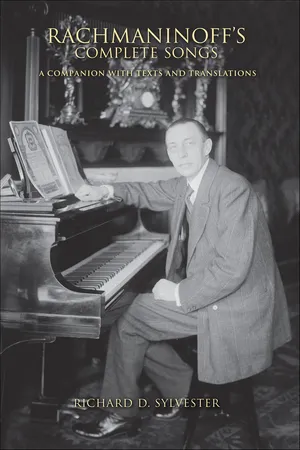
Sergei Rachmaninoff—the last great Russian romantic and arguably the finest pianist of the late 19th and early 20th centuries—wrote 83 songs, which are performed and beloved throughout the world. Like German Lieder and French mélodies, the songs were composed for one singer, accompanied by a piano. In this complete collection, Richard D. Sylvester provides English translations of the songs, along with accurate transliterations of the original texts and detailed commentary. Since Rachmaninoff viewed these "romances" primarily as performances and painstakingly annotated the scores, this volume will be especially valuable for students, scholars, and practitioners of voice and piano.
eBook - ePub
Rachmaninoff's Complete Songs
A Companion with Texts and Translations
- 328 pages
- English
- ePUB (mobile friendly)
- Available on iOS & Android
eBook - ePub
About this book
Trusted by 375,005 students
Access to over 1.5 million titles for a fair monthly price.
Study more efficiently using our study tools.
Information
Subtopic
Classical MusicFifteen Romances, Opus 26 (1906)
1.
When, at the end of their honeymoon in July 1902, Sergei and Natalia Rachmaninoff arrived in Bayreuth for the Wagner festival, they joined a party of fellow Russians led by Konstantin Stanislavsky (on Rachmaninoff’s relationship with Stanislavsky, see Song 62). Together they visited Liszt’s grave, met Cosima Wagner, and attended performances of The Flying Dutchman, Parsifal, and The Ring. They sent a postcard to Siloti, who was at Ivanovka, and another longer greeting to Anton Chekhov, who was spending the summer with his wife the actress Olga Knipper in Stanislavsky’s house outside Moscow. The message to Chekhov read: “Russian pilgrims in Bayreuth, inspired by the majesty of art and the theater, send sincere feelings of tribute to a great talent, and pride in our compatriot” (LN 1, 320). This message from his enthusiastic friends might have brought a hearty laugh from Chekhov, whose idea of theater was a far cry from Wagner’s “Gesamtkunstwerk” about gods, giants, and a gold ring. Yet if there was irony in the implied comparison, the message was quite sincere—in a way all its own, a Chekhov play at the Moscow Art Theater could also be an overwhelming experience of theater as great art.
Rachmaninoff’s interest in Wagner’s music was deepened in Bayreuth, and he remembered scenes from Das Rheingold when he was writing The Miserly Knight the following year. As a student he was sarcastic about the interminable length of Tristan when he, Scriabin, Goldenweiser, and Taneyev were taking turns playing through the score, but he liked playing his own favorite passages from The Ring for friends, skipping the “boring” parts, then announcing “all right now, granddad Wagner, show your stuff!” (VOR 1, 245). In concerts Rachmaninoff conducted between 1905 and 1912 he included orchestral music from Lohengrin, Die Walküre, and the “Siegfried Idyll,” as well as the marvelous “Wesendonk-Lieder.” In concerts after he left Russia, he played piano transcriptions of Wagner right up to his very last recitals in Louisville and Knoxville in 1943, playing Liszt’s arrangement of the “Spinning Chorus” from The Flying Dutchman and a transcription of the “Magic Fire” music from Die Walküre (details of Rachmaninoff’s concert seasons from 1909 to 1943 are in LN 3, 439-67).
2.
With Stanislavsky at Bayreuth were some singers and musicians from the Bolshoi Theater, including a double-bass virtuoso a year younger than Rachmaninoff named Sergei Kusevitskii (1874–1951), later famous as Serge Koussevitzky, conductor of the Boston Symphony from 1924 to 1949 and founder of the music festival at Tanglewood in 1940. Rachmaninoff had first met him when they were students; they would work together over the next fifteen years. Koussevitzky was born in Vyshny-Volochok, a canal town on the Volga. His father Alexander was a Jewish musician who served his twenty-five years of compulsory military service in an army band; when his service ended, he married and started a family. Alexander could play many instruments, and his wife and all their children were musically talented. He formed a family klezmer-band which played at weddings and in taverns, and also toured the province, performing at fairs and carnivals (Iuzefovich, 25-28). Young Sergei could play all the stringed instruments as well as the trumpet and the tuba, but his favorite was the double-bass. He was determined to play it better than anyone else. At seventeen he ran away to Moscow, where he managed to talk his way into the Musical Academy of the Moscow Philharmonic. To study in Moscow, a Jew had to convert to Russian Orthodoxy, a step Koussevitzky undertook in 1893 (ibid., 35). For two years he studied and practiced constantly, gaining experience playing nights in the orchestra of the Italian opera. As his mastery grew, he began giving solo recitals: he “solo-tuned” his bass a whole tone higher in order to play pieces written for cello, which he included in his recitals. Koussevitzky joined the Bolshoi in 1895, and by the time he went to Bayreuth in 1902 he was leader of the ten-man double-bass section of the orchestra, with a salary of 1,200 rubles a year (ibid., 49).
3.
From 1902 to 1904 Rachmaninoff devoted himself to composition. He had no regular income and was living off the money Siloti had loaned him earlier. He earned a small income from his pedagogical activities and an occasional fee for concerts, but money was an issue which would have to be addressed. In May 1903 Natalia gave birth to their first daughter, Irina.
In 1902–03 Rachmaninoff composed his first long work for piano, the Variations on a Theme of Chopin, Op. 22, and his Ten Preludes for Piano, Op. 23. Max Harrison has described the Chopin Variations as “an initial presentation, almost a systematization, of most of his own keyboard discoveries, the pianistic textures that particularly characterize his music for the instrument” (Harrison, 110-11). As a performance piece it is rather long, and the composer wanted to edit it down; he even recommended some cuts. For this reason, it has remained largely “in the shadows” (Martyn,...
Table of contents
- Cover
- Title Page
- Copyright
- Dedication
- Contents
- Preface
- Acknowledgments
- A Note on Dates and Spelling
- List of Abbreviations
- Early Years (1873–1892)
- Nine Unpublished Songs (1890–1899)
- First Published Songs, Opus 4 (1893)
- Six Romances, Opus 8 (1893)
- Twelve Romances, Opus 14 (1896)
- Twelve Romances, Opus 21 (1902)
- Song 46, Without Opus (1900)
- Fifteen Romances, Opus 26 (1906)
- Song 62, Without Opus (1908)
- Fourteen Romances, Opus 34 (1912–1915)
- Song 77, Without Opus (1914)
- Six Poems, Opus 38 (1916)
- After Russia (1917–1943)
- Bibliography
- Index of Singers
- Index of Song Titles in Russian
- Index of Song Titles in English
- Index of Names
Frequently asked questions
Yes, you can cancel anytime from the Subscription tab in your account settings on the Perlego website. Your subscription will stay active until the end of your current billing period. Learn how to cancel your subscription
No, books cannot be downloaded as external files, such as PDFs, for use outside of Perlego. However, you can download books within the Perlego app for offline reading on mobile or tablet. Learn how to download books offline
Perlego offers two plans: Essential and Complete
- Essential is ideal for learners and professionals who enjoy exploring a wide range of subjects. Access the Essential Library with 800,000+ trusted titles and best-sellers across business, personal growth, and the humanities. Includes unlimited reading time and Standard Read Aloud voice.
- Complete: Perfect for advanced learners and researchers needing full, unrestricted access. Unlock 1.5M+ books across hundreds of subjects, including academic and specialized titles. The Complete Plan also includes advanced features like Premium Read Aloud and Research Assistant.
We are an online textbook subscription service, where you can get access to an entire online library for less than the price of a single book per month. With over 1.5 million books across 990+ topics, we’ve got you covered! Learn about our mission
Look out for the read-aloud symbol on your next book to see if you can listen to it. The read-aloud tool reads text aloud for you, highlighting the text as it is being read. You can pause it, speed it up and slow it down. Learn more about Read Aloud
Yes! You can use the Perlego app on both iOS and Android devices to read anytime, anywhere — even offline. Perfect for commutes or when you’re on the go.
Please note we cannot support devices running on iOS 13 and Android 7 or earlier. Learn more about using the app
Please note we cannot support devices running on iOS 13 and Android 7 or earlier. Learn more about using the app
Yes, you can access Rachmaninoff's Complete Songs by Richard D. Sylvester in PDF and/or ePUB format, as well as other popular books in Media & Performing Arts & Classical Music. We have over 1.5 million books available in our catalogue for you to explore.