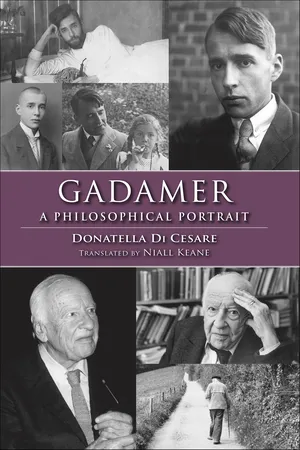
Hans-Georg Gadamer (1900-2002), one of the towering figures of contemporary Continental philosophy, is best known for Truth and Method, where he elaborated the concept of "philosophical hermeneutics," a programmatic way to get to what we do when we engage in interpretation. Donatella Di Cesare highlights the central place of Greek philosophy, particularly Plato, in Gadamer's work, brings out differences between his thought and that of Heidegger, and connects him with discussions and debates in pragmatism. This is a sensitive and thoroughly readable philosophical portrait of one of the 20th century's most powerful thinkers.
- 248 pages
- English
- ePUB (mobile friendly)
- Available on iOS & Android
eBook - ePub
About this book
Trusted by 375,005 students
Access to over 1.5 million titles for a fair monthly price.
Study more efficiently using our study tools.
Information
Topic
PhilosophySubtopic
Phenomenology in Philosophy1 Living through a Century
He who philosophizes is not at one with the previous and contemporary world’s ways of thinking of things. Thus Plato’s discussions are often not only directed to something but also directed against it. (DDP 39/GW5 187)
1. The Sky Over Breslau
Hans-Georg Gadamer was born in Marburg on February 11, 1900. His father was a well-known professor of pharmaceutical chemistry; deeply convinced of scientific progress, he was, according to his son, authoritarian “in the worst way but with the best of intentions” (PA 3/PL 9). In 1902 he was called as a full professor to Breslau, in today’s Poland, where Gadamer spent his entire childhood and adolescence. At the age of only thirty-five, Gadamer’s mother, Emma Caroline Johanna Gewiese, died in the spring of 1904. Her son, who barely knew her, always remembered her fondness for music, her passion for art, and her love of literature.
In the gray atmosphere of his paternal home the years in Breslau were gloomy and oppressive, marked by the technological advances that heralded the new century. On the city’s streets the first cars mingled with horse-drawn carriages. Gas lanterns were slowly replaced by electric lights, movie theaters opened their doors, and telephones were installed. The zeppelin flew across the Breslau sky, but the sinking of the Titanic in 1912 shocked contemporary culture and began to undermine the optimistic faith in technology (EPH 221/EE 8).1 Although Breslau was a quiet provincial city far removed from the front, the effects of the First World War soon made themselves felt. Germany emerged from the chaos of war economically broke, politically unstable, disillusioned, and disoriented by a deep need for direction.
In the spring of 1918 Gadamer enrolled in Breslau University. During his first semester he studied some of the most disparate topics in the humanities: German, art history, psychology, history, and Asian studies. In his second semester he began to follow the lecture courses of the Neo-Kantians Eugen Kühnemann (1868–1946), Julius Guttmann (1880–1950), and Richard Hönigswald (1875–1947), and it was Hönigswald who urged him toward philosophy. Admitted to a seminar on the philosophy of language that Hönigswald held for advanced students, Gadamer asked a question about the difference between signs and words that brought him unexpected praise, strengthened his self-esteem, and in a sense opened his path to philosophy.2
As with many of his generation, the encounter with new ideas in those years occurred through the reading of the Betrachtungen eines Unpolitischen (Reflections of a Nonpolitical Man) by Thomas Mann (1875–1955) and through the cultural criticism exerted by the George-Kreis, the circle around Stefan George (1868–1933).
2. Marburg and Philosophy
In October 1919 Gadamer moved with his family to Marburg, where his father, Johannes Gadamer (1867–1928), had received a new chair and where he became rector in 1922. Through a lucky coincidence the best of German intellectual culture had converged on this university town. It suffices to mention a few names: Ernst Robert Curtius (1886–1956) in Romance studies, Rudolf Bultmann (1884–1976) in theology, Richard Hamann (1879–1961) in art history, and Paul Natorp (1854–1924) and Nicolai Hartmann (1882–1950) in philosophy. Gadamer would take advantage of this constellation through his ability to listen to and learn from different points of view, which distinguished him even then. The twenty years spent in the university town—from 1919 to 1938—were important for his intellectual formation and decisive for his philosophical thought.
His involvement with the George-Circle also dates from his time in Marburg. Gadamer was introduced to the Circle by the Romanist Curtius, who strongly influenced his reading in those years. The Circle was distinctive for its scornful detachment from the decadent civilized world; dominated by the charismatic “leadership” of George, it was governed by ironclad, esoteric rules.3 The Circle’s activity in Marburg revolved around the historian of economics Friedrich Wolters (1876–1930), who taught there from 1920 to 1923; together with his friend, the poet Oskar Schürer (1892–1949), Gadamer attended Wolters’s seminars for a time, where he also became acquainted with Hans Anton. Gadamer later witnessed the relationship between Anton and Max Kommerell (1902–44), the writer and literary critic, which came to a tragic end. Gadamer was attracted to the group only by the privilege given to the poetic experience of truth; however, he was driven out of the Circle, where not only science but also philosophy began to be disliked. An even harder destiny befell Kommerell, who, by trying to keep his distance, showed that George and his poetry could also be admired outside the Kreis.
When Gadamer started studying philosophy, Marburg was famous above all for Neo-Kantianism. Its founder, Hermann Cohen (1842–1918), having worked for decades in Marburg with the rallying cry “Back to Kant,” moved to Berlin in 1912 and left the hard-won fate of the “Marburg School” in the hands of two other proponents: Natorp and Hartmann. Both men, but especially Nicolai Hartmann, would guide Gadamer’s initial steps.
Though considered the last representative of Neo-Kantianism, it was actually Hartmann who declared its end by distancing himself in the name of “critical realism.” Still relatively young, he was a teacher, a friend, and, in a sense, a father for Gadamer, supporting him with affection and esteem. Despite the appearance of being cold and distant, Hartmann was very close to his students. He knew how to alternate between intensive and focused work and evenings animated by his affable and energetic personality. His influence on Gadamer should not be underestimated (RPJ 7/GW2 483).4 It was Hartmann, after all, who convinced him to complete his dissertation with Natorp. Entitled “The Essence of Pleasure according to Plato’s Dialogues” (Das Wesen der Lust nach den Platonischen Dialogen), the dissertation remained unpublished; yet already in those 116 badly written pages, with only five footnotes, there appears the idea of the “good” that, as a bridge between Plato and Aristotle, would guide Gadamer’s future reflections.5 Even if Hartmann and Natorp wrote two diametrically opposed reviews of the work, they both agreed to give it the highest mark.
3. A Demanding Teacher: Heidegger’s Example
Immediately after his graduation in August 1922, Gadamer contracted a severe form of infantile paralysis: poliomyelitis. The illness marked a profound break in his life. He had to live in quarantine while his convalescence stretched throughout the entire winter. In those long months he read, among others, the literary work of Jean Paul and the Logical Investigations of Edmund Husserl (1859–1938). Yet something new occurred during the time of his illness: Natorp lent Gadamer a manuscript on Aristotle written by Husserl’s young assistant in Freiburg, Martin Heidegger (1889–1976).6
Heidegger’s name had been discussed for a long time, and Gadamer had already heard of him. Surrounded by an aura of fame, Heidegger was regarded as the “secret king” of German philosophy—as Hannah Arendt would later describe him in her memoirs.7 However, since Heidegger had not yet published anything, this fame was based only on the suggestive power of his lectures. That was precisely why Natorp, who wanted to appoint him to a professorship at the University of Marburg, asked him for a report on his work on Aristotle. Gadamer, perhaps influenced by Natorp’s positive evaluation, decided to go to Freiburg as soon as his strength would allow him. In a letter dated September 27, 1922, he communicated his decision to Heidegger, who answered quickly with a card.8 This was the beginning of a relationship that lasted a lifetime, and the encounter with Heidegger left an indelible mark on Gadamer. Not only were the results Gadamer had achieved by that time in his study of philosophy put into question, but the initial doubts about his self-confidence, which may have been gained too early, started to emerge (PA 14/PL 23).
In April 1923, not yet having recovered fully from his illness and having just married Frida Kratz (1898–1979), a native of Breslau, Gadamer moved to Freiburg. The small-town university scene was dominated by Husserl, and so Gadamer felt almost obliged to attend his lectures and seminars. For Husserl, it was clear that the young student, recommended by Natorp, should write on Aristotle, while the name of Aristotle seemed the only link that, beyond the label of “phenomenology,” still connected Husserl and Heidegger. Yet Gadamer’s enthusiasm for Heidegger soon mirrored his disappointment in Husserl, who indulged in long didactic monologues during his lectures—Gadamer would later speak of the “seduction of the podium” (GW2 212).9 Fjodor Stepun (1884–1965), one of his fellow students, described Husserl as a “watchmaker gone mad,” because during his explications he turned his right hand in the left, a movement of concentration that had something of a craftsmanlike, ideal descriptive technique to it (PA 35/PL 31). Thereafter, for Gadamer, phenomenology remained above all that of Max Scheler (1874–1928), whom he had already met in 1920 in Marburg and whom he never ceased to admire.
Heidegger had prepared a course on logic for the summer semester of 1923, but when he learned that a colleague was to offer the same course, he decided to change the topic and announced a new title: “Ontology.” A little later the title was stated more precisely: “The Hermeneutics of Facticity.”10 Thus Gadamer’s first encounter with Heidegger took place under the banner of hermeneutics. But during that summer semester Gadamer was almost more attracted to another topic.11 Heidegger held a lecture and gave four seminars, one of which dealt with the sixth book of the Nicomachean Ethics. The concept of phrónesis, discussed in those pages by Aristotle, would accompany Gadamer into his final years.12
The seminar on Aristotle marked the beginning of an even closer relationship between the two that went far beyond academic boundaries: Heidegger invited Gadamer to read the Metaphysics with him, and this work stretched unexpectedly into the summer vacation. From July 29 to August 23, 1923, Gadamer and his wife spent four weeks in Heidegger’s hut, or Hütte, in Todtnauberg. Following his teacher, Gadamer learned how to read Aristotle “phenomenologically,” but at the same time he also learned from Aristotle how to address philosophical questions to his own time (GW10 31–45). Along with the seminars in Freiburg, this reading experience was his first practical “introduction to the universality of hermeneutics” (RPJ 10/GW2 486).
Heidegger, for his part, also needed an introduction. The philosopher from the Black Forest, who had never left Freiburg and Baden, had just been invited to Marburg by Natorp and hence took advantage of Gadamer to learn more about that philosophers’ stronghold. He was inspired by anything but peaceful intentions: even before his official entry to Marburg, Heidegger took an almost aggressive posture toward his Neo-Kantian colleagues. Hartmann was his main target. On July 14, 1923, he wrote to Karl Jaspers (1883–1969), with whom he had developed a philosophical kinship, about his combat plans: he would “make things hot” for Hartmann, supported by the “shock troops” of sixteen students he would bring with him from Freiburg, some of them just hangers-on, others serious and capable collaborators.13
Among the latter was also Gadamer, who left Freiburg reluctantly. The summer semester distanced him once and for all from the “abstract exercises in thinking led by Nicolai Hartmann,” and drew him onto Heidegger’s paths (PA 37/PL 34). His very earliest writings testify to this change. In a contribution to the Festschrift for Natorp published in 1924, Gadamer revealed his perplexities about the idea of a philosophical “system,” which in Neo-Kantianism was almost a dogmatic principle.14 In his review of Hartmann’s Metaphysics of Knowledge (Metaphysik der Erkenntnis) for the distinguished journal Logos, the place where the text was written appears very clearly: Freiburg im Breisgau.15 Although he viewed Hartmann’s rapprochement with phenomenology positively, Gadamer did not consider his Aristotelian realism radical enough. He pointed to the unavoidable task of a “critical destruction of the philosophical tradition,” thus revealing Heidegger as the source of his reflections.16 At issue in the long debate with Hartmann was the purely descriptive attitude, free from every point of view: according to Gadamer, there was “no way to approach a thing that would not be decisively determined by the peculiarity of one’s own position.”17 Though the word “hermeneutics” does not appear, its seeds are clearly recognizable in his critique of the theory of knowledge and his doubts about the very idea of a system.
All beginnings bring significant difficulties. When Gadamer returned to Marburg in the winter semester of 1923–24—this time with his new teacher, whose assistant he had become—he encountered the problem of finding his own place within the complicated academic landscape. He tried to mediate in the relationship between Hartmann and Heidegger, which was steadily worsening. Whereas the majority of students went to the lectures of the latter, the lectures of the former remained poorly attended.18 When Heidegger stepped up t...
Table of contents
- Cover
- Title
- Copyright
- Contents
- List of Abbreviations
- Introduction
- 1 Living through a Century
- 2 The Event of Truth
- 3 Lingering in Art
- 4 On the Way to Philosophical Hermeneutics
- 5 The Constellation of Understanding
- 6 An Ethics Close to Life
- 7 The Enigma of Socrates: Philosophical Hermeneutics and Greek Philosophy
- 8 The Horizon of Dialogue
- 9 Hermeneutics as Philosophy
- 10 Keeping the Dialogue Going
- Index of Names
- Index of Terms
Frequently asked questions
Yes, you can cancel anytime from the Subscription tab in your account settings on the Perlego website. Your subscription will stay active until the end of your current billing period. Learn how to cancel your subscription
No, books cannot be downloaded as external files, such as PDFs, for use outside of Perlego. However, you can download books within the Perlego app for offline reading on mobile or tablet. Learn how to download books offline
Perlego offers two plans: Essential and Complete
- Essential is ideal for learners and professionals who enjoy exploring a wide range of subjects. Access the Essential Library with 800,000+ trusted titles and best-sellers across business, personal growth, and the humanities. Includes unlimited reading time and Standard Read Aloud voice.
- Complete: Perfect for advanced learners and researchers needing full, unrestricted access. Unlock 1.5M+ books across hundreds of subjects, including academic and specialized titles. The Complete Plan also includes advanced features like Premium Read Aloud and Research Assistant.
We are an online textbook subscription service, where you can get access to an entire online library for less than the price of a single book per month. With over 1.5 million books across 990+ topics, we’ve got you covered! Learn about our mission
Look out for the read-aloud symbol on your next book to see if you can listen to it. The read-aloud tool reads text aloud for you, highlighting the text as it is being read. You can pause it, speed it up and slow it down. Learn more about Read Aloud
Yes! You can use the Perlego app on both iOS and Android devices to read anytime, anywhere — even offline. Perfect for commutes or when you’re on the go.
Please note we cannot support devices running on iOS 13 and Android 7 or earlier. Learn more about using the app
Please note we cannot support devices running on iOS 13 and Android 7 or earlier. Learn more about using the app
Yes, you can access Gadamer by Donatella Di Cesare, Niall Keane in PDF and/or ePUB format, as well as other popular books in Philosophy & Phenomenology in Philosophy. We have over 1.5 million books available in our catalogue for you to explore.