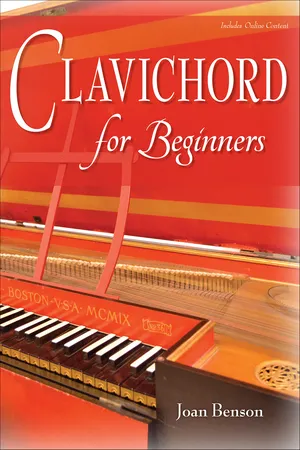
Written by Joan Benson, one of the champions of clavichord performance in the 20th century, Clavichord for Beginners is an exceptional method book for both practitioners and enthusiasts. In addition to detailing the historical origins of the instrument and the evolution of keyboard technique, the book describes the proper method for practicing fingering and articulation and emphasizes the importance of touch and sensitivity at the keyboard.
- 144 pages
- English
- ePUB (mobile friendly)
- Available on iOS & Android
eBook - ePub
Clavichord for Beginners
About this book
Trusted by 375,005 students
Access to over 1.5 million titles for a fair monthly price.
Study more efficiently using our study tools.
Information
Subtopic
MusicaCHAPTER ONE
Clavichord for All Keyboardists
At least in the beginning, the clavichord is unquestionably best suited for learning, for on no other keyboard instrument is it possible to achieve finesse in playing as well as on this one.
Daniel Gottlob Türk, School of Clavier Playing (Klavierschule, 1789)
What Is a Clavichord?
A good clavichord is the simplest, softest, and most sensitively responsive of all keyboard instruments. Its basic structure is as follows:
An oblong wooden frame contains a soundboard on the right. Attached to it are one to three bridges on which strings are stretched. These strings extend from tuning pins on the far right to hitch pins on the far left. Below and perpendicular to the strings are wooden key levers balanced on pins. When a finger presses down the key end of a lever, the opposite end of the lever automatically rises. Protruding upward from this far end is a metal tangent, which strikes and presses against a pair or triplet of strings. These strings vibrate from tangent to bridge, creating both tone and pitch. To the left of the tangents, cloth strips (listing) are woven among the strings. They block extraneous sound that might come from the left of each tangent and stop a tone when the key and its tangent are released.
The clavichord is the only keyboard instrument on which a tone can be altered as long as it lasts. The initial dynamic level is determined by the strength, speed, and distance of the tangent’s (and finger’s) attack. While the tangent stays in contact with the string, the sound will bloom and then gradually fade. During that time any fluctuation in finger and tangent pressure will change the pitch and carrying power of the tone. By varying this pressure purposely once (a portato) or a number of times (a Bebung), the performer can produce special effects of great delicacy. The relationship of finger to string offers dynamic and articulative subtleties, some so small they can scarcely be perceived.
The clavichord is a very personal instrument, heard most directly by the player. It is able to reflect, inspire, and deepen a player’s entire being.
FIGURE 1.1 Clavichord, c. 1800. Photograph courtesy of Donna Gilhousen.

Clavichord for Keyboard Beginners
The earlier one begins to play the clavichord, the further one may progress … with regard to dexterity. For at the tenderest age, the fingers are still supple.
Daniel Gottlob Türk, School of Clavier Playing
In former centuries a child often began music lessons on the clavichord. The instrument was small and easily portable, the keys were short, the touch and tone were light. A child learned to listen to tones and to keep a steady pitch. Practicing did not disturb others, and little maintenance was required beyond tuning. Today the word “keyboard” usually refers to the computer. Video games, amplified sounds, and hectic schedules keep many children from having the tranquility in which to dream. The expressive clavichord can be the perfect outlet for a sensitive child.
The clavichord is excellent for an adult keyboard beginner for the same reasons. Unlike the synthesizer, it stimulates a sensitivity to touch and sound. By minimizing arm weight, it builds finger awareness and a delicacy of tonal control. Above all, in this high-strung world, it can offer a quiet space for privacy, clarity, and repose.
For Harpsichordists
The clavichord is excellent for novices “to train their hands on the keyboard so that they may later play with more confidence and suppleness on the harpsichord.”
Pierre Trichet, Traité des instruments de musique (c. 1640),
quoted in Brauchli, The Clavichord
quoted in Brauchli, The Clavichord
A good clavichordist makes an accomplished harpsichordist, but not the reverse. The clavichord is needed for the study of good performance, and the harpsichord to develop proper finger strength. …
Those who concentrate on the harpsichord grow accustomed to playing in only one color. The varied touch which the competent clavichordist brings to the harpsichord remains hidden from them.
C. P. E. Bach, Essay on the True Art of Playing Keyboard Instruments
Bach’s way of playing would not have been devised at all without the clavichord. … He who once masters this instrument plays the harpsichord quite differently from those who never touch a clavichord.
Johann Friedrich Reichardt, Briefe eines aufmerksamen Reisenden (1774)
It was customary in earlier periods for a keyboardist to play both the harpsichord and the clavichord. Even today, each has its place. The brilliant harpsichord is a more highly articulate solo and ensemble instrument. When a key is depressed, the pluck of a plectrum makes a string vibrate. When the key is released, a damper blocks the sound.
A harpsichordist can control only the beginning and ending of each tone. Dynamic variations are made by differences in musical textures, articulation, and instrumental resonance. On some harpsichords, a player can couple or uncouple separate sets of strings, offering contrasting timbres or levels of pitch.
The more intimate clavichord has much to offer the harpsichordist. It encourages the player to follow a tone as it blooms and fades. The clavichord’s soft and flexible sounds can attune the harpsichordist to fine details and the interrelationship of voices. Fingers and ears learn to form those infinitesimal threads of expression that enhance a musician’s performance.
For Players of Early Pianos
A clavichord is better than a harpsichord or a pianoforte for the beginner. … Anyone who learns from one of the latter instruments will never be as refined in playing and in expression as a person who receives beginning instruction on the clavichord.
Georg Simon Löhlein, Clavier-Schule (1765),
translated in Sandra Soderlund, How Did They Play?
translated in Sandra Soderlund, How Did They Play?
The eighteenth-century clavichord and early piano have much in common.1 Both represent a fresh approach to music that expands the dynamic variations of tones. Particularly with large, five-octave clavichords and their long-lasting tones, crescendos and diminuendos can be extended over measures, and quick changes of dynamics can be dramatic. Instrument makers in late eighteenth-century Sweden went so far as to specialize in color-rich clavichords containing huge soundboards and compasses of up to six octaves.
In the case of the early piano, small leather-covered hammers strike the strings to produce sounds, which are then silenced by cloth or leather dampers. As with clavichords, the sound will vary in loudness according to initial finger attack and pressure. Unlike clavichordists, however, early pianists can relax this pressure after the initial attack, since only the beginning and ending of notes are controlled. Still, the early piano’s hammer power, una corda, and sustaining mechanisms can affect the quality, loudness, and length of sound. In general, by studying the clavichord, players can become more sensitized to the subtle dynamics and articulations available on different eighteenth-century pianos, ranging from Cristofori copies to English grands.
The link between the clavichord and early piano is particularly apparent in Germany and Austria. C. P. E. Bach (from here on called Emanuel), Haydn, and Mozart played the clavichord as children and remained clavichordists all their lives. The sensitive touch they learned on the clavichord they naturally applied to the early piano.
It was common in these countries for keyboard makers to build both clavichords and early pianos. Some of the earliest pianos, by Gottlieb Silbermann, were sold to King Frederick the Great while Emanuel Bach served in his court. Probably the same Silbermann also produced the famous clavichord that Bach owned and played. Its astounding dynamic range allowed him to express a breathtaking scope of emotions.
The sensitive, light, clear “Viennese” fortepianos that Haydn and Mozart played respond completely to a clavichord touch. Thus, I advise those who want to make music on such early pianos to begin with the clavichord.
I first discovered the close connection between clavichords and “Viennese” fortepianos in a European museum in the 1960s.2 While preparing for a clavichord concert, I was locked in the hall overnight by mistake. To while away the hours, I turned to three elegant fortepianos placed on a platform. I opened the lid of one by Andreas Stein and began to play. Exquisite tones filled the hall, and I listened, amazed. Then I played a Nanette Streicher fortepiano and one made by Anton Walter. My clavichord approach seemed to suit these instruments precisely. Time passed unnoticed, and I was completely carried away. This experience inspired me to feature early pianos along with the clavichord in later performances.
For Modern Pianists
During the time of Mendelssohn, Chopin, Schumann, and Liszt, pianos continued to change. Yet at best their shallow key dips, light, sensitive, and rapid actions, and great capacity for colors were naturally attuned to the emotional, melismatic lines of Chopin and the luxurious orchestral effects of Liszt.
This colorful and pliable palette, coupled with a warm, full sound, is found in iron-framed modern pianos of the early twentieth century. The Schubert Club in Saint Paul, Minnesota, owns a stunning 1908 American Steinway Model B. When visiting concert pianists encounter this instrument, they are tempted to overdrive its fragile action. Yet as a clavichordist, I found this piano highly expressive and rewarding to play.
In 1901 the American pianist William Mason, who advocated arm weight coupled with relaxation, described a piano technique that recalls that of the clavichord. To produce a soft tone, fingertips are pulled inward toward the palm. “Through the medium of this touch,” Mason wrote, “pianissimo effects are possible which no other mechanism can reach; for passages of the most extreme delicacy and softness still retain the quality of vitality and clearness of outline.”3
In our current era, dominated by loud, bold sounds, all pianists, both professionals and amateurs, can profit from playing the clavichord. The detailed finger control and auditory acuity it develops can enhance and expand interpretative and technical skills. Two twentieth-century piano artists who owned and played clavichords are Claudio Arrau (grand-pupil of Liszt) and tiny-fingered Mieczysław Horszowski (great-grand-pupil of Beethoven and Chopin). In the twenty-first century, András Schiff reflects the clavichord in his piano performances of keyboard music by Johann Sebastian Bach.
Through the clavichord, pianists are encouraged to go far beyond piano and forte to a finer range of dynamics. They will discover they can shade Bach’s music and clarify the interaction of each voice in a fugue. A melisma of Chopin will become intricately tapered like a vocal improvisation. Lowering the key slightly before beginning to make a softer tone will be useful in the impressionistic music of Debussy.
For a millennium music festival in 2000, I performed on the modern piano for the first time in forty years. It seemed natural, once again, to use arm weight and the una corda and damper pedals and to include the hall’s reflection of sound. The ease with which I conveyed the languid, misty shadings of John Cage’s Landscape #3 I attribute to the clavichord.
For Organists
First take the clavichord … because what you will have learned on the clavichord you will then be able to play easily and well on the organ.
Sebastian Virdung, Musica getutscht und ausgezogen (1511),
quoted in Brauchli, The Clavichord
quoted in Brauchli, The Clavichord
Traditionally, organists valued the clavichord because it gave them the option of practicing and composing at home. Thus, they avoided both the unpleasantness of working in a cold church and the expense of hiring a bellows operator. Famous performers on both instruments included Burgundy’s Henri Bredemers (1472–1522), Spain’s Antonio de Cabezón (1510–66), and Johann Sebastian Bach and his son Wilhelm Friedemann.
The organ differs from other keyboard instruments in that its loud, layered tones remain fully sustained until released. Most pipes are far from the player, and music continues to reverberate throughout the entire hall, which functions as part of the instrument. By playing organ music on the clavichord, the player can acquire a light, more articulate touch. By hearing the sound up close, the organist can focus on a clearly defined miniature version of the music.
Pedal clavichords existed as early as the fifteenth century. An eighteenth-century example by Johann David Gerstenberg survives in Leipzig’s Museum of Musical Instruments. This instrument consists of two clavichords, one above the other, resting on a third clavichord that contains key levers controlled by pedals. The mechanism is so sensitive that it encourages finesse in pedal techni...
Table of contents
- Cover
- Title
- Copyright
- Contents
- Preface and Acknowledgements
- 1 — Clavichord for All Keyboardists
- 2 — Preparing to Play
- 3 — Clavichord Lessons, Series I
- 4 — Clavichord Lessons, Series II
- 5 — Preparing for Pieces
- 6 — Eleven Easy Pieces
- 7 — Exploring the Past: Fifteenth through Seventeenth Centuries
- 8 — Exploring Eighteenth-Century Germany
- 9 — Exploring the Present and Future
- Appendix: Biographical Details
- Notes
- Selected Bibliography
- Extended Bibliography
- CD and DVD Contents Lists
Frequently asked questions
Yes, you can cancel anytime from the Subscription tab in your account settings on the Perlego website. Your subscription will stay active until the end of your current billing period. Learn how to cancel your subscription
No, books cannot be downloaded as external files, such as PDFs, for use outside of Perlego. However, you can download books within the Perlego app for offline reading on mobile or tablet. Learn how to download books offline
Perlego offers two plans: Essential and Complete
- Essential is ideal for learners and professionals who enjoy exploring a wide range of subjects. Access the Essential Library with 800,000+ trusted titles and best-sellers across business, personal growth, and the humanities. Includes unlimited reading time and Standard Read Aloud voice.
- Complete: Perfect for advanced learners and researchers needing full, unrestricted access. Unlock 1.5M+ books across hundreds of subjects, including academic and specialized titles. The Complete Plan also includes advanced features like Premium Read Aloud and Research Assistant.
We are an online textbook subscription service, where you can get access to an entire online library for less than the price of a single book per month. With over 1.5 million books across 990+ topics, we’ve got you covered! Learn about our mission
Look out for the read-aloud symbol on your next book to see if you can listen to it. The read-aloud tool reads text aloud for you, highlighting the text as it is being read. You can pause it, speed it up and slow it down. Learn more about Read Aloud
Yes! You can use the Perlego app on both iOS and Android devices to read anytime, anywhere — even offline. Perfect for commutes or when you’re on the go.
Please note we cannot support devices running on iOS 13 and Android 7 or earlier. Learn more about using the app
Please note we cannot support devices running on iOS 13 and Android 7 or earlier. Learn more about using the app
Yes, you can access Clavichord for Beginners by Joan Benson in PDF and/or ePUB format, as well as other popular books in Mezzi di comunicazione e arti performative & Musica. We have over 1.5 million books available in our catalogue for you to explore.