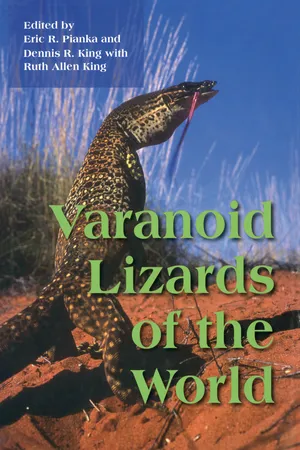
The large and impressive monitor lizard (genus Varanus) has attracted a great deal of interest. Despite being wary and difficult to observe, monitors have received an extraordinary amount of attention from devoted students. Varanoid Lizards of the World is a comprehensive account of virtually everything important that is known about monitor lizards, beginning with detailed species accounts and proceeding to various modern comparative analyses. Where possible, people who have had detailed field experience with a particular species have assembled the species accounts. In the process of reporting what is known, the book also identifies what remains to be learned about these lizards. This volume stands as a model for showing how such a diverse monophyletic group can be exploited both to identify and to understand the actual course of evolution.
- 593 pages
- English
- ePUB (mobile friendly)
- Available on iOS & Android
eBook - ePub
Varanoid Lizards of the World
About this book
Information
1. Introduction
In Latin, “monere” means “to warn.” The word “monitor” comes from the Latin noun “monitio,” which means someone who is a warner. According to ancient belief, these lizards were supposed to warn people that crocodiles were in an area. The generic name Varanus comes from the Arabic word “waran,” the Egyptian name for the Nile monitor Varanus niloticus, which basically means “monitor” in Arabic. Many large varanids commonly adopt a bipedal stance in which the lizard raises itself vertically and supports itself on its hind legs and tail. Because a lizard then has a clear and elevated view of its surroundings, this upright posture may have given rise to the name “monitor” (Fig. 1.1).
Monitor lizards (genus Varanus) have attracted a great deal of interest; these large and impressive lizards are often the centerpieces of reptile house exhibits. Around the world, dedicated varanophiles keep and breed these magnificent lizards in captivity. Monitors tend to be fairly wary and difficult to observe; therefore, they are not particularly tractable research subjects, but they have nevertheless received an extraordinary amount of attention from devoted students. Often, each scrap of information about these lizards requires perseverance and hard work or simply a substantial amount of luck. Varanus enthusiasts tend to cooperate freely and exchange data among themselves. This has been emphatically demonstrated again and again during production of this book, as we have received willing assistance from monitor enthusiasts worldwide. The founder of varanid systematics was Robert Mertens, most of whose work was published in German. He wrote in 1942, “Since I—about 30 years ago—got my first living Nile monitor and became acquainted with his life habits in a terrarium, the monitor lizards have fascinated me all the time, these ‘proudest, best-proportioned, mightiest and most intelligent’ lizards as Werner strikingly called them” (Mertens 1942, p. 4). Two varanid symposia have been held in Germany (Bohme and Horn 1991; Horn and Bohme 1999). Walter Auffenberg of the University of Florida spent many years in the field following monitor lizards, studying their ecology. This dedicated student of varanids published a monumental trilogy of extremely important books containing a vast amount of information about the ecology and behavior of three species: V. komodoensis, V. olivaceus, and V. bengalensis (Auffenberg 1981, 1988, 1994). Two other extremely useful compendia of varanid biology are the books by Bennett (1998) and King and Green (1999).

Figure 1.1. A Varanus gouldii surveys its surroundings (photo by Jeff Lemm).
Fifty-three species of Varanus are now currently recognized worldwide. All occur in Africa, Asia, Southeast Asia, and Australia (the New World is sadly impoverished, although fossil varanids and the sister group to monitors, Helodermatids, are known from North America). A rash of new species from remote Indonesian and Philippine Islands in Southeast Asia has recently been described (cerambonensis, caerulivirens, finschi, melinus, mabitang, macraei, and yuwonoi), several others have been recently elevated to species status (kordensis, spinulosus, and ornatus), and others doubtlessly remain to be described. Some “species” (gouldii, indicus, tristis, and scalaris) actually represent species complexes that will require revision and recognition of new species. The largest adaptive radiations have occurred in Australia, where they are commonly known as “goannas,” and where 24 endemic species have been named (several other new Australian species remain to be described). Several Asian species, including V. indicus and V. prasinus, have also reached northern Australia. One very interesting Australian clade, the subgenus Odatria, has evolved dwarfism.
“Goanna” is believed to be a corruption of the name “iguana,” which belongs to a family of lizards found mainly in North and South America, and the name is used to describe varanids of all sizes in Australia. Some Australians often also use the word incorrectly for large members of another family, the Scincidae.
Similarly, in South Africa in the old Dutch language Afrikaans, monitors are called “leguaan,” which is related to the German “Leguan” for iguana. Because Australia was also colonized by Dutchmen (“New Holland”), the origin of the South African and the Australian names for monitors may have the same origins.
On the basis of morphological evidence, Mertens (1942, 1958, 1963) recognized 10 subgenera, 5 of which survive today. Ziegler and Böhme (1997) examined hemipeneal structure and revised and extended Mertens’s classification, erecting a new subgenus Soterosaurus for V. salvator and its subspecies. Two subgenera, Odatria and Varanus, both of which are speciose, have undergone adaptive radiations in Australia. The nine currently recognized subgenera (Böhme 2003) and the species belonging in each are listed in Table 1.1.
Monitor lizards live in a wide variety of habitats, ranging from mangrove swamps to dense forests to savannas to arid deserts. Some species are aquatic, some semiaquatic, others terrestrial, whereas still others are saxicolous (rock dwelling), semiarboreal, or truly arboreal.
The varanid lizard body plan appears to have been exceedingly successful: it has been around since the late Cretaceous, 80 million years ago, as evidenced by the Mongolian fossil Estesia. Varanus are morphologically conservative but vary widely in size, which makes this genus ideal for comparative studies of the evolution of body size. No matter what size a monitor happens to be, it always looks like a monitor! These lizards range from the diminutive Australian pygmy monitor Varanus brevicauda (~17–20 cm in total length and 8–20 g in mass) to Indonesian Komodo dragons (Varanus komodoensis), which attain lengths of 3 m and weights of 150 kg. Komodo monitors, however, are themselves dwarfed by a closely related, extinct, gigantic varanid Varanus priscus (formerly Megalania prisca). This Australian Pleistocene species is estimated to have reached more than 6 m in total length and to have weighed over 600 kg. Varanus priscus fossils have been dated at 19,000 to 26,000 years BP.
Monitors may well be more closely related to snakes than to most other lizards. Many monitor lizards are active predatory species that raid vertebrate nests and eat large vertebrate prey (some smaller species also feed extensively on invertebrates, including centipedes, large insects, earthworms, crustaceans, and snails). Many monitor lizards are the top predators in the communities in which they live.
Varanids are by far the most intelligent of all lizards. At the National Zoo in Washington, D.C., individual Komodo monitors have their own personalities and recognize each keeper. These big lizards exhibit curiosity: one lizard walked up to its keeper and gently climbed up on him before taking a notebook from the keeper’s shirt pocket in its mouth! The Komodo then dropped down, put the notebook on the ground, and tongue flicked it, as if to ask, “Why is this of such interest?” Recent experiments on captive V. albigularis by John Phillips at the San Diego Zoo suggest that some varanids can actually count. Lizards were conditioned by feeding them groups of four snails in separate compartments with movable partitions, which were opened one at a time to allow monitors to eat each batch of four snails. Upon finishing the fourth snail, lizards were allowed into another chamber containing four more snails. After such conditioning, one snail was removed from some snail groups. Lizards searched extensively for the missing fourth snail, even when they had access to the next group. Similar experiments with varying numbers of snails showed that these varanids can count up to six, but with groups of snails larger than six, the monitors seemed to stop counting and merely classified them as “lots,” eating them all before moving on to the next chamber (King and Green, 1999, p. 43). Such an ability to count probably evolved as a consequence of raiding nests of reptiles, birds, and mammals, because average clutch or litter size would be around six.
TABLE 1.1.
Recognized subgenera of Varanus and species currently assigned to them.a
Recognized subgenera of Varanus and species currently assigned to them.a
Empagusia (4 species) | Papusaurus |
bengalensis (2 subspecies) | salvadorii |
dumerilii | |
flavescens | Philippinosaurus |
rudicollis | mabitang |
olivaceus | |
Euprepriosaurus (14 species) | |
caerulivirens | Polydaedalus |
cerambonensis | niloticus |
doreanus | ornatus |
finschi | albigularis (3 subspecies) |
indicus | exanthematicus |
jobiensis | yemenensis |
juxtindicus | |
keithhornei | Psammosaurus |
kordensis | griseus (3 subspecies) |
macraei | |
melinus | Soterosaurus |
prasinus (2 subspecies) | salvator (8 subspecies) |
spinulosus | |
yuwonoi | Varanus (8 species) |
giganteus | |
Odatria (17 species) | gouldii (2 subspecies) |
acanthurus (3 subspecies) | komodoensis |
baritji | mertensi |
brevicauda | panoptes (3 subspecies) |
caudolineatus | rosenbergi |
eremius | spenceri |
gilleni | varius |
glauerti | |
glebopalma | |
kingorum | |
mitchelli | |
pilbarensis | |
primordius | |
scalaris (2 subspecies) | |
semiremex | |
storri (2 subspecies) | |
timorensis | |
tristis (2 subspecies) |
a From Ziegler and Böhme (1997) and Böhme (2003).
Teeth of most varanids are serrated along the rear edge, which facilitates cutting and tearing the skin and flesh of prey as these big lizards pull back on their bite. Varanus komodoensis routinely kill deer and pigs in this way, and one Komodo monitor actually eviscerated a water buffalo (Auffenberg 1981). Varanus komodoensis and the extinct V. priscus are ecological equivalents of large saber-toothed cats, using their slashing bite to disembowel large mammals. V. priscus, which was contemporary with aboriginal humans, probably ate Homo, although strangely, Australian aborigines seem not to have any dream-time stories about gigantic, fierce, man-eating lizards.
Scientists have recently discovered useful pharmacological agents in varanoid lizards. Venoms of Heloderma are complex mixtures of over a dozen small peptides, neurotransmitters, proteins, and other molecules, which have powerful effects on mammalian physiology (Raufman 1996). Natural selection has invented molecular analogs that mimic important mammalian hormones such as the neurotransmitter serotonin, secretin, and a variety of peptides and proteins. One lowers blood pressure, another regulates insulin release, and still another attacks certain cancers. Yet another, a peptide called gilatide, improves memory in rats and is a candidate for development of a drug to treat Alzheimer’s disease. Such molecules could prove to be useful drugs to control hypertension, diabetes, and cancer. One such drug. Exendin-4, derived from Gila monster venom, is currently being evaluated for treatment of type 2 diabetes (Edwards et al. 2001; Seppa 2001). Some, but not all, of these molecules are also found in snake venoms, which tend to be much more toxic.
Although Komodo dragons are not actually considered to be venomous, they virtually are. Their saliva harbors over 50 different strains of bacteria, some of which are highly septic. If a K...
Table of contents
- Cover
- Title Page
- Copyright
- Dedication
- Contents
- List of Contributors
- Acknowledgments
- Part I
- Part II: Introduction to Part II: Species Accounts
- Part III
- Glossary
- Index
- Authors
Trusted by 375,005 students
Access to over 1.5 million titles for a fair monthly price.
Study more efficiently using our study tools.
Frequently asked questions
Yes, you can cancel anytime from the Subscription tab in your account settings on the Perlego website. Your subscription will stay active until the end of your current billing period. Learn how to cancel your subscription
No, books cannot be downloaded as external files, such as PDFs, for use outside of Perlego. However, you can download books within the Perlego app for offline reading on mobile or tablet. Learn how to download books offline
Perlego offers two plans: Essential and Complete
- Essential is ideal for learners and professionals who enjoy exploring a wide range of subjects. Access the Essential Library with 800,000+ trusted titles and best-sellers across business, personal growth, and the humanities. Includes unlimited reading time and Standard Read Aloud voice.
- Complete: Perfect for advanced learners and researchers needing full, unrestricted access. Unlock 1.5M+ books across hundreds of subjects, including academic and specialized titles. The Complete Plan also includes advanced features like Premium Read Aloud and Research Assistant.
We are an online textbook subscription service, where you can get access to an entire online library for less than the price of a single book per month. With over 1.5 million books across 990+ topics, we’ve got you covered! Learn about our mission
Look out for the read-aloud symbol on your next book to see if you can listen to it. The read-aloud tool reads text aloud for you, highlighting the text as it is being read. You can pause it, speed it up and slow it down. Learn more about Read Aloud
Yes! You can use the Perlego app on both iOS and Android devices to read anytime, anywhere — even offline. Perfect for commutes or when you’re on the go.
Please note we cannot support devices running on iOS 13 and Android 7 or earlier. Learn more about using the app
Please note we cannot support devices running on iOS 13 and Android 7 or earlier. Learn more about using the app
Yes, you can access Varanoid Lizards of the World by Erick Pianka, Dennis King, Erick Pianka,Dennis King in PDF and/or ePUB format, as well as other popular books in Biological Sciences & Zoology. We have over 1.5 million books available in our catalogue for you to explore.