In most places on the African continent, multiple health care options exist and patients draw on a therapeutic continuum that ranges from traditional medicine and religious healing to the latest in biomedical technology. The ethnographically based essays in this volume highlight African ways of perceiving sickness, making sense of and treating suffering, and thinking about health care to reveal the range and practice of everyday medicine in Africa through historical, political, and economic contexts.
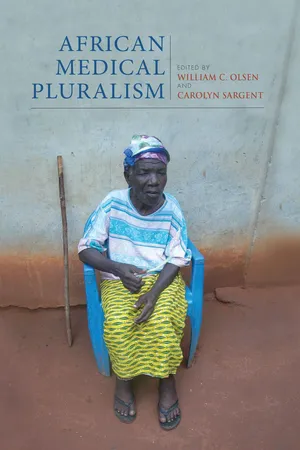
eBook - ePub
African Medical Pluralism
- 280 pages
- English
- ePUB (mobile friendly)
- Available on iOS & Android
eBook - ePub
African Medical Pluralism
About this book
Trusted by 375,005 students
Access to over 1.5 million titles for a fair monthly price.
Study more efficiently using our study tools.
Information
1The Value of Secrets
Pragmatic Healers and Proprietary Knowledge
OVER THE PAST TWO DECADES, tense debates about traditional medicine, herbal resources, and African science have circled around secrets again and again. Scientists argue that healer’s secrets are an obstacle to meaningful collaboration. Bureaucrats assert that healer’s secrets prevent the development of national resources. Healers claim simultaneously that they have no secrets and that it is their right to defend their secrets. Each statement positions the speaker in a complex landscape of science, law, and capital. This essay contemplates the value of secrets. It does not consider particular healing secrets but rather how secrecy is emerging as both a problem and a right.
In the process I unpack what a secret is in this field, when leveled as an accusation and when implemented as a strategy. While the uneven movement of healing knowledge in Africa has long been linked to the production of gender, age, and labor hierarchies, the problem of healers’ secrets as it is constituted today emerged as healing became entangled with property regimes, both those that shape the institutional labor of scientists and those that structure the legal maneuvers to protect traditional knowledge.
The scientific investigation of traditional medicine in many African countries was institutionalized in the 1970s as newly independent governments struggled to find the hard currency needed to purchase pharmaceuticals critical to any national healthcare system. These efforts dovetailed with regionalist, Pan-Africanist dreams to support an indigenous pharmaceutical industry in Africa. At times, they also became entangled with international efforts promoted by the World Health Organization to mobilize traditional healers as a solution to the shortage of workers in the healthcare sector of developing countries. At other times, the scientific development of traditional medicine has been promoted as a first step in the manufacturing of African pharmaceuticals and has had a force of its own. Therapeutic plants, it seemed, offered more political and economic possibilities if they could be separated from the relations critical to healers and their healing knowledge. From its emergence as a postcolonial category of knowledge and practice, then, traditional medicine has been a reaction to international private property regimes—with attempts both to circumvent those regimes and to participate in them.
The global “harmonization” of intellectual property laws, more recently, has raised the stakes of disclosing healing knowledge. This research was collected during the initial grace period for compliance with the World Trade Organization’s agreement Trade-Related Aspects of Intellectual Property Rights (TRIPS) for Least Developed Countries (LDCs). All sub-Saharan African nations were feeling particular pressure to make progress toward the incorporation of the WTO’s minimum standards for intellectual property into their national laws. Under the current extension of the grace period for LDCs, debates about the value of healers’ secrets continue, as do debates about the globalization of intellectual property and how it will affect therapeutic regimes and cultures in Africa.
Therapeutic knowledge in East Africa has long unfolded among healers called to serve ancestors, spirits, devils, gods, and other nonhuman actors (Feierman, Langwick 2011a, Livingston 2005, Luedke and West 2006). The sensitivities and capacities of healers are forged in efforts to manage their own afflictions and to seek a context in which they might heal (Feierman 1974; Janzen 1982, 1992). These efforts involve learning to act in relation to plants, ancestors, and spirits; that is, coming to know their potency, needs, desires, frustrations, and quirks (Giles 1999, Langwick 2007, Stoller 1995). The passing on of therapeutic knowledge through generations is, in essence, the extension of these relationships (Geissler and Prince 2009). Before human and nonhuman guides entrust initiates with new therapeutic knowledge, they gauge whether these healers-to-be have not only the intellectual capacity to know how, but also the moral fortitude and equipoise to discern when it is wise, to use knowledge that has the power to kill as well as to heal. When responsibilities to nonhuman worlds cause friction during initiatives to “develop” traditional medicine, they are often glossed as healers’ secrets. As a result, healers who are interested in exploring collaborations with scientists are finding themselves in the slightly awkward position of asserting their right to “keep secrets.” Such defenses of secrets remember precolonial forms of life and arenas of collective action in ways that interrupt contemporary relations between therapeutic knowledge, political authority, and property regimes.
Attributions or accusations of secrecy gloss deep dissonances. They obscure the extension of healing knowledge through carefully cultivated (and at times unpredictable) relationships with ancestors, spirits, gods, and other nonhuman actors. And they index failures in translation. Part of what has consistently muddled collaborations between African healers and both scientists and legal advocates who are interested in their therapeutic knowledge is that African medicine is an extension of relationship, not an object of property (Langwick 2011b). It is a set of obligations, not a right. Furthermore, African therapeutics generate innovation through engagement, not single authorship. Such epistemic practices and the ontological realities that inhere in them do not (always) sit easily with those of modern science or law.
The first part of this essay considers the productive frictions involved in framing the limitations and boundaries of relationship as “healers’ secrets.” I attend to the ways that healers’ own efforts to defend their secrets have come to challenge the political work that traditional medicine is being asked to do in national and international development initiatives, which cast it as a raw material—a resource for medical science, economic growth, and health development. These defenses point to the deeper transformation required. The second part of the essay examines the experimentation in organizational forms and social relations around contemporary traditional medicine. I focus most closely on one relatively unique project to develop a school for traditional healers, which highlights many of the demands this historical moment is making on healing.
In Defense of Secrets
In 2003, a group of regional scholars and bureaucrats formed the East African Network on Medicinal Plants and Traditional Medicine (International Development Research Centre [IDRC] 2003). Putatively, this forum provides the opportunity for research agendas, priorities, and methods, as well as legal frameworks, to be developed, debated, shared, and coordinated on national, regional, and global levels. The network held the first regional Workshop on the Sustainable, Safe, and Effective Use of Medicinal Plants in Eastern Africa the first year of its founding. The organizers of the workshop engaged healers as a group of stakeholders. In the representational politics of this regional gathering, healers embodied one set of interests in evidence-based traditional medicine. Healers’ claims stood as equivalent to the claims of researchers, policy makers, private entrepreneurs, and journalists. Rather than treating healers as mediums through which ancestral shades, Islamic and Christian spirits, and various mischievous nonhuman agents work to shape afflictions and their cures—rather than treating them as embodiments of the complex relations through which expertise and efficacy are constituted—the structure of the workshop strove to reduce healers to people with “stakes” in medicinal plants. The excess created by their designation as “stakeholders” simmered, leaked, and at times exploded into proceedings. In particular, through conversations about secrets, healers at the workshop illuminated the connections between these bureaucratic moves to position them as stakeholders in efforts “enterprising-up”1 traditional medicine and current political investments in what knowledge and knowing are.
A tension ran through the 2003 stakeholders workshop between members who wanted to open the discussion to issues of secrecy and those who moved to close them down via appeals to intellectual property rights. At times some participants would explicitly identify the secrets or opacities that inhere in the ways that intellectual property is used. But even more significant, I would argue, were the moments in which secrets bubbled up, refusing to be captured under the rubric of intellectual property. These moments provide a glimpse of the limits—the contingent boundaries—of the representational politics being built up through traditional medicine and a glimpse of the exclusions—the realms of unrepresentability—that will be a fundamental challenge to the maintenance of this representational politics. Below, I quote one segment of the meeting transcript at some length as it captures one of these moments.2
Mr. Kariuki (HERBALM, Kenya) asked why there is so much secrecy. He added that there are institutions that are willing to come forward such as Kenya Association of Manufacturers to assist in commercialization of herbal products. . . . In Africa, we are shelving our indigenous knowledge while allowing the outside world to come and take this knowledge and our medicinal plants. To alleviate poverty, we should market our medicinal plants and promote their propagation across the region, and we also need to identify those who can commercialize them.
Dr. Orwa responded that there is secrecy in commercialization. So far on IPR [intellectual property rights] issues we still do not know how to go about it. However, with formulation patenting can be done. For scientific papers botanical names are given. Dr. Orwa believes that several people who have come up with different processes can patent one medicinal plant. There is a lot of plant material of interest. The setback is that people work in isolation; hence there is lack of coordination and linkages.
Dr. Sekagya pointed out that secrecy is important in traditional knowledge and that secrecy is environmentally friendly. If knowledge is exposed, there is danger of overexploitation.
Dr. Malecela-Lazaro [National Institute for Medical Research, Tanzania] emphasized that secrecy creates monopoly, which is a vital criteria [sic] for commercialization. For example, some plants that were brought in by missionaries and are growing in our countries are exported to Europe. But since there are no intellectual property rights in place, we have no hand in these issues.
Dr. Sekagya commented that he has no problem with secrecy. He continued by saying that he started his work with 15 plants but has now more than 50 plants. The problem is how the plants are used.
Prof. Mahunnah re-stressed that Intellectual Property Rights is [sic] not a country level issue; rather it is a subject of international interest, controlled most by the industrialized world. Hence, there is a need as a region to have a common regional position where IPR issues can be presented to the global arena. Developing countries have been asked to develop a sui generis system to handle IPR issues under the TRIPS [Trade-Related Aspects of Intellectual Property Rights] Agreement, but not many countries have implemented this. In addition, these agreements are often being revised and have deadlines to the detriment of the developing world. Some African countries have signed and ratified these protocols, and hence are party to the decision made by the parties to these agreements [emphasis added].
While some condemned the secrecy of healers, others acknowledged that research into the medicinal qualities of plant, animal, and mineral products brings with it new restrictions on information, which are built into organizational structures, forms of expertise, collaborative agreements, patents, and other forms of protection. “[T]here is secrecy in commercialization.” “Secrecy is important to traditional knowledge.” When read as intellectual property, secrecy “is a subject of international interest, controlled most by the industrialized world.” The tension is over who will disclose what, to whom, and with what consequences. As Hayden (2003) has shown in her examination of bioprospecting projects in Mexico, secrecy is not the sole purview of traditional healers. Nor is ‘openness’ the unqualified stance of the market. Rather the channels through which information flows—who is able to know what—constitute relationships, spaces, and even scales of activity (e.g., local, national, regional, global).3
Advocating for the limited exposure of particular knowledge, Dr. Sekagya’s comments raise these questions about the self-evident understandings of secrecy and transparency. The secrecy for which he argues is important to the existence and to the distribution of traditional knowledge. This is a secrecy that facilitated the growth of his personal repertoire of plants (from 15 to 50). Clearly, secrecy here does not mean a lack of information or a total refusal to transmit knowledge. Secrecy marks the movements of specialized knowledge and the making of particular forms of expertise.
Through the language of the secret, Dr. Sekagya draws into this debate the workings of an emergent or relational knowledge (see also Langwick 2011a, 2011b; Geissler and Prince 2009). His secrets enact and acknowledge relationships; they are about the specificity of inclusions, not the boundaries of exclusions. He strives to hold open the possibility that knowledge is not trapped in plants, minds, or communities, but, rather, healing knowledge lives in the dynamic relations between them. In so doing, he challenges the forms of knowledge constituted through current articulations of intellectual property law, with its insistence on disclosure and enablement in exchange for an exclusive right for limited time.
In calling for “a mechanism to safeguard and reinforce secrecy,” Dr. Sekagya seeks a way to resist the forms of representation and appropriation embedded in efforts to treat and protect medicinal knowledge as property. Dr. Orwa also refers to the generative power of information sharing when he states “The setback is that people work in isolation; hence there is lack of coordination and linkages.” Yet who works in isolation? Not healers who actively embody their relationships with ancestral shades, a range of otherworldly entities (some with religious affiliations and some without), patients, words, books, plants, and a host of other things too numerous to name. Not scientists with their institutional affiliations, funding relationships, collegial interactions, technology, equipment, theories, and a host of other things too numerous to name. The call for “coordination and linkages” is a call to reconfigure the relationships among the human and nonhuman entities critical to the development of a particular form of traditional medicine. The question, therefore, is not whether there are “coordination and linkages,” but, rather, who thinks that they should be changed and how? When Professor Muhannah insists that the group develops their strategy in the context of international property regimes, he quiets the discussion for a moment. But he does not resolve the issue. Similar defenses of secrets unexpectedly interrupted discussions throughout the regional meeting.
Contemporary struggles for control over therapeutic plants and healing knowledge in Africa are generating new forms of organization and community that embody what Schoenbrun (2006) has called a “heterotemporal modern Africa beyond the hybri...
Table of contents
- Cover
- Half title
- Title
- Copyright
- Dedication
- Contents
- Introduction
- Biomedicine and African Healing
- Symptoms and Therapeutic Pluralities
- Hospital Ethnography
- Afterword
- Contributors
- Index
Frequently asked questions
Yes, you can cancel anytime from the Subscription tab in your account settings on the Perlego website. Your subscription will stay active until the end of your current billing period. Learn how to cancel your subscription
No, books cannot be downloaded as external files, such as PDFs, for use outside of Perlego. However, you can download books within the Perlego app for offline reading on mobile or tablet. Learn how to download books offline
Perlego offers two plans: Essential and Complete
- Essential is ideal for learners and professionals who enjoy exploring a wide range of subjects. Access the Essential Library with 800,000+ trusted titles and best-sellers across business, personal growth, and the humanities. Includes unlimited reading time and Standard Read Aloud voice.
- Complete: Perfect for advanced learners and researchers needing full, unrestricted access. Unlock 1.5M+ books across hundreds of subjects, including academic and specialized titles. The Complete Plan also includes advanced features like Premium Read Aloud and Research Assistant.
We are an online textbook subscription service, where you can get access to an entire online library for less than the price of a single book per month. With over 1.5 million books across 990+ topics, we’ve got you covered! Learn about our mission
Look out for the read-aloud symbol on your next book to see if you can listen to it. The read-aloud tool reads text aloud for you, highlighting the text as it is being read. You can pause it, speed it up and slow it down. Learn more about Read Aloud
Yes! You can use the Perlego app on both iOS and Android devices to read anytime, anywhere — even offline. Perfect for commutes or when you’re on the go.
Please note we cannot support devices running on iOS 13 and Android 7 or earlier. Learn more about using the app
Please note we cannot support devices running on iOS 13 and Android 7 or earlier. Learn more about using the app
Yes, you can access African Medical Pluralism by William C. Olsen, Carolyn Sargent, William C. Olsen,Carolyn Sargent in PDF and/or ePUB format, as well as other popular books in History & African History. We have over 1.5 million books available in our catalogue for you to explore.