"Playful and (un)deadly serious . . . chew[s] through a near-exhaustive array of films, television, literature, culture, music and even cocktails."—
Times Literary Supplement
They have stalked the horizons of our culture, wreaked havoc on moribund concepts of dead and not dead, threatened our sense of identity, and endangered our personal safety. Now zombies have emerged from the lurking shadows of society's fringes to wander the sacred halls of the academy, feasting on tender minds and hurling rot across our intellectual landscape. It is time to unite in common cause, to shore up defenses, firm up critical and analytical resources, and fortify crumbling lines of inquiry. Responding to this call, Brain Workers from the Zombie Research Center poke and prod the rotting corpus of zombie culture trying to make sense of cult classics and the unstoppable growth of new and even more disturbing work. They exhume "zombie theory" and decaying historical documents from America, Europe, and the Caribbean in order to unearth the zombie world and arm readers with the brain tools necessary for everyday survival. Readers will see that zombie culture today "lives" in shapes as mutable as a zombie horde—and is often just as violent.
"An intelligent and highly engaging collection that will appeal to legions of zombie fans, to students in the humanities, and to scholars working in fields that have already been affected by or are now preparing for the zombie apocalypse. It blends entertaining, illuminating, and accessible readings of zombies and zombie culture with unique interventions made from authoritative positions of expertise."—Julian Murphet, author of
Faulkner's Media Romance
eBook - ePub
The Year's Work at the Zombie Research Center
- 544 pages
- English
- ePUB (mobile friendly)
- Available on iOS & Android
eBook - ePub
The Year's Work at the Zombie Research Center
About this book
Information
Topic
Scienze socialiSubtopic
Cultura popolare nell'arte1Zombie Psychology
STEPHEN WATT
I wasn’t a sex symbol, I was a sex zombie.
Veronica Lake
Two scenes in Ruben Fleisher’s Zombieland (2009) emblematize key psychical and affective dimensions of much zombie culture, dimensions that are often subordinated in critical discussions to such terms as terror or horror or neglected altogether. At first glance the earlier of these scenes seems almost silly—so much fodder for gifted actors to exploit—and irrelevant both to the film’s narrative and to the larger psychical and affective issues inherent to such recent films as 28 Days Later (2002), Shaun of the Dead (2004), Pontypool (2009), and others. After Tallahassee (Woody Harrelson), zombie exterminator extraordinaire and one of the film’s two protagonists, makes his brash entrance and confronts Columbus (Jesse Eisenberg) on a highway littered with wrecked vehicles, debris, and even the broken fuselage of a downed jet, the pair join forces and make their way down a more rural, uncluttered road. Shortly thereafter, as Columbus recounts in his voice-over narration, Tallahassee reveals his one “weakness” when they stop at a breach in a twisted metal barrier on the roadside, gazing down into a grassy ravine where a Hostess Bakeries truck has veered off the road. Tallahassee announces that he could “use a Twinkie” and begins his descent to the truck, prompting Columbus to recommend a regimen of light calisthenics and stretching as dictated by his self-imposed Rule #18: “Limber up.” Tallahassee rejects the suggestion, reminding his companion that lions don’t “limber up” before taking down a gazelle. When they arrive at the truck, Fleisher trains close-ups on the Hostess name and strands of red hearts that comprise the company’s logo on the side and back of the trailer, which Tallahassee opens excitedly, expecting to find a Twinkie. Instead, a cascade of Hostess Sno Balls falls at his feet. Feverishly searching for a Twinkie, he is both enraged and repulsed by the Sno Balls, shouting, casting them irreverently aside, and stomping them into pulp. By contrast, Columbus opens a package and enjoys eating one, promoting the freshness of its distinctive coconut flavor, which, in turn, motivates Tallahassee’s retort: “I hate coconut—it’s not the taste, it’s the consistency.” The scene ends with Tallahassee vowing to continue his quest for a Twinkie, which he does later when the duo enters Blaine’s Supermarket, and where, after the requisite dispatching of zombies, they meet and are conned by Wichita (Emma Stone) and her sister Little Rock (Abigail Breslin).
The second of these scenes occurs in a flashback in Zombieland when Columbus recalls his “insanely hot” neighbor (Amber Heard), known only as 406 after her apartment number, banging frantically on his door. At home alone for the third consecutive Friday night, drinking Mountain Dew Code Red and playing video games, Columbus is amazed that this beautiful young woman has entered his apartment and actually thrown her arms around him. As his narration explains, all he ever wanted was to find a girl to take home to his emotionally distant parents and, with her, form a “cool, functional family.” On this Friday night (which takes place before a mutant strain of mad cow disease in a mere two months has reduced America to a wasteland), his neighbor is terrified and seeks comfort from a harrowing assault by what she believed to be a homeless and “sick” man who attempted to bite her. Exhausted by the encounter, she lowers her head on Columbus’s shoulder to close her eyes for a moment, prompting him to gush that he is now “living the dream”—that is, he may actually be able to fulfill his fantasy of gently brushing a girl’s long hair behind her ear. After a brief temporal ellipsis, however, his fantasizing is shattered by the girl’s horrific transformation, a process marked almost immediately by her vomiting of a bilious liquid. Now one of the undead, she lunges at him and he recoils; he apologizes for hurting her while defending himself, and soon she is splayed on top of him in the bathroom. Columbus attempts to ward her off, directs a spray can at her face, and then wraps her in a nearly transparent shower curtain, upon which the outline of her mouth is impressed and through which blood and other assorted gunk explode. The attack ends with his smashing her head with the porcelain top of his toilet’s water reservoir, not once but twice, a repetition that serves as the origin of one of his most insistent rules: whether wielding a shotgun, baseball bat, or piece of a toilet, always administer a “double tap,” particularly to a zombie’s head. Otherwise, you might just become a human Happy Meal.
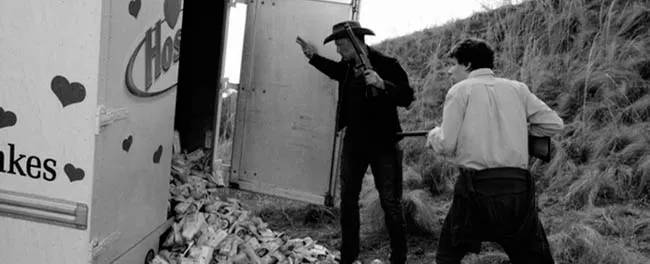
1.1. Sno Balls in Hell, Zombieland (2006).
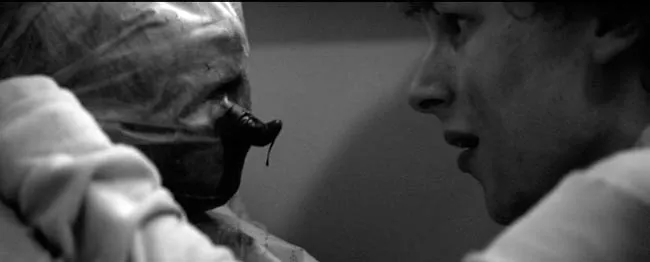
1.2. “Living the Dream,” Zombieland (2006).
Albeit quite different, these two scenes not only further motifs that inform Zombieland but also gesture to the psychoanalytic and affective dimensions of many contemporary films featuring the undead. The latter scene with 406, for example, advances two motifs established almost from the film’s first frames: bloody mouths and relentless orality on the one hand, toilets and human offal on the other. The former motif is hardly surprising, as zombie films frequently train close-ups on bloody mouths oozing partially masticated flesh; in this regard, the contemporary undead, unlike their predecessors in such films as Victor Halperin’s White Zombie (1932) and Jacques Tourneur’s I Walked with a Zombie (1943), are figures of manducation, things that bite and cannibalize with indiscriminate abandon. So when Fred Botting characterizes zombies as “not machine, not animal, not inert matter” but as “residually human at the level of appearance and thoroughly in-human,” he gestures toward a fundamental question about exactly how such creatures might be understood (187). Cinematic privileging of the mouth in representations of the undead, a privilege achieved in Zombieland by numerous close-ups of zombies ripping through flesh, belching, or regurgitating blood, recalls Georges Bataille’s meditation on the beginnings of the human body and his juxtaposition of humans and animals. Discussing this relationship, Roland Barthes invokes Bataille’s notion that the mouth is “the beginning or, if one prefers, the prow of animals,” a commencement that man—by sharp contrast—lacks (“Outcomes” 241). If animals begin with their mouths, then the undead might be regarded as closer to animals than humans. Zombieland at times reinforces this analogy, with the undead in one segment feeding on roadkill (humans) until Tallahassee speeds onto the scene, blasts the predator with a strategically opened car door, and brings the grisly meal to an abrupt halt.
But the matter of zombie identity is usually more nuanced, more psychically resonant, than this equation expresses, as the undead are seldom mistaken for or identified with animal predators, so many lions stalking gazelle. And when they are—a reporter in Pontypool, unsure of exactly what he is witnessing, describes a gathering mob of the undead as a “herd,” another compares them to dogs or a school of piranha—this analogy is soon proven to be inadequate. Equally important, their human antagonists seldom regard them as animals, whose treatment is typically delimited by a kind of moral foundation or ethical obligation predicated, at least in part, on our “sense of the mortality and vulnerability” that we share with nonhuman others (Wolfe, Philosophy and Animal Life 11).1 What transpires in Columbus’s apartment exceeds any such ethics, as we watch the transformation of an object of desire into one of both fear and revulsion—a Twinkie surrounded by hearts turned into a malevolent Sno Ball, as it were—a process intimated in an early montage in Zombieland when a topless zombie stripper, dollar bills adorning her G-string, pursues her customers into the parking lot of a club, vomiting dark blood as she runs. That is to say, the attack in Columbus’s apartment might be contextualized with a meaningful comparison in Freudian psychoanalysis—namely, the analogy between sexual need and biological hunger, both of which exert psychical pressure to be satisfied. Indeed, Freud’s Three Essays on the Theory of Sexuality (1905), described by Peter Gay as one of the two “pillars” of psychoanalysis, begins with this very analogy (Freud Reader 239):
The fact of the existence of sexual needs in human beings and animals is expressed in biology by the assumption of a “sexual instinct,” on the analogy of the instinct of nutrition, that is, of hunger. Everyday language possesses no counterpart to the word “hunger,” but science makes use of the word “libido” for that purpose. (240)2
This comparison, however, barely scratches the surface of the attack in Columbus’s apartment, for 406’s rapacity and persistence surpass any notions of mere hunger (as does Tallahassee’s pursuit of Twinkies, a point to which I shall return). How are we to understand this paradigm in Zombieland: the relationship between the desire of the protagonists, in Columbus’s case an unexceptional longing for a girlfriend, and the representation of the undead, including their unrelenting demand for human flesh?
Further complicating the issues of both the nature of the undead and our responses to their slaughter, as Maria Warner describes in Phantasmagoria: Spirit Visions, Metaphors, and Media into the Twenty-First Century, the zombie “has been robbed of all the qualities that make up personhood—feelings, sentience, reflexivity, memory—but survives under a sentence of immortality (like a vampire)” (359). Well, not exactly—zombies are hardly immortal. Still, unlike the moral response Cary Wolfe outlines in which humans recognize the vulnerability and mortality they share with animals, this excavation of personhood produces in zombies an ontological difference we cannot share. Is this what enables us not only to countenance but also to enjoy the slaughter of zombies in films like Zombieland? The question itself marks a recent development in representations of the undead, for both history and earlier cinema are replete with instances of a subject peoples’ domination by a superior power and a diminution of personhood that can hardly be celebrated. In the postcolonial Haiti of White Zombie, for instance, zombies labor in their master’s sugarcane plantation, “plodding like brutes, like automatons.”3 When one worker stumbles into the blades of a machine processing cane, no one notices or seems to care; production continues in all of its inexorability, implying that the zombie workers are of less value than animals and certainly as mortal. Equally important, while we deplore the brutal domination of such workers, the film does not create sufficient emotional engagement for us to be moved by their passing. These nameless workers, much like the Muselmänner Giorgio Agamben describes in Remnants of Auschwitz (1999), function as “mummy men” or the “living dead,” expressionless beings regarded by most guards and fellow prisoners with profound indifference, and about whom Primo Levi in Survival in Auschwitz (1986) observed, “One hesitates to call them living: one hesitates to call their death death.”4 Here, Fred Botting’s observation again seems relevant: the undead are “residually human” yet, at the same time, decidedly “in-human.”
Through a series of visual and narrative motifs, Zombieland addresses the questions implicit in the example above from White Zombie and the intellectual framing provided by Bataille, Botting, Warner, and others: What are the undead, and how should we respond to them? Are they innocent victims, animals, or machines, or something much less (or more)? More specifically, the shocking transformation of an object of desire—or of sensual, if not sexual, fantasy—into a zombie in Columbus’s apartment bears more scrutiny, as do Columbus’s initial apologies for fracturing 406’s ankle with his bedroom door as she attacks him. In this flashback his beautiful neighbor becomes a figure of the uncanniness of all zombies: embodiments of the familiar rendered profoundly unfamiliar, terrifying, and even repulsive. His eventual killing of her with part of a toilet, as I shall explain, furthers a larger motif in Zombieland associating the undead with excrement, the “not me” that is routinely flushed away from our lives. Similarly, through its burlesque of desire and repulsion, its degradation of objects symbolized by hearts into figures of abjection, Tallahassee’s response to Sno Balls gestures toward the same feeling as desire is transformed into its opposite: disgust. In such scenes, questions of affect, emotional intensity, and viscerality are foregrounded, joining the elements ably summarized by Kyle Bishop in his explanation of the increased prominence of zombie films since September 11, 2001. For Bishop, the “protocols” of this genre include the “imminent threat of violent death,” a “postapocalyptic backdrop,” the “collapse of societal infrastructures,” the “indulgence of survivalist fantasies, and the fear of other surviving humans” (“Dead Man” 20). To these narrative conventions, I want to add three additional psychological and affective dimensions of many zombie films—drive, desire, and disgust—all theorized within what has now become a conspicuous turn in contemporary culture to the Freudian uncanny.
For however cogent postcolonial or late capitalist explanations of the current zombie phenomenon might be,5 zombie films traffic in both psychical complexity and what might be called, after Sianne Ngai’s influential book, “ugly feelings” that demand further investigation. One such feeling in Zombieland, a high-intensity one not cataloged by Ngai, is potentially as complex as the nature of the undead—namely, the obvious pleasure Tallahassee takes in killing the undead, at times in extravagantly violent ways. And, as I have posed earlier, why is it similarly pleasurable, even funny, to watch this spectacle? In asking this question and asserting the immediacy of affective readings of zombie culture, I do not mean to suggest that psychoanalytic valences never inform more self-consciously politicized zombie texts or political readings of them; nor do I mean to refute Melissa Gregg’s assertion that “passion, emotion and affect” constitute “the new frontier for politics” (105).6 In his unpacking of the allegorical dimensions of George A. Romero’s Land of the Dead (2005), for example, Adam Lowenstein makes a powerful case for the modern horror film’s allegorical tethering to “specific national contexts” and “historical trauma,” in this instance the war in Iraq. Freud’s concept of Nachträglichkeit, or deferred action, helps Lowenstein decode Romero’s re-transcription of the traumatic memory of a war fought by a working class (zombies) on behalf of powerful industrialists represented in the film by Kaufman (Dennis Hopper). So when the leader of the zombies, the former gas station operator known only as Big Daddy, entraps Kaufman in his limousine and shatters its windshield with the nozzle of a gas pump, Lowenstein detects traces of the antiwar slogan “No blood for oil” and an allusion to the precipitous rise in gasoline prices caused by the Iraq War, a rise felt most keenly by the very families whose sons and daughters were fighting the war. More important for my purposes, through his depiction of Big Daddy as a problem solver and strategic leader, Romero, in Lowenstein’s view, achieves the rare feat of manipulating his audience to empathize with a zombie (114). In this way Big Daddy can be seen to reside at the opposite end of an affective spectrum from the one occupied by the undead in Zombieland, who demonstrate no strategic intelligence and evince no resistant politics—or any politics, for that matter—and, more important, fail to elicit even a scintilla of empathy from the spectator.
This chapter concerns such issues, the psychoanalytic and affective dimensions of representations of the undead. For, like vampires, zombies have never been, first and foremost, mere figures of political or economic allegory. Their appeal, such as it is, is much more visceral and psychical, even sexual, as I attempt to outline here.
Uncanny Vampires, Uncanny Zombies: Desire and Drive
“It is only rarely that a psycho-analyst feels impelled to investigate the subject of aesthetics, even when aesthetics is understood to mean not merely the theory of beauty but the theory of the qualities of feeling. He works in other strata of mental life and has little to do with the subdued emotional impulses.” Thus Freud begins his 1919 essay “The ‘Uncanny,’” and within the space of his opening paragraphs he identifies the motives of his argument: first, to “distinguish as ‘uncanny’ certain things within the boundaries of what is ‘fearful’,” and, second, to counter those discourses in aesthetics that “in general prefer to concern themselves with what is beautiful, attractive and sublime—that is, with feelings of a positive nature—and with the circumstances and objects that call them forth, rather than with the opposite feeli...
Table of contents
- Cover
- Half title
- Title
- Copyright
- Dedication
- Contents
- * Acknowledgments
- * Introduction: The Zombie Research Center FAQ
- 1 Zombie Psychology
- 2 Zombie Demographics
- 3 Zombie Spaces
- 4 Zombie Media
- 5 Zombie Health Care
- 6 Zombie Physiology
- 7 Zombie Performance
- 8 Zombie Race
- 9 Zombie Politics
- 10 Zombie Postfeminism
- 11 Zombie Linguistics
- 12 Zombie Arts and Letters
- 13 Zombie Philosophy
- 14 Zombie Cocktails
- * Afterword: Zombie Archive
- * Works Cited
- * List of Contributors
- * Index
Trusted by 375,005 students
Access to over 1.5 million titles for a fair monthly price.
Study more efficiently using our study tools.
Frequently asked questions
Yes, you can cancel anytime from the Subscription tab in your account settings on the Perlego website. Your subscription will stay active until the end of your current billing period. Learn how to cancel your subscription
No, books cannot be downloaded as external files, such as PDFs, for use outside of Perlego. However, you can download books within the Perlego app for offline reading on mobile or tablet. Learn how to download books offline
Perlego offers two plans: Essential and Complete
- Essential is ideal for learners and professionals who enjoy exploring a wide range of subjects. Access the Essential Library with 800,000+ trusted titles and best-sellers across business, personal growth, and the humanities. Includes unlimited reading time and Standard Read Aloud voice.
- Complete: Perfect for advanced learners and researchers needing full, unrestricted access. Unlock 1.5M+ books across hundreds of subjects, including academic and specialized titles. The Complete Plan also includes advanced features like Premium Read Aloud and Research Assistant.
We are an online textbook subscription service, where you can get access to an entire online library for less than the price of a single book per month. With over 1.5 million books across 990+ topics, we’ve got you covered! Learn about our mission
Look out for the read-aloud symbol on your next book to see if you can listen to it. The read-aloud tool reads text aloud for you, highlighting the text as it is being read. You can pause it, speed it up and slow it down. Learn more about Read Aloud
Yes! You can use the Perlego app on both iOS and Android devices to read anytime, anywhere — even offline. Perfect for commutes or when you’re on the go.
Please note we cannot support devices running on iOS 13 and Android 7 or earlier. Learn more about using the app
Please note we cannot support devices running on iOS 13 and Android 7 or earlier. Learn more about using the app
Yes, you can access The Year's Work at the Zombie Research Center by Stephen Watt,Dan Hassler-Forest,Erik Bohman,Stephen Shapiro,Jack Raglin,Atia Sattar,Seth Morton,Andrea Ruthven,Tatjana Soldat-Jaffe,John Gibson,Jonathan P. Eburne,Stephen Schneider, Edward P. Comentale,Aaron Jaffe, Edward Comentale, Aaron Jaffe in PDF and/or ePUB format, as well as other popular books in Scienze sociali & Cultura popolare nell'arte. We have over 1.5 million books available in our catalogue for you to explore.