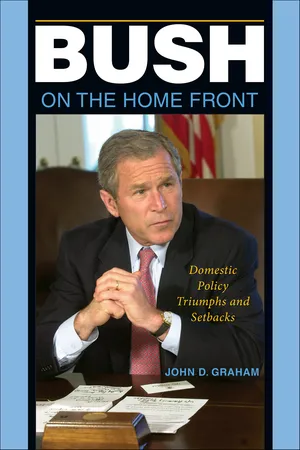
Military operations in Afghanistan and Iraq consumed so much attention during his presidency that few people appreciated that George W. Bush was also an activist on the home front. Despite limited public support, and while confronting a deeply divided Congress, Bush engineered and implemented reforms of public policy on a wide range of issues: taxes, education, health care, energy, environment, and regulatory reform. In Bush on the Home Front, former Bush White House official and academic John D. Graham analyzes Bush's successes in these areas and setbacks in other areas such as Social Security and immigration reform. Graham provides valuable insights into how future presidents can shape U.S. domestic policy while facing continuing partisan polarization.
- 427 pages
- English
- ePUB (mobile friendly)
- Available on iOS & Android
eBook - ePub
About this book
Information
1
Ambiguous Mandate, Polarized Congress
As George W. Bush’s last year in office came to a conclusion, critics declared that our forty-third president was a failure. There are certainly many difficulties to be cited: the prolonged military occupation of Iraq, the messy aftermath of Hurricane Katrina, the burgeoning federal debt, rising fuel prices, a proliferation of home foreclosures, the painful recession that began in 2008, and concerns about health care and income inequality.
Polls indicate that Bush left office as one of the most unpopular presidents in modern history. In 2008 his Gallup Poll approval rating reached a sixty-year low: 28 percent. The previous record low was set by Harry Truman in the midst of the Korean War. Ironically, Bush also holds the record for the highest approval rating in history: 90 percent in the days after the attacks of September 11, 2001.1 But for most of his presidency Bush struggled to achieve a 50 percent approval rating. Anti-Bush sentiment, coupled with a war-weary public and the scandals in Congress, contributed to the Democratic takeover of the House and Senate in November 2006. Given the public’s mood, the Republican presidential candidates in 2008 all sought to emulate Ronald Reagan more than George W. Bush.2 Obama’s clear win at the polls in 2008 may have resulted in part from Bush’s unpopularity and McCain’s inability to separate himself from Bush’s image.
Bush’s national security policies are certainly the subject of intense scrutiny and criticism, both in the United States and around the world. As much as I agree that Bush’s activist foreign policy merits meticulous scrutiny, I am struck by how many citizens, opinion leaders, and scholars have little knowledge of Bush’s domestic policies or hold misperceptions about them.
The imbalance in the scholarly literature is perhaps most striking. While the “war on terror” literature is huge and growing, there are few assessments of what Bush accomplished, and did not accomplish, on the domestic front. It is curious that some authors seek to explain why Bush had little or no domestic success, without even taking the time to examine his actual domestic record.3
Some critics argue that Bush and his domestic aides were so preoccupied with the war in Iraq that there was little sustained attention to domestic policy.4 Others assert that the Bush White House was unwilling to invest scarce political capital on the domestic front, since his priorities were elsewhere. As evidence for this view, critics point to a comparative study which found that Bush made a smaller number of detailed legislative proposals to Congress on domestic issues than any recent president.5
Others allege that Bush was uninterested in domestic policy or that his domestic policy advisers in the White House were weak, ill-informed, or unimaginative.6 As evidence for this argument, critics point to the high rate of turnover in the White House domestic policy and economics staffs compared to the continuity in Bush’s foreign policy team.7 The implication of these arguments is that Bush didn’t really have a meaningful or consistent domestic policy.8
Yet another criticism is that Bush had a domestic agenda but was unable to persuade the Congress and the American people to go along with its ideas.9 For example, the Congress did not enact a constitutional amendment prohibiting gay marriage, even though Bush supported such an amendment. According to this view, Bush’s agenda was “hijacked by the right” and was thus unacceptable to most Americans.10 A related critique is that Bush pushed an “ideologically polarizing agenda” that did more to antagonize Democrats than deliver concrete results for conservatives.11
This book offers a different, more positive view. Based on personal experience, I know that Bush was quite interested in domestic policy and devoted a substantial amount of personal time and political energy to domestic issues. In fact, Bush made important contributions to domestic policies concerning taxes, education, health care, energy, clean air, labor, regulatory reform, and financial-sector relief. His successors will change, or even reverse, some of these policies, but much of Bush’s domestic work is likely to persist for decades to come. Bush’s degree of success as a domestic policy maker is not simply underappreciated. It is remarkable in light of his tenuous standing with the public and the sharp partisan divisions in the Congress.12
The book builds upon a small but growing body of scholarship on the Bush presidency.13 Previous authors have explored the formation of the Bush administration,14 his performance in 2001–2003,15 his “second-term blues,”16 why Bush should be considered a “big-government conservative,”17 his leadership style,18 how he differed from Ronald Reagan,19 public opinion of Bush and the Republican Congress,20 how Bush intermingled campaigning and governing,21 and how partisan polarization in Washington defined his presidency.22 Although this literature touches on selected aspects of Bush’s domestic record, it does not provide an in-depth assessment of his successes and failures at home. This book supplies such an assessment.
I define “success” and “failure” by asking three questions: Was Bush effective in enacting his domestic policy agenda? Did the Bush administration make progress in the implementation of his policies? And is there reason to believe that Bush’s policies will be effective and worthwhile? I focus more on the first two questions because it is too early to make a definitive policy evaluation of the merits of many of Bush’s policies. But I do venture a preliminary evaluation of some policies based on the limited available evidence and the general principles of policy analysis.
In addition to assessing Bush’s performance as a domestic policy maker, I draw on modern theories of presidential and congressional power to shed light on how Bush achieved his successes, and why some pieces of his domestic agenda were delayed, weakened, or killed altogether.23 Much can be learned from the Bush experience, both his successes and his failures. In the final chapter, I derive some useful lessons about how future presidents can be effective domestic policy makers, assuming that American politics continues to be equally and sharply divided along partisan lines.
Contrary to popular belief, Bush’s law-making successes were not rooted primarily in Republican “control” of the House and Senate. Single-party control of the White House and Congress is not necessary for lawmaking success, and it certainly does not ensure that success.24 In fact, Bush achieved more lawmaking success in his first term, when his apparent control of Congress was less secure, than he did at the start of his second term, when the Republican margins in Congress were at their peaks.
My thesis is that Bush was most effective in lawmaking when he recognized his tenuous political standing, analyzed the competing interests in Congress, and chose policy initiatives with broad appeal among Republicans and at least some appeal among key Democrats in the Senate. He was especially effective when he worked the powerful interest groups with ties to the Democratic Party and fostered collaboration with key “crossover” Democrats.25 Even when his legislative proposals could not be passed, Bush used his executive powers aggressively, knowing that the Congress—an institution that requires supermajorities to act—was too divided to obstruct him effectively.
Future presidents who are elected in landslides may have the luxury to govern differently. It remains to be seen whether President Barack Obama can overcome polarization. For future presidents who aspire to be activists in domestic policy but face partisan polarization, there are constructive lessons here about how to become an effective policy maker. I shall argue that, due to fundamental features of American politics, future presidents may be constrained in ways that Bush was constrained.
It would be a mistake to assume that Bush’s domestic policy successes were a side effect of his temporary burst of popularity after the tragic events of 9/11. There was an eighteen-month burst in Bush’s job-approval ratings that contributed to his legislative successes on homeland security and military policies, key issues that are beyond the scope of this book. Yet there is little evidence that Bush’s temporary popularity helped him on the traditional domestic issues that are the subject of my investigation. For example, the 9/11-induced popularity did not translate into near-term legislative victories on energy policy or the 2002 economic stimulus package favored by Republicans.26 In fact, the stimulus bill was never passed and the energy bill, which I analyze in chapter 6, was not passed until 2005.
The Governing Strategy
Given that Bush governed with a razor-thin margin in the Electoral College, substantial public disapproval of his presidency, and an ever-present filibuster threat in the Senate, there was good reason to predict that he would fail as a domestic lawmaker. One might have expected that Bush’s accomplishments would be confined to foreign and defense policy, where presidential powers (relative to Congress and the judiciary) are large and where the public and Congress are most likely to defer to presidential leadership.27 Yet this book shows that Bush was frequently an effective domestic policy maker. Bush borrowed from strategies that worked when he was governor of Texas. A two-part governing strategy, which is illuminated by modern theories of presidential and congressional power, was executed in a wide range of domestic policy areas that are illustrated in chapters 2 through 11.
The first part of the governing strategy was frustrating to many people. Bush made a relatively small number of legislative proposals and gave them priority attention. It is much easier to please interest groups by giving each of them its own legislative proposal, and then blaming failure on the Congress. But Bush knew he did not want to blame his fellow Republicans, who controlled the House and Senate for much of his tenure. And Bush did not have the margins in the Congress—especially in the Senate—to pursue a partisan legislative strategy.28
Good-government advocates generally prefer the classic bipartisan strategy, where leaders of both parties in the House and Senate are engaged cooperatively by the White House from the outset. On rare occasions (for instance, homeland security policy after 9/11), Bush pursued a classic bipartisan strategy.29 More often, Bush practiced a “cross-partisan” technique where legislation is passed primarily with votes from the president’s party, coupled with the minimum number of votes needed from the other party in order to overcome gridlock.30 In cross-partisanship, a president does not engage the legislative leaders of the other party, presumably because they are in opposition to the president’s agenda or because the negotiating terms they would set for their cooperation are unattractive to the White House. Since Bush often had sufficient Republican votes in the House to pass his agenda without any votes from House Democrats, he frequently coupled a partisan strategy in the House with an outreach to potential crossover Democrats in the Senate.
The Bush White House took creative steps to facilitate cross-partisanship. For example, in many cases the White House chose not to submit detailed legislative packages and instead allowed members of Congress to develop specific bills within broad parameters established by the White House. Bush also selected some domestic issues (such as health, education, and energy conservation) where the national Democratic Party was already eager to enact stronger federal legislation. Interestingly, Bush was not reluctant to reach out to powerful interest groups with ties to the Democratic Party in order to compensate for his tenuous standing in the polls. By driving a wedge between the Senate Democratic leadership and these powerful groups, the Bush White House often found the votes...
Table of contents
- Cover
- Half title
- Title
- Copyright
- Contents
- Preface and Acknowledgments
- 1 Ambiguous Mandate, Polarized Congress
- 2 Lower Taxes, More Spending
- 3 The Social Security Debacle
- 4 Making Sure Kids Learn
- 5 Drug Coverage for Seniors
- 6 Producing More Energy
- 7 Consuming Less Energy
- 8 Cleaner Air, Warmer Climate
- 9 Illegal Immigration: Punishment or Amnesty?
- 10 Tort and Regulatory Reform
- 11 Meltdown and Bailouts
- 12 Taking Stock, with Lessons for Future Presidents
- Notes
- Index
Trusted by 375,005 students
Access to over 1.5 million titles for a fair monthly price.
Study more efficiently using our study tools.
Frequently asked questions
Yes, you can cancel anytime from the Subscription tab in your account settings on the Perlego website. Your subscription will stay active until the end of your current billing period. Learn how to cancel your subscription
No, books cannot be downloaded as external files, such as PDFs, for use outside of Perlego. However, you can download books within the Perlego app for offline reading on mobile or tablet. Learn how to download books offline
Perlego offers two plans: Essential and Complete
- Essential is ideal for learners and professionals who enjoy exploring a wide range of subjects. Access the Essential Library with 800,000+ trusted titles and best-sellers across business, personal growth, and the humanities. Includes unlimited reading time and Standard Read Aloud voice.
- Complete: Perfect for advanced learners and researchers needing full, unrestricted access. Unlock 1.5M+ books across hundreds of subjects, including academic and specialized titles. The Complete Plan also includes advanced features like Premium Read Aloud and Research Assistant.
We are an online textbook subscription service, where you can get access to an entire online library for less than the price of a single book per month. With over 1.5 million books across 990+ topics, we’ve got you covered! Learn about our mission
Look out for the read-aloud symbol on your next book to see if you can listen to it. The read-aloud tool reads text aloud for you, highlighting the text as it is being read. You can pause it, speed it up and slow it down. Learn more about Read Aloud
Yes! You can use the Perlego app on both iOS and Android devices to read anytime, anywhere — even offline. Perfect for commutes or when you’re on the go.
Please note we cannot support devices running on iOS 13 and Android 7 or earlier. Learn more about using the app
Please note we cannot support devices running on iOS 13 and Android 7 or earlier. Learn more about using the app
Yes, you can access Bush on the Home Front by John D. Graham in PDF and/or ePUB format, as well as other popular books in History & North American History. We have over 1.5 million books available in our catalogue for you to explore.