"Rabuzzi rejects the status quo, presenting viable, often spiritual, alternatives to prevailing high-tech, patriarchal models of childbirth" (
Booklist).
Rabuzzi, author of
The Sacred and the Feminine and
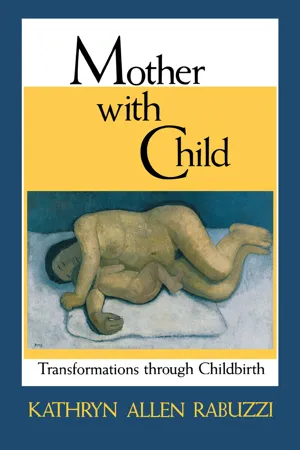
Motherself, contends that childbearing has been denigrated, denied, and devalued. This book is intended to help women rename, re-ritualize, reinterpret, and reframe childbearing for themselves and their partners.
"A lovely book. . . . It is a book for anyone wishing to reexamine and reclaim birth's potential for sacredness." —Robbie Davis-Floyd, author of
Birth as an American Rite of Passage
"Excellent." —
The Reader's Review
- 240 pages
- English
- ePUB (mobile friendly)
- Available on iOS & Android
eBook - ePub
About this book
Information
Print ISBN
9780253208279
NOTES
INTRODUCTION
1. Rebecca Rowe Parfitt, The Birth Primer: A Source Book of Traditional and Alternative Methods in Labor and Delivery (Philadelphia, Pa.: Running Press, 1977), p. 8.
2. Andre Droogers, The Dangerous Journey: Symbolic Aspects of Boys’ Initiation among the Wagenia of Kisangani, Zaire (The Hague and New York: Mouton, 1980), p. 46.
3. Gerda Lerner, The Creation of Patriarchy (New York and Oxford: Oxford University Press, 1986), pp. 238–39.
4. The essays in Alice Jardine and Paul Smith, eds., Men in Feminism (New York and London: Methuen, 1987), provide a helpful discussion of poststructuralism and feminist theory relevant to this issue.
5. Ann Cornelison, Women of the Shadows (New York: Vintage Books/Random House, 1977), p. 132.
6. For further discussion of Stanislav Grof’s work and some of the reactions to it, see “Birth Trauma” in chapter 8.
7. David Chamberlain, Babies Remember Birth: And Other Extraordinary Scientific Discoveries about the Mind and the Personality of Your Newborn (New York: Ballantine Books, 1988), p. 176.
8. Kenneth Ring, “Near-Death Studies: An Overview,” in The Near-Death Experience: Problems, Prospects, Perspectives, ed. Bruce Greyson and Charles P. Flynn (Springfield, Ill.: Charles Thomas, 1984), p. 5.
9. Margot Edwards and Mary Waldorf, Reclaiming Birth; History and Heroines of American Childbirth Reform (Trumansburg, N.Y.: Crossing Press, 1984), p. 187.
10. Dorothy Dinnerstein, The Mermaid and the Minotaur: Sexual Arrangements and Human Malaise (New York: Harper & Row, 1976), p. 28.
11. Dinnerstein, p. 34.
12. Dinnerstein, p. 25.
13. Mary O’Brien, The Politics of Reproduction, (Boston: Routledge & Kegan Paul, 1981), p. 8.
14. O’Brien, p. 105. The original is from Hegel, “On Love,” in his Early Theological Writings.
15. Emily Martin, The Woman in the Body: A Cultural Analysis of Reproduction (Boston: Beacon Press, 1987).
16. Sarah Ruddick, Maternal Thinking: Toward a Politics of Peace (Boston: Beacon Press, 1989), p. 48.
17. Ruddick, p. 48.
18. See especially Chamberlain on this point.
19. Penelope Washbourne, Becoming Woman: The Quest for Wholeness in Female Experience (New York: Harper & Row, 1977), p. 90.
20. Julia Kristeva, “Stabat Mater,” in The Kristeva Reader, ed. Toril Moi (New York: Columbia University Press, 1986), p. 179.
21. Sylvia Brinton Perera, “The Descent of Inanna: Myth and Therapy,” in Feminist Archetypal Theory: Interdisciplinary Re-Visions of Jungian Thought, ed. Estella Lauter and Carol Schreier Rupprecht (Knoxville: University of Tennessee Press, 1985).
22. Patricia Reis, Through the Goddess: A Woman’s Way of Healing (New York: Continuum, 1991), p. 181.
23. Kathryn Allen Rabuzzi, Motherself: A Mythic Analysis of Motherhood (Bloomington: Indiana University Press, 1988), pp. 205–6.
24. Marta Weigle, Creation and Procreation: Feminist Reflections on Mythologies of Cosmogony and Parturition (Philadelphia: University of Pennsylvania Press, 1989), p. xi.
I. PRECONCEPTION(S)
1. Suzanne Arms, Immaculate Deception; A New Look at Women and Childbirth in America (Boston: San Francisco Book/Houghton Mifflin, 1975), p. 144.
2. Frederick Leboyer, Birth without Violence (New York: Alfred A. Knopf, 1975), pp. 30–31.
3. See, for example, Emily Martin, The Woman in the Body: A Cultural Analysis of Reproduction (Boston: Beacon Press, 1987), and Robbie E. Davis-Floyd, “Birth as an American Rite of Passage,” in Childbirth in America: Anthropological Perspectives, ed. Karen L. Michaelson (South Hadley, Mass.: Bergin & Garvey, 1988).
4. Encyclopaedia Britannica, under “Childbirth,” 1961 ed.
5. See, for example, Dawson Church, Communing with the Spirit of Your Unborn Child (San Leandro, Calif.: Aslan, 1988).
6. Robbie E. Davis-Floyd, prepublication copy of “The Technocratic Body and the Organic Body: Cultural Models for Women’s Birth Choices,” in The Anthropology of Science and Technology, a special issue of Knowledge and Society, vol. 9, ed. David J. Hess and Linda L. Layne (Hartford, Conn.: JAI Press, in press), 21.
7. Davis-Floyd, p. 21.
8. Gena Corea, The Mother Machine: Reproductive Technologies from Artificial Insemination to Artificial Wombs (New York: Harper & Row, 1985), p. 170.
9. Corea, p. 39.
10. Quoted in Corea, p. 47.
11. Shulamith Firestone, The Dialectic of Sex: The Case for Feminist Revolution (New York: Bantam Books, 1970), p. 238.
12. Deborah Lipp, “Mothering after Incest,” in Mothering 363 (Spring 1992), p. 119.
II. CONCEPTION
1. Hesiod, Theogony, trans. Norman O. Brown (Indianapolis: Library of Liberal Arts/Bobbs-Merrill, 1953), p. 56.
2. Karl J. Narr, “Paleolithic Religion,” trans. Matthew J. O’Connell, in The Encyclopedia of Religion, 1987.
3. For a full discussion of this hypothesis, see Richard E. Leakey and Roger Lewin, People of the Lake: Mankind and Its Beginnings (G...
Table of contents
- Cover
- Half title
- Title
- Copyright
- Contents
- Preface
- Introduction
- I. Preconception(s)
- II. Conception
- III. Miraculous Conceptions
- IV. Misconceptions
- V. Pregnancy: A Natural Initiation Process
- VI. Models of Labor and Delivery
- VII. Phases of Labor
- VIII. “Delivery”: A Time of Potential Revelation
- IX. The Postpartum Period
- Conclusion
- Notes
- Index
Trusted by 375,005 students
Access to over 1.5 million titles for a fair monthly price.
Study more efficiently using our study tools.
Frequently asked questions
Yes, you can cancel anytime from the Subscription tab in your account settings on the Perlego website. Your subscription will stay active until the end of your current billing period. Learn how to cancel your subscription
No, books cannot be downloaded as external files, such as PDFs, for use outside of Perlego. However, you can download books within the Perlego app for offline reading on mobile or tablet. Learn how to download books offline
Perlego offers two plans: Essential and Complete
- Essential is ideal for learners and professionals who enjoy exploring a wide range of subjects. Access the Essential Library with 800,000+ trusted titles and best-sellers across business, personal growth, and the humanities. Includes unlimited reading time and Standard Read Aloud voice.
- Complete: Perfect for advanced learners and researchers needing full, unrestricted access. Unlock 1.5M+ books across hundreds of subjects, including academic and specialized titles. The Complete Plan also includes advanced features like Premium Read Aloud and Research Assistant.
We are an online textbook subscription service, where you can get access to an entire online library for less than the price of a single book per month. With over 1.5 million books across 990+ topics, we’ve got you covered! Learn about our mission
Look out for the read-aloud symbol on your next book to see if you can listen to it. The read-aloud tool reads text aloud for you, highlighting the text as it is being read. You can pause it, speed it up and slow it down. Learn more about Read Aloud
Yes! You can use the Perlego app on both iOS and Android devices to read anytime, anywhere — even offline. Perfect for commutes or when you’re on the go.
Please note we cannot support devices running on iOS 13 and Android 7 or earlier. Learn more about using the app
Please note we cannot support devices running on iOS 13 and Android 7 or earlier. Learn more about using the app
Yes, you can access Mother with Child by Kathryn Allen Rabuzzi in PDF and/or ePUB format. We have over 1.5 million books available in our catalogue for you to explore.