"Examines in a remarkably rich and varied way the construction of otherness and foreignness within this complexly 'national' cinema tradition." —John MacKay, Yale University
Identifying who was "inside" and who was "outside" the Soviet/Russian body politic has been a matter of intense and violent urgency, especially in the high Stalinist and post-Soviet periods. It is a theme encountered prominently in film. Employing a range of interpretive methods practiced in Russian/Soviet film studies,
Insiders and Outsiders in Russian Cinema highlights the varied ways that Russian and Soviet cinema constructed otherness and foreignness. While the essays explore the "us versus them" binary well known to students of Russian culture and the ways in which Russian films depicted these distinctions, the book demonstrates just how impossible maintaining this binary proved to be.
Contributors are Anthony Anemone, Julian Graffy, Peter Kenez, Joan Neuberger, Stephen M. Norris, Oleg Sulkin, Yuri Tsivian, Emma Widdis, and Josephine Woll.
"An anthology that is the best I have ever had the pleasure of reading . . . Lucidly written, well researched, persuasively argued, lavishly illustrated,
Insiders and Outsiders in Russian Cinema can be read with pleasure and profit by anyone from the general reader interested in Russian culture to the most seasoned Russian film specialist." —Denise J. Youngblood, University of Vermont,
Russian Review
"In a word, the theoretical richness and sophistication of this collection parallel the complexity of its topics and serve as an excellent cross-section of how the theme of foreigners and outsiders is examined in contemporary studies in film." —
Slavonic & East European Journal
eBook - ePub
Insiders and Outsiders in Russian Cinema
- 200 pages
- English
- ePUB (mobile friendly)
- Available on iOS & Android
eBook - ePub
Insiders and Outsiders in Russian Cinema
About this book
Trusted by 375,005 students
Access to over 1.5 million titles for a fair monthly price.
Study more efficiently using our study tools.
Information
Subtopic
Russian History1.
The Foreigner’s Journey to Consciousness in Early Soviet Cinema
The Case of Protazanov’s Tommi
Foreigners in Early Russian Film
The kind of “otherness” being examined in this essay is very straightforward—the films I shall examine have a foreign protagonist. It is a commonplace of the study of Russian history, politics, or culture to say that because of a widespread perception of Russian backwardness, Russians have always had a nervous desire to compare themselves and their culture with other countries, particularly those of the rest of Europe (which raises the question whether Russia is part of Europe or not) and the United States. The latter has provided a particular point of reference since both countries share an ambiguous attitude to Europe and both have the same vastness, large population, and huge economic potential based on natural resources. Thus Russia was imagined as a “New America” by the Symbolist poet Aleksandr Blok in his poem of that title of December 1913.1
Russian film has also always been eager to draw comparisons between Russian/Soviet life and the life and attitudes of those who live beyond its borders, and in this context we are able to draw upon a very large range of cinematic material consisting both of films set in Russia that feature foreign characters and of films set abroad, including adaptations of Western novels and plays. As Yuri Tsivian argues in his essay in this volume, the history of the carefully controlled importation of foreign films during the Soviet era also yields useful evidence. It both tells us how those responsible for running the Soviet film industry and specifically for the choice of films to import used this mechanism to construct an ideologically driven picture of Western life in the minds of Soviet viewers, and also how, perversely, those Soviet viewers managed to “read between the lines” and use this material to give themselves some sense of what life outside the Soviet Union was actually like.
Film came to Russia in 1896, only months after the Lumière Brothers’ films were shown in Paris, but it was a decade before there was native Russian production of acted films. Since all these first films were foreign and most of the subjects and the characters in them were foreign, film itself was considered to be a “foreign” phenomenon. In this context it is not surprising that the first Russian producers wanted their studios to make films about Russian subjects and Russian history. What is conventionally called the first Russian film, Vladimir Romashkov’s Sten’ka Razin, released on November 16, 1908, took as its subject the life of the Don Cossack who led a peasant revolt in 1670, capturing several towns along the Volga before he was defeated and taken to Moscow to be broken on the wheel.
Sten’ka has remained a central hero of the Russian popular imagination, so that it is appropriate that he should be the subject of the first Russian film. What is interesting, however, is that the film does not show him and his men revolting. Instead it shows their “forest revels,” their epic drinking bouts, which evoke another key aspect of the Russian self-image. Sten’ka is also shown reveling with a captive Persian princess. Though they themselves are hardly model upstarts, the rebels blame the princess for diverting their leader from the true path, and plot against her. Thus the first foreigner to be depicted in a Russian film is constructed as the quintessential “perfidious jade” of European Orientalism. Race, gender, religion, dress, behavior, all mark her out as “Other,” and her fate is sealed: in the film’s final sequence she is thrown into the Volga. The mother of Russian rivers envelops the threat to Russian manhood.
Overall, however, the prerevolutionary industry’s eyes remained firmly directed on Russian characters and Russian themes. Sometimes foreign works were taken as source material but reimagined in a Russian setting, a practice followed by Evgenii Bauer in his films Grezy (Daydreams, 1915), taken from the 1892 novel Bruges la Morte by the Belgian Symbolist writer, Georges Rodenbach, and Zhizn’ za zhizn’ (A Life for a Life, 1916), which is based on the hugely popular novel Serge Panine by Georges Ohnet. It is also perhaps instructive that in Bauer’s Silent Witnesses (Nemye svideteli, 1914), the characters with foreign names, Ellen and Baron von Rehren, are represented as cynical and treacherous hedonists and adulterers.
Despite the introverted gaze of Russian directors, Western films continued to be widely shown in Russia throughout the silent era, both before and after the Revolution, and they remained extremely popular with audiences.2 The influx of foreign films provided a stream of images of Western characters and Western life, and fostered cults of Western stars. The Russian industry had been thrown into chaos by the 1917 Revolution, and it did not reemerge on any scale until 1924. Contrary to its prerevolutionary practice, it immediately started giving its audiences pictures of foreigners, perhaps in conscious or unconscious contrast to the images provided by the repertoire of popular French, German, and American films. Specifically it provided a subset of films whose plots told the story of a visit by a foreigner to the USSR and examined his or her reaction to this experience. Indeed, the Soviet industry’s representation of foreigners becomes centered on their reactions to the Soviet system.
Coming to Consciousness
The phenomenon identified by Katerina Clark as “coming to consciousness,” widespread in the fiction and the films of the period, followed a model set by such pre-Socialist Realist works as Maxim Gorky’s novel Mother (Mat’, 1907) and involved an encounter between a character who is well intentioned but not ideologically “conscious” and a mentor figure who can direct the character’s energy in a politically conscious direction.3 In the case of Mother the peasant heroine learns from the words and the behavior of her politically conscious son, Pavel, and his friends.
The model was widely used in film, for example in works about the collectivization of the Russian village, including Sergei Eisenstein’s The Old and the New (Staroe i novoe, 1929), Aleksandr Dovzhenko’s Earth (Zemlia, 1930), and Aleksandr Medvedkin’s Happiness (Schast’e, 1935), but it is also present in the Civil War drama Chapaev, directed by the Vasil’ev “brothers” in 1934, in which the commissar, Furmanov, leads the commander, Chapaev, to a political understanding of the nature of the struggle he is involved in, and therefore to consciousness. Boris Shumiatskii, the head of the Soviet film industry, regarded this film as a model that Soviet cinema should follow.
Foreigners in Russian Film: Mr. West
In April 1924 Lev Kuleshov’s The Extraordinary Adventures of Mr. West in the Land of the Bolsheviks (Neobychainye prikliucheniia Mistera Vesta v strane bol’shevikov) opened in the Soviet Union. The hero, Mr. West, whose very name announces the director’s polemical intent, is the President of the New York YMCA, and is motivated to visit Moscow, as an intertitle tells us, by “Yankee curiosity.” This film is very well known, and I do not intend to linger on it, but it is worth noting that both the character and his treatment in the film’s plot set the model that later films would follow throughout the Soviet period. Mr. West’s experience, and that of the foreigners who follow in his footsteps, of coming to accept the Tightness of the Soviet system, is a particular subset of the coming to consciousness trope identified by Katerina Clark. In the films of this type the first stage is to identify the protagonist as a foreigner, and in Kuleshov’s film this is done in a spectacularly obvious way, with Mr. West carrying a flag and wearing stars-and-stripes socks, but it is also crucial that the figure about to experience change is identified as a positive character, a character with potential—Mr. West is shown to be kind and well intentioned (see fig. 1.1).
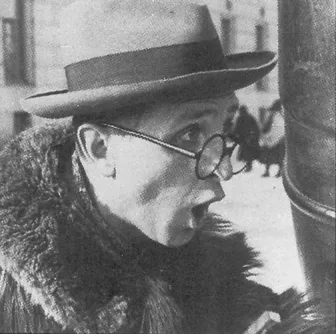
Figure 1.1. The Foreigner with Potential: Mr. West. From Lev Kuleshov, The Extraordinary Adventures of Mr. West in the Land of the Bolsheviks (1924).
Next, his reactions to Soviet reality are tested. Gradually he comes to consciousness and understanding, and learns a political and personal lesson, making a choice that marks his acceptance of the Soviet Bolshevik way of life. At the end of the film Mr. West sends his wife the following radio message: “Dear Madge: I send you greetings from Soviet Russia. Burn those New York magazines and hang a portrait of Lenin in the study. Long live the Bolsheviks! Yours, John.”
So in The Extraordinary Adventures of Mr. West in the Land of the Bolsheviks the cinematic model of coming to understanding, acceptance, and consciousness has been established. In fact, arguments still rage about Kuleshov’s representation of Mr. West, of the Bolsheviks, and of the underworld gang he gets involved with, for Mr. West is shown as gullible and naive, innocent and malleable. This is what makes him suitable “human material” and causes both the gang and the Bolsheviks to try to manipulate him. But Kuleshov’s (almost certainly ambiguous) intentions are in a sense irrelevant here.4 Mr. West has set a model for other filmmakers to follow.
Eight months after Mr. West, another misguided American appeared in a Soviet film, in the form of the rotund businessman, Oliver McBright, in Iurii Zheliabuzhskii’s The Cigarette Girl from Mossel’proma (Papirosnitsa ot Mossel’proma), released in December 1924. Perhaps modeled on the caricatures of capitalists familiar to us from the cartoons of the revolutionary period and echoed in Sergei Eisenstein’s film Strike (Stachka), which would open the following year, McBright is first seen teetering unsteadily down from his private plane on a mission to sell Russian women his ready-to-wear collection. Following in the footsteps of Mr. West, he packs his many heavy cases into a carriage, but they are far too bulky, and, of course, when the carriage drives off it loses a wheel. McBright has not come to Russia to learn, but to exploit the fallibility of Soviet women, and his scheme is not crowned with success.
Following the Model: Visitors from East and West
The model of the visiting outsider, from East or West, who comes to the Soviet Union, sees that it is good, and in most cases takes or sends the lesson back home, is widespread in the first years of the Soviet film industry. A political example of the genre, involving an encounter of a character from the East, is provided by Vsevolod Pudovkin’s film Storm over Asia (The Descendant of Chingiz Khan [Potomok Chingus Khana]), released in November 1929. Set in the east of the Soviet Union during the Civil War, it tells the story of a Mongol trapper, Bair, who encounters a group of Red partisans. When the leader of the partisans dies from wounds he has received, he passes on a message to his group that they must be faithful to the legacy given to them by Moscow. This scene of ideological baton passing adds another dimension to the ritual of becoming Soviet, with stress laid on language and on a particular ideologically powerful word. When Bair is arrested and interrogated by officers of the British Intervention Forces, he proves that he has learned his lesson by his smiling acceptance of the epithets “Red” and “Partisan” and his warm reaction to the word “Moscow” (see fig. 1.2). This knowledge is powerful enough to save his life and to stop him succumbing to the blandishments of the British, and at the end of the film he leads a rebellion against their power.
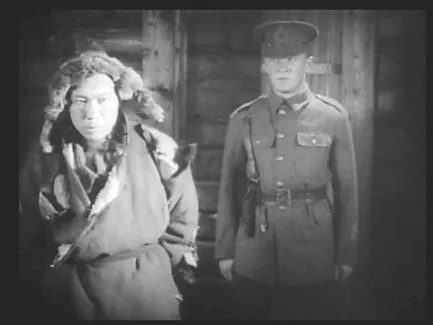
Figure 1.2. Bair Proves His Bolshevism.
From Vsevolod Pudovkin’s Storm over Asia (1929).
From Vsevolod Pudovkin’s Storm over Asia (1929).
Vsevolod Ivanov’s Story “Armored Train 14–69”
Iakov Protazanov’s 1931 film Tommi was based on an episode in Vsevolod Ivanov’s 1921 story “Armored Train 14–69” (Bronepoezd 14–69), which appeared in the January-February 1922 issue of the journal Krasnaia Nov’ and was published in book form later that year.5 Ivanov later wrote a highly successful stage version and the story was reissued twenty-seven times before the fortieth anniversary of the revolution and translated into a number of languages. Ivanov recalls the writing of the story in his memoir “The History of My Books” (Istoriia moikh knig).6 After arriving in Petrograd from Omsk at the start of 1921, he became close to Proletkul’t and joined the Serapion brothers, a group of writers who sought to separate the arts from political constraints.7 In spring 1921 he gave a lecture to the workers on an armored train, which caused him to remember a piece he had read in a Siberian Red Army paper about lightly armed partisans seizing an armored train from the Whites and the heroic self-sacrifice of the Chinese partisan and former Tsarist coolie Sin Bin-U, who had given his life for the Revolution by lying down on the tracks to stop the train. When the armored train he was visiting was sent to the Far East, Ivanov transferred the action to that area.
“Armored Train 14–69” is set in 1920 and centers on the experiences of three men, Nezelasov, Peklevanov, and Vershinin. Captain, later Colonel, Nezelasov is a White officer who dreams of being Bonaparte. Sent to bring the armored train, which is carrying a lot of ammunition, out of the taiga and into the port where he is stationed, so that the local garrison can use the ammunition to fire their guns and put down the incipient rebellion, Nezelasov is beset by fears of cowardice and eventually killed by a group of partisans led by Vershinin. Peklevanov, the second major character, is a revolutionary who took part in the 1905 Revolution. At the start of the story he escapes from imprisonment by the Whites. He lies low in the city and organizes rebellion, in association with the partisan leader Vershinin, but he, too, is eventually shot by a member of the Japanese intervention forces. At the start of the story Vershinin is still attempting to let the Civil War pass him by, but when they learn that their two young sons have been killed by a White punishment brigade both he and his wife join the partisans. It is Vershinin, who at great cost and with only lightly armed peasant troops, captures the train from Nezelasov and his men and successfully drives it to the town where it is used to complete the defeat of the local Whites.
There are a number of foreign characters in the story, allied with both sides in the conflict. So the battle between Red and White, and thus between “us” and “them,” is not confined to the Russian characters but is echoed in the behavior of their foreign allies. The forces of the Intervention are represented as predominantly American and Japanese, though there are also passing references to Czech troops, to “khrantsuzy” (French) in the town, to well-d...
Table of contents
- Cover
- Half Title
- Title Page
- Copyright Page
- Table of Contents
- Acknowledgments
- Introduction: Insiders and Outsiders in Russian Cinema
- 1. The Foreigner’s Journey to Consciousness in Early Soviet Cinema: The Case of Protazanov’s Tommi
- 2. The Wise and Wicked Game: Reediting, Foreignness, and Soviet Film Culture of the Twenties
- 3. Dressing the Part: Clothing Otherness in Soviet Cinema before 1953
- 4. Under the Big Top: America Goes to the Circus
- 5. Eisenstein’s Cosmopolitan Kremlin: Drag Queens, Circus Clowns, Slugs, and Foreigners in Ivan the Terrible
- 6. The Picture of the Enemy in Stalinist Films
- 7. Identifying the Enemy in Contemporary Russian Film
- 8. About Killers, Freaks, and Real Men: The Vigilante Hero of Aleksei Balabanov’s Films
- 9. Fools and Cuckoos: The Outsider as Insider in Post-Soviet War Films
- List of Contributors
- Index
Frequently asked questions
Yes, you can cancel anytime from the Subscription tab in your account settings on the Perlego website. Your subscription will stay active until the end of your current billing period. Learn how to cancel your subscription
No, books cannot be downloaded as external files, such as PDFs, for use outside of Perlego. However, you can download books within the Perlego app for offline reading on mobile or tablet. Learn how to download books offline
Perlego offers two plans: Essential and Complete
- Essential is ideal for learners and professionals who enjoy exploring a wide range of subjects. Access the Essential Library with 800,000+ trusted titles and best-sellers across business, personal growth, and the humanities. Includes unlimited reading time and Standard Read Aloud voice.
- Complete: Perfect for advanced learners and researchers needing full, unrestricted access. Unlock 1.5M+ books across hundreds of subjects, including academic and specialized titles. The Complete Plan also includes advanced features like Premium Read Aloud and Research Assistant.
We are an online textbook subscription service, where you can get access to an entire online library for less than the price of a single book per month. With over 1.5 million books across 990+ topics, we’ve got you covered! Learn about our mission
Look out for the read-aloud symbol on your next book to see if you can listen to it. The read-aloud tool reads text aloud for you, highlighting the text as it is being read. You can pause it, speed it up and slow it down. Learn more about Read Aloud
Yes! You can use the Perlego app on both iOS and Android devices to read anytime, anywhere — even offline. Perfect for commutes or when you’re on the go.
Please note we cannot support devices running on iOS 13 and Android 7 or earlier. Learn more about using the app
Please note we cannot support devices running on iOS 13 and Android 7 or earlier. Learn more about using the app
Yes, you can access Insiders and Outsiders in Russian Cinema by Stephen M. Norris, Zara M. Torlone, Stephen M. Norris,Zara M. Torlone in PDF and/or ePUB format, as well as other popular books in Media & Performing Arts & Russian History. We have over 1.5 million books available in our catalogue for you to explore.