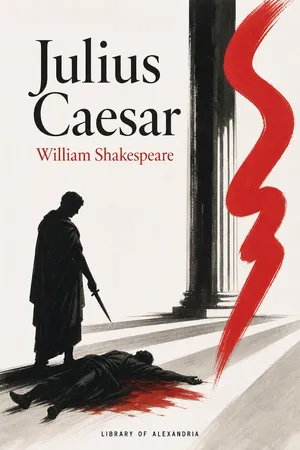
Can an act of betrayal save a republic-or destroy it? In ancient Rome, private doubts become a public catastrophe as men of honor struggle for power.
William Shakespeare's Julius Caesar dramatizes the conspiracy against Rome's dominant leader and the turmoil that follows his assassination. At its heart stands Brutus, caught between affection for Caesar and fear for the republic. Persuaded by Cassius to join the conspirators, he stakes his conscience and reputation on the belief that political murder can serve the common good.
But removing a ruler is not the same as controlling what comes next. Mark Antony's funeral oration turns mourning into a force the conspirators cannot contain, exposing the distance between honorable intentions and political judgment. Through charged debates, intimate conflicts, and public speeches, Shakespeare asks who earns the right to lead-and how readily a crowd can be moved. The play endures because its questions about loyalty, ambition, and the uses of language remain urgently recognizable.
What readers find inside:
- A divided conscience - Brutus weighs friendship against civic duty, making his moral uncertainty central to the tragedy.
- Conspiracy and ambition - Cassius and his fellow plotters reveal the uneasy mixture of principle, resentment, and calculation behind political action.
- The Ides of March - Caesar's assassination becomes the turning point in a struggle whose consequences reach far beyond the conspirators' plans.
- Persuasion in public - Brutus's defense and Antony's funeral speech show how rhetoric shapes judgment and redirects a crowd.
- The aftermath of violence - The contest for Rome tests claims of honor and exposes the human cost of pursuing power through bloodshed.
A compelling choice for readers of classical drama, students exploring Shakespeare, and anyone drawn to stories of leadership and political conflict, this tragedy rewards attention to both its public arguments and its private doubts.
Enter Shakespeare's Rome and follow the choices that turn a defense of the republic into tragedy.