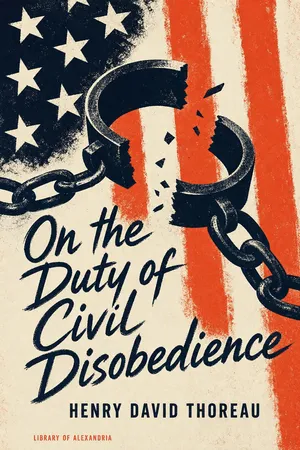
When the law supports injustice, is obedience still a virtue? Henry David Thoreau asks readers to judge government by conscience rather than surrender conscience to government.
First published in 1849, On the Duty of Civil Disobedience is a foundational essay in American political thought. Writing in opposition to slavery and the Mexican-American War, Thoreau questions the authority of a state that demands support for actions its citizens believe are wrong. His refusal to pay a poll tax, and the night in jail that followed, give concrete force to his argument about individual responsibility.
Thoreau challenges the assumption that majority rule makes a decision morally right. He distinguishes respect for law from respect for justice and argues that merely disapproving of wrongdoing is not enough when one's own cooperation helps sustain it. His insistence on ethical independence later influenced Gandhi and Martin Luther King Jr. The essay remains a searching companion to debates about protest, citizenship, and the limits of political obligation.
What readers find inside:
- Conscience before compliance - Thoreau argues that individuals must answer for their actions even when those actions are sanctioned by law.
- Resistance in practice - His tax refusal and imprisonment reveal how withdrawing cooperation can become a form of political action.
- Slavery and war - His criticism of American government is grounded in the urgent injustices of his own time.
- The limits of majority rule - The essay asks why numerical power should be mistaken for moral authority.
- The cost of inaction - Thoreau presses readers to examine the distance between holding an opinion and acting upon it.
For readers of political philosophy, students of American literature, and anyone thinking seriously about peaceful protest, this brief essay offers a demanding encounter with the responsibilities of citizenship.
Begin with Thoreau's challenge and consider where your own obligations to justice begin.