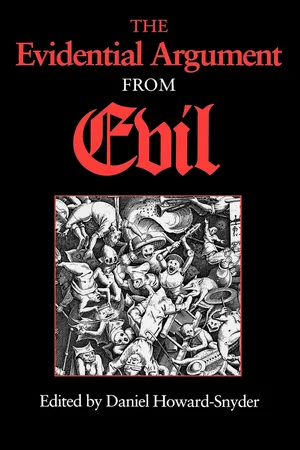
Is evil evidence against the existence of God? A collection of essays by philosophers, theologians, and other scholars.
Even if God and evil are compatible, it remains hotly contested whether evil renders belief in God unreasonable.
The Evidential Argument from Evil presents five classic statements on this issue by eminent philosophers and theologians, and places them in dialogue with eleven original essays reflecting new thinking by these and other scholars.
The volume focuses on two versions of the argument. The first affirms that there is no reason for God to permit either certain specific horrors or the variety and profusion of undeserved suffering. The second asserts that pleasure and pain, given their biological role, are better explained by hypotheses other than theism. Contributors include William P. Alston, Paul Draper, Richard M. Gale, Daniel Howard-Snyder, Alvin Plantinga, William L. Rowe, Bruce Russell, Eleonore Stump, Richard G. Swinburne, Peter van Inwagen, and Stephen John Wykstra.
eBook - ePub
The Evidential Argument from Evil
- 384 pages
- English
- ePUB (mobile friendly)
- Available on iOS & Android
eBook - ePub
The Evidential Argument from Evil
About this book
Information
Topic
Theology & ReligionSubtopic
Ethics & Moral Philosophy1.
The Problem of Evil and Some Varieties of Atheism
This chapter is concerned with three interrelated questions. The first is: Is there an argument for atheism based on the existence of evil that may rationally justify someone in being an atheist? To this first question I give an affirmative answer and try to support that answer by setting forth a strong argument for atheism based on the existence of evil.1 The second question is: How can the theist best defend his position against the argument for atheism based on the existence of evil? In response to this question I try to describe what may be an adequate rational defense for theism against any argument for atheism based on the existence of evil. The final question is: What position should the informed atheist take concerning the rationality of theistic belief? Three different answers an atheist may give to this question serve to distinguish three varieties of atheism: unfriendly atheism, indifferent atheism, and friendly atheism. In the final part of the paper I discuss and defend the position of friendly atheism.
Before we consider the argument from evil, we need to distinguish a narrow and a broad sense of the terms “theist,” “atheist,” and “agnostic.” By a “theist” in the narrow sense I mean someone who believes in the existence of an omnipotent, omniscient, eternal, supremely good being who created the world. By a “theist” in the broad sense I mean someone who believes in the existence of some sort of divine being or divine reality. To be a theist in the narrow sense is also to be a theist in the broad sense, but one may be a theist in the broad sense—as was Paul Tillich—without believing that there is a supremely good, omnipotent, omniscient, eternal being who created the world. Similar distinctions must be made between a narrow and a broad sense of the terms “atheist” and “agnostic.” To be an atheist in the broad sense is to deny the existence of any sort of divine being or divine reality. Tillich was not an atheist in the broad sense. But he was an atheist in the narrow sense, for he denied that there exists a divine being that is all-knowing, all-powerful, and perfectly good. In this paper I will be using the terms “theism,” “atheist,” “agnosticism,” and “agnostic” in the narrow sense, not in the broad sense.
I
In developing the argument for atheism based on the existence of evil, it will be useful to focus on some particular evil that our world contains in considerable abundance. Intense human and animal suffering, for example, occurs daily and in great plenitude in our world. Such intense suffering is a clear case of evil. Of course, if the intense suffering leads to some greater good, a good we could not have obtained without undergoing the suffering in question, we might conclude that the suffering is justified, but it remains an evil nevertheless. For we must not confuse the intense suffering in and of itself with the good things to which it sometimes leads or of which it may be a necessary part. Intense human or animal suffering is in itself bad, an evil, even though it may sometimes be justified by virtue of being a part of, or leading to, some good which is unobtainable without it. What is evil in itself may sometimes be good as a means because it leads to something that is good in itself. In such a case, while remaining an evil in itself, the intense human or animal suffering is, nevertheless, an evil which someone might be morally justified in permitting.
Taking human and animal suffering as a clear instance of evil which occurs with great frequency in our world, the argument for atheism based on evil can be stated as follows:
1. There exist instances of intense suffering which an omnipotent, omniscient being could have prevented without thereby losing some greater good or permitting some evil equally bad or worse.2
2. An omniscient, wholly good being would prevent the occurrence of any intense suffering it could, unless it could not do so without thereby losing some greater good or permitting some evil equally bad or worse.
3. There does not exist an omnipotent, omniscient, wholly good being.
What are we to say about this argument for atheism, an argument based on the profusion of one sort of evil in our world? The argument is valid; therefore, if we have rational grounds for accepting its premises, to that extent we have rational grounds for accepting atheism. Do we, however, have rational grounds for accepting the premises of this argument?
Let’s begin with the second premise. Let s1 be an instance of intense human or animal suffering which an omniscient, wholly good being could prevent. We will also suppose that things are such that s1 will occur unless prevented by the omniscient, wholly good (OG) being. We might be interested in determining what would be a sufficient condition of OG failing to prevent s1. But, for our purpose here, we need only try to state a necessary condition for OG failing to prevent s1. That condition, so it seems to me, is this:
Either (i) there is some greater good, G, such that G is obtainable by OG only if OG permits s1,3
or (ii) there is some greater good, G, such that G is obtainable by OG only if OG permits either s1 or some evil equally bad or worse,
or (iii) s1 is such that it is preventable by OG only if OG permits some evil equally bad or worse.
It is important to recognize that (iii) is not included in (i). For losing a good greater than s1 is not the same as permitting an evil greater than s1. And this is because the absence of a good state of affairs need not itself be an evil state of affairs. It is also important to recognize that s1 might be such that it is preventable by OG without losing G (so condition (i) is not satisfied) but also such that if OG did prevent it, G would be lost unless OG permitted some evil equal to or worse than s1. If this were so, it does not seem correct to require that OG prevent s1. Thus, condition (ii) takes into account an important possibility not encompassed in condition (i).
Is it true that if an omniscient, wholly good being permits the occurrence of some intense suffering it could have prevented, then either (i) or (ii) or (iii) obtains? It seems to me that it is true. But if it is true, then so is premise (2) of the argument for atheism. For that premise merely states in more compact form what we have suggested must be true if an omniscient, wholly good being fails to prevent some intense suffering it could prevent. Premise (2) says that an omniscient, wholly good being would prevent the occurrence of any intense suffering it could, unless it could not do so without thereby losing some greater good or permitting some evil equally bad or worse. This premise (or something not too distant from it) is, I think, held in common by many atheists and nontheists. Of course, there may be disagreement about whether something is good, and whether, if it is good, one would be morally justified in permitting some intense suffering to occur in order to obtain it. Someone might hold, for example, that no good is great enough to justify permitting an innocent child to suffer terribly.4 Again, someone might hold that the mere fact that a given good outweighs some suffering and would be lost if the suffering were prevented, is not a morally sufficient reason for permitting the suffering. But to hold either of these views is not to deny (2). For (2) claims only that if an omniscient, wholly good being permits intense suffering, then either there is some greater good that would have been lost, or some equally bad or worse evil that would have occurred, had the intense suffering been prevented. (2) does not purport to describe what might be a sufficient condition for an omniscient, wholly good being to permit intense suffering, only what is a necessary condition. So stated, (2) seems to express a belief that accords with our basic moral principles, principles shared by both theists and nontheists. If we are to fault the argument for atheism, therefore, it seems we must find some fault with its first premise.
Suppose in some distant forest lightning strikes a dead tree, resulting in a forest fire. In the fire a fawn is trapped, horribly burned, and lies in terrible agony for several days before death relieves its suffering. So far as we can see, the fawn’s intense suffering is pointless. For there does not appear to be any greater good such that the prevention of the fawn’s suffering would require either the loss of that good or the occurrence of an evil equally bad or worse. Nor does there seem to be any equally bad or worse evil so connected to the fawn’s suffering that it would have had to occur had the fawn’s suffering been prevented. Could an omnipotent, omniscient being have prevented the fawn’s apparently pointless suffering? The answer is obvious, as even the theist will insist. An omnipotent, omniscient being could have easily prevented the fawn from being horribly burned, or, given the burning, could have spared the fawn the intense suffering by quickly ending its life, rather than allowing the fawn to lie in terrible agony for several days. Since the fawn’s intense suffering was preventable and, so far as we can see, pointless, doesn’t it appear that premise (1) of the argument is true, that there do exist instances of intense suffering which an omnipotent, omniscient being could have prevented without thereby losing some greater good or permitting some evil equally bad or worse.
It must be acknowledged that the case of the fawn’s apparently pointless suffering does not prove that (1) is true. For even though we cannot see how the fawn’s suffering is required to obtain some greater good (or to prevent some equally bad or worse evil), it hardly follows that it is not so required. After all, we are often surprised by how things we thought to be unconnected turn out to be intimately connected. Perhaps, for all we know, there is some familiar good outweighing the fawn’s suffering to which that suffering is connected in a way we do not see. Furthermore, there may be unfamiliar goods, goods we haven’t dreamed of, to which the fawn’s suffering is inextricably connected. Indeed, it would seem to require something like omniscience on our part before we should lay claim to knowing that there is no greater good connected to the fawn’s suffering in such a manner than an omnipotent, omniscient being could not have achieved that good without permitting that suffering or some evil equally bad or worse. So the case of the fawn’s suffering surely does not enable us to establish the truth of (1).
The truth is that we are not in a position to prove that (1) is true. We cannot know with certainty that instances of suffering of the sort described in (1) do occur in our world. But it is one thing to know or prove that (1) is true and quite another thing to have rational grounds for believing (1) to be true. We are often in the position where in the light of our experience and knowledge it is rational to believe that a certain statement is true, even though we are not in a position to prove or to know with certainty that the statement is true. In the light of our past experience and knowledge it is, for example, very reasonable to believe that neither Goldwater nor McGovern will ever be elected President, but we are scarcely in the position of knowing with certainty that neither will ever be elected President. So, too, with (1), although we cannot know with certainty that it is true, it perhaps can be rationally supported, shown to be a rational belief.
Consider again the case of the fawn’s suffering. Is it reasonable to believe that there is some greater good so intimately connected to that suffering that even an omnipotent, omniscient being could not have obtained that good without permitting that suffering or some evil at least as bad? It certainly does not appear reasonable to believe this. Nor does it seem reasonable to believe that there is some evil at least as bad as the fawn’s suffering such that an omnipotent being simply could not have prevented it without permitting the fawn’s suffering. But even if it should somehow be reasonable to believe either of these things of the fawn’s suffering, we must then ask whether it is reasonable to believe either of these things of all the instances of seemingly pointless human and animal suffering that occur daily in our world. And surely the answer to this more general question must be no. It seems quite unlikely that all the instances of intense suffering occurring daily in our world are intimately related to the occurrence of a greater good or the prevention of evils at least as bad: and even more unlikely, should they somehow all be so related, that an omnipotent, omniscient being could not have achieved at least some of those goods (or prevented some of those evils) without permitting the instances of intense suffering that are supposedly related to them. In the light of our experience and knowledge of the variety and scale of human and animal suffering in our world, the idea that none of this suffering could have been prevented by an omnipotent being without thereby losing a greater good or permitting an evil at least as bad seems an extraordinarily absurd idea, quite beyond our belief. It seems then that although we cannot prove that (1) is true, it is, nevertheless, altogether reasonable to believe that (1) is true, that (1) is a rational belief.5
Returning now to our argument for atheism, we’ve seen that the second premise expresses a basic belief common to many theists and nontheists. We’ve also seen that our experience and knowledge of the variety and profusion of suffering in our world provides rational support for the first premise. Seeing that the conclusion, “There does not exist an omnipotent, omniscient, wholly good being,” follows from these two premises, it does seem that we have rational support for atheism, that it is reasonable for us to believe that the theistic God does not exist.
II
Can theism be rationally defended against the argument for atheism we have just examined? If it can, how might the theist best respond to that argument? Since the argument from (1) and (2) to (3) is valid, and since the theist, no less than the nontheist, is more than likely committed to (2), it’s clear that the theist can reject this atheistic argument only by rejecting its first premise, the premise that there are instances of intense suffering which an omnipotent, omniscient being could have prevented without thereby losing some greater good or permitting some evil equally bad or worse. How, then, can the theist best respond to this premise and the considerations advanced in its support?
There are basically three responses a theist can make. First, he might argue not that (1) is false or probably false, but only that the reasoning given in s...
Table of contents
- Cover
- Half title
- Title
- Copyright
- Dedication
- Contents
- Preface
- Introduction: The Evidential Argument From Evil
- 1. The Problem of Evil and Some Varieties of Atheism
- 2. Pain and Pleasure: An Evidential Problem for Theists
- 3. Some Major Strands of Theodicy
- 4. Aquinas on the Sufferings of Job
- 5. Epistemic Probability and Evil
- 6. The Inductive Argument from Evil and the Human Cognitive Condition
- 7. Rowe’s Noseeum Arguments from Evil
- 8. The Problem of Evil, the Problem of Air, and the Problem of Silence
- 9. The Skeptical Theist
- 10. Defenseless
- 11. Some Difficulties in Theistic Treatments of Evil
- 12. Reflections on the Chapters by Draper, Russell, and Gale
- 13. On Being Evidentially Challenged
- 14. The Evidential Argument from Evil: A Second Look
- 15. The Argument from Inscrutable Evil
- 16. Some (Temporarily) Final Thoughts on Evidential Arguments from Evil
- Bibliography
- Contributors
- Index
Trusted by 375,005 students
Access to over 1.5 million titles for a fair monthly price.
Study more efficiently using our study tools.
Frequently asked questions
Yes, you can cancel anytime from the Subscription tab in your account settings on the Perlego website. Your subscription will stay active until the end of your current billing period. Learn how to cancel your subscription
No, books cannot be downloaded as external files, such as PDFs, for use outside of Perlego. However, you can download books within the Perlego app for offline reading on mobile or tablet. Learn how to download books offline
We are an online textbook subscription service, where you can get access to an entire online library for less than the price of a single book per month. With over 1.5 million books across 990+ topics, we’ve got you covered! Learn about our mission
Look out for the read-aloud symbol on your next book to see if you can listen to it. The read-aloud tool reads text aloud for you, highlighting the text as it is being read. You can pause it, speed it up and slow it down. Learn more about Read Aloud
Yes! You can use the Perlego app on both iOS and Android devices to read anytime, anywhere — even offline. Perfect for commutes or when you’re on the go.
Please note we cannot support devices running on iOS 13 and Android 7 or earlier. Learn more about using the app
Please note we cannot support devices running on iOS 13 and Android 7 or earlier. Learn more about using the app
Yes, you can access The Evidential Argument from Evil by William L. Rowe,Paul Draper,Richard Swinburne,Eleonore Stump,Alvin Plantinga,William P. Alston,Stephen J. Wykstra,Peter van Inwagen,Bruce Russell,Richard M. Gale, Daniel Howard-Snyder in PDF and/or ePUB format, as well as other popular books in Theology & Religion & Ethics & Moral Philosophy. We have over 1.5 million books available in our catalogue for you to explore.