![]()
1 | INTERNATIONAL FOLK POTTERY
A Brief Primer
White Ware of Siegburg.
Red Brown Ware of Raeren.
Brown or Mottled Ware of Frechen.
Rusty, Dark Brown and Enameled Wares of Kreussen.
Gray Ware of Grenzhausen, with Blue, Brown, and Purple Enamels.
Brown and Gray Wares of Bouffioux.
Ferruginous Ware of Bunzlau.
Dark Red Ware of Dreyhausen.
Color comparison of typical stonewares from different German, Belgian, and Polish production centers, E. A. Barber (1907)1
IN THIS BOOK I USE THE TERMS “FOLK” AND “TRADITIONAL” INTERchangeably to describe the potters and their products featured here. By folk potters I mean those who’ve learned their designs and handcrafting skills by observation and practice in a family or apprenticeship setting, and are thus human links in a chain of artistic transmission that can span many generations and centuries. Participating in a group-shared tradition doesn’t mean, however, that folk potters can’t interpret what they’ve learned to suit their individual needs and creative impulses, with each contributing to the tradition as it’s handed on.
This understanding distinguishes folk pottery from the ceramics more familiar to many readers: machine-molded table and kitchen wares mass produced in factories and the work of school-trained studio potters guided by an aesthetic consciousness rooted in the mid-nineteenth century. Until the Industrial Revolution and subsequent Arts and Crafts movement, virtually all pottery making was folk; in many parts of the world it still is. I should point out, however, that the term “folk pottery,” adopted by American researchers and collectors in the 1970s, is not universally recognized; in Great Britain, for example, the equivalent term is “country pottery.”2 Although my focus here is on such wares, I’ll occasionally use industrial and studio examples for comparison. I’ll also be using “pottery” and “ceramics” interchangeably to mean any fired-clay object, while recognizing that in some circles the latter is a broader term that can encompass more than pots. A “pottery” can also refer to a production site or workshop.
Despite the amazing diversity of the world’s ceramic traditions over time, space, and cultures, it is possible to break them down in a simplified way into types based largely on fabric (clay body) and surface treatment (glaze and decoration) as a touchstone for the variety of wares I’ll be discussing. And an understanding of the nature of clay is a good place to begin. Clay is a pliable earth composed largely of silica and alumina—the two most abundant minerals in the earth’s crust—broken down from stone over millions of years. When mixed with water, the platelike particles slide against each other, and this plasticity allows clay to be shaped into virtually any form imaginable. Most clays include other elements, such as iron, as well as organic material (but not nearly so much as soil or dirt). To be usable as pottery, the clay must be hardened by firing, after which it will retain its shape even when wet.3
Much of the typology laid out below will be familiar to pottery enthusiasts, but the nonspecialist reader should find it helpful for explaining terminology used in the following chapters.
Earthenware
Earthenware is pottery composed of coarse-grained clay that fires at a relatively low temperature (up to 2,000°F/1,093°C, but often lower). The resulting product is at best only partly vitrified, with the spaces between the grains not filled with glass melted from the silica, and is therefore porous and relatively soft. There is much variation in the fired color, but the most characteristic is reddish brown, with a significant amount of iron in the clay.
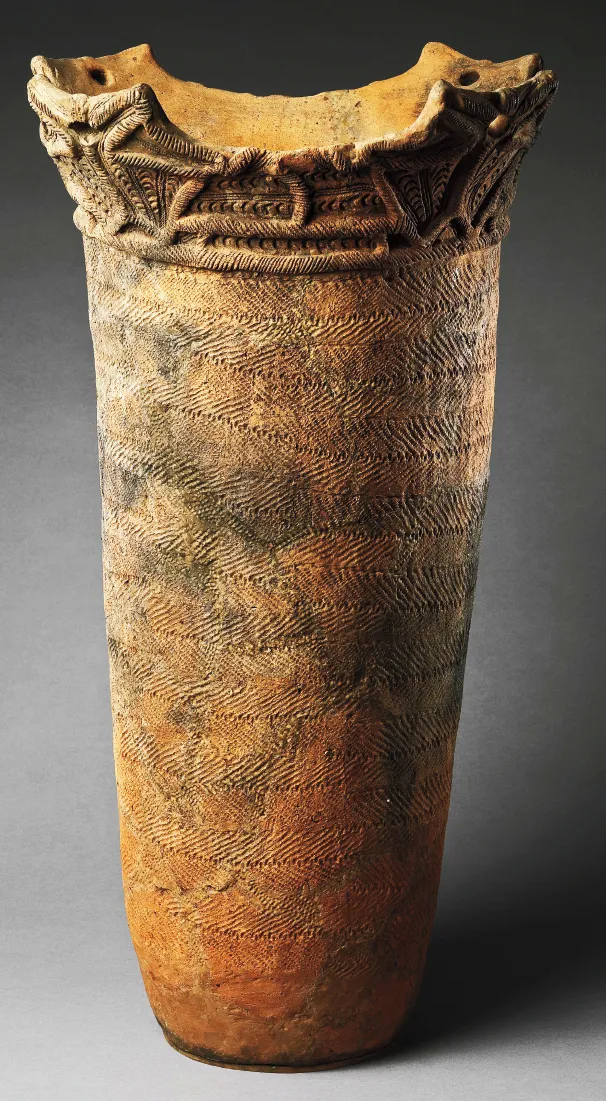
Unglazed earthenware, sometimes called terracotta, is the world’s oldest pottery (fig. 1.1), dating to even before the Neolithic period (the New Stone Age) when pottery making became widespread, and is still being made today. Early potters developed several ways of strengthening their pots. To decrease shrinkage and cracking while drying and firing, a temper such as sand or crushed stone, grog (crushed potsherds), shell, or organic material (e.g., straw) would be added to the clay. To smooth the surface of pots and make them less likely to leak, the exterior could be burnished with a stone and/or coated with refined slip (liquid clay) before firing. Decorative techniques include incising, stamping, modeling the damp clay, and painting before or after firing.
Glaze is the glassy coating that seals a pot and enhances its appearance. Two types of glaze have been used on folk earthenware, as well as on the fritware that follows: lead glaze and low-fired alkaline glaze. In the former, lead serves as a flux to help melt the glassy ingredient (quartz or flint); in the latter, confined to the Middle East, an alkaline substance such as plant ash serves the same purpose. These glazes do not always bond well to the clay body, so a small amount of body clay could be added to a lead-glaze solution for a better fit, giving the normally clear finish a yellowish cast when fired. Historic Euro-American earthenware is often referred to as redware, with the lead glaze intensifying the reddish color of the clay beneath it.
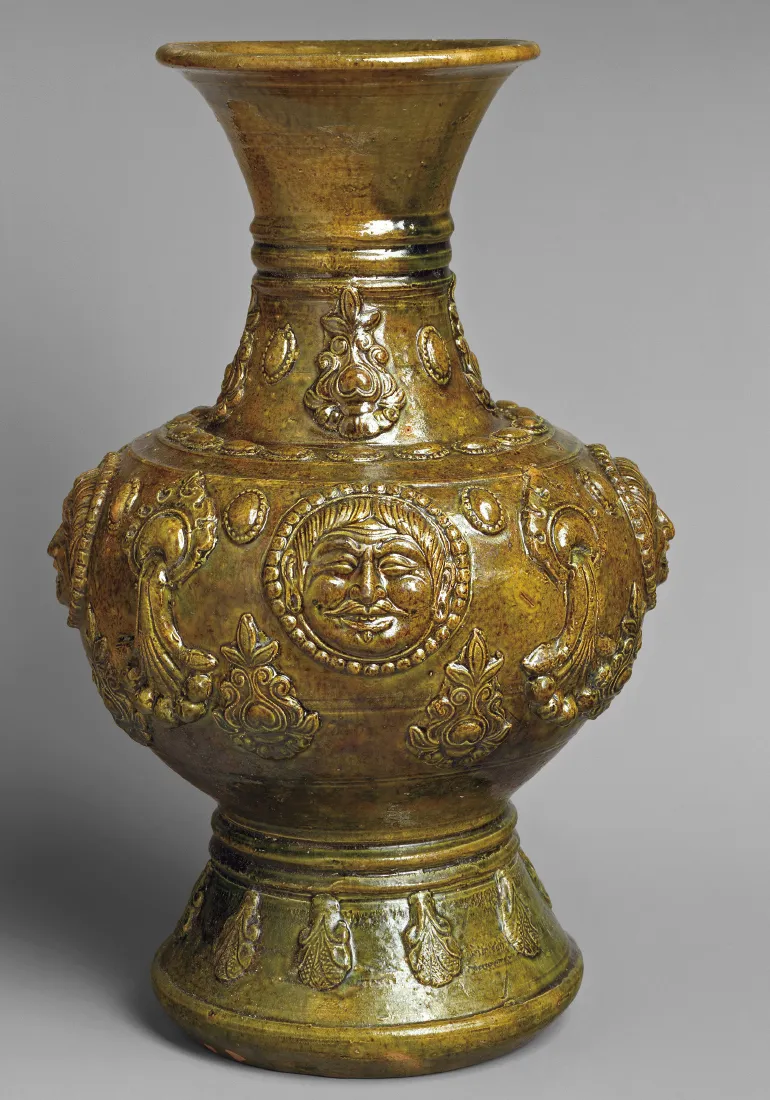
The ways in which glazed earthenware can be decorated provide stylistic clues about when and where it was made and the society that created it. The most basic approach is to color the glaze with a metallic oxide, the commonest being copper for green (fig. 1.2), iron for brown, and manganese for dark brown or purple-black (fig. 1.3). Adding tin oxide turns a clear glaze white and opaque, an ideal “canvas” on which to paint (fig. 1.4).
Slip (clay—white or colored—liquefied to the consistency of cream) can be applied to contrast with the body clay. Three widespread approaches to slip decoration are trailing, sgraffito, and inlay. For trailing, the slip, controlled by the decorator’s hand movements, flows from a container through a narrow tube to lay a design onto the pot’s surface (figs. 1.3 and 1.5). For sgraffito, a pot’s surface is first coated with white slip, then a design is scratched or scraped through this engobe to expose the dark clay beneath (fig. 1.6). Slip inlay, practiced in the earthenware tradition of Sussex, England (fig. 1.7), as well as the stoneware traditions of Korea (sanggam) and Japan (mishima), involves cutting or impressing designs or letters into the damp clay that are then filled with slip. Further decorative techniques are underglaze painting, overglaze enameling, and lusterware with copper, silver, or gold salts painted on tin glaze for a metallic sheen (fig. 1.8).
Figure 1.1. Terracotta fukabachi (deep jar) with cord-impressed herringbone pattern, 27½" high, Aomori Prefecture, Japan, Middle Jōmon (“cord-marked”) period, ca. 2500 BCE, representing one of the world’s oldest pottery traditions. Collection of the Metropolitan Museum of Art, New York, www.metmuseum.org.
Figure 1.2. Earthenware jar with copper-green lead glaze and sprig-molded reliefs of Central Asian and Buddhist influence, China, Sui dynasty, late 6th century CE. Collection of the Metropolitan Museum of Art, New York, www.metmuseum.org.
Fritware
Fritware, or stonepaste, was created by medieval Islamic potters in response to imported Chinese white wares that were greatly admired for their blankness. Its composite body (related to that of earlier Egyptian “faience” and later European soft-paste porcelain), which combined quartz, clay, and an alkaline flux fused into a glassy frit, is light in color and thus suited to painted decoration (fig. 1.9).4 The fritware of Ottoman Turkey, called çini, continues today in an improved version.
Stoneware
Composed of a fine-grained clay that vitrifies at high temperature (typically 2300°F/1260°C), stoneware fires to a light gray, tan, or buff color and, as the name indicates, is hard as stone and thus able to withstand rough usage. The successful development of stoneware depended on the discovery of high-firing refractory clays and advances in kiln design.
There are two very different approaches to glazing traditional stoneware. The earliest, developed in China before the time of Christ and later spread to Korea, Japan, and Southeast Asia, is high-firing alkaline glaze, with plant ash and/or lime acting as a flux to help melt a silica source such as quartz or feldspar (fig. 1.10). When body clay is added as a binder, iron in the clay colors the glaze green in a reduction (smoky) kiln atmosphere and brown in an oxidizing (carbon free) one. A natural ash glaze occurs when wood-fuel ashes blown by the kiln draft from the firing chamber melt on the ware; one origin theory is that Asian potters observing this began to add ashes as an intentional glaze, prepared as a solution for coating the wares prior to firing. How Far Eastern alkaline glazes came to be used on folk stoneware of the American South will be considered in Chapter 3.
Chinese potters of the Song dynasty (960–1279 CE) created a range of colors in their glazes by carefully controlling the...