Essays exploring the methodologies used by film scholars to develop a spatial history of the moving image.
Leading scholars in the interdisciplinary field of geo-spatial visual studies examine the social experience of cinema and the different ways in which film production developed as a commercial enterprise, as a leisure activity, and as modes of expression and communication. Their research charts new pathways in mapping the relationship between film production and local film practices, theatrical exhibition circuits and cinema going, creating new forms of spatial anthropology. Topics include cinematic practices in rural and urban communities, development of cinema by amateur filmmakers, and use of GIS in mapping the spatial development of film production and cinema going as social practices.
"Introduces some of the concrete ways practical mapping and GIS technologies help elaborate historical film projects. . . . The scope of many of these projects is breathtaking in scale. . . . Others embrace ethnographic methods that tell poignant individual stories. Still others deftly merge qualitative and quantitative approaches. . . . As a whole, the volume brings together disparate fields of study in interesting ways." —James Craine, California State University, Northridge
"This collection breaks new ground for cinema history. Hallam and Roberts have gathered some of the foremost scholars who are mapping spatial histories of the moving image and the geographies of film production, distribution and consumption. Introducing new interdisciplinary methods and asking new questions,
Locating the Moving Image takes film studies into new territory, beyond the boundaries of the text and its interpretation, towards an understanding of the relationship between culture, spatiality and place." —Richard Maltby, Matthew Flinders Distinguished Professor of Screen Studies, Flinders University
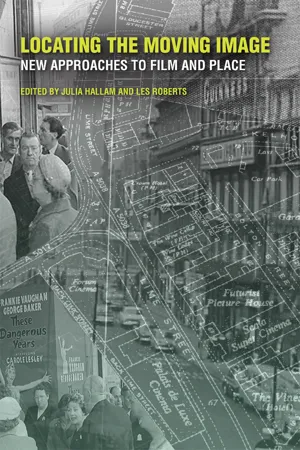
eBook - ePub
Locating the Moving Image
New Approaches to Film and Place
- 276 pages
- English
- ePUB (mobile friendly)
- Available on iOS & Android
eBook - ePub
Locating the Moving Image
New Approaches to Film and Place
About this book
Trusted by 375,005 students
Access to over 1.5 million titles for a fair monthly price.
Study more efficiently using our study tools.
Information
ONE
Film and Spatiality: Outline of a New Empiricism
SPATIAL (RE)ORIENTATIONS: INTERDISCIPLINARY EXCURSIONS
Metaphor is never innocent. It orients research and fixes results.
—JACQUES DERRIDA
In recent years ideas of the spatial and the cinematic have come together in an irresolute fashion, each fumbling hesitantly toward the other without appearing entirely sure of how or indeed if the other might respond. Discussions and debates around themes of, for example, cinematic geography, cartographic cinema, cinematic cartography, cinematic urbanism, urban cinematics, urban projections, movie mapping, cinetecture, city in film, cinematic city, geography of film, cinematic countrysides, and so on,1 while testament to a rich and ever more expansive discourse on film, space, and place (albeit one with a disproportionate skew toward the urban), may also be seen as a jumble of discursive waypoints that confound as much as guide our way through a critical landscape that at times resembles an interdisciplinary quagmire.
Spatiality may be the common currency, but, much like the volatile euro, it struggles to hold together an otherwise fractured union that, in disciplinary terms at least, is just as likely to entrench as dissolve its internal borders. Part of the problem lies in the way specific film/space neologisms lay claim to a specificity of meaning and practice that is all too rarely self-evident. It is always therefore necessary to dig deeper around the terms to excavate a fuller understanding of how they are being theorized, what epistemological foundations they are built upon, who is advancing the arguments, and what disciplinary background he or she is coming from. As the briefest of surveys of recent literature makes plain, what might be meant by, say, the geography of film is open to any number of competing and overlapping claims. Take cartographic cinema and cinematic cartography, for example. Just how navigable is the pathway that leads us from Tom Conley's elaboration of the former to that of Sébastien Caquard or Les Roberts,2 each of whom have deployed the term “cinematic cartography” in ways that are not only different from each other, but which are both markedly different from Conley's ideas on cartographic cinema or Giuliana Bruno's writings on film, cartography, and the psychogeographies of (e)motion?3 Although it is certainly navigable, it is by no means as straightforward a journey as the terms themselves might lead us to believe. A widespread and seemingly contagious spread of metaphors of mapping across social and cultural fields of study further complicates attempts to nail down the conceptual parameters by which ideas of cartography in relation to film might be generically understood. As Conley himself notes, “[t]he field of cultural studies is riddled with the idea of ‘mapping.’”4 Indeed, a search on Google Scholar for the social sciences, arts, and humanities reveals nearly forty thousand academic texts with the word “mapping” in the title. “Locating” the moving image is, therefore, in the first instance a process of “mapping” the meanings that have variously clustered around discussions of space and place in recent studies on film history and practice.
Wittingly or otherwise, the essays in this book all represent more hands-on responses to the metaphorization of space and cartography that has overshadowed the development of more practice-oriented approaches to cultural mappings.5 While, on the one hand, they may be cited as evidence of a spatial turn6 in the humanities and social sciences (and in film studies research more particularly), they also—and perhaps more persuasively—may be seen as examples of a shift away from a self-regarding rhetoric of space that has, in the words of Henri Lefebvre, “become the locus of a ‘theoretical practice’ which is separated from social practice and which sets itself up as the axis, pivot or central reference point of Knowledge.”7 Each of the contributions therefore proceeds from the premise that spatial methods and analyses are not ends in themselves (a meta-theoretical foray into the innate spatialities or cartographic properties of the cinematic medium) but are more productively deployed as tools and apparatuses for exploring the social, cultural, and economic geographies surrounding different forms of film practice and consumption. Mapping as mapping, in other words, as analytical engagement with, on the one hand, maps and mapping practices as a means to explore new approaches and understandings of film and spatiality, and, on the other, with digital mapping and geospatial technologies that scholars are increasingly turning to as further explorations in this field continue to gather pace.
One of the chief aims of this book is to demonstrate the ways in which spatial methodologies are reinvigorating film scholarship by charting new pathways (figuratively and geographically) through the multilayered landscapes of film production, distribution, exhibition, and consumption. In this respect the contributions each serve to amply illustrate Franco Moretti's observation that maps function “as analytical tools [that bring] to light relations that would otherwise remain hidden.”8 These new approaches to film, space, and place thus expand understandings of the spatial histories and spatial geographies of the moving image by allowing fine-grained analysis of relations and correlations that would offer themselves up less readily by other means. In this regard, as well as probing questions of spatiality and exploring the methodological advantages of GIS (geographical information systems) and other spatial analytic software, the common factor that binds the chapters in this book together is that they all represent significant advances toward the development of a new empiricism in film studies research, one that is concerned with moving away from interpretive studies of cinema texts to embrace different forms of film production and consumption,9 as well as refocusing on cinema as a site of social, cultural, and economic exchange.10 It is important to stress that this need not be read as the sign of a positivistic backlash against the detailed interpretive work that has paid close attention to the formal and ideological properties of the film medium as a signifying system.11 Rather, it is more instructive to look upon these methodological shifts in film studies as a restless desire to venture further outside the confines of more traditional approaches that have centered on the study of feature films to embrace perspectives that engage wholeheartedly with the social, economic, and cultural aspects of filmmaking and viewing in its many and varied forms. The scholars whose work is presented in this volume come from a diversity of interdisciplinary backgrounds and with that diversity bring new approaches to the study of film that embrace the heterogeneity and complexity of film's sociality.
Dismissive of the theoretical paint-by-numbers approach he sees as a dominant trend in current film discourse, filmmaker Allan Siegel argues that “present discursive practices surrounding the medium of film tend to exaggerate the decoding, deconstructing, and dissecting of the film text at the expense of those quotidian media creating experiences that elucidate and alter social space.”12 Siegel is by no means the first to voice exasperation at a critical default setting that has it that if you are doing film studies you are in the business of doing textual analysis, and that if you are doing textual analysis you will perforce be in the business of doing theory. Robert Allen notes that at the 2008 Society for Cinema and Media Studies (SCMS) conference in Philadelphia, three out of three hundred panels were focused on the sociality of cinema and that two-thirds of the one thousand papers presented involved readings of films. For Allen, this brought to the fore the need to redefine what his object of study is13 (see also Allen, this volume) and to press the case for a re-evaluation of the role of empirical methods in a discipline hitherto characterized by “its suspicion of the empirical and [its] tendency to confuse intellectual engagement with the empirical world outside the film text with empiricism.”14
If the SCMS example may be read as an indicator of a general ambivalence toward the empirical, not to mention an apparently deep-seated conservatism, then it is one that also brings with it the recognition that exploring other avenues of research (such as those that have drawn film scholars further into the domains of geography and history) demands intellectual engagement and dialogue that ventures beyond fixed disciplinary boundaries. This may also engender a degree of suspicion or anxiety inasmuch as it entails straying into less familiar territory, and hence it brings with it the need (or, as might also be the case, reluctance) to chart more uncertain terrain. In his masterful study of film noir and urban space, Ed Dimendberg notes that film scholars all too rarely “travel to the extra-cinematic precincts of geography, city planning, architectural theory, and urban and cultural history.”15 If we apply this formula to Charlotte Brunsdon's London in Cinema, which by the author's own admission makes only “fleeting reference to significant aspects of London's cultural history and geography,”16 then we obtain a clearer picture of the way what is meant by “cinematic geography” in any given context is shaped with a particular constituency in mind, in this latter instance a film studies readership for whom the films, rather than the city, come first. Yet, as Dimendberg observes, “[t]reating the city as expression of some underlying myth, theme, or vision has tended to stifle the study of spatiality in film,” that is, as a historical subject matter that is “as significant as [film's] more commonly studied formal and narrative features.”17
Shifts in film scholarship that fall under the banner of what may be described as a new empiricism represent not so much a disavowal of theory, nor a post-theory battle line drawn in the sand, but are characterized instead by a methodological pragmatism in which the extra-cinematic precincts to which Dimendberg refers are seen as productive terrain for the cultivation of new research questions and for the development of different critical and theoretical approaches and perspectives. Insofar as these precincts play host to a coy exchange of interdisciplinary gestures, they stake out a space of potentiality that may take the form of “empty meeting grounds”—“characterized by bad faith and petty suspicion on both sides,”18 but may equally flourish as contact zones: dialogic spaces of encounter, negotiation, and reciprocal exchange.19
On a practical level, for film researchers venturing into the world of geospatial computing, one of the most important issues to contend with is, of course, the difficulties faced in getting to grips with what, for the initiate, may seem like baffling and intimidating technology. In the early stages of the research this is often compounded by the researcher not necessarily being fully abreast of the full range of functionalities that GIS technologies can deliver. This brings with it the problem that a certain level of experimentation may be necessary before the scope and detail of the research questions and objectives become fully apparent. Given the steep learning curve demanded by software such as ArcGIS, those with no more than an approximate notion of where this geospatial dalliance may potentially lead them might well be disinclined to fully take the plunge, or might simply not have the time or resources to do the groundwork necessary to flesh out a viable project proposal.20 On the other hand, it might be the case that a clear set of research questions has been formulated, in which case the challenge is to determine in what ways the technology can be harnessed to inform the research process and, as with the examples presented in this collection, to successfully deliver the project objectives. Such a scenario would in all likelihood entail the film researcher venturing across campus to seek advice from, or pitch a collaborative idea to, colleagues in the geography, computing, architecture, or civic design departments. This is where things can often get interesting, where the rhetoric of interdisciplinarity gets put to the test.
The hesitance of some in the film studies community to breach the interdisciplinary divide is certainly understandable insofar as an impression is cultivated that to do so risks entanglement with positivistic frameworks of analysis that fly in the face of the more critical, interpretive, and qualitative epistemologies more typically associated with film studies research. Although such an impression certainly downplays the extent to which film has long been of interest to geographers, urbanists, architects, and others working in so-called spatial disciplines, there nevertheless remains the attendant perception of wandering into an interdisciplinary zone of ontological insecurity in which the familiar landmarks and intellectual habitus that discursively locate the film scholar are thrown into flux.
Similarly, for those working in the geospatial sciences and computing, whose perspectives are more likely to be shaped by quantitative and statistical modes of analysis, measurement and survey, urban design, or land management, the more fuzzy humanistic language of film and cultural studies might also induce a certain level of insecurity to the extent that an alliance with the more interpretive paradigms routinely employed by film scholars might be seen in some way to compromise their reputation as “hard” scientists engaged in rigorous empirical research. Playing or performing their respective language games—a concept developed by the philosopher Ludwig Wittgenstein to “bring into prominence the fact that the speaking [and use] of a language is part of an activity, or of a form of life”21—scholars from across disciplines are to a certain extent only able to meaningfully converse by acquiescence to a process of what the anthropologist Tanya Luhrmann refers to as “interpretative drift.” This refers to the slow shift in interpretation whereby “ideas about the world become persuasive as a by-product of a practice.”22 Given that the practice of interdisciplinarity as a process of interpretive drift entails a certain investment in terms of the utility and application that scholars might wish to benefit from in the longer term, then this too represents a factor that might militate against the otherwise enthusiastic consummation of an interdisciplinary marriage. In instances where the union is, let's say, more transactional, that is, wedded to short-term benefits without the expectation of longer-term commitment, the nature of the collaboration may take the form of an instrumental stitching together of two disciplinary perspectives that in all other respects have remained unyielding to the advances of the other.
The point we are making, therefore, is that the more “spatial” the spatial turn in film studies becomes, the more that questions surrounding the negotiation, management, and sustainability of interdisciplinary research into film and spatiality warrant critical attention. Accordingly, one of the aims of this introduction is to reflexively observe the research process, basing our discussion on the example of the University of Liverpool's Mapping the City in Film project, which formed part of a wider interdisciplinary researc...
Table of contents
- Cover Page
- Title Page
- Copyright Page
- Contents
- • Acknowledgments
- 1 - Film and Spatiality: Outline of a New Empiricism
- 2 - Getting to “Going to the Show”
- 3 - Space, Place, and the Female Film Exhibitor: The Transformation of Cinema in Small-Town New Hampshire during the 1910s
- 4 - Mapping Film Exhibition in Flanders (1920–1990): A Diachronic Analysis of Cinema Culture Combined with Demographic and Geographic Data
- 5 - Mapping the Ill-Disciplined? Spatial Analyses and Historical Change in the Postwar Film Industry
- 6 - Mapping Film Audiences in Multicultural Canada: Examples from the Cybercartographic Atlas of Canadian Cinema
- 7 - The Geography of Film Production in Italy: A Spatial Analysis Using GIS
- 8 - Mapping the “City” Film 1930–1980
- 9 - Retracing the Local: Amateur Cine Culture and Oral Histories
- 10 - Beyond the Boundary: Vernacular Mapping and the Sharing of Historical Authority
- 11 - Afterword: Toward a Spatial History of the Moving Image
- • Contributors
- • Index
Frequently asked questions
Yes, you can cancel anytime from the Subscription tab in your account settings on the Perlego website. Your subscription will stay active until the end of your current billing period. Learn how to cancel your subscription
No, books cannot be downloaded as external files, such as PDFs, for use outside of Perlego. However, you can download books within the Perlego app for offline reading on mobile or tablet. Learn how to download books offline
Perlego offers two plans: Essential and Complete
- Essential is ideal for learners and professionals who enjoy exploring a wide range of subjects. Access the Essential Library with 800,000+ trusted titles and best-sellers across business, personal growth, and the humanities. Includes unlimited reading time and Standard Read Aloud voice.
- Complete: Perfect for advanced learners and researchers needing full, unrestricted access. Unlock 1.5M+ books across hundreds of subjects, including academic and specialized titles. The Complete Plan also includes advanced features like Premium Read Aloud and Research Assistant.
We are an online textbook subscription service, where you can get access to an entire online library for less than the price of a single book per month. With over 1.5 million books across 990+ topics, we’ve got you covered! Learn about our mission
Look out for the read-aloud symbol on your next book to see if you can listen to it. The read-aloud tool reads text aloud for you, highlighting the text as it is being read. You can pause it, speed it up and slow it down. Learn more about Read Aloud
Yes! You can use the Perlego app on both iOS and Android devices to read anytime, anywhere — even offline. Perfect for commutes or when you’re on the go.
Please note we cannot support devices running on iOS 13 and Android 7 or earlier. Learn more about using the app
Please note we cannot support devices running on iOS 13 and Android 7 or earlier. Learn more about using the app
Yes, you can access Locating the Moving Image by Julia Hallam, Les Roberts, Julia Hallam,Les Roberts in PDF and/or ePUB format, as well as other popular books in Médias et arts de la scène & Direction et production de films. We have over 1.5 million books available in our catalogue for you to explore.