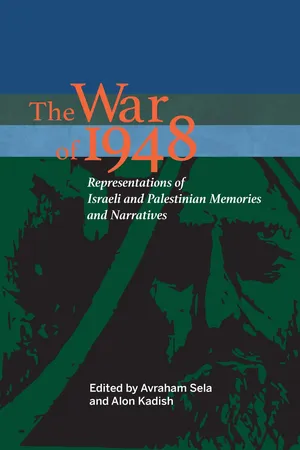
The 1948 War is remembered in this special volume, including aspects of Israeli-Jewish memory and historical narratives of 1948 and representations of Israeli-Palestinian memory of that cataclysmic event and its consequences. The contributors map and analyze a range of perspectives of the 1948 War as represented in literature, historical museums, art, visual media, and landscape, as well as in competing official and societal narratives. They are examined especially against the backdrop of the Oslo process, which brought into relief tensions within and between both sides of the national divide concerning identity and legitimacy, justice, and righteousness of "self" and "other."
eBook - ePub
The War of 1948
Representations of Israeli and Palestinian Memories and Narratives
- 242 pages
- English
- ePUB (mobile friendly)
- Available on iOS & Android
eBook - ePub
The War of 1948
Representations of Israeli and Palestinian Memories and Narratives
About this book
Trusted by 375,005 students
Access to over 1.5 million titles for a fair monthly price.
Study more efficiently using our study tools.
Information
1The 1948 Palestine War on the Small Screen
A Comparative Analysis of Its Representation in Two Israeli Television Series
Introduction
Televised history has become the focus of growing academic research, which examines its uniqueness compared to the tradition of written history, and emphasizes its significant role in shaping collective memory. Film and television became central mechanisms of memory construction during the second half of the twentieth century and Western scholarship has long been emphasizing the power of fictional as well as documentary film in the representation of history1 and defending television’s capabilities to “mediate” history successfully against those who doubt it.2 According to Edgerton, televisual characteristics such as immediacy, dramatization, personalization, and intimacy, all shape the medium’s interaction with the past. Sorlin mentions the potential of television’s serials to expose “long durations,” describe mental and social processes, and create meaningful encounters with historical figures.
Wars have been particularly attractive as a central subject of prominent television series, both documentary and fiction. From the 1940s’ Why We Fight, through the 1970s’ The World at War, to Ken Burns’s The Civil War, the drama, visuality, and extended impact of war inspired the creation of series that became landmarks in the history of television documentary.3
The two Israeli historic-documentary series examined here also have war as a central subject: the 1948 War, a major signpost in the Arab-Israeli ongoing conflict. The series are Amud Ha’esh (Pillar of Fire4) and Tkumah (Revival5). The series were produced by the state owned Israeli Television Channel One, a generation apart. Pillar of Fire (POF) is a product of the late 1970s, at the apex of Israel’s most agonizing years following the traumatic 1973 Yom Kippur War and sense of growing international isolation, which culminated in the 1975 UN Resolution that “Zionism is a form of racism.” Its creators’ express goal was to explain and justify the Zionist ethos and celebrate the Zionist enterprise.6 The series covers the period of 1896–1948, from the beginning of political Zionism to the founding of the State of Israel. Each of its 19 chapters is one hour in length. When it was first broadcast in 1981 it earned an 89 percent rating (high even when considering that there was only one channel then).
Tkumah (TK) was produced in the mid-1990s, toward the state’s jubilee celebration in 1998, when it was first broadcast. In an era of multi-channel television it still earned a 30 percent rating. Despite the time gap between them, TK was a continuation of POF in that it sought to encompass the first 50 years of Israel. It covers the period from the 1930s, the prologue to the 1948 War, until the assassination of Prime Minister Rabin in 1995, which the series perceived as a breakdown of the Oslo process and the loss of hope for its further development. It reviews this period with a critical eye, its creators’ declared wish being to express the state’s multi-vocality and introduce to the Israeli public hitherto silenced counter-narratives.7
The production processes of the two series largely correspond to their ideological approaches. POF is practically the unified creation of its main editor and scriptwriter Yigal Lossin, then director of programming and creator of news magazines and documentary programs and series on Channel 1. TK’s 22 one-hour chapters, on the other hand, were created by 19 of the country’s leading documentary directors. The series’ chief editor, Gideon Drori, was a producer, director, and editor of Channel 1, who had participated as a director-editor in the production of POF at the time. Drori, who passed away in 2005, was also a known civil rights activist. He drew-up general guidelines for TK, but the directors had enough artistic freedom to put together a complex, multi-vocal view of the period.
During the 20-year gap between the two series significant changes affected the Zionist hegemonic master-narrative: its dominant status weakened, especially with the emergence as of the late 1980s of a “new history” of Israel’s early years represented by critical young historians, who challenged the Zionist-Israeli foundational assumptions and mythical ethos, especially policies and practices in and around the 1948 war. Drawing on newly released official archives, these historians pointed to Israel’s active role in the creation of the Arab-Palestinian refugee problem,8 triggering broad academic and public controversies.9
These changes were expressed in the cultural scene, notably in film and television. Researchers offered the following periodization of Israel’s cinematic history:10 Films about pioneers made before the establishment of the state and the nationalist-heroic cinema that followed the state’s birth adhered to the Zionist narrative, including adoration of pioneering and negative approach to Arabs and their narrative. Significant change began in the 1970s and peaked in the 1980s, with what Gertz referred to as “the cinema of the stranger and deviant” or what Shohat called “the Palestinian wave,” that gave voice to the Arab-Palestinian and additional “other” protagonists, like new immigrants and Sephardic (Oriental) Jews. Although early harbingers of a different and critical approach were produced much earlier,11 it took more than a decade before films critical of the Zionist ethos and its realization were proliferating and screened in cinemas and on television. Films such as Khirbat Khiz’ah, Khamsin, and Behind Bars, produced in 1978, 1982, and 1984, respectively, exhibit a new approach to the Arab-Israeli conflict and to the position of the Arab in the Zionist narrative. Simultaneously, history textbooks began to give more expression to the Arab point of view and negative Arab stereotypes diminished.12 The 1948 War and the Palestinian Arab refugee problem were central subjects of these critical tendencies.
The comparative study here places POF and TK within this changing Israeli reality. It uses narratological-semiotic research tools for analysis of the televisual text, with the purpose of showing that different constructive means are used to represent the different ideologies of the two series. The chapter examines four major aspects of the 1948 War as represented by both series. It first describes the place of the 1948 War in the serial narrative of each series, concentrating on temporal and plot structures. It then proceeds to exhibit the modes each series uses to represent the Arab side. The third aspect it examines is the representation of the Palestinian refugee problem, while the last one shows the difference between the series in the treatment of major aspects of the Zionist ethos of the War. The chapter thus aims to give full insight into the concept each series presents of the War, as well as to illustrate the total inseparability of “form” from “content.”
The 1948 War in the Serial Narrative of Each Series
The 1948 War is a central topic in both series but functions differently in each of them: while in POF it is the final and ultimate phase toward the yearned goal of a Jewish state, in TK it is an initial, traumatic event, with far-reaching implications for the years to come.
The Jewish/Israeli-Arab conflict is a central theme in POF. Its presence is gradually magnified as the series progresses. The Conflict is described as a total conflict between two sides: the Jewish community (Yishuv), which struggles to realize the Zionist vision of Jewish statehood, and the Arabs—of Palestine and the neighboring countries—and their leaders, whose purpose is to destroy the Zionist enterprise. The Conflict is present from the very start of the series’ narrative. In chapter 2, “The Arabs Awaken,” the attack on the Tel-Hai settlers in March 1920 is described, as well as the April 1920 Arab riots in Jerusalem, the first major violent attack perpetrated by Arab-Palestinians against Jews recorded in the series. The developing violent conflict is the central axis of the complex political struggle described in the series, which revolved on Jewish immigration and settlement and the emerging option of dividing the country between the adversaries.
The series elaborates on the Arabs’ 1921 and 1929 riots and the 1936–39 revolt. It describes in detail the suffering and victims of Arab violence on the Jewish side, such as the massacre of 67 members of the historic Hebron community in August 1929. The Zionist legitimate response to the Arab violence, according to the series, was the creation of Jewish defensive organizations: Ha-Shomer (The Watchman) in 1909, the Haganah (Defense) in 1920—and within it the Palmach (abbreviation of Strike Companies) in 1941—which later transformed into the Israel Defense Forces (IDF). Representation of the Conflict culminates in the series’ last three chapters: the Arabs’ refusal to accept the November 29, 1947, UN Resolution on the partition of Palestine into Jewish and Arab states and the declaration of war against its implementation. The series ends in May 1948 with the proclamation of the State of Israel. The war is still raging, but Israel’s victory is imminent.
In TK the 1948 War is the first round in the swelling Israeli-Arab conflict, which is the central axis of the series. It is situated right after the prologue in chapter 1. Chapters 2 and 3 describe the battles of the war: the first presents the coping of the Yishuv and its defense forces with the first stages of the war—the November 1947 UN resolution on partition until May 1948—while chapter 2 shows the continuation of the war after the establishment of the state and describes its heavy price in human losses (constituting one percent of the current Jewish population). Unlike POF, TK does not emphasize the story of two morally opposite parties, i.e., the Jewish one preoccupied with construction while the Arabs sought destruction. Rather, it depicts the War as the case of two sides entangled in a fatal struggle, for which both share the responsibility and from which both suffer heavily.
The temporal structure of the two series further clarifies the different functions of the 1948 War in each of them. The basis for the analysis here is Genette’s typology,13 which analyzes what he entitles “tense,” by showing the author’s choices in the categories of “order,” “duration,” and “frequency.” POF is found to be chronological and diachronic, as far as the order of events is concerned. It presents a complete linear narrative from beginning to end, which serves its overarching plot—“from Diaspora to National Revival.” A discernible tendency of deceleration is identified from chapter 14 onward. Instead of the “summary” characterizing the first part of the series, with chapters covering periods of about ten years, a “slowdown” is observed toward the end. Chapters 17 and 18 cover about half a year each, and the final chapter 19 describes a period of less than two months. Thus the events between the UN resolution and the declaration of the State of Israel gain extra significance. The political victory of Zionism combined with the ultimate military struggle to protect the newly born state receive considerable “commemorative time”14 and are emphasized as the result and the objective of a long historical process.
TK’s temporal structure is different and more complex: it is chronological and thematic at the same time. Chapters of the chronological axis deal with primary episodes in the Israeli-Arab conflict, starting with the 1948 War, then the 1956 Sinai War, the 1967 Six-Day War, the 1973 Yom Kippur War, and so on. The thematic axis consists of chapters dealing with social and cultural processes, for example the great wave of immigration during the state’s first decade, relations between Oriental and European Jews, religious and secular, Left and Right politics, etc. These chapters are integrated among those describing the Israeli-Arab conflict, but do not form a chronology. This complex structure portrays the constant interaction between the Israeli-Arab conflict and the socio-cultural processes in Israel. Ideologically it points to the fact that the main events of the conflict ...
Table of contents
- Cover
- Half title
- Title
- Copyright
- Contents
- Preface and Acknowledgments
- Israeli and Palestinian Memories and Historical Narratives of the 1948 War—An Overview
- Part 1: Israeli-Jewish Narratives: Continuity and Change
- Part 2: The Politics of Space Memory
- Part 3: Palestinian Traumatic Memory
- Epilogue: Reflections on Post-Oslo Israeli and Palestinian History and Memory of 1948
- Index
Frequently asked questions
Yes, you can cancel anytime from the Subscription tab in your account settings on the Perlego website. Your subscription will stay active until the end of your current billing period. Learn how to cancel your subscription
No, books cannot be downloaded as external files, such as PDFs, for use outside of Perlego. However, you can download books within the Perlego app for offline reading on mobile or tablet. Learn how to download books offline
Perlego offers two plans: Essential and Complete
- Essential is ideal for learners and professionals who enjoy exploring a wide range of subjects. Access the Essential Library with 800,000+ trusted titles and best-sellers across business, personal growth, and the humanities. Includes unlimited reading time and Standard Read Aloud voice.
- Complete: Perfect for advanced learners and researchers needing full, unrestricted access. Unlock 1.5M+ books across hundreds of subjects, including academic and specialized titles. The Complete Plan also includes advanced features like Premium Read Aloud and Research Assistant.
We are an online textbook subscription service, where you can get access to an entire online library for less than the price of a single book per month. With over 1.5 million books across 990+ topics, we’ve got you covered! Learn about our mission
Look out for the read-aloud symbol on your next book to see if you can listen to it. The read-aloud tool reads text aloud for you, highlighting the text as it is being read. You can pause it, speed it up and slow it down. Learn more about Read Aloud
Yes! You can use the Perlego app on both iOS and Android devices to read anytime, anywhere — even offline. Perfect for commutes or when you’re on the go.
Please note we cannot support devices running on iOS 13 and Android 7 or earlier. Learn more about using the app
Please note we cannot support devices running on iOS 13 and Android 7 or earlier. Learn more about using the app
Yes, you can access The War of 1948 by Avraham Sela, Alon Kadish, Avraham Sela,Alon Kadish in PDF and/or ePUB format, as well as other popular books in History & Jewish History. We have over 1.5 million books available in our catalogue for you to explore.