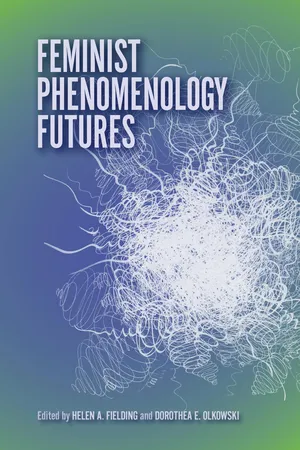
Distinguished feminist philosophers consider the future of their field and chart its political and ethical course in this forward-looking volume. Engaging with themes such as the historical trajectory of feminist phenomenology, ways of perceiving and making sense of the contemporary world, and the feminist body in health and ethics, these essays affirm the base of the discipline as well as open new theoretical spaces for work that bridges bioethics, social identity, physical ability, and the very nature and boundaries of the female body. Entanglements with thinkers such as Heidegger, Merleau-Ponty, Beauvoir, and Arendt are evident and reveal new directions for productive philosophical work. Grounded in the richness of the feminist philosophical tradition, this work represents a significant opening to the possible futures of feminist phenomenological research.
eBook - ePub
Feminist Phenomenology Futures
- 400 pages
- English
- ePUB (mobile friendly)
- Available on iOS & Android
eBook - ePub
Feminist Phenomenology Futures
About this book
Trusted by 375,005 students
Access to over 1.5 million titles for a fair monthly price.
Study more efficiently using our study tools.
Information
Topic
PhilosophySubtopic
Ethics & Moral PhilosophyPART 1
THE FUTURE IS NOW
1 USING OUR
INTUITION
Creating the Future Phenomenological Plane of Thought
INTRODUCTION: USING OUR INTUITION
What is intuition? Both philosophical and psychological understandings of the idea of intuition may have left feminist philosophy with more questions than answers. Is intuition a sixth sense? Is it cognitive or sensory or something else? Michèle Le Doeuff has pointed out that intuition, in classical philosophical language, designates a mode of immediate apprehension, a direct intellectual grasp as opposed to mediated knowledge achieved through reasoning, discussion, internal debate, dialectic, experimentation, deduction, language, or proofs. Given this definition, intuition was once thought to be a valid mode of knowledge. It was thought to cooperate with these various methods of inquiry and to be what sets the process of discovery in motion as well as what completes it.
But today, according to Le Doeuff, intuition is no longer respected. Hegel is charged with having replaced intuition with conceptual analysis. Intuition, he insisted, does not reflect upon itself and so is nothing more than beautiful thoughts. Beautiful thoughts are not knowledge. In this way, intuition was separated from discourse, and that was its demise. For without discourse, intuition ceases to be understood as a precise method or system.1 It ceases to have usefulness and value. Nonetheless, I am advocating that we consider intuition as a method within a structure, a structure within which feminist phenomenology can make its future as the future of phenomenology.
HOW TO DO THIS
Let us begin, of course, with the situated woman whose thinking sets the process of discovery in motion. The situated woman is an embodied woman. In what is by now a well-known phrase, Simone de Beauvoir asserts that the body is not a thing but a situation.2 A body that is a situation and is not a “thing” changes. So if the body is precisely the situation in which we grasp the world and set the process of discovery in motion, the situated woman is “embodied, inter-subjective, shaped by history, culture, and society,” and, importantly, actively engaged with the world.3 Thus, the situated, embodied woman’s temporalization is intrinsic to her being, which is not that of an unchanging thing.
And yet in practice the situated woman’s embodiment has yet to be fully recognized as her freedom, her transcendence. She is often seen as embedded in her embodiment. But this understanding can change. We can make use of “intuition” in a precise and determinate sense to make this change. But first, in order to proceed, let us look more closely at the question of embodiment.
EMBEDDED IN EMBODIMENT
If one were to ask almost any phenomenological philosopher (including those gendered/sexed male) “What is feminist phenomenology about?” one answer that would invariably be offered is “Embodiment, it’s about embodiment.” Feminist phenomenology is embedded in notions of embodiment possibly because prior to feminist phenomenology, there was very little discussion in philosophy about embodiment.4
It has been well noted that philosophy’s preoccupation with reason and knowledge has recognized only somewhat recently (given its long history) that reason and knowledge were frequently defined in opposition to “feminine embodiment,” an opposition that demanded exclusion, transcendence, and domination, for embodiment appeared on the philosophical scene as an obstacle to the mind’s absolute demand for clear thinking and the drive for knowledge.5 This view had the additional impact (although some perhaps thought benefit) of depriving women of a university education and, even in the case of women who did manage to obtain such an education, of devaluing their work because of their bodies.6 For this reason, feminist phenomenologists often found their voice by bringing the body to the mind. In the Continental tradition, Edith Stein, Hannah Arendt, Simone de Beauvoir, and Luce Irigaray are frequently recognized for implicitly and explicitly raising the question of woman’s place in society, politics, and philosophy in a manner that thematizes questions of embodiment.7
But as important as embodiment is to feminist phenomenology, its significance raises the question of why embodiment became so important in phenomenological philosophy and less so in others. This in turn raises the question of method and of the plane of thought within which this concept and the method for addressing it have arisen. Of course, feminist phenomenologists remain intensely alert to questions of method.
Maurice Merleau-Ponty, somewhat subversively, called phenomenological method a style—for example, the “style” in which this particular essay is written. It is deliberately styled so as to draw attention to certain concepts. Such alterations are unexpected in academic work but sanctioned by the methodological concept of style and the phenomenological importance of lived expression addressed by this discourse.8
Edmund Husserl was profoundly attuned to the meaning of his phenomenological method. Provocatively, it has been noticed that for Husserl “phenomenology slows down the stream of consciousness,” and without this slowdown, we lose our focus on the fullness, the depth and the complexity of things, and also on the fullness of events in the world.9 This brings us to ask what it means to slow consciousness down and how this method, this slowdown alters the naïve experience of embodiment.
Bringing the body to the mind may be more complicated than constructing a syllogism, more difficult than habituation. In our daily lives, we are often expected to play certain embodied roles. As I have noted elsewhere, “Mostly we feel joy and happiness when we are expected to, and we feel sorrow and sadness when it is required of us. Illuminating an interruption or an interval in which we can slow down or refrain from these demands is exhausting and troublesome; fragile states require separation and cushioning.”10 But taking our cue from Husserl, we may not be able to carry out the slowdown of consciousness by looking directly at embodiment. It may be that looking directly is like looking at the sun—we burn our eyes.
Husserl shows us through the epoché that looking directly does not accomplish a slowdown. For example, in the current philosophical climate, the temptation to substitute naïve psychological assumptions—those of neuroscience, for example—for philosophical ideas looms over us and threatens to produce reductive imperatives about the seemingly true nature of consciousness—and so also about embodiment, the body that is brought to mind.
This is not a slowdown. It does not give us the time to grasp our consciousness as embodiment. A true epoché would give us the opportunity, not to objectify the body, but to recognize, as Sartre argued, that consciousness exists its body.11 The connection is existential, meaning lived; no thematization is necessary to bring the body to the mind if it is already a contingent point of view from which it is impossible to withdraw. From this point of view, the body is not an object; the body is the translucent matter of consciousness, a revelation for consciousness, a condition of consciousness, suffered as pleasure and pain, love and hate.12 What need is there to bring this body to consciousness?
So is it not also the case that as much as phenomenology must engage with, take its orientation from, the human and natural sciences, and now more than ever from technological sciences, we might be cautious about the kinds of claims coming from these so-called rivals?13 “To start with, the human sciences, especially sociology, wanted to replace . . . [philosophy]. . . . Then it was the turn of epistemology, linguistics, or even of psychoanalysis and logical analysis.”14
But even bigger claims come from the disciplines of communication, information science, technology, medicine, and neuroscience, all of which clamor for the title “friends of the concept” so that the “simulacrum,” the copy of the copy of the concept, has overtaken the philosophical concept, claimed its place. The simulacrum “indicates a society of information services and engineering.”15 In a situation where anyone can claim to be an authority, the Idea, the philosophical concept interrogates each claimant, exposing the simulacra, which is to say the perversion of or deviation from the Idea.
Of course, feminists have shown again and again that without non-philosophy—politics, culture, the arts and sciences—engaging with philosophy, it becomes moribund, reflecting only on itself and losing its revolutionary impetus. But if a simulacrum is all philosophy can be, then its concepts are ghostly.
Yet even if we evade the ghostly simulacrum: “Possession of the concept does not appear to coincide with revolution, the democratic State, and human rights.”16 How can this be? “As for us, we possess concepts—after so many centuries of Western thought, we think we possess them—but we hardly know where to put them because we lack a genuine plane. . . . The Greeks . . . possessed the plane that we no longer possess.”17
We contemporary feminist phenomenological philosophers need to be clear about the plane of thought within which our concepts are placed. Our cherished concept of embodiment is acquired by reflecting upon the situatedness from which we ourselves arise. But on what plane of thought is that situatedness itself located? What is a plane of thought, after all? A plane of thought has been defined as a milieu populated by concepts and methods.
Gilles Deleuze asserts that the plane of philosophy has only two facets: thought and nature or speech and bodies—two facets, two faces of the same plane of philosophy. Were we to embrace this line of thought, our philosophical plane would be immanent; it would consist of a potentially infinite field of fractals, both physical molecular fractals and molecular crystalline thoughts that are attributes of bodies.18 For example, ordinary persons caught in a shop by an armed, masked individual may find themselves in the type of situation that transforms them from shoppers into hostages. This, Deleuze claims, is an incorporeal transformation on the order of a speech act.19 It allows for a clear distinction between nature and language—that is, between the actions and passions of bodies, and the speech acts that express this in language. Since language does not penetrate bodies, language is merely attributed to bodies. Nature and language—is this all we need: a material assemblage of bodies and an abstract machine of language?
In this model, each “I” is an Other. Each “I” is the affection of a passivity that experiences its own intelligence, an intelligence operating upon it but not by it.20 It is a fractured, two-faceted, fractal “I,” a passive self, always an Other, always an effect of determinations acting upon it and so never “itself.” Thus situated by nature and thought, passive and fractured, situated embodiment is out of its reach. The “I am” that is Other does what it must. It thinks what it might. It cannot intuit nor can it create.
In nature and thought this is a beautiful image, an aesthetic image of a field of fractals and crystals. This field would constitute embodiment as an assemblage of physical forces or as a thought concept, but not as a lived assemblage and a lived expressed concept—not as situated, and not as a consciousness that exists its body.
T...
Table of contents
- Cover
- Half title
- Title
- Contents
- Copyright
- A Feminist Phenomenology Manifesto / Helen A. Fielding
- Introduction / Dorothea E. Olkowski and Helen A. Fielding
- Part 1. The Future Is Now
- Part 2. Negotiating Futures
- Part 3. The Ontological Future
- Part 4. Our Future Body Images
- Part 5. Present and Future Selves
- Index
Frequently asked questions
Yes, you can cancel anytime from the Subscription tab in your account settings on the Perlego website. Your subscription will stay active until the end of your current billing period. Learn how to cancel your subscription
No, books cannot be downloaded as external files, such as PDFs, for use outside of Perlego. However, you can download books within the Perlego app for offline reading on mobile or tablet. Learn how to download books offline
Perlego offers two plans: Essential and Complete
- Essential is ideal for learners and professionals who enjoy exploring a wide range of subjects. Access the Essential Library with 800,000+ trusted titles and best-sellers across business, personal growth, and the humanities. Includes unlimited reading time and Standard Read Aloud voice.
- Complete: Perfect for advanced learners and researchers needing full, unrestricted access. Unlock 1.5M+ books across hundreds of subjects, including academic and specialized titles. The Complete Plan also includes advanced features like Premium Read Aloud and Research Assistant.
We are an online textbook subscription service, where you can get access to an entire online library for less than the price of a single book per month. With over 1.5 million books across 990+ topics, we’ve got you covered! Learn about our mission
Look out for the read-aloud symbol on your next book to see if you can listen to it. The read-aloud tool reads text aloud for you, highlighting the text as it is being read. You can pause it, speed it up and slow it down. Learn more about Read Aloud
Yes! You can use the Perlego app on both iOS and Android devices to read anytime, anywhere — even offline. Perfect for commutes or when you’re on the go.
Please note we cannot support devices running on iOS 13 and Android 7 or earlier. Learn more about using the app
Please note we cannot support devices running on iOS 13 and Android 7 or earlier. Learn more about using the app
Yes, you can access Feminist Phenomenology Futures by Helen A. Fielding, Dorothea E. Olkowski, Helen A. Fielding,Dorothea E. Olkowski in PDF and/or ePUB format, as well as other popular books in Philosophy & Ethics & Moral Philosophy. We have over 1.5 million books available in our catalogue for you to explore.