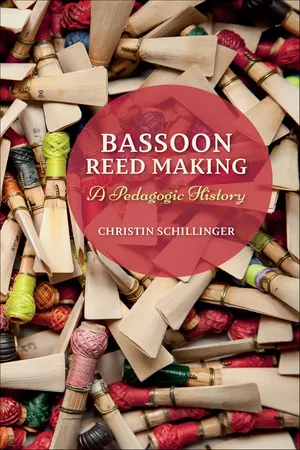
Withheld by leading pedagogues in an effort to control competition, the art of reed making in the early 20th century has been shrouded in secrecy, producing a generation of performers without reed making fluency. While tenets of past decades remain in modern pedagogy, Christin Schillinger details the historical pedagogical trends of bassoon reed making to examine the impact different methods have had on the practice of reed making and performance today. Schillinger traces the pedagogy of reed making from the earliest known publication addressing bassoon pedagogy in 1687 through the publication of Julius Weissenborn's Praktische Fagott-Schule and concludes with an in-depth look at contemporary methodologies developed by Louis Skinner, Don Christlieb, Norman Herzberg, and Lewis Hugh Cooper. Aimed at practitioners and pedagogues of the bassoon, this book provides a deeper understanding of the history and technique surrounding reed-making craft and instruction.
- 176 pages
- English
- ePUB (mobile friendly)
- Available on iOS & Android
eBook - ePub
About this book
Trusted by 375,005 students
Access to over 1.5 million titles for a fair monthly price.
Study more efficiently using our study tools.
Information
Subtopic
MusicPART I
THE HISTORY OF BASSOON PEDAGOGY
1Pedagogic Methods, 1697–1803
An Oral Tradition
During the late seventeenth and early eighteenth centuries, bassoonists trained without the modern pedagogical aids of method books, tuners, and metronomes. Formal instruction included mimicry and personal interaction with musicians. Professional musicians and bassoonists wrote pedagogic exercises for their students, the most famous being the bassoon concerti of Antonio Vivaldi. These were not concert works but primarily study pieces for the female students of the Ospedale della Pietà.1
Most texts from this era are descriptive rather than instructive, focusing on character and range and neglecting pedagogic information. They include generalized descriptions of a bassoon’s cosmetic appearance, simple tablatures, and brief summaries of use. The earliest known text directly addressing bassoon pedagogy dates from 1697. German Daniel Speer’s Grund-richtige, Kurtz- Leicht- und Nöthiger jetzt Wol-vermehrter Unterricht der Musicalischen Kunst oder Vierfaches Musicalisches Kleeblatt Worinnen zu ersehen wie man füglich und in kurzer Zeit (Fundamental instructions in the art of music . . .) is a general instruction book for multiple instruments with a fingering chart devoted to the two-keyed dulzian. Speer mentions positioning and provides a few lessons, continuing a custom established in the first woodwind instruction book, a Dutch text on recorders published in 1654. After Speer, instructional books for instruments grew in number, if not in quality, particularly in England. Eighty-two were published between 1654 and 1750. Of these, eight were French; two, German; and the remainder, English.2
The most influential instructional publications between Speer’s in 1697 and Pierre Cugnier’s in 1780 are Joseph Majer’s Museum musicum theoretico practicum (1732), Johann Philipp Eisel’s Musicus autodidaktos (1738), Johann J. Quantz’s Versuch einer Anweisung die Flöte traversiere zu spielen (1752), François Garsault’s Notionnaire, ou mémorial raisonné (1761), Jacques Hotteterre’s Méthode pour apprendre à jouer en tres peu de temps de la flûte traversière (. . .) augementée (. . .) des tablatures de la clarinette et due basson (1765), and Compleat Instructions for the Bassoon . . . (1770) by an anonymous Englishman, which marks the first instructional book dedicated entirely to the bassoon.
Joseph Friedrich Bernhard Caspar Majer’s Museum musicum (The study of music) published in 1732 with a second edition in 1741, and Eisel’s Musicus autodidaktos (Musician’s method) from 1738, offer a window into eighteenth-century instruments, performance practice, and pedagogy. Museum musicum is divided into two sections: musica theoretica (Music theory) and musica practica (Music application). First, Majer discusses music fundamentals, including clef reading, notation, meter, rhythm, and symbology. Second, he surveys multiple instruments. Beginning with vocal studies, relevant to all musical disciplines, Majer then delves into the wind family. His treatment of the bassoon (a three-keyed instrument), including a fingering chart and illustration, is the same treatment he gives to the zink, the flageolet, and the two-keyed clarinet. He completes this section with a discussion of the string family. An appendix includes a comprehensive dictionary of musical terms, a twin to Walther’s Musicalisches Lexicon (Musical dictionary) published in the same year. Walther freely borrows from Niedt’s Musicalische Handleitung (Musical guide), which had been revised by Mattheson a decade prior.3
Musicus autodidaktos (1738), written by Johann Philip Eisel, is another general instructional text for multiple instruments. For the bassoon, Eisel discusses tone production but goes no further in instruction or description of the instrument. His work is noteworthy because of its inclusion of so many instruments of the time. Like Museum musicum, the brief articles and fingering charts in Musicus autodidaktos give insight into instrument construction in 1738. Eisel presents his text as a series of questions he then answers. His accessible layout references the historical philosophers.4
Johann Joachim Quantz’s Versuch einer Anweisung die Flöte traversiere zu spielen (On playing the flute) was first published in both German and French in 1752. His flute method is widely accepted as a major resource for understanding eighteenth-century pedagogy and performance practice. It is improbable that the founding fathers of bassoon pedagogy would be unfamiliar with his pedagogical techniques and practices. Although titled “On Playing the Flute,” Quantz’s text is broad-based, accessible, and relevant to all musicians. Quantz says of his pedagogical aims, “. . . I am endeavoring to train a skilled and intelligent musician, and not just a mechanical flute player; I must try not only to educate his lips, tongue, and fingers, but must also try to form his taste, and sharpen his discernment.”5 This tutor advances far beyond the others. The depth with which it addresses topics is groundbreaking in the field of teaching. A supplement to chapter 6, “Of the Use of the Tongue in Blowing upon the Flute,” discusses the oboe and the bassoon. Entitled “Several Remarks for the Use of the Oboe and Bassoon,” it details commonalities with the flute: tonguing, double tonguing, reed quality, embouchure, and posture. In a mere six paragraphs, Quantz addresses the bassoon more fully and with more deliberation than anyone had before to then. According to Judith Schwartz, “The book affords a glimpse of a man whose opinions were based on wide experience, intelligent observation, and a keen practical sense . . . the qualities of a great teacher, musician, and human being thoroughly dedicated to his art.”6
Garsault’s Notionnaire, ou mémorial raisonné (1761) (Encyclopedia of reason) offers an all-encompassing discussion of mythology, math, religion, and music. Its treatment of the bassoon is purely descriptive, but touches on multiple subjects—for example, the role of the bassoon in an orchestra and its construction, assembly, and range. He also includes a cursory description of reed construction.7
The 1765 Bailleux edition of Jacques le Romain Hotteterre’s Méthode pour apprendre à jouer en tres peu de temps de la flûte traversière (. . .) augementée (. . .) des tablatures de la clarinette et due bassoon, (Method for Playing Flute, Recorder, and Oboe. Includes Tablatures for Clarinet and Bassoon) includes a fingering chart and general instructions for the bassoon. Although Jacques, the most celebrated of the famed Hotteterre family, was primarily a flutist, his inclusion in bassoon pedagogy stems from the importance of the Hotteterre family in instrument making during the seventeenth and eighteenth centuries. To have instructions and tablature from a maker is invaluable in tracing pedagogical lineage. Hotteterre’s pedagogical approach to the flute lasted as a model into the twentieth century; however, his name is scarcely associated with bassoon pedagogy.8
The English publishing firm Longman, Lukey and Co. released the first tutor devoted entirely to the bassoon in 1770. The author of Compleat Instructions for the Bassoon or Fagotto Containing a perfect Drawing of that Instrument & a modern Scale of all the Notes is unknown; however, it is notable that before Pierre Cugnier’s seminal “Le Basson” in 1780 there was a tutor for bassoonists and their craft. Compleat Instructions is referenced by multiple twentieth-century bassoon scholars as the first tutor specifically and wholly for the bassoon; however, the treatise itself is lost.9
The instructional texts of the seventeenth and eighteenth centuries illustrate that oral training was then the premier pedagogical approach. Primarily, method books were descriptive rather than instructive, generalized rather than directed, theoretical rather than pedagogical. Although the number of publications on the bassoon was rising, constituting a definite advancement in pedagogy, they were still lacking in quality.
The Performer/Author: Cugnier and Ozi
Like woodwind pedagogues (such as Johann Quantz) before them, bassoonists in the last decades of the eighteenth century began writing comprehensive treatises and methods directed at amateurs. With the exception of the anonymous English tutor of 1770, earlier works were tablatures within universal music texts; bassoonists were not involved in their authorship. The performer/author model of the latter decades ensures a deeper pedagogical approach with a broader overall scope.
In 1780, Jean-Benjamin Laborde published his four-volume Essai sur la musique (Essay on music). Contained in this work is the first major all-encompassing source of instruction for the bassoon, “Le Basson,” by Pierre Cugnier. The impact of “Le Basson” spread throughout France and had been translated into German by 1790. It differs from earlier works both in scope and depth. Cugnier addresses posture, tone production, embouchure, articulation, fingering (including trills), reeds, reed making, bassoon construction, and the instrument’s use within a larger context. Beyond mere description, he offers instruction on improving general proficiency and understanding of the bassoon.10
The depth and scope of Cugnier’s prose represent an astonishing leap from all earlier methods as well as a new beginning in bassoon pedagogy. “Le Basson” marks the first work by an experienced professional bassoonist: Cugnier performed with the Paris Opera from 1764 until 1780. His text signals a shift in bassoon pedagogy: master and oral instructor becomes author.
Seven years after Cugnier’s seminal work, another famous Parisian bassoonist, Etienne Ozi, published a method directly aimed at improving bassoon proficiency in amateurs. Méthode nouvelle et raisonnée pour le basson (New method and understanding for bassoon) (1787) includes in-depth discussions of the same topics found in Essai sur la musique’s “Le Basson” but adds applicable lessons and exercises composed by Ozi. This augmentation of Cugnier’s work is decisive in loosening one more binding tie to oral instruction. Students no longer depended on teachers for music pertinent to their training. A notable aspect of Ozi’s Méthode that varies from Cugnier’s “Le Basson” is its construction. Ozi’s work is more accessible, with well-organized articles, subheadings, and a table of contents. Also, it is self-sufficient, not just one part of a larger tome. Like Cugnier’s work before it, Ozi’s Méthode nouvelle et raisonnée pour le basson had multiple French editions as well as a German translation.11
Although new directions in bassoon pedagogy were beginning in France and quickly moving to Germany, England remained tied to the past. English publications contemporary with Laborde’s Essai sur la musique and Ozi’s Méthode nouvelle et raisonnée continued to discuss the bassoon in general terms as a part of universal wind tutors. A typical example, Joseph Gehot’s Complete Instructions for Bassoon (1784), was published as one of a set of complete instructions for every musical instrument. Gehot toured France and Germany as a violinist, composer, and pedagogue, so he could have been exposed to the French instructional trends of the late eighteenth century. One can conclude that it was his choice that Complete Instruction is descriptive rather than instructive.12
The Founding of the Paris Conservatoire
The emergence of leading pedagogic treatises from Paris foreshadows the city’s importance as the birthplace of modern bassoon pedagogy. At the close the eighteenth century, Paris was the unrivaled musical capital of Europe. As musicians flooded the Parisian music scene, the city quickly became the indisputable center of woodwind musicianship. The excellency of French woodwind playing was internationally accepted in the West as late as 1850.13
For wind players, the progression from verbal instruction to formalized training happened quite suddenly. Ironically, it was during a time of grave social inequity and injustice that the foundation of future music pedagogy was laid. In the last decade of the eighteenth century, Paris was in the chaos of the French Revolution. The middle class formed the Garde Nationale under the command of General Le Marquis de Lafayette to maintain order. Bernard Sarrette, in command of 150 soldiers in the French National Guard’s Filles-Saint-Thomas district, founded La Musique de la Garde Nationale, an ensemble of 44 musicians who played songs of French patriotism. When the National Assembly, separate from the king, emerged as the new governing body in June of 1789, Sarrette’s band continued. On July 14, as the Bastille was stormed, Sarrette offered it in an official capacity to the military. Within a year, La Musique de la Garde Nationale was appearing throughout the Parisian metropolitan area, whose theatres and opera houses had been closed by the revolution, and it was attracting the primary wind talent of the time.14
In 1792, musicians began advocating for a school for wind music. Though initially rejected by the city of Paris, a music school was permitted by the new national government (the Legislative Assembly) to house 120 sons of men serving in the French National Guard. Offering free instruction, it opened with standards already in place. Prospective students endured an entrance examination proctored by their primary professor and the music master. Those accepted supplied their own instrument, music paper, and uniform. Because this was a training ground for military bands of superior quality, only wind instruments were taught, by instructors who were members of Sarrette’s band. This training institution for French National Guard bands was given the name Ecole Gratuite de Musique de la Garde Nationale Parisienne (Free School of Music of the Parisian National Guard) and served as an important stepping-stone to the current conservatory and university models of today. Although sanctio...
Table of contents
- Cover
- Half title
- Title
- Copyright
- Dedication
- Contents
- Preface
- Acknowledgments
- Introduction
- Part I. The History of Bassoon Pedagogy
- Part II. The History of Bassoon Reed Making
- Part III. The History of Bassoon Reed-Making Pedagogy
- Part IV. Bassoon Reed-Making Pedagogy in Twentieth-Century America
- Conclusion
- Appendix 1. Reed Notes: Don Christlieb (1945)
- Appendix 2. Herzberg Bassoon Reed Exam (August 16, 1991)
- Appendix 3. Cooper’s Reed Contribution System
- Appendix 4. Timeline of Relevant Publications and Events in the History of Bassoon Reed-Making Pedagogy
- Notes
- Select Bibliography
- Index
Frequently asked questions
Yes, you can cancel anytime from the Subscription tab in your account settings on the Perlego website. Your subscription will stay active until the end of your current billing period. Learn how to cancel your subscription
No, books cannot be downloaded as external files, such as PDFs, for use outside of Perlego. However, you can download books within the Perlego app for offline reading on mobile or tablet. Learn how to download books offline
Perlego offers two plans: Essential and Complete
- Essential is ideal for learners and professionals who enjoy exploring a wide range of subjects. Access the Essential Library with 800,000+ trusted titles and best-sellers across business, personal growth, and the humanities. Includes unlimited reading time and Standard Read Aloud voice.
- Complete: Perfect for advanced learners and researchers needing full, unrestricted access. Unlock 1.5M+ books across hundreds of subjects, including academic and specialized titles. The Complete Plan also includes advanced features like Premium Read Aloud and Research Assistant.
We are an online textbook subscription service, where you can get access to an entire online library for less than the price of a single book per month. With over 1.5 million books across 990+ topics, we’ve got you covered! Learn about our mission
Look out for the read-aloud symbol on your next book to see if you can listen to it. The read-aloud tool reads text aloud for you, highlighting the text as it is being read. You can pause it, speed it up and slow it down. Learn more about Read Aloud
Yes! You can use the Perlego app on both iOS and Android devices to read anytime, anywhere — even offline. Perfect for commutes or when you’re on the go.
Please note we cannot support devices running on iOS 13 and Android 7 or earlier. Learn more about using the app
Please note we cannot support devices running on iOS 13 and Android 7 or earlier. Learn more about using the app
Yes, you can access Bassoon Reed Making by Christin Schillinger in PDF and/or ePUB format, as well as other popular books in Media & Performing Arts & Music. We have over 1.5 million books available in our catalogue for you to explore.