Existential semiotics involves an a priori state of signs and their fixation into objective entities. These essays define this new philosophical field.
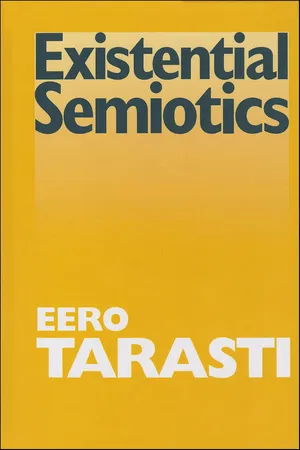
- 219 pages
- English
- ePUB (mobile friendly)
- Available on iOS & Android
eBook - ePub
Existential Semiotics
About this book
Information
PART ONE
Philosophical Reflections
1
On the Paths of Existential Semiotics
Very seldom do new theories and philosophies appear as complete systems that interpret texts in a consistent manner. In addition, some ideas resist a too systematic or too “scientific” expression. This has led many a scholar to make aphoristic, poetic, or novelistic utterances. The new doctrine, which I call “existential semiotics,” is precisely of this kind. Its fundamental theses start to take shape in my mind in an intuitive way, and as yet I can convey them only fragmentarily.
As a semiotician, I am faced with challenging tasks. Time passes—already decades ago, the first generation of semiotics gave place to the second generation of sign theory. Still, the classics of semiotics from Peirce to Greimas and Sebeok have not, of course, lost their pertinence and validity. Even the later works of Foucault, Barthes, and Kristeva can be considered a “second-generation semiotics,” not to mention Eco’s novels, Derrida’s deconstruction, cognitive science, Baudrillard, Bourdieu, and so on. It is common to this second generation that the foundation of classical semiotics has been pushed into the background; yet in spite of all, that foundation still exists, and the texts of these later thinkers cannot be understood without this connection. The avoidance of new theories in the proper sense characterizes all of these second-generation semioticians. Their texts reflect the conditionality of all permanent values, unbelief, the inner conflicts of postmodern man, particularly the dangers of anything “social,” “communal,” chaos instead of structures. After the glorious days of structuralism, no one has dared to create a new theory of semiotics. Joseph Margolis has spoken about universes of flux, where everything is in motion. Nothing is stable, schematic, or fixed. The rigid models of classical semiotics are not suitable for analyzing such a universe. Is it possible to model the dynamically changing, temporal, flowing world?
Is it possible that by enriching first-generation semiotics, by adding there, perhaps, the Heideggerian “timefilter,” we might construct a new approach? Or shall we completely reject the old sign theories and rebuild them on a radically new basis? If the answer to the last question is “yes,” then why should we continue speak of “semiotics” at all? There are, naturally, schools that persist in believing that things are this or that because Peirce or Greimas said so, and not because things are so. Every now and then, the semiotician wandering around the world meets such sectarians who, like the Amish people in Lancaster, Pennsylvania, strive to maintain their doctrines untouched. I am afraid they have become the “arteriosclerosis” of semiotic circulation. Semiotics has to be renewed if it wants to preserve its position on the vanguard of thought.
The next question on the way to a new semiotics concerns how to portray, in an intellectually satisfactory way, certain intuitive, visionary aspects, to which the instinct may guide a scholar. One should not despise intuition; but the problem is, how can it be rendered into a communicable model, into a metalanguage? In this vein, one encounters entities such as the “existentials” of Heidegger or the “synthetic a priori judgments” of Kant. Consequently, I am encouraged to introduce some theses of my own:
1. Reality consists of “energy fields,” in which prevail particular laws that can be described or conceptualized only with great difficulty. In such a field, similar situations or events effectually pull each other together. Correspondingly, energetically negative or positive events are connected and strengthen each other: Disasters call forth more disasters, successes bring about more successes. As it says in the Bible, the one who has much will be given more; whereas the one who has little, even that will be taken away. If something is in our minds, it soon happens. Everything that is immanent in the human mind strives for manifestation; the hidden or unconscious must be revealed—it must rise to the “surface” of reality.
Stop. Have we now sunk to the level of the psychology or telepathy of some weekly magazines? Good heavens, no!—since our modest endeavor is still strictly “scientific.” Insofar as the aforementioned intuitive knowledge can be made explicit, one really would obtain a method for explaining the past as well as forecasting the future. This would involve an effort to render the time-bound "existential” intuition into something objective. We would resolve the dilemma of Karl Jaspers: “What is valid for all the times, is objective, whereas what is transitory in a moment, but still eternal, is existential.”
In fact, however, one recognizes the above-mentioned connections of events only if he or she is there, not by external observation. Anthropologists realized this long ago, when they invented approaches such as “participating observation” or “observation making someone participate.” The observer can perceive correctly the human, semiotic field of energy only by participating in it, while at the same time being aware that he/she also influences it. Georg Henrik von Wright lectured years ago about “the argument of a brain surgeon,” a delusion that the objective description of the neural network would free us from interpretation and lead to universally valid knowledge about human action. The human world of Dasein is always based upon the presence of a subject therein, where even absence is a significant fact. Maybe the theory of Yuri Lotman was, on the level of culture, an attempt to model its “flux,” as it were, from the inside.
2. The aforementioned thesis already touches closely the categories of ‘being out’ or ‘being in’ (In-sein/Ausser-sein), or simply external/internal. The said thesis includes the error that research would only be possible in the category of the external. Even about those phenomena of which a subject may have “inner” knowledge, he/she must first pretend to be ignorant, to be placed outside of them, thereby to “prove” or legitimize the correctness of what one knows. This is a phenomenon that endlessly recurs in arts studies, among other places. One imagines that the Firstness of phenomena would constitute such an objective zero-point for interpretation.
After all, the concepts inner/outer cannot be separated from the classical distinction objective/subjective, to which Kierkegaard dedicated so many pages in his philosophical output. The prevailing scientific paradigm determines the relationship between objective and subjective as follows: The objective conditions of physics and its laws set limits upon our subjective emotions and choices. However, the Kierkegaardian thesis is even more radical: The subjective and the objective never meet. They are not like separate spheres, such that where the "objective” finishes is where the subjective starts. Rather, they are two different approaches to the same world of Dasein.
In Interpretation, Radical but Not Unruly (1995: 52), Joseph Margolis thinks along the same lines when he argues: “There is no known procedure (rule, criterion, algorithm, law, or the like) by which, from a description of any physical events, we could infer in a reliable way any culturally significant events we spontaneously (normally) recognize; nor for any culturally significant events, could we infer any reasonably detailed and pertinent physical events in which they would be embodied and by reference to which they could then be indexed.”
Nor does the so-called “supervenience theory” hold true in existential semiotics. This theory says: “If x and y have the same physical structure and x has the mental quality of P, then y must also have this quality P.” One need only think of what happens in the novel La luna e i falò by the Italian author Cesare Pavese: The main protagonist returns from the United States to Italy, to a small village of his home region, Piemonte. He goes to the same house in which he spent his childhood; he encounters there the same signs as earlier. But at the same time everything has changed. The places x (the village before) and y (the village now) are physically quite the same, but spiritually they are entirely different from the viewpoint of the subject.
The structuralists wanted to show how individual interpretations were dependent on history, tradition, and surrounding culture. My subjective judgments only repeat the “automatisms” of a culture. In order to be able to estimate the degree of subjectivity and freedom of my existential choice, I have to know in which context and according to which norms it was done. I must be conscious of the limits of my choice and act, what I could and could not have done, departing from my own conditions. Especially if I am judging the individuality of an artist, his voice in the choir of texts and discourses, I must know to what extent he knew and followed the “grammar” or langue of his time. But am I right when I place myself, my own subjectivity, into his skin—by unscrupulously stepping into his place?
In any case, we must have an idea of how it was to be a subject in ancient Rome, in the court of the Sun King, or in the cafés of post-war Paris in order to understand Lucretius, Racine, or Rend Char.
The categories subject/object are, of course, contained as early as in the actantial model and narratology of Propp and Greimas. But what does it mean to be a subject or object in some position determined by the semiotic square? In the new existential semiotics, one must aim for seeing the signs from the inside, to recognize their inner microorganic life. The narratological model and the theory of psychoanalysis both start from the hypothesis that there is a subject and object. The situation is such that the subject wants to have the object. The catalyzing power, thus, is the Freudian Trieb or the Lacanian or Kristevian désir. But what does it mean? If the object of the desire is a value object, say the Ring of the Nibelungen and the power it represents in Wagner’s work by the same name, the case is overtly a very simple one. Certain individual and collective values have been invested in the object; therefore, it has become desired in the Dasein world of the protagonists of the drama. (There are naturally even here, according to psychoanalysts, all kinds of fetishizing surrogate objects that shape the processes of one’s mind.)
More difficult would be a situation in which the object is another subject, or in which the subject becomes an object. In human communication the existential law prevails: A subject who deals with another subject as his object is himself soon put in the same position; that is, he becomes treated as an object and thus is treated the same way he has treated others. On this principle of human dialogue, among other things, is based the ethics of altruism: Do to other people the same as you would have them do to you. Nevertheless, since human communication is never perfect, the subjects do not always understand that they are also objects to each other. The priest from the countryside in the novel Journal d’un cure de campagne by Georges Bernanos does not realize what kind of sign he functions in his parish, and is thus mistaken in his judgments and in his acts.
Another basic problem of human knowledge is whether a subject can experience himself as an object. Imagine a situation in which a subject must undergo a biopsy by a physician. The subject brings to the clinic a jar containing a small bloody piece of himself, which contains objective information about him that could determine his entire future. Is this not a situation in which a subject, in an embarrassing way, notices himself to be simultaneously subject and object?
On the other hand, one might imagine that to be a subject—at least that is something rather unambiguous. Cogito, ergo…. However, to Kierkegaard’s mind nothing is more difficult for a subject than existing. It is so difficult that it is a lifelong task for the subject just to try every moment to become an existing subject. He can never entirely be it; he can only aim for it. Kierkegaard says: “An existing subject has to choose between two avenues. He can do all he can in or- der to forget that he exists, which causes him to become ridiculous, since existence has the peculiar property that the existing exists whether he wants it or not.” (The pianist and musicologist, Charles Rosen, “the most versatile of living musicians,” as he has been advertised, once said that he would like to become a learned man. “But you are already a learned man,” I exclaimed. “No, one can only become a learned man, never be it,” he answered. I remarked how this idea coincided with the thought of Kierkegaard. Rosen replied, “It is no wonder, since the idea is genuinely romantic, and Kierkegaard got everything from the German school of philosophy of Jena.") In addition, the idea of an existing subject appeared already in Augustinus, in his powerful vision about the time before it, the world of the pagans, and after it, the state of God (De civitate Dei).
A suspicious semiotician-reader may at this moment throw my essay into the corner and say, “What has all this to do with semiotics? It is of no interest.” What I am searching for is perhaps the most important thing in semiotics; namely, the states before the formation of signs, accordingly “pre-signs” (in Finnish “esi-merkkeja”). When the sign has crystallized, there remains almost nothing to be done—on the level of signs themselves. Peirce tried to classify signs in relationship with themselves and made some interesting findings, like the relationships of legisign/sinsign/qualisign or type/token, etc. Nevertheless, the most interesting, existential moment of signs is in the moment before or after them, since the life of signs does not stop, of course, with their fixation into objects. In any case, if there are existential signs, they are always in a state of becoming. Therefore, only in exceptional cases can the analysis articulate the text or situation into clear-cut units. They can have moments, which constitute existential demarcations. There are situations in which the continuous becoming, flux, and streaming of signs—which hence imitates the inner movement of subjects carrying them—stops, stagnates for a while into a phase of l’être en soi (the sign is the same as its concept). There form and substance, matter and mind, communication and signification are united in oneness. However, the pause is always temporary.
3. Signs always appear in connection with a certain situation. For Sartre, a situation was something social, almost political. In this connection, it is yet to be understood in a broader, “philosophical” sense. The sign situation means a given and concrete temporal-local position in which the sign appears. The situation can be predictable or unpredictable. In the latter case, it is identified with a structure. In fact, then, one can no longer talk so much about a situation. Rather, the sign emerges from its union with the structure. The sign can be in any existential relations with its situation; it can either deny or affirm that situation.
In some cases, signs get all their power from their situations. In that case, they are actually weak signs; they do not have in themselves any inner force. Even signs that are a part of a structure are weak, but not so feeble as completely situational signs. Structures, out of which they grow, always have a greater permanence. Sometimes signs are in a relationship of negation to their structure. They seem to be strong when they set themselves in their po...
Table of contents
- Cover
- Half Title
- Title Page
- Copyright Page
- Table of Contents
- Preface As an Introduction
- Part One Philosophical Reflections
- 1. On the Paths of Existential Semiotics
- 2. Signs and Transcendence
- 3. Endo-/Exogenic Signs, Fields, and Worlds
- 4. Understanding, Misunderstanding, and Self-Understanding
- 5. Signs of Anxiety; or, The Problem of the Semiotic Subject
- Part Two In the Forest of Symbols
- 6. From Aesthetics to Ethics: Semiotic Observations on the Moral Aspects of Arts, Especially Music
- 7. The “Structural” and “Existential” Styles in Twentieth-Century Arts
- 8. On the Authenticity and Inauthenticity of Art
- Part Three The Social and Cultural Field of Signs
- 9. On Post-colonial Semiosis
- 10. Semiotics of Landscapes
- 11. Poetics of Place (Particularly in Music)
- 12. Walt Disney and Americanness: An Existential-Semiotical Exercise
- 13. “…and you find the right one”: A Narratological Analysis of an Advertising Film
- 14. Senses, Values—and Media
- Index
Trusted by 375,005 students
Access to over 1.5 million titles for a fair monthly price.
Study more efficiently using our study tools.
Frequently asked questions
Yes, you can cancel anytime from the Subscription tab in your account settings on the Perlego website. Your subscription will stay active until the end of your current billing period. Learn how to cancel your subscription
No, books cannot be downloaded as external files, such as PDFs, for use outside of Perlego. However, you can download books within the Perlego app for offline reading on mobile or tablet. Learn how to download books offline
Perlego offers two plans: Essential and Complete
- Essential is ideal for learners and professionals who enjoy exploring a wide range of subjects. Access the Essential Library with 800,000+ trusted titles and best-sellers across business, personal growth, and the humanities. Includes unlimited reading time and Standard Read Aloud voice.
- Complete: Perfect for advanced learners and researchers needing full, unrestricted access. Unlock 1.5M+ books across hundreds of subjects, including academic and specialized titles. The Complete Plan also includes advanced features like Premium Read Aloud and Research Assistant.
We are an online textbook subscription service, where you can get access to an entire online library for less than the price of a single book per month. With over 1.5 million books across 990+ topics, we’ve got you covered! Learn about our mission
Look out for the read-aloud symbol on your next book to see if you can listen to it. The read-aloud tool reads text aloud for you, highlighting the text as it is being read. You can pause it, speed it up and slow it down. Learn more about Read Aloud
Yes! You can use the Perlego app on both iOS and Android devices to read anytime, anywhere — even offline. Perfect for commutes or when you’re on the go.
Please note we cannot support devices running on iOS 13 and Android 7 or earlier. Learn more about using the app
Please note we cannot support devices running on iOS 13 and Android 7 or earlier. Learn more about using the app
Yes, you can access Existential Semiotics by Eero Tarasti in PDF and/or ePUB format, as well as other popular books in Literature & Literary Criticism Theory. We have over 1.5 million books available in our catalogue for you to explore.