"Illuminates the enduring importance of political and economic dynamics not yet fully explored in the study of African cinema." —
Africa
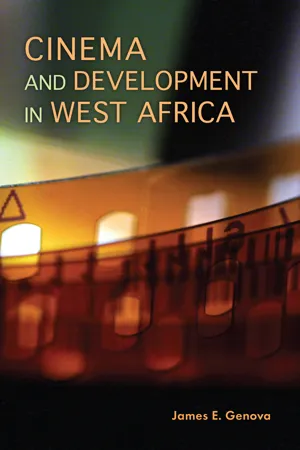
Cinema and Development in West Africa shows how the film industry in Francophone West African countries played an important role in executing strategies of nation building during the transition from French rule to the early postcolonial period.
James E. Genova sees the construction of African identities and economic development as the major themes in the political literature and cultural production of the time. Focusing on film both as industry and aesthetic genre, he demonstrates its unique place in economic development and provides a comprehensive history of filmmaking in the region during the transition from colonies to sovereign states.
- 222 pages
- English
- ePUB (mobile friendly)
- Available on iOS & Android
eBook - ePub
Cinema and Development in West Africa
About this book
Information
Subtopic
Film History & Criticism1 The Cinema Industrial Complex in French West Africa to the 1950s
In 1949, André Lemaire submitted a report to Commission du cinéma d’outremer, a division of the Ministère de la France d’outre-mer (formerly the Ministère des colonies) that addressed matters pertaining to cinema in the French colonies, that signaled the emergence of a new dimension to the cultural politics of empire in French-ruled West Africa. In this report, Lemaire discussed the problem of “raising the level of the Africans,” which he argued had been solved for the elite but not the masses. To further France’s objectives, Lemaire said officials should recognize that “in most cases” they were operating in social contexts in which societies “are organized on traditional bases of oral culture and [are] more open to the concrete thing than the abstract thing.” Consequently, he continued, “it seems that the image is particularly designed to resolve in part the problem here posed.” Lemaire then came to the point of his recommendations. He argued that “in effect, there is by now no doubt that the procedures of visual education, and in particular the cinema, are extremely powerful means of expression and susceptible of rapidly diffusing among the nonevolved population the most diverse [forms of] knowledge. The subtlety of that means of expression enables addressing practically all the problems in adapting the level of the exposé to that of the spectator.” Lemaire concluded that “the use of audiovisual procedures” to generate “reciprocal information” and “to culturally orient the populations in all areas, technical, economic, and social, is liable to ameliorate the human climate and favor a harmonious entente” between Africans and Europeans. He urged the French administrators to study how the Belgians, English, and Americans used film to advance their interests.1
Lemaire’s notes addressed a growing interest among colonial officials and French politicians in the efficacy of cinema as a tool of empire, especially as an integral part of French cultural politics projected in its overseas territories and more broadly around the world. As Sue Harris and Elizabeth Ezra note, “The French recognized earlier than most the importance of cultivating a national image,” as well as “the central role of cinema in constructing and disseminating this image.” The importance of filmmaking in France confirms, they conclude, “cinema’s role as possibly the single most important medium for the transmission of French cultural values and identity in the twentieth and twenty-first centuries.”2 While officials tacitly recognized to an extent the power of film in the colonies as early as the 1930s, it was not until the post–World War II era that the cinema industrial complex took a more concrete form in Africa. With it came an expanding concern over the impact moving pictures might be having in France’s empire. There followed a series of regulations concerning what constituted acceptable films for African audiences, quotas to promote the French film industry as part of postwar economic and cultural recovery, and questions as to how to integrate Africans into the cinema industrial complex without handing control over the making of films to Africans. However, by the mid-1950s, cultural activists from French West Africa had also begun to appropriate film as part of their arsenal in the struggle to resist imperialism and assert their independence. Cinema, then, was becoming one of the terrains on which the fight for control over representation and for the minds of Africans was engaged while political authority in the colonies slipped from France’s hands into those of the Westernized elite.3 In addition, the struggle over moving pictures played out directly on the materialist terrain, as colonial officials explicitly connected the fundamental question of economic development in France and West Africa to making motion pictures. This chapter examines the articulation of a colonial film politics in the federation from the 1930s to the 1950s, focusing on the structural aspects of the cinema industrial complex as it took shape in the late imperial era.
In the particular case of French colonialism in West Africa, cinema has recently attracted scholars’ attention. The result has been the development of two distinct lines of analysis. One approach, evident in the work of Kenneth Cameron, Rachel Moore, David Henry Slavin, and Dina Sherzer, has focused on an examination of the ways in which, through film, empire has served as a constitutive element in metropolitan identities and imaginings of places such as Africa.4 Chapter 2 deals more extensively with the issues raised by researchers drawn to that dimension of film and empire. The other, represented by Frank Ukadike, Imruh Bakari and Mbye Cham, June Givanni, Manthia Diawara, Joseph Gugler, and Femi Shaka, has centered around a reconstruction of narratives on the origins of African cinema and the uses of film in the postcolonial African context and is the focus of this chapter.5 Neither approach to the treatment of cinema in the colonial context provides an analysis of how the French imperial government set out to purposely articulate a film politics as an essential pillar of colonial rule, and neither examines the processes whereby that project was made integral to French postwar reconstruction.
Diawara poses the basic question that frames the current discussion, namely determining “the role played by the French government and individuals in furthering film production in their former colonies in a manner that has not interested other ex-colonial powers such as England and Belgium.” I extend that query backward to the last decades of imperial rule as well, since what came after decolonization was presaged in the colonial era. Diawara takes the position that “the French had no policy of producing films that were especially intended for their subjects in Africa” and concludes with the sweeping claim that “the French colonial system … had no economic, political, or cultural policy encompassing the majority of its subjects.”6 However, while it is true that France did not create anything approximating the British anthropological film programs of the Bantu Educational Kinema Experiment or the Colonial Film Unit that attempted to incorporate Africans into the making of educational documentaries aimed at their colonial subjects, the French imperial nation-state did concern itself with “film politics” as it related to all of their colonial subjects in West Africa and helped to produce docu-fiction films aimed at autochthonous audiences.7 Officials at every level of the imperial administration stretching back to the corridors of power in Paris filed reports, issued circulars, promulgated decrees, and solicited regular surveys on the subject of the place and impact of film in West Africa. Moreover, the absence of a formal and fully functioning government institution solely directed to produce films for an African audience should not be taken to indicate a willful indifference to the kinds of images African moviegoers consumed or a lack of engagement in manufacturing those representations. The litany of regulations and careful parsing of film treatments and movies to vet their appropriateness for West Africans suggests the depth of French interest in cinema aimed at the African colonial subject.
In a similar vein, Murphy and Williams categorically state that France’s policy with respect to cinema in West Africa “was simply to show French films to Africans.” In contradistinction to other colonizing powers, they argue that “the French approach at least allowed Africans to be considered as a proper audience for proper films.” Like Diawara, Murphy and Williams cite the 1934 Laval decree as “a rare example of government intervention” in the realm of cinema, and on top of that, they suggest it was “rarely invoked.” This approach leads them to conclude that “unlike a range of other cultural forms—poetry, song, music, stories—film had, for very obvious reasons, almost no part to play in the anticolonial process.”8 It is true that Francophone West African cinema is “a child of African political independence,” as Cham notes, but that does not mean the cinema industrial complex wasn’t a crucial site of the decolonization struggle.9 The objective material conditions in West Africa may have precluded the actual making of films by Africans in Africa (I discuss the special place of Vieyra’s Groupe africain du cinéma and its 1955 production Afrique-sur-Seine in chapter 3 of this study), but cultural activists did discuss the important role film had to play in (re)constructing a truly independent Africa in both representational and materialist terms. Moreover, the French colonial state was very cognizant of the power of movies and the connection between what Africans saw on the screen and France’s capacity to maintain power in the region. This is attested to by the frequent invocation of the Laval decree (especially after 1945) and its further systematic elaboration during the 1950s.
For his part, Ukadike describes French colonial film policy as merely seeking to maintain the monopolies of the distribution cartels Compagnie africaine cinématographique industrielle et commercial (COMACICO) and Société d’éxploitation cinématographique africaine (SECMA) in the region. Ukadike reduces film politics, such as it existed, to the collusion between capitalist enterprises and the state. Their interests were confined to preventing the conditions for the emergence of an “African cinema [that] would bring competition and a change in audience taste that might challenge their exclusive hold on the African market.”10 However, although Ukadike makes this gesture toward a consideration of the materialist dimension of film politics in late colonial Francophone West Africa, in his analysis of the economics of filmmaking he does not venture beyond the calculations of market share. Subsequently, he traces the aesthetic aspects of the emergence of West African cinema, making occasional mention of the problems confronted by directors in terms of financing and distribution. While the French imperial nation-state certainly did not take any active role in undermining the dominance of the two distribution monopolies, it did express an interest in developing an African cinema under its direction that would sustain France’s influence, if not political power, in the region. As part of the expanding legislation through which officials formulated a “film politics” in the postwar years, the government in Paris envisaged the formation of a full cinema industry in West Africa, replete with all its attendant technologies and processes, under French management, of course. Moreover, France’s economic concerns as they related to film redounded on metropolitan economic reconstruction, a point entirely missed in Ukadike’s discussion.11 For the French government, the market dimensions of cinema in West Africa were not limited to simply assuring a profit for COMACICO and SECMA. In fact, the distributors often clashed with colonial officials because of Paris’s insistence that they show French films in sufficient quantities or face stiff fines and potentially the loss of their license to screen movies. Consequently, the relationship between the distribution monopolies and the imperial nation-state was not as cozy as it would appear at first blush.
My aim in this chapter is to explore France’s conscious articulation of a “film politics” for West Africa as challenges mounted to its political mastery in the region. Cinema was an important field within which colonial officials and anticolonial cultural producers worked out the process of decolonization. In the formulation of this late colonial film politics, the salient features that structured the emergence of Francophone West African cinema in the 1960s became evident. Some of the issues that constituted the nexus around which West African cineastes had to work to develop their art are strikingly apparent in the debates over France’s film politics in the 1950s. In this regard, representation and materialism were overriding concepts that informed the discourse of imperial officials and metropolitan governments alike as they wrestled with defining (and controlling) the place of moving pictures in West Africa. How they framed the field, then, determined the access points available to the postcolonial filmmakers who came in their wake.
France and Cinema in Colonial West Africa before 1945
The notes submitted by Lemaire to the Ministère de la France d’outre-mer in 1949 were part of an effort among French imperial officials after 1945 to create a coherent film policy in the colonies. Just two months later, the Academie des sciences d’outre-mer forwarded its own notes to the Ministère de la France d’outre-mer in which it stated that “cinema constitutes, with radio, one of the most powerful weapons of which a nation could make use, in the present period, for its propaganda.” “Documentary film, in particular,” the academy continued, “possesses, from this point of view, a capacity and an action infinitely more expansive and more effective than the book or the newspaper, which touches a much more limited public.” The documentary film “does not present any point [of reference] except for the image,” and owing to “its magic” that is “even at times [constitutive of] its undeniable reality,” documentary film “presents an undeniable value.”12 I examine the theoretical debates over the particular efficacy of documentary filmmaking in chapter 4. But at this point it is interesting to note, as discussed in the introduction, that the radical cineastes of the Third Cinema movement in Latin America also embraced documentary filmmaking as the most appropriate cinematic form for galvanizing the masses to revolutionary action. The current focus, though, is on the broader articulation of a film politics within the context of the French imperial nation-state.
The desire among colonial officials for a clear and consistent “politics of film” was not new in the post-1945 period. In fact, it dated to the early 1930s. However, the arguments for such a policy were expressed in more urgent terms following the war as a result of the explosive growth of the film industry, reflected in the rapidly increasing number of movie houses in French West Africa and the vastly expanded demand among African audiences for film.13 First, though, it is important to sketch the early presence of moving pictures in West Africa and the colonial state’s approach to the cinema. As Ukadike observes, “Cinema came to Africa as a potent organ of colonialism.” In addition to the Christian missionaries who came armed with “film and slide projectors,” there were European filmmakers and fledgling distributors who began to set up “mobile cinemas” by at least 1905 in Dakar, Senegal.14 However, motion pictures in the region at this time were not integrated into a coherent strategy of imperial rule. Private filmmakers and distributors made and showed movies in Africa to largely European expatriate communities, while missionaries operated mostly independently of (and sometimes in conflict with) the colonial state.15 The infrastructure for the cinema industrial complex was nowhere evident in French West Africa until the 1920s. Moreover, those who made films about Africa and Africans did so within a conceptual universe that already carried centuries-old tropes of the “primitive native.” The images of Africans produced by non-African filmmakers and projected almost entirely to audiences outside the continent participated in an extant hegemonic representational environment in which they added their own inflections but did not offer any ruptures with the past.
Like governments in Europe and North America, the colonial state did not at first recognize how important film could be as an integral part of colonial rule. It was part of an imperialist process, an organ, but not yet a tool. Moreover, for Africans the period before the 1920s was one of very selective encounters with moving pictures. Those conscripted to serve in the slaughterhouse of the western front during the First World War probably had more sustained contact with the cinema than any other community from the colonies.16 But even then, their exposure would have been in Europe, not in their own land; this was an entirely different contextual space within which the conscripts became “spectators” in the sense that Nick Browne discusses it in his analysis of Stagecoach.17 At some level, where the viewer is physically seated shapes the reading of the filmic text.
Little information is available about the early presence of cinema in French West Africa. However, scholars have arrived at a consensus that the first permanent movie theaters were established by the 1920s in the federation. Not surprisingly, those spaces existed only in a select few major cities; Dakar, as the capital of French West Africa, was the epicenter. Many of those first theaters appear to have been owned by Lebanese migrants, France having acquired Lebanon as a League of Nations mandate from the Ottoman Empire following the First World War. Thu...
Table of contents
- Cover
- Title
- Copyright
- Contents
- Acknowledgments
- Abbreviations
- Introduction: Cinema as Art and Industry
- 1 The Cinema Industrial Complex in French West Africa to the 1950s
- 2 The Colonialist Regime of Representation, 1945–60
- 3 West African Anticolonial Film Politics, 1950s–60s
- 4 The Postcolonial African Regime of Representation
- 5 The West African Cinema Industrial Complex, 1960s–70s
- Postscript: Francophone West African Cinema to the Present
- Notes
- Bibliography
- Index
Trusted by 375,005 students
Access to over 1.5 million titles for a fair monthly price.
Study more efficiently using our study tools.
Frequently asked questions
Yes, you can cancel anytime from the Subscription tab in your account settings on the Perlego website. Your subscription will stay active until the end of your current billing period. Learn how to cancel your subscription
No, books cannot be downloaded as external files, such as PDFs, for use outside of Perlego. However, you can download books within the Perlego app for offline reading on mobile or tablet. Learn how to download books offline
Perlego offers two plans: Essential and Complete
- Essential is ideal for learners and professionals who enjoy exploring a wide range of subjects. Access the Essential Library with 800,000+ trusted titles and best-sellers across business, personal growth, and the humanities. Includes unlimited reading time and Standard Read Aloud voice.
- Complete: Perfect for advanced learners and researchers needing full, unrestricted access. Unlock 1.5M+ books across hundreds of subjects, including academic and specialized titles. The Complete Plan also includes advanced features like Premium Read Aloud and Research Assistant.
We are an online textbook subscription service, where you can get access to an entire online library for less than the price of a single book per month. With over 1.5 million books across 990+ topics, we’ve got you covered! Learn about our mission
Look out for the read-aloud symbol on your next book to see if you can listen to it. The read-aloud tool reads text aloud for you, highlighting the text as it is being read. You can pause it, speed it up and slow it down. Learn more about Read Aloud
Yes! You can use the Perlego app on both iOS and Android devices to read anytime, anywhere — even offline. Perfect for commutes or when you’re on the go.
Please note we cannot support devices running on iOS 13 and Android 7 or earlier. Learn more about using the app
Please note we cannot support devices running on iOS 13 and Android 7 or earlier. Learn more about using the app
Yes, you can access Cinema and Development in West Africa by James E. Genova in PDF and/or ePUB format, as well as other popular books in Media & Performing Arts & Film History & Criticism. We have over 1.5 million books available in our catalogue for you to explore.