Beginning in 1172, Judah ibn Tibbon, who was called the father of Hebrew translators, wrote a letter to his son that was full of personal and professional guidance. The detailed letter, described as an ethical will, was revised through the years and offered a vivid picture of intellectual life among Andalusi elites exiled in the south of France after 1148. S. J. Pearce sets this letter into broader context and reads it as a document of literary practice and intellectual values. She reveals how ibn Tibbon, as a translator of philosophical and religious texts, explains how his son should make his way in the family business and how to operate, textually, within Arabic literary models even when writing for a non-Arabic audience. While the letter is also full of personal criticism and admonitions, Pearce shows ibn Tibbon making a powerful argument in favor of the continuation of Arabic as a prestige language for Andalusi Jewish readers and writers, even in exile outside of the Islamic world.
eBook - ePub
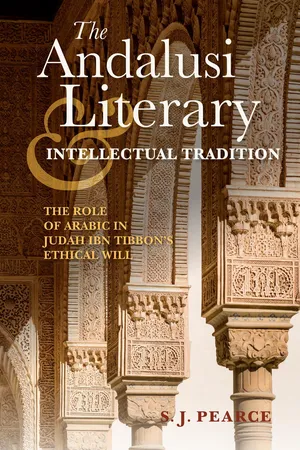
The Andalusi Literary and Intellectual Tradition
The Role of Arabic in Judah ibn Tibbon's Ethical Will
- 278 pages
- English
- ePUB (mobile friendly)
- Available on iOS & Android
eBook - ePub
The Andalusi Literary and Intellectual Tradition
The Role of Arabic in Judah ibn Tibbon's Ethical Will
About this book
Information
1 | “PEN, I RECOUNT YOUR FAVOR!” |
Reading, Writing, and Translating in Memory of al-Andalus |
THE NATURAL AND cultural wonders of al-Andalus are among the most powerful forces and prevalent tropes in the Arabic and Arabizing Hebrew literature of Spain’s native sons and their descendants. In poetry and prose, Andalusis lavish high praise on their land and on the superiority of their landsmen in all respects—especially their cultural and literary skill. The place is, of course, lauded in works of futūḥ (conquest narratives), masālik wa-l-mamālik (geographic surveys), and ṭabaqāt (sociological categorization). Poetry praises the lushness of the land and the wisdom and general superiority of the people; and when those authors and their intellectual descendants are forced to leave, we see loss, exile, and nostalgia as common refrains in Arabic and Arabizing Hebrew poetry. Ibn Shuhayd writes perhaps the most famous lament over the city of Córdoba after the collapse of the Umayyad caliphate.1 Ibn Ḥazm praises the lush land and the expressions of its cultural values in a work of courtly love and, subsequently, to counteract what he saw as the barbarity of the Almoravid and Almohad invasions, writes a treatise in the faḍā’il al-Andalus (merits of al-Andalus) mode highlighting the achievements of the Andalusi literary class.2 And perhaps most salient for the discussion that follows, Abraham ibn ‘Ezra’ (ca. 1093–ca. 1170) wrote a mournful lament over the collective exilic fate of the Jews of al-Andalus and over the loss of the land:
Calamity came upon Spain from the skies,
And my eyes pour forth their streams of tears.
I moan like an owl for the town of Lucena,
where Exile dwelled, guiltless and strong,
for a thousand and seventy years unchanged—
until the day that she was expelled,
leaving her like a widow, forlorn,
deprived of Scriptures and books of the Law . . .
I shave my head and bitterly keen
for Seville’s martyrs and sons who were taken,
as daughters were forced into strangeness of faith.
Córdoba’s ruined, like the desolate sea . . . 3
With respect to the general shift from praise to lament, Ross Brann comments: “The trope’s persuasive power rests not only on the ritualized remembrance of experienced and imagined loss, but also and more particularly on the community’s recollection of exactly what was lost.”4 The lament over the land and the culture that sprang from it grows out of the praise that preceded it.
Judah ibn Tibbon was unabashedly a “cultural nationalist,”5 elevating a national Israel above all others. For example, in the ethical will, he exhorts Samuel to charity so that he “will be respected by both great and small, and by Israel and the other nations,”6 establishing a parallelism that equates a national Israel with great men and the other nations with lesser men; yet he was also a thoroughly Arabized thinker and writer, exiled from a place where those two things represented no contradiction. Even so, Judah never wrote any sort of explicit defense of or lament for al-Andalus and its Arabic literary culture; nor did he hold himself as an Andalusi apart from the Jewish communities in the north once he found himself in their midst as did his near contemporary, Moses ibn ‘Ezra’ (unrelated to the aforementioned Abraham ibn ‘Ezra’), who, like many of his contemporaries, consistently tied the superiority of Andalusi Jewry to its lineage as the descendants of the exiles of Jerusalem.7 It is worth noting that Brann has described this type of nostalgia as motivating in Ibn ‘Ezra’ a desire “to present himself as a teacher and transmitter of Andalusian Jewish culture”;8 in other words, the model of an Andalusi cultural translator in exile already existed. Nevertheless, in time Judah adopted the pieces of that model that were useful to his textual program without ever explicitly taking on the mantle of the rhetoric of nostalgia. His program of translation serves the needs of his adopted community in medieval Lunel, a city in southern France just a few kilometers away from the modern city that bears the same name, for works of religion and philosophy in a language at least nominally accessible to them. In doing so, Judah telegraphs that same profound longing for and pride in al-Andalus to readers who have been receptive to it while writing a prideful defense of Arabic into his compositions; and he uses translation and his writing about translation to articulate these correlated sentiments.
The cornerstone of Judah’s intellectual project was the translation of Arabic texts, word for word, into Hebrew. In doing so, he created philosophical and religious texts that preserved the features and complexities of the original work as well as the linguistic features of the source language, and he wrote about the importance of both of those aspects of textual conservation. By examining the relationships between Hebrew and Arabic and secular and sacred writing, this first chapter delves more deeply into Judah’s program of literal translation and examines the ways in which it allowed him to transmit his ideas about Andalusi texts and textual culture. Furthermore, it sets the process of word-for-word translation into a broader context of the transposition and adaptation of Andalusi literary models and cultural ideals for non-Arabophone audiences outside of the Islamicate world. As much as Judah was meticulously literal in his rendering of text, he was also a cultural conduit who channeled his belief in the superiority of the Arabic language and of al-Andalus to transmit and preserve a wide range of texts.
THE TIBBONID WORKSHOP
Judah ibn Tibbon was born in Granada around the year 1120, the scion of a family that, if the Arabic etymology of the family name is to be any guide,9 may have originally made their living as grain millers.10 Although he is most closely and regularly associated with the city of Granada (a place that factors into his thinking about the Andalusi character of Arabizing Hebrew poetry, as is discussed in chapter 4), there is also some evidence connecting his family’s origins to the city of Seville.11 The first direct evidence that we have of Judah’s presence in Lunel as a resident of that city comes, as do the whereabouts of so many itinerant thinkers and writers, in Benjamin of Tudela’s Itineraries, in which he writes about the various scholars he meets in towns with substantial Jewish populations in the south of France:
From there [Montpellier] it is four parsangs (parsa’ot) to Lunel, where there is a Jewish community that studies Torah day and night. It includes the great rabbi Meshullam and his sons, all wise, great, and well-to-do: Joseph, Isaac, Jacob, Aaron, as well as the contrarian Asher, who rejects worldly matters and abstains from meat, always occupies himself with books, and is very learned in matters of Talmud. Also: Moses, the brother-in-law of the rabbi Samuel the Elder; and Ulsarnu; and Solomon ha-Cohen; and Judah ben Tibbon the Spaniard, a physician (Yehudah ha-rofe’ ben Tibbon ha-Sefardi). They support, teach, and provision everyone who comes from a far-off land to study Torah, for as long as they study in the college there. They are wise, generous, and holy men who observe the commandments and have great munificence toward their brethren, wherever they are. There are about 300 Jews in this community; may the Rock preserve them. From there it is two parsangs to Posquieres.12
However, it has long and consistently been suggested that by the time Benjamin encountered him there in such illustrious company, Judah would have already been living in Lunel for close to a decade, perhaps having left Granada as early as 1148 with the advent of Almohad rule in the Iberian Peninsula. Although the ethical will is a text of tremendous autobiographical character, James T. Robinson calls it “notable” that it never refers to the political and cultural changes that ostensibly drove Ibn Tibbon out of al-Andalus and north across the Pyrenees. In Judah’s work we do not even see the kinds of hints to the political upheaval and advent of North African rule in al-Andalus that we find in the work of Abraham ibn ‘Ezra’, who wrote that he found himself in Rome to escape “the oppressors.”13
Once in Provence, Judah began to translate works of Arabic philosophy into Hebrew for his coreligionists there, since they were not uniformly literate in Arabic, and for a wider European audience as well. Some of his translations were created for specific patrons in response to specific requests: The first parts of Judah’s Ḥovot ha-levavot, the Hebrew version of Baḥya ibn Paqūda’s Hidāya ilā farā’id al-qulūb (Duties of the Heart), are dedicated to Judah’s teacher Meshullam ben Jacob (also mentioned in the passage of Benjamin of Tudela’s Itineraries cited above and whose role in Judah’s intellectual formation is discussed in chapter 3) and the other parts to Abraham ben David; Solomon ibn Gabirol’s Kitāb iṣlāh al-akhlāq (Improvement of Moral Qualities) was translated into Hebrew as Tiqqun Middot ha-Nefesh for Meshullam’s son Asher (whose role as patron and fellow is discussed in further detail in chapter 4). The specific impetus behind some of his other translations is less clear—except perhaps to say that they were chosen “methodically and prudently, for he was writing for popular consumption”14—but still form part of a coherent Andalusi philosophical and religious corpus: an additional work by Ibn Gabirol, namely his Kitāb mukhtar al-jawāhir (Choice of Pearls) translated into Hebrew as Mivḥar ha-peninim; Judah Halevi’s Kitāb al-radd wa-l-dalīl fī l-dīn al-dhalīl (Book of Proofs and Refutations in Defense of the Despised Faith), which came to be known in both Arabic and Hebrew more simply as The Kuzari and, although not Andalusi in origin but certainly popular in the region, Sa‘adya Ga’on’s Kitāb al-amanāt wa-l-itiqadāt (Book of Beliefs and Opinions) translated into Hebrew under the title Sefer emunot ve-de‘ot. Judah also translated a pair of reference works for the study of the Hebrew Bible, known together in Hebrew as the Maḥbarot ha-diqduq (The Grammatical Notebooks). These two works, originally compiled by Jonah ibn Janāḥ (b. ca. 985), were entitled Kitāb al-Lum‘a (Book of Variegated Flower Beds), a style guide and grammatical resource that was translated into Hebrew as Sefer ha-riqmah (Book of Woven Patterns), and Kitāb al-Uṣūl (Book of Roots), an Arabic-language lexicon of the Hebrew Bible translated into Hebrew as Sefer ha-Shorashim. As a translator, he coined many words for scientific and philosophical concepts that existed in Arabic, a consequence of the by-then longstanding Greek-to-Arabic translation movements, but that did not yet exist in Hebrew. Although Judah is not typically characterized in the scholarship as having been a writer in his own right, his considerable output of text paints a coherent and compelling picture that is worthy of further attention. He wrote prologues and epilogues to these works as well as epistles in which he delineated his own principles for translation. In addition to the prologues and epilogues, his original compositions included a letter to Asher ben Meshullam of Lunel describing his process of translating the Tiqqun Middot ha-Nefesh and the aforementioned letter to Samuel written in the genre of the ethical will, which generally advises on how to lead a correct personal and professional life, transmitting values from an older generation to a younger one. In the latter, Judah also references an original composition on grammar and style; but as far as is known, that work was never completed and does not survive even in quotations or fragments. Additional treatises are attributed more insecurely to Judah; so, ...
Table of contents
- Cover
- Half title
- Title
- Copyright
- Contents
- Acknowledgments
- A Note on Translations and Transliterations
- Introduction: “The Preface of Every Book Is Its First Part”: An Overview of Materials and Methodologies
- 1 “Pen, I Recount Your Favor!”: Reading, Writing, and Translating in Memory of al-Andalus
- 2 “Examine Your Hebrew Books Monthly and Arabic Books Bimonthly”: Autobiography and Bibliography in the Islamic West
- 3 “On Every Sabbath, Read . . . the Bible in Arabic”: Reading the Hebrew Bible as Arabic Literature
- 4 “The Words of the Ancient Poets”: Poetics between Jewish and Islamic Scripture
- 5 “The Arab Sage Said”: Transmitting Arabic Philosophy in Translation
- 6 “From Vessel to Vessel”: The Reception and Reimagining of the Tibbonid Project
- Conclusion: “This Book Has Been Completed”: Looking Back and Ahead at al-Andalus in Translation
- Appendix: Judah ibn Tibbon’s Ethical Will: A New Translation
- Bibliography
- Index
Trusted by 375,005 students
Access to over 1.5 million titles for a fair monthly price.
Study more efficiently using our study tools.
Frequently asked questions
Yes, you can cancel anytime from the Subscription tab in your account settings on the Perlego website. Your subscription will stay active until the end of your current billing period. Learn how to cancel your subscription
No, books cannot be downloaded as external files, such as PDFs, for use outside of Perlego. However, you can download books within the Perlego app for offline reading on mobile or tablet. Learn how to download books offline
Perlego offers two plans: Essential and Complete
- Essential is ideal for learners and professionals who enjoy exploring a wide range of subjects. Access the Essential Library with 800,000+ trusted titles and best-sellers across business, personal growth, and the humanities. Includes unlimited reading time and Standard Read Aloud voice.
- Complete: Perfect for advanced learners and researchers needing full, unrestricted access. Unlock 1.5M+ books across hundreds of subjects, including academic and specialized titles. The Complete Plan also includes advanced features like Premium Read Aloud and Research Assistant.
We are an online textbook subscription service, where you can get access to an entire online library for less than the price of a single book per month. With over 1.5 million books across 990+ topics, we’ve got you covered! Learn about our mission
Look out for the read-aloud symbol on your next book to see if you can listen to it. The read-aloud tool reads text aloud for you, highlighting the text as it is being read. You can pause it, speed it up and slow it down. Learn more about Read Aloud
Yes! You can use the Perlego app on both iOS and Android devices to read anytime, anywhere — even offline. Perfect for commutes or when you’re on the go.
Please note we cannot support devices running on iOS 13 and Android 7 or earlier. Learn more about using the app
Please note we cannot support devices running on iOS 13 and Android 7 or earlier. Learn more about using the app
Yes, you can access The Andalusi Literary and Intellectual Tradition by Sarah J. Pearce in PDF and/or ePUB format, as well as other popular books in Literature & European Literary Criticism. We have over 1.5 million books available in our catalogue for you to explore.