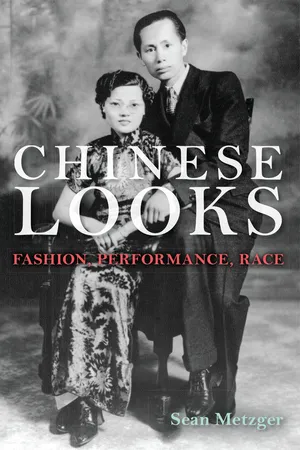
From yellow-face performance in the 19th century to Jackie Chan in the 21st, Chinese Looks examines articles of clothing and modes of adornment as a window on how American views of China have changed in the past 150 years. Sean Metzger provides a cultural history of three iconic objects in theatrical and cinematic performance: the queue, or man's hair braid; the woman's suit known as the qipao; and the Mao suit. Each object emerges at a pivotal moment in US-China relations, indexing shifts in the balance of power between the two nations. Metzger shows how aesthetics, gender, politics, economics, and race are interwoven and argues that close examination of particular forms of dress can help us think anew about gender and modernity.
- 316 pages
- English
- ePUB (mobile friendly)
- Available on iOS & Android
eBook - ePub
About this book
Trusted by 375,005 students
Access to over 1.5 million titles for a fair monthly price.
Study more efficiently using our study tools.
Information
PART 1
The Queue
A Fashion to Die For
During the summer of 1908, the New York Times reported on the shipment from China to the United States of a ton of human hair, valued at $5,000. The locks “came from the heads of Chinese bandits who had been beheaded” and were intended “to build up the pompadours of American girls.”1 Continuing with a seeming non sequitur, the article then described one Mrs. Clarke, a nurse on board the same freighter as the hair. Clarke had served in the Philippines and described the “great mistake” of the Americans’ befriending of the Filipinos as equals (a revisionist history to be sure!). According to this medical emissary, the Filipinos sought U.S. government jobs so as not “to soil their hands or clothes.” The Times resumed its titular topic with its description of another box of “Chinese pigtails” taken by “crafty Americans, who collected the gruesome souvenirs for profit in three months’ plunder of Chinese burial grounds.”2 The paper further explained that the Chinese were said to bury deceased men upright with their queues exposed, in order for the men to be lifted to heaven by their tresses.
Combing through the meanings packed in these boxes of hair reveals how such unlikely objects loosely tie together discourses of aesthetics, race, religion, commerce, labor, and imperialism. The slippage from China to the Philippines, from one American imperialist venture—taken in concert with a series of European allies when the United States had not yet secured its own territorial boundaries—to another decades later, when the frontier had officially closed and manifest destiny propelled the U.S. military across the Pacific, connects the ascendant U.S. industrial power decisively to Asia. Indeed, many wealthy Americans who would play major roles in the political and economic life of the U.S. nation-state owed their fortunes to the China trade, including the Forbes, Roosevelt, and Russell families. In the example given by the Times, the population that provided the fuel for these successful commercial ventures and that enabled the United States to become a modern industrialized country were cast as heathen hooligans. Such a construction depended on the lengthy braids known as queues, and these same hairpieces—once shorn from their original scalps and repurposed—would apparently serve to prop up visions of feminine beauty in the early 1900s. Chinese men’s hair has clearly had more ideological and financial weight than we might imagine today.
The braid and tonsure combination known as the queue, or more commonly as the pigtail, was and remains the dominant representation of Chineseness related to the mythos of the American frontier. For audiences in the United States, the queue weaves together the contradictions of asymmetrical modernization across the Pacific, signified through embodied notions of masculinity. Its incongruous associations with profit making and inassimilable difference emerge most prominently during the late nineteenth century through the career of the preeminent yellowface actor Charles Parsloe. The nexus of transnational Chinese labor, the domestic setting and lore of the American West, and the formal properties of melodrama render a hairpiece the key signifier of Chinese particularity. In other words, the skein of race created and sustained through the queue in the nineteenth century ties together three sets of elements involving work, location, and medium of representation. These rudiments found the historically specific practice of Charles Parsloe’s performance that is the subject of chapter 1. The legacy of Parsloe’s yellowface practice, which depended on the queue as a costume piece and prop, continued to inform a specific kind of frontier tale, a queue narrative, even after his death.
However, at the beginning of the twentieth century, the melodramas carrying this story line extended into the new medium of film. This shift illustrates how the object sustains but also alters certain ideas about Chineseness in a very different historical moment from Parsloe’s heyday: when Chinese people were quite effectively screened out of the United States, when the frontier had been declared closed, when the braid had disappeared from quotidian life in China, and when transnational industrialists used Chinese hair for everything from wigs to soup strainers. This situation placed actual queues, rather than Parsloe and his signature prop, into circulation as commodities, as shown by the boxes of hair mentioned previously. To create a dialogue with my work on Parsloe, I turn in chapter 2 to ask what values accrue to Chinese men’s tresses through mass production. This chapter is subdivided into two sections, primarily about silent film melodramas and cinematic Westerns as electronic media that pick up the queue narrative. These cinematic examples and the other screen phenomena discussed in the chapter reveal a shifting index of perceived Chinese masculinity within an American context but with sometimes radically different results because of the changing historical context and the move from stage to screen. Creating an archive of the queue’s appearance in a variety of performances on stage and screen suggests how the object condenses a wide array of discourses and material as it morphs understandings of race, manhood, and modernity during the long twentieth century.
Charles Parsloe’s Chinese Fetish
1
IN THE NINETEENTH AND EARLY TWENTIETH CENTURIES, THE ABSENCE of Asian bodies on U.S. stages resulted in actors developing what Josephine Lee calls “a complex set of codes for the presentation of the Oriental Other” that borrowed from the lexicon of Asian stereotypes.1 I group such codes—conventional associations of signs and meanings that purportedly convey Asianness—under the term “yellowface performance.” Over the decades, actors in yellowface have often stirred controversy; indeed, Anna May Wong’s complaints about Luise Rainer in the film The Good Earth (Sidney Franklin, 1937) led in part to Wong’s attempts to shift the representations of Chinese figures on the silver screen. But the relative obscurity of nineteenth-century yellowface performers impedes the contextualization of such disputes.2 The career of the white actor Charles Parsloe during the 1870s provides the most comprehensive case study available with which to examine early yellowface practice. The popularity of his embodiment of the “Chinaman” (a term indicating a theatrical construction that I invoke as a counterpoint to the lived experience of Chinese men) both depends on and informs hegemonic constructions of Chineseness. Parsloe’s performance practice constitutes a kind of ventriloquism, in which he animates the Chinaman and specifically his queue as a fetish that substitutes for and conceals the dominant anxieties about Chinese immigrants among the white majority in the United States during the late 1800s. The histories and genres through and to which Parsloe’s hairpiece generates meaning code the object as the dominant feature of the skein of race in late-nineteenth-century melodrama. The queue becomes the material apparatus of racialization through its deployment in frontier narratives.
Parsloe developed the Chinaman role through four melodramas: Bret Harte’s Two Men of Sandy Bar (1876), Harte and Mark Twain’s Ah Sin (1877), Joaquin Miller’s The Danites in the Sierras (1877; hereafter The Danites) and Bartley Theodore Campbell’s My Partner (1879). According to scripts and performance reviews, these theatrical productions depicted their Chinese characters through performers’ costumes and mannerisms, with queue jokes and stage dialect frequently notated in dramatic texts. In the case of Parsloe, these signifiers apparently conveyed Chineseness to his audiences. James Moy cites several reviews of Parsloe’s performance as Ah Sin, the most flattering of which claims that the actor’s portrayal could “scarcely [be] excelled in truthfulness to nature and freedom from caricature.”3 In spite of the fact that Two Men of Sandy Bar and Ah Sin flopped both commercially and critically, Parsloe used these productions to elevate his reputation, moving from a competent character actor to the foremost player of Chinaman roles. After performing Hop Sing in Harte’s drama and the title role in Ah Sin, Parsloe played Washee Washee in The Danites. According to his obituary, Parsloe next “toured in ‘My Partner.’ For 1,300 nights he played the role of Wing Wee [sic], the Chinaman, and his share of the profits amounted to over $100,000.”4 Parsloe’s evolving embodiment of the theatrical Chinaman is expressed through the actor’s yellowface performance in Ah Sin, The Danites, and My Partner, which constitutes a “melodramatic formation” that reveals nineteenth-century American attitudes about the Chinese in the United States as well as the struggles over changing racial, class, and gender dynamics that characterized the slowly reintegrating union in the 1870s.5
Locating Parsloe’s Chinamen
The relations between the United States and China during the late 1800s form the backdrop for the dramatic worlds that Parsloe entered as Hop Sing, Ah Sin, or Washee Washee. Although none of the plays in which these characters appeared explicitly addresses international politics, media concerning U.S.-China diplomacy probably informed the reception of Parsloe’s Chinese characters. East Coast theatergoers probably had little contact with Chinese residents in the United States, but “celestials” and “heathen Chinee” had loomed large in the national imagination for some time.6 As Stuart Miller has noted, “Americans had been trading with the Chinese since 1785 and enthusiastically supporting Protestant missionaries there since 1807,” even if the two countries did not formalize diplomatic relations until the mid-1840s.7 At this time, in the wake of China’s defeat in the First Opium War, U.S. representatives followed Britain’s lead and negotiated the Treaty of Wangxia, which sought concessions from the Middle Kingdom in the form of access to more ports and fewer restrictions on trade. The United States further benefited from European incursion into Chinese territory when the Treaty of Tianjin was signed in 1858. This treaty contained two provisions particularly relevant to the Sino/American interface as it began to take shape over the long twentieth century. First, the Qing dynasty allowed Anson Burlingame, the U.S. minister to China from 1861 to 1867, to live in Beijing as opposed to one of the port cities, and he therefore obtained a broader view of Chinese society than that of previous ambassadors. Second, foreign missionaries were permitted to travel to the interior of China. These missionaries would, in turn, provide the most detailed accounts—biased, to be sure—of life in China during the 1800s.
If this period witnessed U.S.-China relations reach what seemed a height of relative prosperity, with the Qing government even asking Burlingame to lead the Chinese international diplomatic entourage on its visit to the United States in 1868, the 1870 “massacre” of approximately twenty foreigners in Tianjin altered U.S.-China diplomacy and set the tone for the period up to Chinese exclusion in 1882. Reports of the increasing violence that plagued the waning Qing regime combined with U.S. domestic concerns over Chinese immigrants, who fled the internal revolts and famine that spread through the Middle Kingdom in the mid-1800s. Between 1860 and 1880, the Chinese population in the United States tripled, with the 1880 U.S. Census recording 105,465 Chinese individuals residing in the country. The influx of so many immigrant workers affected employment opportunities, particularly in California, where the Chinese arrived in the greatest numbers. The increasing presence of Asians in the U.S. workforce and the attendant anxieties accompanying the demographic shifts led to a changing discourse around Chinese subjects that culminated in the almost complete restriction of Chinese immigration in 1882.
Ah Sin, The Danites, and My Partner all take place in the homosocial environment of frontier mining camps, as such geographic locations directly correlate to the historical spaces occupied by early Chinese immigrants.8 By the 1860s approximately twenty-four thousand Chinese, or two-thirds of the total Chinese population in the United States, were working in the California mines.9 Although the individual striving to raise his social status through industrious efforts in the mines conformed to the ethos requisite for U.S. citizenship, popular views of Chinese men on the frontier depicted them as scavenging opportunists of ambiguous gender and sexuality. This ambiguity arose as Chinese workers adopted the roles of laundrymen in order to mitigate the discriminatory acts that might otherwise force their departure from the mining camps.10 Unfortunately, the inadvertent challenge to normative masculinity that characterized Chinese labor would also provide one of the justifications for Chinese exclusion, because the malleability of the Chinese workforce led to “both racialized and gendered” indictments of Chinese people as “embodiments of an unrepublican dependence caused by the evils of capitalism,” as Gunther Peck has noted.11
Although domesticity is quite compatible with and even supports notions of manifest destiny, the assumption of “women’s” labor by Chinese men became justifications for Chinese exclusion in at least two ways.12 First, white observers argued that Chinese men who performed “women’s” work facilitated the descent of white women into immoral positions.13 Second, Chinese laundry work highlighted the absence of women in Chinese communities. This absence fed the belief in the dominant media that Chinese social organization in the United States encouraged female prostitution. So strong was this association that the U.S. government enacted a law in 1862, as well as the Page Act of 1875, that legally established connections among Chinese immigrants, labor, and prostitution.14 When media images of young white women lured into opium dens began to saturate public discourse throughout the 1870s, two independent lines of thought—that Chinese men’s labor forced white women into brothels and that Chinese men frequented prostitutes—converged.15 “During the era of Reconstruction . . . suspicion and fears of division” may have tempered arguments for exclusion based solely on race, but “a moral argument based on gender and sexuality that implicitly substantiated racial difference” finally encouraged Chinese exclusion.16
Contrasting with many images...
Table of contents
- Cover
- Half title
- Title
- Copyright
- Dedication
- Contents
- Acknowledgments
- Introduction
- Part 1 • The Queue
- Part 2 • The Qipao
- Part 3 • The Mao Suit
- Epilogue
- Notes
- Index
Frequently asked questions
Yes, you can cancel anytime from the Subscription tab in your account settings on the Perlego website. Your subscription will stay active until the end of your current billing period. Learn how to cancel your subscription
No, books cannot be downloaded as external files, such as PDFs, for use outside of Perlego. However, you can download books within the Perlego app for offline reading on mobile or tablet. Learn how to download books offline
We are an online textbook subscription service, where you can get access to an entire online library for less than the price of a single book per month. With over 1.5 million books across 990+ topics, we’ve got you covered! Learn about our mission
Look out for the read-aloud symbol on your next book to see if you can listen to it. The read-aloud tool reads text aloud for you, highlighting the text as it is being read. You can pause it, speed it up and slow it down. Learn more about Read Aloud
Yes! You can use the Perlego app on both iOS and Android devices to read anytime, anywhere — even offline. Perfect for commutes or when you’re on the go.
Please note we cannot support devices running on iOS 13 and Android 7 or earlier. Learn more about using the app
Please note we cannot support devices running on iOS 13 and Android 7 or earlier. Learn more about using the app
Yes, you can access Chinese Looks by Sean Metzger in PDF and/or ePUB format, as well as other popular books in History & Chinese History. We have over 1.5 million books available in our catalogue for you to explore.