Specialists on Palestinian politics, history, economics, and society examine the continuities that bind the twentieth and twenty-first centuries.
Recent developments in Palestinian political, economic, and social life have resulted in greater insecurity and diminishing confidence in Israel's willingness to abide by political agreements or the Palestinian leadership's ability to forge consensus. This volume examines the legacies of the past century, conditions of life in the present, and the possibilities and constraints on prospects for peace and self-determination in the future. These historically grounded essays by leading scholars engage the issues that continue to shape Palestinian society, such as economic development, access to resources, religious transformation, and political movements.
"The multidisciplinary essays in this volume portray a nation contemplating the possibility of stalemate, hemmed in, and searching for outlets to express its self-determination. . . . [Davis and Kirk] divide the book thematically into three sections, focusing broadly on colonialism and its effects, politics and law in the Palestinian territories, and the future of the Palestinian state and its place in the international system." —
Publishers Weekly
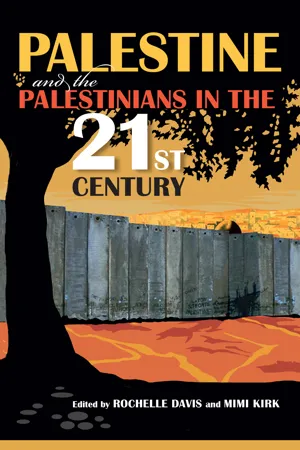
eBook - ePub
Palestine and the Palestinians in the 21st Century
- 292 pages
- English
- ePUB (mobile friendly)
- Available on iOS & Android
eBook - ePub
Palestine and the Palestinians in the 21st Century
About this book
Trusted by 375,005 students
Access to over 1.5 million titles for a fair monthly price.
Study more efficiently using our study tools.
Information
PART 1
Colonial Projects and Twentieth-Century Currents
1. The Zionist Colonization of
Palestine in the Context of
Comparative Settler Colonialism
To deeply understand Zionism and the state of Israel, one must engage with the field of comparative settler colonialism. The expansion and conquest by Europe that began in 1500 produced two kinds of related but clearly distinguishable forms of colonialism. One was metropole colonialism, in which Europeans conquered and ruled vast territories but administered and exploited them without seeking to make them their home; British India is a good example. The other type was settler colonialism, in which the conquest by European states brought with it substantial waves of settlers who with the passage of time sought to make the colonies their national patrimony. This process entailed a relationship with the indigenous people that ranged from dispossession to elimination, or from slavery to cheap labor, depending on the land and labor formations of a given settler society. Settler colonialism can be said to have begun in earnest with the English—and later Scottish-Presbyterian—settlers in Ireland in the second half of the sixteenth century, and continued with the settler colonies in what would become Virginia and New England in the seventeenth century. It is within the burgeoning field of comparative settler colonialism that I seek to place the Zionist colonization of Palestine and the state of Israel.1
The achievements of the comparative study of settler colonialism have been at once scholarly and political. Many settler projects gave birth to powerful nation-states, which have asserted their hegemonic narratives nationally and internationally. The comparative field not only acutely refutes these narratives through evidence and interpretation; it also creates a language that amounts to a transformative alternative to the way in which these settler societies narrate themselves. Three fundamentals of hegemonic settler narratives are thus undermined: (1) the uniqueness of each settler nation, (2) the privileging of the intentions and consciousness of settlers as sovereign subjects, and (3) the putatively inconsequential presence of natives in regard to the form and contours of settler societies.
To take uniqueness first, there is something deeper in the comparative approach than what the act of comparing obviously entails. This something is akin to what Benedict Anderson calls, in a separate but intimately related context, the modularity of nationalism. Comparative studies of settler nations undercut the claim to uniqueness not because they find all settler nations identical; in fact, many of these comparisons result in underscoring historical specificity as much as similarity. What they do, however, is offer a language that identifies a white settler trajectory and renders it reminiscent of other white settler trajectories. This is true not only for studies whose explicit purpose is to make a comparative argument (e.g., a study of the United States and South Africa as white settler projects), but also for those that are solely concerned with one case (e.g., a study of Zionist Israel as a white settler project that brings to bear upon this single case the conceptual language of comparative settler colonialism).
The exponents of comparative settler colonialism neither are oblivious to intentions nor suggest that intentions do not matter. In his masterful book on the United States and South Africa, White Supremacy, the late George Fredrickson attributes much explanatory importance to the fact that the Dutch East India Company’s intention in creating the Cape colony in the mid-seventeenth century was to have a secure trading post on the way to the Indian Ocean, whereas the intention in establishing the English colonies in Ireland at the end of the sixteenth century and in what would become Virginia and New England in the early seventeenth century was to create pure settlements and exclude the local population. The idea is therefore not to ignore intentions. Yet, one must acknowledge that a persistently structural and predominantly material investigation overwrites intentions and, crucially, emphasizes results. This kind of examination could, for example, substantially change the way many consider the ethnic cleansing during the 1948 war in Palestine. Instead of the rather obsessive concern with whether or not there was an Israeli master plan to cleanse Palestine of Arab presence, one might ask whether the structural logic embedded in settler nationalism, which the notion of a Jewish nation-state implies, explains the cleansing. One might also ask whether cleansing-as-result is not, empirically and ethically, as important as cleansing-as-intention (or the absence thereof).
The third fundamental—whether the presence of indigenous people is consequential to how settler societies were shaped—is possibly the most subtle fundamental and the one that exposes the exclusionary, or segregationist, nature of white liberalism and perhaps also of multiculturalism. The more liberal versions of hegemonic settler narratives may admit that along the otherwise glorious path to nationhood bad things were done to the indigenous people and, where applicable, to enslaved Africans. They may even condemn these “bad things” and deem them unacceptable. At the same time these narratives, by the very way in which they are conveyed, deny that the removal and dispossession of indigenous peoples and the enslavement of others is an intrinsic part of what settler nations are—indeed, it is the most pivotal constituent of what they are—rather than an extrinsic aberration of something essentially good or an extrinsic issue that requires attention and action. The point is not whether settler nations are good or bad, but the extent to which the act of exclusion in reality is congruous with the hegemonic rendering of that reality. The exclusionary fundamental that inheres in these white hegemonic narratives lies not in the denial by the sovereign settlers of the wrong they did to those whom they disinherited or enslaved (though this happens too), but in the denial that the interaction with the dispossessed is the history of who the settlers collectively are. What is denied is the extent to which the nonwhite world has been an intrinsic part of what is construed as European or Western history.
The comparative study of settler societies is not a subaltern studies project. It does not seek to salvage the voice of the dispossessed victims of settler colonialism and reassert it, nor does it adhere to a postcolonial methodology or register. In fact, most of these works’ chief subject matter is the settlers themselves more than the metropoles or the indigenous peoples. But this subject matter is described in terms of its incessant interaction with the peoples who were either dispossessed and removed or used for labor. In this type of analysis, by definition there cannot be a history of the institutions and ideologies of the settler societies that is not simultaneously a history of settler-native relations. The history of white supremacy throughout Fredrickson’s oeuvre is not a trajectory within the larger American or South African histories; in a very consequential way the history of white supremacy is the history of these settler societies.
Similarly, this work cannot include a history of private property (as the subject of legal studies and political theory) in early modern England that is not at the same time a history of land-looting first in Ireland and then east of the Appalachians. Analogously, and to be dwelt on in greater detail below, there cannot be a history of the cooperative settlements and settlement-theories, which is one trajectory in the hegemonic Israeli narrative, that is separable from another trajectory in that narrative, namely the “Arab Problem”; for what shaped the cooperative settlements and made some theories more pertinent and applicable than others was precisely what the Zionists called the Arab Problem, or the consequential existence of indigenous people who, from a settler vantage point, posed a problem. For example, Arabs (and for the most part, Mizrahi Jews) are completely absent from kibbutzim. This absence is the single most important fact in the history of the kibbutzim, for it tells the story of inclusion and exclusion.
One of the most important things to bear in mind when examining the nature of the Israeli occupation, the wall, the Nakba, and so forth, is that the creation of a nation-state out of a settler society is not just a foundational event but a continuing process. It is worth remembering the observation by Australia-based scholar Patrick Wolfe: “The determination ‘settler-colonial state’ is Australian society’s primary structural characteristic rather than merely a statement about its origins. … Invasion is a structure, not an event.”2
Three fundamentals of hegemonic settler narratives were mentioned above: the uniqueness of each settler nation, the exclusive primacy accorded to the settlers’ subjectivity, and the denial that the presence of the colonized has been the single most significant factor in determining the structure and nature of the settler society. The Zionist Israeli narrative is a particular case of that general depiction. Its three fundamentals accordingly are: the alleged uniqueness of the Jewish nation in its relentless search for sovereignty in the biblically endowed homeland; the privileging of the consciousness of the Zionist settlers at the expense of the colonized, as well as the privileging of the intentions of colonization by the settlers rather than the consequences for the indigenous Palestinians; and the denial that the presence of the Palestinian Arabs on the land destined for colonization was the single most significant factor that determined the shape that the settlers’ nation took.
This third fundamental is articulated in the way Zionist scholars and others who followed present the history of Palestine from the beginning of Zionist settlement in the 1880s until 1948 and beyond. They present the dual society thesis, meaning that two completely separate and self-contained entities emerged in Palestine: the Jewish Yishuv and Palestinian Arab society. Each developed according to its own trajectory, which is explicable—in the former case—by a combination of European origins and Jewish essence. Each trajectory is depicted as unrelated to the other, with the only meaningful relations being those of a struggle between two impregnable national collectives (if the national authenticity of the Palestinians is not altogether denied).3 It cannot be sufficiently stressed that what is denied is not the mere presence of Arabs in Palestine, but rather the fact that their presence and resistance were consequential to the very essence of the Zionist colonization project and the Israeli nation-state. This thesis is clearly the ultimate scholarly articulation of the empty land concept.
One of the most original scholars of the Israeli-Palestinian conflict, the Israeli historical sociologist Gershon Shafir, demolishes the dual society paradigm. He brings to bear the language and method of comparative settler colonialism upon the early phase of Zionist colonization (1882–1914) and later upon the nature of the Israeli state. He masterfully demonstrates that although it contains certain historically specific features, Zionism is nonetheless perfectly comparable to other settler projects, and what shaped the nature of Zionist colonization, including its institutions and state formation, was the settler-indigene struggle rather than intrinsic ideologies and the attempts to realize them. Adhering to a different concept—relational history—Zachary Lockman argues the same. Relational history is a concept Lockman borrows from Perry Anderson and adapts to his own research. By relational history Anderson meant a history “that studies the incidence—reciprocal or asymmetrical—of different national or territorial units and cultures on each other,” a history “that is the reconstruction of [such units’] dynamic interrelationships over time.” The result is that unlike Shafir, whose sole focus is the Zionist settlers, Lockman looks at the interaction between Arab and Jewish railway workers in Mandatory Palestine.4
My work complements studies such as Shafir’s and Lockman’s by adding a dimension whose subject matter and themes they do not examine. The comparative study of settler societies has been for the most part concerned with land, labor, and legal and political institutions. My interest is that of the literary and intellectual historian, who is concerned with interpreting human consciousness, imagination, and ideas, and with placing them in their material context. My work therefore shows that the framework of settler colonialism is applicable not only to the base (to use somewhat loosely Marxist terminology)—to land and labor—but also to the superstructure, to themes such as ideology, literary imagination, the use of the Old Testament, and scholarly knowledge. Below I show how deeply the sense of being part of a settler project was ingrained in the thought and consciousness of two prominent Zionists from the pre-1948 period.
Chaim Arlosoroff’s “Exercise” in Comparative Settler Colonialism
While scores of pro-Zionist scholars have been at pains to suppress the degree to which the presence of the Palestinian Arabs was intrinsic to the nature of the Zionist project, and the extent to which the Zionist project was a settler-colonial project, a no less committed Zionist inadvertently manifested awareness of precisely that which would be later denied. This Zionist was Dr. Chaim Arlosoroff (1899–1933), by far the intellectually brightest politician of note within labor Zionism; it has been speculated th...
Table of contents
- Cover
- Title
- Copyright
- Contents
- Acknowlegments
- Introduction
- Part 1. Colonial Projects and Twentieth-Century Currents
- Part 2. Politics, Law, and Society: Twenty-First-Century Developments and Paradigms
- Part 3. Trajectories for the Future, Solutions for a State
- Contributors
- Index
Frequently asked questions
Yes, you can cancel anytime from the Subscription tab in your account settings on the Perlego website. Your subscription will stay active until the end of your current billing period. Learn how to cancel your subscription
No, books cannot be downloaded as external files, such as PDFs, for use outside of Perlego. However, you can download books within the Perlego app for offline reading on mobile or tablet. Learn how to download books offline
Perlego offers two plans: Essential and Complete
- Essential is ideal for learners and professionals who enjoy exploring a wide range of subjects. Access the Essential Library with 800,000+ trusted titles and best-sellers across business, personal growth, and the humanities. Includes unlimited reading time and Standard Read Aloud voice.
- Complete: Perfect for advanced learners and researchers needing full, unrestricted access. Unlock 1.5M+ books across hundreds of subjects, including academic and specialized titles. The Complete Plan also includes advanced features like Premium Read Aloud and Research Assistant.
We are an online textbook subscription service, where you can get access to an entire online library for less than the price of a single book per month. With over 1.5 million books across 990+ topics, we’ve got you covered! Learn about our mission
Look out for the read-aloud symbol on your next book to see if you can listen to it. The read-aloud tool reads text aloud for you, highlighting the text as it is being read. You can pause it, speed it up and slow it down. Learn more about Read Aloud
Yes! You can use the Perlego app on both iOS and Android devices to read anytime, anywhere — even offline. Perfect for commutes or when you’re on the go.
Please note we cannot support devices running on iOS 13 and Android 7 or earlier. Learn more about using the app
Please note we cannot support devices running on iOS 13 and Android 7 or earlier. Learn more about using the app
Yes, you can access Palestine and the Palestinians in the 21st Century by Rochelle Davis, Mimi Kirk, Rochelle Davis,Mimi Kirk in PDF and/or ePUB format, as well as other popular books in Politics & International Relations & Middle Eastern History. We have over 1.5 million books available in our catalogue for you to explore.