How the persecution of witches reflected the darker side of the central social, political, and cultural developments of the sixteenth and seventeenth centuries.
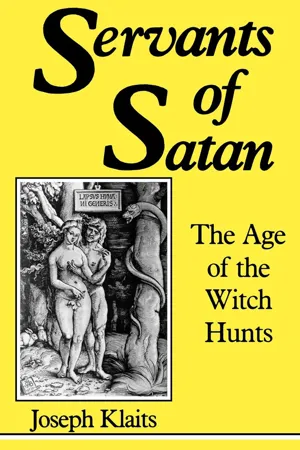
This is the first book to consider the general course and significance of the European witch craze of the sixteenth and seventeenth centuries since H.R. Trevor-Roper's classic and pioneering study appeared some fifteen years ago. Drawing upon the advances in historical and social-science scholarship of the past decade and a half, Joseph Klaits integrates the recent appreciations of witchcraft in regional studies, the history of popular culture, anthropology, sociology, and psychology to better illuminate the place of witch hunting in the context of social, political, economic and religious change.
"In all, Klaits has done a good job. Avoiding the scandalous and sensational, he has maintained throughout, with sensitivity and economy, an awareness of the uniqueness of the theories and persecutions that have fascinated scholars now for two decades and are unlikely to lose their appeal in the foreseeable future." —
American Historical Review
"This is a commendable synthesis whose time has come . . . fascinating." —
The Sixteenth Century Journal
"Comprehensive and clearly written . . . An excellent book." —
Choice
"Impeccable research and interpretation stand behind this scholarly but not stultifying account." —
Booklist
"A good, solid, general treatment." —Erik Midelfort, C. Julian Bishko Professor Emeritus of History and Religious Studies, University of Virginia
"A well written, easy to read book, and the bibliography is a good source of secondary materials for further reading." —
Journal of American Folklore
- 224 pages
- English
- ePUB (mobile friendly)
- Available on iOS & Android
eBook - ePub
About this book
Information
Print ISBN
9780253351821
Subtopic
Early Modern History1
The Witchcraft Enigma
Were there really witches? Did women attempt to inflict harm on their neighbors by magic? Did they actually gather for nocturnal rites of devil worship? Among modern interpreters of the witch trials, opinions about the existence and activities of witches have ranged from total credulity to complete skepticism. Even the most basic questions lack firm answers, and nearly all the logical possibilities have been upheld: that the idea of witchcraft was a hoax invented by self-interested churchmen and other authorities, that witches not only existed but also possessed supernatural powers granted them by Satan, and numerous intermediate positions. The witch trials constitute perhaps the greatest enigma of the least understood era in modern history. There is still no complete consensus among historians on this subject, but recent scholarship has approached the problem of the witch hunts with a high degree of precision and has achieved notable advances in our knowledge.
Seventy years ago there was little controversy. Numerous studies of the witch trials appeared from the 1880s to the years of the First World War, and scholarship pointed toward a single conclusion. Marshaling mountains of sources, the indefatigable writers of that generation, most notably the German scholar, Joseph Hansen, and Americans Andrew Dickson White, Henry Charles Lea, and George Lincoln Burr, concluded that witchcraft trials were the sad result of medieval superstitious fears and the copious use of torture to elicit confessions. From wide reading in the surviving trial records and demonological handbooks, these scholars became convinced that the authorities, particularly those in the Catholic church, were hypocritically manipulating a gullible public to enhance their own power. Or, alternatively, they classed churchmen and other officials among the gullible—honest but foolish victims of the superstitious belief in witchcraft.1
The first generation of witchcraft scholars, whose works are still valuable compendiums of source materials, emerged from predominantly Anglo-Saxon, Protestant milieus, which accepted the near-total identification of medieval Catholicism with ignorance and backwardness. Children of an optimistic age that placed supreme faith in the progress of reason, they confidently consigned witchcraft to the dustbin of history, an object lesson in the folly of irrational religion. The conviction that reason had conquered superstition with the trials’ end made it clear to these scholars that here was one more episode in the epic struggle between science and religion, a war that happily concluded with the worldwide triumph of Western values and material civilization at the dawn of the twentieth century. These biases made it easy for them to believe accounts of mass witch trials conducted by the clerical judges of the papal Inquisition in fourteenth-century France and Italy. In fact, we now know that these accounts are fraudulent and that relatively few witch trials were conducted in Catholic Europe during the supposedly dark Middle Ages.2
Like all historical models, that of the prewar scholars had its internal inconsistencies. Even when the tales of inquisitorial witch hunts were accepted at face value, it was always clear that most of the witch trials took place not in the medieval era, but after the advent of the Renaissance and Reformation. Protestants had been as active as Catholics in prosecuting witches during the sixteenth and seventeenth centuries, and torture was not inflicted on many of those who confessed to witchcraft. As often happens, however, this prewar interpretation was ultimately rejected not as a result of internal criticism but because of a change in the general cultural environment. By shattering the illusion of moral progress in the modern West, the war of 1914–18 reopened many questions formerly regarded as settled. To the postwar generation, a society capable of immense blood sacrifices to the cults of nation-state and industrial technology no longer seemed selfevidently rational and progressive when compared with contemporary non-Western cultures or earlier periods of European history.
In the general cultural reassessment that characterized Western thought between the two world wars, the role of the ethnographers was very great. Eager to understand non-Western cultures without succumbing to the biases of missionaries and colonists, anthropologists sought out communities that were as free as possible from European influences. The reports they brought back of highly organized societies were well received by intellectuals predisposed to question the values of their own culture. Among the most intriguing findings of the new anthropology was that witch beliefs played constructive roles in many societies. Although differing in some respects from the witchcraft of Europe’s past, non-Western beliefs in the harm inflicted and curses effected by ostensibly supernatural means strongly resembled Europe’s own experience with witchcraft. No longer was it possible to hold the opinion that the witch hunts were uniquely an instrument or symptom of medieval Catholic irrationality. Clearly, a new framework for interpreting the witch trials was in order, one that would place the European experience in a broader context.
Unfortunately, the first attempt at charting a new direction for European witchcraft studies led to a dead end. James Frazer’s monumental collection of folklore, The Golden Bough, had appeared just before World War I. Frazer’s work and its novel ethnographic consciousness inspired many scholars to look into the European tradition of folklore. In 1921 one such writer, Egyptologist Margaret Murray, published The Witch Cult in Western Europe. In this and subsequent books, she claimed that the victims of the witch trials were members of an ancient cult that had originated in Egypt and became the prevalent religion in Europe until the seventeenth century. Murray described Christianity as the religion of only a tiny elite, which had managed to suppress most written references to the majority’s faith. She was able to show to her own satisfaction that a fertility cult dedicated to the horned, two-faced god, called Janus or Dianus by the Romans, flourished in Europe until repressed in the great witch trials by hostile Christians who mistook the cult’s activities for the worship of Satan. Organized into covens, the worshipers of Dianus attended weekly meetings (called “esbats” by Murray), which she claimed were the basis for the misconstrued stories of witches’ sabbats.
Murray’s bold theses have been effectively criticized many times over the years, most recently by Norman Cohn, who shows with great thoroughness that her opinions rest on a tangled tissue of highly selective quotations, mistranslated passages, and out-and-out fabrications.3 Although the popular reputation of Murray’s works remains remarkably strong, no serious student of the subject accepts her evidence. Her theories nevertheless continue to provide an imagined historical foundation for members of witch cults today. Such modern witches practice a kind of pagan worship of Mother Earth. They reject completely a belief in Satan and have no connection with the supposed devil-worshiping witches of witch-hunt lore.
It is possible, of course, that although Murray was wrong in her reasoning, her conclusions were correct. A few scholars have continued to point out similarities between accounts of witches’ sabbats and folkloric practices devoted to fertility.4 This resemblance is circumstantial evidence for the existence of organized groups of devil worshipers. The important point, however, is that no one has been able to show that covens of witches actually existed in the Middle Ages or during the period of the witch craze. An occasional historian may still be willing to continue the nineteenth century romantic tradition of Jules Michelet and assert the reality of peasant devil worship as a sublimated form of social revolt.5 But in the absence of uncoerced testimonies to the existence of witch gatherings, such assertions must remain unproved.
Thus, two well-known interpretations of the witch hunts seem deficient: first, that they were simply an inevitable consequence of clerical superstition and power hunger; and, second, that the trials reflected the existence of a network of organized societies practicing something called witchcraft. The question remains, then, how can one explain the ubiquitous accounts of sabbats and devil worship? Of course, one option is simply to assume the reality of Satan and the accounts of witch activities. Given these assumptions, such talents as flying through the air and changing one’s shape become entirely plausible gifts of the devil. Those who assert the reality of such phenomena, however, clearly pass beyond the bounds of historical scholarship into the realm of theology.6 Obviously, the axioms of modern historical method—axioms I endeavor to apply throughout this book—make it impossible to consider an interpretation of witchcraft predicated on the devil’s existence. This is not an issue that can be addressed profitably in historical discourse.
Somewhat more accessible to historical analysis is the theory that tales of airborne trips to the witches’ sabbats resulted from visions induced by hallucinogenic substances. The widespread use of drugs in modern culture has prompted scholars to consider the possibility that trance-inducing plant derivatives may explain the uniform accounts of flying and devil worship.7 This may be an attractive hypothesis, but, once again, there is no persuasive evidence for the existence of drug cults at the time of the trials. Although witches were often accused of using hallucinatory ointments, we can be certain that at least in some cases such charges were completely false. Particularly impressive in this regard is the evidence accumulated by Alonso de Salazar, a judge of the Spanish Inquisition, who made a thorough study of witchcraft charges in 1611. Salazar conducted experiments with alleged hallucinogens that had been seized from accused witches in the Basque country of northern Spain. When he administered the supposedly potent drugs to animals, the judge found the material to be perfectly harmless. Salazar then learned from the accused that they had tried to satisfy the fantasies of their eager and credulous prosecutors by turning over jars containing such worthless concoctions as pork fat mixed with chimney soot and water. As a result, the inquisitor confidently concluded that there was no use of drugs among the so-called Basque witches.8 Although some people elsewhere in Europe may have been using hallucinogens, evidence of drug involvement in witchcraft is extremely sketchy and mostly circumstantial. For example, a recent attempt to attribute the Salem trials to an attack of ergotism, a disease accompanied by hallucinations and caused by eating rotten bread, turned out on closer analysis to be based on a long chain of unlikely assumptions.9 Nearly all analyses linking witchcraft with drugs rest on highly suspect testimony drawn from secondhand or more remote accounts of (often coerced) witch confessions.
Even if they were not drug induced, it is possible that the confessions of accused witches resulted from psychotic delusions. Some scholars and physicians have argued that mental illness lay at the root of the witch trials and have labeled as clinical symptoms the witches’ reports of their night flying and devil worship. No doubt some of those confessing to witchcraft were suffering from mental illness as we understand the term, but this explanation cannot account for many of the thousands of cases. In numerous instances enough is known about the victims to make us certain that they were not insane. Too often, psychiatric explanations of witchcraft have been based on fundamental misunderstandings—for example, confusing witches with the possessed—and on psychiatry’s tendency to abstract the behavior of an individual from its societal context.10
If delusions lay behind the witch hunts, they appear in most cases to have originated in the minds of the prosecutors, not the accused. After a century of witchcraft scholarship, it is at last becoming apparent that there is no reliable evidence of the existence of devil-worshiping witch cults and that the relatively few individuals who sincerely believed themselves to be devotees of Satan typically acquired such beliefs by suggestion from preachers or prosecutors. This conclusion emerges from the efforts of recent scholars to explain the witch trials by addressing the other major activity (in addition to devil worship) usually attributed to witches, namely, bringing harm to their neighbors by supernatural means.
On the surface, harmful magic may appear an even more mysterious and inaccessible area than rituals devoted to a devil figure. Yet the abundant records compiled by modern ethnography enable us to understand much more about such magical beliefs than was previously possible. Inspired by E. E. Evans-Pritchard’s pioneering work in the 1930s on witchcraft among the Azande of South West Africa, numerous anthropologists have made careful studies of witchcraft beliefs all over the world.11 As a result of this field work, we can now see many parallels between traditional Western cultures and others elsewhere.
Medieval and early modern Europe shared with numerous other technologically primitive societies a conviction that unseen forces were responsible for everyday events. Not only cataclysms like wars, earthquakes, and epidemics, but also the basic conditions of life—weather, birth, illness, and death—were explained by recourse to occult (i.e., hidden) powers. It was widely believed that demonic spirits could withhold needed rainfall, turn milk sour or make the cow dry up, render women sterile and men impotent, and, in general, cause injury, disease, and death to humans, plants, and animals. In the absence of modern medicine, science, and technology, the world seemed filled with mysteries, and quite understandably these mysteries held terrors.12
In his monumental study of Western attitudes toward death, Philippe Ariès has pointed out the significance of linguistic variants on the themes of evil and the demonic.13 In the Romance languages the words for misfortune, illness, and mishap stem from the same root, meaning evil or malign, that is the base of the word for devil. Thus, in French, malheur, maladie, and malchance are all related to the Latin malum, from which le malin (the word for devil) also is derived. All kinds of suffering were connected linguistically with the devil, the source of all evil. So, too, were the harmful actions of witches, actions known in Latin as maleficia, in English as malefice. Etymological evidence reinforces the conclusion that, learned or illiterate, nearly all Europeans before the mid-seventeenth century were convinced of the reality of malevolent demonic spirits who caused all manner of misery.
Indeed, every branch of Christianity denounced as heretical the opinion that there are no devils. But few espoused this deviant opinion, not primarily out of fear of religious sanctions, but because there was no other convincing way to explain reality. Whereas the citizens of advanced nations in the twentieth century can rely on a physician in the face of most threatening illnesses, the medicine of the age of the witch hunts was crippled by a mistaken theory inherited from the ancient Greeks. We have meteorology to explain such catastrophes as destructive hailstorms, but the peoples of past times could portray these events only in personal terms—as divine retribution for sin, instances of temptation meant to test the believer’s faith, or the actions of evil demons.
Thus, the most important practical matter confronting premodern Europeans was how to protect themselves against environmental forces that constantly threatened to overwhelm them. Religion provided the leading defense against these terrors. Aside from opening the road to spiritual fulfillment for the pious, the Christian churches had a social function in reducing the level of personal and community fear. By availing himself of religious sacraments, prayers, and other rituals and by depending on his faith in God, the congregant believed himself armed against evil. Thus, the rite of baptism is in part an exorcism of demonic forces; the marriage ritual invokes the superior power of God for the protection of the couple; holy water can supplement human resources with divine guardianship; and prayer may offset human weakness with God’s strength. These are just a few examples of the ways Christian practice sought to cope with the human sense of powerlessness in the face of threatened disaster.14
As a means of understanding and coping with evil, the concept of witchcraft had great appeal to people chronically subject to personal tragedy. Vulnerable as they were, victims often attributed the evils that befell them to the intervention of witches. In Western societies during the sixteenth and seventeenth centuries, most people regarded the witch as the malevolent human ally of ubiquitous demonic spirits. Witchcraft was a convenient way of explaining misfortune. Even more important, it was an explanation that offered the victim an apparent remedy: the witch could be executed.15
Certainly there were people in the age of the witch hunts, although perhaps not many, who tried to harm their neighbors through black magic. Thanks to the work of Keith Thomas and other scholars, we now know the importance of “white magic,” that is, magic for good ends, in village life. Everywhere in Europe, wizards (also known as cunning folk, conjurers, or simply magicians) attempted to heal the sick, inspire love, foretell the future, and...
Table of contents
- Cover
- Title
- Copyright
- Contents
- Preface
- Introduction
- 1. The Witchcraft Enigma
- 2. Medieval Witches
- 3. Sexual Politics and Religious Reform in the Witch Craze
- 4. Classic Witches: The Beggar and the Midwife
- 5. Classic Accusers: The Possessed
- 6. In the Torture Chamber: Legal Reform and Psychological Breakdown
- 7. An End to Witch Hunting
- Notes
- Bibliography
- Index
Trusted by 375,005 students
Access to over 1.5 million titles for a fair monthly price.
Study more efficiently using our study tools.
Frequently asked questions
Yes, you can cancel anytime from the Subscription tab in your account settings on the Perlego website. Your subscription will stay active until the end of your current billing period. Learn how to cancel your subscription
No, books cannot be downloaded as external files, such as PDFs, for use outside of Perlego. However, you can download books within the Perlego app for offline reading on mobile or tablet. Learn how to download books offline
Perlego offers two plans: Essential and Complete
- Essential is ideal for learners and professionals who enjoy exploring a wide range of subjects. Access the Essential Library with 800,000+ trusted titles and best-sellers across business, personal growth, and the humanities. Includes unlimited reading time and Standard Read Aloud voice.
- Complete: Perfect for advanced learners and researchers needing full, unrestricted access. Unlock 1.5M+ books across hundreds of subjects, including academic and specialized titles. The Complete Plan also includes advanced features like Premium Read Aloud and Research Assistant.
We are an online textbook subscription service, where you can get access to an entire online library for less than the price of a single book per month. With over 1.5 million books across 990+ topics, we’ve got you covered! Learn about our mission
Look out for the read-aloud symbol on your next book to see if you can listen to it. The read-aloud tool reads text aloud for you, highlighting the text as it is being read. You can pause it, speed it up and slow it down. Learn more about Read Aloud
Yes! You can use the Perlego app on both iOS and Android devices to read anytime, anywhere — even offline. Perfect for commutes or when you’re on the go.
Please note we cannot support devices running on iOS 13 and Android 7 or earlier. Learn more about using the app
Please note we cannot support devices running on iOS 13 and Android 7 or earlier. Learn more about using the app
Yes, you can access Servants of Satan by Joseph Klaits in PDF and/or ePUB format. We have over 1.5 million books available in our catalogue for you to explore.