A collection of fifteen essays exploring what folklore is, its history, and how it all connects to the world.
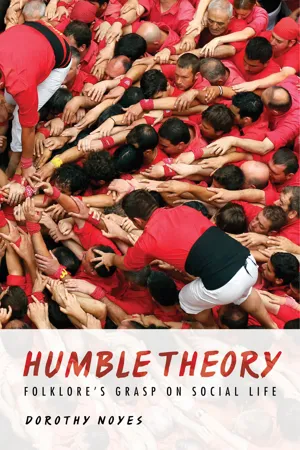
Celebrated folklorist, Dorothy Noyes, offers an unforgettable glimpse of her craft and the many ways it matters. Folklore is the dirty linen of modernity, carrying the traces of working bodies and the worlds they live in. It is necessary but embarrassing, not easily blanched and made respectable for public view, although sometimes this display is deemed useful. The place of folklore studies among modern academic disciplines has accordingly been marginal and precarious, yet folklore studies are foundational and persistent. Long engaged with all that escapes the gaze of grand theory and grand narratives, folklorists have followed the lead of the people whose practices they study. They attend to local economies of meaning; they examine the challenge of making room for maneuver within circumstances one does not control. Incisive and wide ranging, the fifteen essays in this book chronicle the "humble theory" of both folk and folklorist as interacting perspectives on social life in the modern Western world.
"Tying folklore to larger trends in Western cultural thought, leaving behind narrow concerns with genre or fossilized expressive forms,
Humble Theory showcases the potential of folkloristics to contribute meaningfully to interdisciplinary conversations about culture." —
Journal of Folklore Research
"
Humble Theory is a big book. From a small scholarly field, it announces the most substantial, far-seeing insights into the world's social life. By writing it, Noyes becomes the kind of public intellectual the United States needs." —
Journal of American Folklore
- 470 pages
- English
- ePUB (mobile friendly)
- Available on iOS & Android
eBook - ePub
About this book
Trusted by 375,005 students
Access to over 1.5 million titles for a fair monthly price.
Study more efficiently using our study tools.
Information
1 Humble Theory*
SOME OF YOU will remember the dictionary definition of the word humble, as propounded by Charlotte the Spider: “not proud and near the ground” (White 1952). Just as Charlotte found the epithet appropriate to Wilbur the Pig, perhaps we can agree that it is appropriate to folklorists and the kind of theory-making to which we should aspire. We who wear the scarlet F upon our bosoms are perhaps in no position to be proud, and for the present I think we should stop worrying about it: we would be better off cultivating shamelessness. If we are proud of anything, to be sure, it is of being near the ground. I enter, therefore, a plea not for grand but for humble theory.
Folklorists occupy a certain historical and institutional ground; we have built on it for a long time and our theoretical aspirations necessarily take it as their launch pad. Two issues lie behind the question posed for the AFS forum, “Why is there no grand theory in folkloristics?”
One, as I’ve suggested, is straightforward status anxiety. We labor under the stigma of the F-word and are constantly having either to explain it or to invent in its place new euphemisms. Since the latter arise from the desire to flee the stigma rather than an emergent reordering of the discipline, they are doomed to failure.
I have limited faith in collective campaigns for disciplinary respectability. As everyone from Castiglione to Molière to Bourdieu tells us, the quest for social distinction is doomed to undermine itself. I would also remind us that we are not the only discipline suffering from status anxiety. Even political scientists, who occupy a space far higher than we do on the imagined ladder toward transcendent knowledge, characteristically experience what international relations scholar Ned Lebow likes to call “physics envy.” In the course of interaction with specialists in international relations over the years, I have discovered that not a few suffer also from folklore envy. Their grand theories having failed to predict such non-negligible matters as the end of the Cold War, they find themselves attracted to disciplines closer to the ground and attuned to contingencies, softer voices, and the constraints of language and history.
Folklorists, likewise, envy actors both below and above us on this stairway to heaven. Closer to the ground than we are the artists and activists who make social life and whose collective labor shapes its forms. We long to be creative writers or makers of the revolution, not parasites upon such endeavors.
On the other side we have theory envy. The theory in question is typically not the grand theory of social science but the high theory of literary studies and philosophy. The latter has more glamour but can also be more resonant to folklorists, for in its poetic or world-making ambitions it mimics the primary symbolic systems we study.1 Sometimes we throw up our climbing ropes and haul ourselves painfully from the ground of social experience to the heights of, for example, poststructuralism—often hanging by a thread from a cliff rather than finding a secure footing, step by step. I would remind us of our historical position on the slope or, better said, in the middle. The folklorist has characteristically been a provincial intellectual, and while this position has no glamour whatsoever, it’s more significant than we think. The nation-state was made stable by the labor of provincial intellectuals trying to integrate their local realities and the overarching order into a viable whole. Today provincial intellectuals are wrestling with globalization. It’s a position that poses strong temptations, to which some folklorists in a variety of historical situations have succumbed—hence the stain of the scarlet F—but it’s also a position that offers constructive and critical opportunities possessed neither by the top nor the bottom. We need to learn to live with the ambivalence of the middle position.
The second issue we face is the need to map out useful work in the world for the people who call themselves folklorists. Here I feel there is something to be done. So let me stress that while I don’t find the notion of grand theory useful to us at this stage in our disciplinary life—or perhaps ever—I am absolutely not refusing theory as such either in general or for folklorists: I am rather trying to define our right relationship to it.
First, we need to recognize the necessary complexity of folkloristic practice. If you will indulge a lapsed Episcopalian, folklore is a trinity, of which the three persons are indivisible. The field cannot theorize without strongly grounded, in-depth ethnography of particulars. The field has no purpose without engagement in the world, trying to understand and amend the social processes that created the F-word and other, far worse stigmas. Practice in the world has no lasting efficacy without theory to clarify its means and ends and make its efforts cumulative. The ethnographer, the practitioner, and the theorist are mutually dependent and mutually constitutive: they cohabit, to different degrees, in singular folklorist bodies. We tend to forget this and too often moralize the differences between these three tasks because historically they have informed three different types of institution: the archive, the public practice, and the academic program. We who are lodged in these institutions acquire their local dispositions and can hardly help knowing where our bread is buttered. But when any of these three labors is neglected, the discipline suffers. We are currently at the end of a long phase of reaction to an earlier overemphasis on theory, when the lures of science and of objectivity tore us painfully from both grounded understandings and the pursuit of social justice. A restored focus on ethnography and practice has resulted in enormously improved ethnography and more successful practice. But the field has paid a price in fragmentation, no longer knowing how to draw intellectual connections between one situation and another. This fragmentation doesn’t only impoverish theory per se: it also saps our ability to understand ethnographic particulars and to create coalitions towards practical ends of liberation.
Instead, we need to render unto theory what is due to theory. In part that means getting over our anxiety about reductionism. Thought is reduction. But humble theory recognizes that all our work is essay, in the etymological sense: a trying-out of interpretation, a provisional framing to see how it looks. In the absence of a better alternative, there is much to be said for the Enlightenment project. Science reduces reality in an effort to understand it but it also lays itself open to an ongoing process of collective correction and revision. While science as converted into institutional practice has often not lived up to its own ideals, so that its authority has legitimated various kinds of oppression, we can nonetheless recognize that science’s own ideology gives us the tools to make this critique. And there is still a qualitative difference in openness to revision between, let’s say, evolutionary theory and intelligent design.
While I would like us, in a humble spirit, to reclaim theory, I would not go so far as to look for grand theory. Grand theory constructs for itself grand objects: human nature, the nature of society, and so forth. Folklore does not have the resources to set up in competition with sociology, psychology, or anthropology. Our history has given us a smaller garden to cultivate, but not an infertile one.
We have our scarlet F to think about. Those forms and practices that have historically been labeled as folklore do not reside in dramatically different and distant cultural worlds from that of the labelers. Folklore is the intimate Other of modernity, the remnant that can be swept out of sight but not easily disposed of. Dell Hymes and others have long argued that the stone the builders had rejected should become the cornerstone of the human sciences.2 There is no reason we should not work toward this goal—but we must recognize our immediate practical limitations. Folklore is also the intimate Other of the academy. We are there and not going away, but we will continue to make our colleagues uneasy and we are not going to have armies of scholars out saving the world for folklore any time soon—which may be a good thing. Dealing with the residual, the emergent, and the interstitial gives us quite enough ground for the few of us there are to occupy it.
Along with the external constraints on our disciplinary space, our internal intellectual history provides us with a limited but important ground to build on. We should remember that the American Folklore Society was founded as an act of opposition to the grand theory of the period: evolutionary biology as it was mistakenly generalized to account for cultural and social difference. Franz Boas’ message was that anthropologists were theorizing in advance of the facts, as Sherlock Holmes would say: they did not yet know how to read the particulars of cultural situations. William Wells Newell deliberately brought together Francis James Child and Franz Boas—one looking at the English stock then celebrated as the apex of cultural evolution, one looking at Native Americans, seen by many anthropologists as savages at the bottom of the ladder. By putting the expressions of both of these groups under the common lens of German philological method (cf. Bauman 2008) and by explicitly setting up these two groups along with new immigrants and once-enslaved Africans as the range of subjects whose lore the AFS should examine, Newell was insisting on the common humanity and common historicity of the people whom grand theory had set asunder (1888). Our field was thus at the inauguration of what Jason Baird Jackson has called “the Americanist tendency toward theoretical modesty, grounded in an appreciation of the complexities of history and ethnography located in actual places and times” (2004, 202). As the presidential address of Dell Hymes in 1974 strongly reminded us, this is a usable past (1975).3
For the moment, we are better equipped to criticize grand theory than to build it. At the same time, however, we can continue to address that middle territory between grand theory and local interpretation.4 Performance theory, it’s often said, is only method, but method takes us to theory. We begin to think in the act of describing and see particulars in the act of comparing. We need an analytical vocabulary allowing us to move across situations. We cannot leapfrog from the local into transcendent meaning, and my political scientist friends are encountering the reverse problem as they try to plummet in the other direction. The questions proper to our field are in the middle of the ladder. They are not Why-questions but How-questions, about the life of forms in society. They are our old topics: transmission, performance, and differentiation. How do forms move across time and space and remain recognizable? How do the people who recurrently interact in a given situation generate forms in common, and how do those forms work back again upon their makers? How is form marked by voice, such that we can recognize it as folk, or as Cajun, or as mine or as Other? We have two centuries of scholarship built upon this ground, which in recent years we have neglected. Humble it may be, but we have a there there. We have a there here and need not go looking to the stars—cosmic or academic—for salvation.
Notes
1. These symbolic systems are, of course, the mode of vernacular theory, which calls on metaphor rather than abstraction to encapsulate and clarify reality. As Charles Briggs pointed out in the AFS discussion, vernacular theory was the empty chair at our table in this forum. Vernacular theory is more intimately linked to capital-T Theory than we think. Of course postcolonial studies, science studies, and other fields have amply revealed the Eurocentric categories informing supposedly culture-free theoretical formulations, but there is also a positive side to the relationship. Many in the hard sciences, where grand theory is so unproblematized that it need not be named and defended as such, freely recognize the poetic foundations of their thinking and the frequent impetus to scientific discovery from humble metaphor (e.g., Ziman 1991). Closer to home, the new identity-based disciplines have made an explicit point of building academic theory out of vernacular theory (Roberts 1999, 135).
2. This metaphor was invoked by The Remnant, an appropriately named hip-hop group, in their performance at the opening ceremony of the 2005 AFS annual meeting.
3. Naturally this, like all origin myths, must be treated as such: rhetorically useful and unencumbered by inconvenient nuance. John W. Roberts’ closer reading of Newell (2008) reveals that American folklore was not as free of the Europeans’ nationalism or the anthropologists’ evolutionary racism as we would like to think. But like all good constitutions, Newell’s initial program for the AFS provides a blueprint for the eventual transcendence of its own historical limitations.
4. In discussion, Gary Alan Fine pointed to Robert K. Merton’s “theories of the middle range.”
References
Bauman, Richard. 2008. “The Philology of the Vernacular.” Journal of Folklore Research 45:29–36.
Hymes, Dell. 1975. “Folklore’s Nature and the Sun’s Myth.” Journal of American Folklore 88:345–369.
Jackson, Jason Baird. 2004. “Recontextualizing Revitalization: Cosmology and Cultural Stability in the Adoption of Peyotism among the Yuchi.” In Reassessing Revitalization: Perspectives from North America and the Pacific Islands, edited by Michael Harkin, 183–205. Lincoln: University of Nebraska Press.
Newell, William Wells. 1888. “On the Field and Work of a Journal of American Folk-Lore.” Journal of American Folklore 1:3–7.
Roberts, John W. 1999. “‘… Hidden Right Out in the Open’: The Field of Folklore and the Problem of Invisibility.” Journal of American Folklore 112/444: 119–39.
————. 2008. “Grand Theory, Nationalism, and American Folklore.” Journal of Folklore Research 45:45–54.
White, E. B. 1952. Charlotte’s Web. New York: Harper.
Ziman, John. 1991. Reliable Knowledge: An Exploration of the Grounds for Belief in Science. Cambridge: Cambridge University Press.
* This piece is a lightly revised transcript of my comments at the forum “Why Is There No ‘Grand Theory’ in Folkloristics?” organized by Lee Haring and held at the Annual Meeting of the American F...
Table of contents
- Cover
- Title Page
- Copyright
- Dedication
- Contents
- Introduction
- Part I: The Work of Folklore Studies
- Part II: Histories and Economies of Tradition
- Part III: Slogan-Concepts and Cultural Regimes
- Index
Frequently asked questions
Yes, you can cancel anytime from the Subscription tab in your account settings on the Perlego website. Your subscription will stay active until the end of your current billing period. Learn how to cancel your subscription
No, books cannot be downloaded as external files, such as PDFs, for use outside of Perlego. However, you can download books within the Perlego app for offline reading on mobile or tablet. Learn how to download books offline
Perlego offers two plans: Essential and Complete
- Essential is ideal for learners and professionals who enjoy exploring a wide range of subjects. Access the Essential Library with 800,000+ trusted titles and best-sellers across business, personal growth, and the humanities. Includes unlimited reading time and Standard Read Aloud voice.
- Complete: Perfect for advanced learners and researchers needing full, unrestricted access. Unlock 1.5M+ books across hundreds of subjects, including academic and specialized titles. The Complete Plan also includes advanced features like Premium Read Aloud and Research Assistant.
We are an online textbook subscription service, where you can get access to an entire online library for less than the price of a single book per month. With over 1.5 million books across 990+ topics, we’ve got you covered! Learn about our mission
Look out for the read-aloud symbol on your next book to see if you can listen to it. The read-aloud tool reads text aloud for you, highlighting the text as it is being read. You can pause it, speed it up and slow it down. Learn more about Read Aloud
Yes! You can use the Perlego app on both iOS and Android devices to read anytime, anywhere — even offline. Perfect for commutes or when you’re on the go.
Please note we cannot support devices running on iOS 13 and Android 7 or earlier. Learn more about using the app
Please note we cannot support devices running on iOS 13 and Android 7 or earlier. Learn more about using the app
Yes, you can access Humble Theory by Dorothy Noyes in PDF and/or ePUB format, as well as other popular books in Social Sciences & Cultural & Social Anthropology. We have over 1.5 million books available in our catalogue for you to explore.