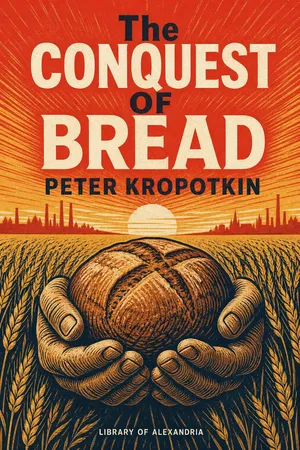
If society can produce enough for everyone, why do so many go without? Peter Kropotkin makes this question the starting point for a radical rethinking of ownership, work, and everyday life.
In The Conquest of Bread, Kropotkin argues that wealth is a collective inheritance: land, cities, machinery, and knowledge owe their value to the efforts of countless generations. No individual, he contends, can justly claim exclusive ownership of what so many have helped create. From this premise he develops a case for anarchist communism, grounded in common ownership and voluntary cooperation rather than capitalist competition or centralized state control.
His argument moves from principles to practical needs. Food, housing, clothing, agriculture, and industry become tests of what a transformed society must deliver. He challenges wage systems and rigid divisions of labor while insisting that well-being means more than subsistence: people also need leisure, art, learning, and satisfying work. The book endures because it connects large questions of economic justice to the ordinary arrangements through which people live and work together.
What readers find inside:
- Wealth and inheritance - A challenge to private monopoly over resources and knowledge built through generations of shared effort.
- Necessities first - An argument that social revolution must secure food, shelter, and clothing for everyone.
- Work and wages - A critique of wage labor and systems that measure entitlement by individual output.
- Voluntary cooperation - An account of how association and agreement can organize social life without coercive authority.
- Life beyond survival - A defense of leisure, intellectual pursuits, and artistic enjoyment as human needs rather than privileges.
For readers of political philosophy, students of anarchism and socialism, and anyone questioning the relationship between abundance and inequality, this is a direct encounter with a demanding vision of social change.
Begin reading and consider what it would mean to make well-being for all the starting point of economic life.