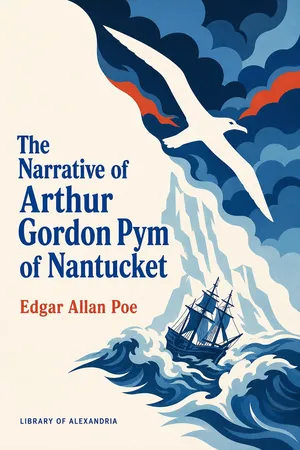
A young stowaway dreams of adventure. The ocean answers with mutiny, starvation, and a mystery at the edge of the known world.
In The Narrative of Arthur Gordon Pym of Nantucket, Edgar Allan Poe follows an inexperienced young voyager aboard the whaling ship Grampus. Hidden below deck, Arthur Pym depends on his friend Augustus for survival, only to find that life above is no safer. A violent struggle for control of the vessel begins a harrowing sequence of confinement, deprivation, and desperate choices.
Poe's only novel moves from the physical terrors of a sea voyage toward the uncanny possibilities of the Antarctic. Its matter-of-fact accounts of ships, navigation, and endurance make its increasingly strange discoveries all the more unsettling. What begins as an escape from ordinary life becomes an exploration of how little people can know-or control-when familiar landmarks disappear. The tension between practical detail and inexplicable dread gives this nineteenth-century tale its enduring power.
What readers find inside:
- A perilous beginning - Pym's secret passage aboard the Grampus turns youthful curiosity into a struggle to stay alive.
- Mutiny at sea - Violence and divided loyalties expose the fragile order on which shipboard life depends.
- Extreme survival - Hunger, isolation, and danger force the voyagers to confront the limits of endurance.
- Polar mystery - The journey south leads into unfamiliar landscapes and disturbing discoveries.
- Gothic uncertainty - An elusive boundary between observed fact and the inexplicable keeps the reader questioning what comes next.
For readers of classic nautical adventure, Gothic fiction, and tales of polar exploration, this is a voyage where the promise of discovery cannot be separated from the threat of disaster.
Step aboard with Pym and follow the sea road from youthful ambition into unsettling mystery.