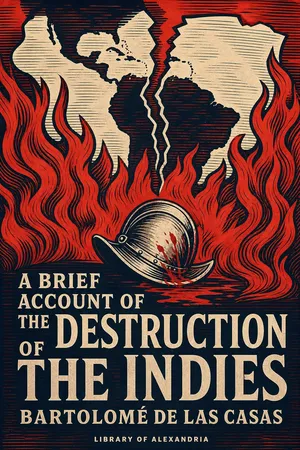
What happens when a voice inside an empire exposes the cruelty behind its conquests? Bartolomé de las Casas turns testimony into an urgent demand for justice.
First published in 1552, A Brief Account of the Destruction of the Indies denounces the violence inflicted on Indigenous peoples during Spain's conquest of the Americas. Las Casas, a Dominican friar who had once participated in the colonial system, describes killings, forced labor, and the devastation of communities. His purpose is not simply to record suffering, but to persuade the Spanish crown to stop abuses committed under its authority.
Moving across regions of the Americas, the work repeatedly connects the pursuit of wealth with the destruction of human lives. Its force comes from the clash between professed Christian beliefs and the conduct of conquerors who claimed to act in their name. Both a polemical appeal and a historical source, it remains important for understanding colonial violence, early arguments for Indigenous rights, and the moral responsibilities of those who witness injustice. Its accusations also invite careful reflection on how testimony is used to challenge political power.
What readers find inside:
- A challenge to conquest - Las Casas condemns the cruelty inflicted on Indigenous communities by Spanish colonizers.
- Greed and power - The pursuit of gold and wealth emerges as a driving force behind exploitation.
- Faith and conscience - Christian moral claims are set against the violence carried out by professing Christians.
- An appeal to authority - The work calls on the Spanish crown to intervene against colonial abuses.
- Human dignity - A sustained defense of Indigenous humanity gives the argument its enduring urgency.
This is essential reading for students of Latin American history, readers exploring colonialism and Indigenous rights, and anyone interested in the relationship between conscience and power.
Begin this historic appeal and encounter a voice that refused to let conquest pass without judgment.