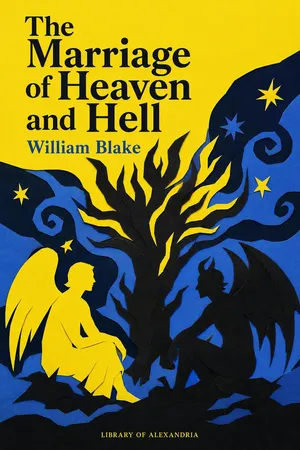
What if the forces we are taught to condemn are essential to imagination and life? William Blake turns familiar ideas of good and evil inside out in this fiery work of poetry, satire, and spiritual inquiry.
Composed in the revolutionary atmosphere of the late eighteenth century, The Marriage of Heaven and Hell challenges the division of human experience into obedient virtue and dangerous desire. Blake sets energy against restraint, questions religious authority, and presents contraries as necessary to existence. His angels and devils unsettle received wisdom rather than offer a comfortable moral lesson.
The work moves between verse, prose, aphorism, and visionary encounters. Its celebrated Proverbs of Hell compress provocative ideas into brief, memorable statements, while the Memorable Fancies use otherworldly conversations to explore belief and perception. By turns playful, confrontational, and mysterious, Blake's writing asks how much of what we call truth is shaped by habit, fear, or authority. Its enduring appeal lies in that invitation to question-and to imagine beyond inherited limits.
What readers find inside:
- The power of contraries - Opposing forces become a way to understand creativity, conflict, and human experience.
- Provocative proverbs - Brief aphorisms challenge assumptions about wisdom, excess, desire, and restraint.
- Visionary encounters - Angels and devils bring spiritual arguments into vivid, unsettling focus.
- Religious satire - Blake questions doctrines and institutions that separate spiritual life from bodily energy.
- Imagination and perception - The work explores how human vision can be limited and how those limits might be overcome.
For readers of Romantic poetry, seekers drawn to mysticism, and anyone interested in the meeting of literature and philosophy, this is a compact work with questions that reach far beyond its historical moment.
Enter Blake's visionary world and discover what happens when familiar moral boundaries begin to shift.