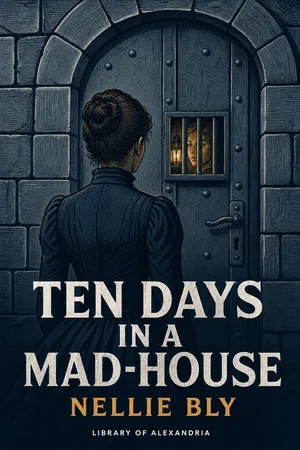
She entered an asylum to uncover the truth. Once inside, speaking rationally was no guarantee that anyone would let her out.
In 1887, twenty-three-year-old Nellie Bly accepted a dangerous assignment for the New York World: feign insanity, gain admission to the women's asylum on Blackwell's Island, and report what happened behind its locked doors. Ten Days in a Mad-House follows her passage through medical examinations, Bellevue Hospital, and confinement, revealing how readily authorities could mistake vulnerability for mental illness.
Inside the asylum, Bly abandoned her performance and behaved normally, yet the staff continued to regard her as insane. She recorded cold baths, inadequate food, neglect, and cruelty, while listening to the women confined around her. Her account asks who gets believed, how poverty and language barriers shape a diagnosis, and what happens when an institution's authority goes unchallenged. The reporting helped prompt a grand jury investigation and increased city funding for care. Its lasting force lies in Bly's direct observations and her refusal to treat suffering as routine.
What readers find inside:
- A dangerous assignment - Bly describes the preparation and examinations that took her from undercover reporter to asylum patient.
- Life behind locked doors - Daily routines reveal the physical hardship and humiliation endured by confined women.
- Women too easily dismissed - Encounters with fellow patients expose the consequences of poverty, isolation, and barriers to being understood.
- The trap of diagnosis - Bly shows how difficult it becomes to prove sanity once officials have decided otherwise.
- Reporting with consequences - The account connects eyewitness testimony with public scrutiny and demands for institutional reform.
For readers of investigative journalism, women's history, and the history of mental health care, this is both a tense personal narrative and a searching examination of power over vulnerable lives.
Step inside with Bly and discover the observations that forced New York to confront what it had allowed.