"An enlightening commentary on Merold Westphal's intricate thought and provokes new questions concerning the original project of his diverse philosophy." —B. Keith Putt, editor of
The Future of Continental Philosophy of Religion
Merold Westphal is considered to be one of the preeminent Continental philosophers of religion. His articulation of faith as the task of a lifetime has become a touchstone in contemporary debates concerning faith's relationship to reason. As Justin Sands explores his philosophy, he illuminates how Westphal's concept of faith reveals the pastoral, theological intent behind his thinking. Sands sees Westphal's philosophy as a powerful articulation of Protestant theology, but one that is in ecumenical dialogue with questions concerning apologetics and faith's relationship to ethics and responsibility, a more Catholic point of view. By bringing out these features in Westphal's philosophy, Sands intends to find core philosophical methodologies as well as a passable bridge for philosophers to cross over into theological discourses.
"[An] engaging and illuminating work." —William Desmond, David Cook Chair in Philosophy, Villanova University, Professor of Philosophy, Institute of Philosophy, KU Leuven, Belgium
"A long overdue critical homage to one of the bravest religious thinkers of our generation." —Richard Kearney, Charles B. Seelig Chair of Philosophy at Boston College
eBook - ePub
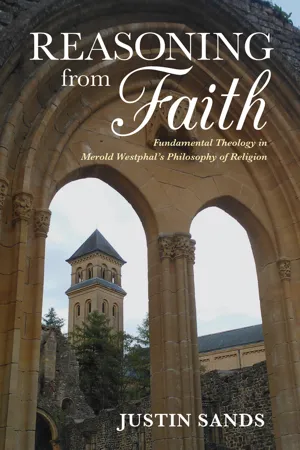
Reasoning from Faith
Fundamental Theology in Merold Westphal's Philosophy of Religion
- 328 pages
- English
- ePUB (mobile friendly)
- Available on iOS & Android
eBook - ePub
About this book
Trusted by 375,005 students
Access to over 1.5 million titles for a fair monthly price.
Study more efficiently using our study tools.
Information
Topic
PhilosophySubtopic
Christian Theology
1. OF HERMENEUTICS AND STYLE
How to Read Westphal
TEXTUAL FIDELITY: WESTPHAL’S PHILOSOPHICAL STYLE
Beginning our investigation by understanding how Westphal thinks of and approaches philosophy and theology will inform us of his motivations and the subsequent implications of his writing. We start by investigating Westphal’s hermeneutics and his earlier writings to gain a particular ‘Westphalian’ perspective for things to come. What is important is to look at how he first receives his intellectual influences and carefully parses out their meaning before crafting his own original thinking. From here, one should see the foundations of Westphal’s own hermeneutics.
First and foremost, Westphal is primarily a scholar rather than an original thinker; he maintains a textual fidelity by always investigating the author’s original intention and how the text in question was received in its day. It is only from that position that he moves toward a contemporary interpretation or his own critique. His first book, History and Truth in Hegel’s Phenomenology, published in 1979, is a superbly close reading of Hegel’s Phenomenology of Spirit. Westphal constructs his text around Hegel’s structure, crafting his work as a companion study of Hegel with the only goal of explaining Phenomenology, not developing any contemporary critique or adapting it for any other project.1 This is the same case for his next primary influence, Søren Kierkegaard, in the book Becoming a Self, a commentary on Concluding Unscientific Postscript. Once he turns to Emmanuel Levinas, he follows a similar style, but this time fashions the work as a dialogue between Levinas and Kierkegaard in the aptly titled Levinas and Kierkegaard in Dialogue.2
Westphal carries this scholastic style throughout all of his work, often focusing on one author at a time and then adding his own critique through linking to either another author or a converging concept. When reading his work, one can get the sense that it is a dialogue on another dialogue: Westphal and Author X, who also happens to be “talking” to another thinker, be it Kierkegaard talking to Hegel (more exactly, Danish Hegelians), Hegel to Spinoza, Levinas to Heidegger (or Kierkegaard), Aquinas to Pseudo-Dionysius, and so on. This pattern is especially seen in Transcendence and Self-Transcendence, Westphal’s most original text, where each chapter title refers to an author whose concept(s) accounts for the central theme of the chapter (e.g., “Hegel: The Onto-Theological Pantheism of Spirit”), with subsequent chapters continuing Westphal’s line of reasoning by engaging another author.3 He abandons this style only when dealing with a single issue, for example, in God, Guilt, and Death, where he seeks to find the existential meaning of religion. All of this is to say that Westphal is a reader of texts first, a philosopher second: he initially is concerned about the text or author, and then either comments on it or links the text to another.
Rarely does he diverge from this style and rarely does he ever form any completely novel concepts or neologisms. Even with his particularly innovative use of Aufhebung, Westphal still maintains that term’s connection to Hegel and, by way of comparison, to Kierkegaard’s teleological suspension. For Westphal, the keys to overcoming particular problems or to advancing our understanding are given in the texts handed down through our intellectual history.4
This might seem like a typical strategy for a philosopher, but it is an important acknowledgment for us to make at the headwaters of our investigation because it tells us what terrain lies ahead and how to best navigate it. Whereas some philosophers, such as his contemporaries John Caputo and Richard Kearney, are keen on creating their own concepts and/or stretching the limits of their influences, Westphal is more conservative: he sticks closely to his sources, and when he ventures away from reading other authors in their own contexts, he does so by appropriation.5 In relation to our present inquiry, the books History and Truth in Hegel’s Phenomenology of Spirit, Becoming a Self, and, to a lesser degree, Levinas and Kierkegaard in Dialogue are like eddies or landmarks along a riverbank that reveal changes in the course of Westphal’s thinking. Furthermore, the subjects of these books are thinkers, not topics. The thinkers whom Westphal explores, and whom he places into dialogue, become just as important for mapping Westphal’s thinking as what he says about them.
This is significant for three reasons: First, it shows the evolution of his thinking—seeing how he progresses from one dialogue partner to another uncovers what he sees as most philosophically problematic in contemporary life while also revealing his insights into how to address those issues. Second, his most important contributions often come from how he connects certain authors—how he reads Kierkegaard with a Hegelian lens, for example, and how that discloses the tension between Aufhebung and the teleological suspension. Looking at these dialogues as a progression uncovers certain themes that run throughout his own thinking and through that of his interlocutors.6 A particular example, which will become a central theme of ours in the coming chapters, is the relationship between politics and biblical faith. Whether it is Hegel, Kierkegaard, Levinas, or, collectively, Freud, Marx, and Nietzsche, Westphal sees that each of these authors has something to say about how a ‘believing soul’ should live out faith and the ethical choices that must be addressed within faith.7 Looking at these engagements—not just how he reads authors but with whom he reads them—gives us a greater understanding of Westphal’s own perspective on these issues. Finally, his dependence on the texts themselves reveals the founding principle for his hermeneutics—the primacy of the text or author over application is the underlying theme behind his whole thinking. This perhaps stems from his Protestant background, where Scripture and its interpretation are primary and essential guides for faith. This is relevant because the interpretation of Scripture forms most of his theological concepts. In Suspicion and Faith, for example, he links the Freud, Marx, and Nietzsche’s hermeneutics of suspicion to the biblical prophets of suspicion who levy similar critiques against religious praxis. This is also true of Whose Community? Which Interpretation? in which he appropriates Gadamer as a heuristic for reading the Bible.
B. Keith Putt’s concluding interview in Westphal’s Festschrift, titled Gazing through a Prism Darkly, solidifies how this concern for the text, and this appeal to Scripture, weave themselves together to create the canvas for Westphal’s work by highlighting his concern for canonicity and suspicion.8 Referring back to Westphal’s article “The Canon as Flexible, Normative Fact,” in which he argues that canons should be considered with “both affirmation and suspicion,” Putt asks Westphal about the relationship between canonicity and interpretation, particularly interpretations that are informed through a hermeneutics of suspicion.9 Westphal responds:
Your question suggests, “Well, what about the texts themselves? Does one approach them with suspicion?” Of course, it seems to me that the first thing to emphasize is the point that you have already suggested. We never have the texts themselves; we always have interpretations … on interpretations … on interpretations, and those are certainly subject to suspicion. But then there still remains the question, “What about the production of the texts themselves?” Granted, in terms of deciphering its meaning, we are always working in a tradition of interpretation, but what about the possibility that things went into composition of those texts of which we should be suspicious?10
Referring back to the Bible, Westphal states that his own opinion is that the Bible was written with human hands, which problematizes the reception of those texts; “God’s involvement in [their] production” makes them “the Word of God” but that does not entail that everything in the Bible fell “directly down from heaven.” In this way, Scripture, analogous to Christ, is both human and divine. The cleavage in the analogy is whether the Bible, like Christ, is sinless. On this issue, Westphal is somewhat ambivalent; he leaves the question open, stating that he does not “feel an overwhelming compulsion to deny that human sinfulness was part of the process by which the Scriptures came to be,” noting that biblical exegetes might uncover what role human sinfulness played in their writing. However, he states, “I wouldn’t want to lose the faith perspective, which seems to be the bottom line, that God was involved in the production of those writings in such a way that we can turn to them and expect to hear God speaking to us.”11
By referring to biblical sources, their various interpretations, then relating those to one’s own, we can begin to see that central to Westphal’s hermeneutics is the relationship between a given text’s authority and the suspicion against the text itself. To make this connection between Westphal and his sources a bit clearer, it is necessary to further examine the article that Westphal and Putt are referencing, “The Canon as Flexible, Normative Fact.”
Authority and Suspicion: Westphal’s Canonicity
In “The Canon as Flexible, Normative Fact,” Westphal addresses the tension between the general consensus that establishes particular works as classics and the arbitrariness of what and who creates that consensus. For Westphal the most pressing questions are, What gets to be considered a classic? and, Who decides? Following David Tracy’s definition of a classic, he argues that these texts “belong to our story, are part of the narrative of our identity. They belong to us in a special way because we belong to them in a special way.”12 For Westphal, this process is not a binary either-or development but a situation of continuous plurality in which consensus and disagreement cause changes in gradations between “the center and the periphery,” or moves texts out of the conversation all together (as if the texts move “up and down the charts, as well as on and off”).13 The principle of all this is that our story is interwoven with these texts, they are a part of our story, and our story also helps sustain and designate them as classics. Furthermore, because our story is unfolding, the classics themselves change and new ones emerge. Westphal emphasizes this last notion, stating that “to call a contemporary text a classic is to make a prophecy,” a bold statement about where our story is heading while also a claim about what we wish it to become.14
Within this tension between a future-oriented becoming and tradition-oriented, historical worldview, Westphal refers back to Derrida’s concern about the violence inherent in canons. This is where a hermeneutics of suspicion enters his thinking. Westphal appeals to Derrida’s arguments that canons are based on a notion of legality and are “the origin or institution of legal systems…. [A]s the very term ‘canon’ suggests, there is an analogy between legal systems and literary canons in the roles they play in the formation of social identity and the maintenance of social integration.”15 This formation, for Derrida, is a violent formation: a struggle between the individuals in a society to form the identity and course of that society. Which laws (and classics) each society (dis)establishes tell us a great deal about that society. With regard to our concern about how to read Westphal, this point should not be missed: the authors he engages, and to whom he links with others in dialogue, reveal as much about his philosophical thinking as does his own singular critique of those authors.16 His selection of authors and his subsequent dialogues are themselves a commentary and a critique.
Referring back to the violent nature of these canons, neither Westphal nor Derrida argues that this violence is necessarily physical. Westphal states that Derrida’s first concern is the “‘differential character of force’ since it can be ‘direct or indirect, physical or symbolic, exterior or interior, brutal or subtly discursive and hermeneutic, coercive or regulative, and so forth.’”17 Westphal backs off from Derrida’s strong phrasings of violence and terrorism but still holds to the principle that establishing such a canon is a struggle of becoming by way of exclusion and hierarchy. In summarizing his assessment of Derrida, Westphal states:
[Derrida’s] point, as I understand it, is to remind us of the social force of norms that are interpretations, that cannot claim the legitimacy of ultim...
Table of contents
- Cover
- Title Page
- Copyright
- Dedication
- Contents
- Acknowledgments
- Abbreviations
- Introduction
- 1 Of Hermeneutics and Style: How to Read Westphal
- 2 Recontextualization: A Westphalian Aufhebung?
- 3 Westphal and Hegel: Judging Religion through Politics
- 4 Hegelians in Heaven, but on Earth … : An “Unfounding,” Kierkegaardian Faith
- 5 Religiousness: The Expression of Faith
- 6 Faith Seeking Understanding: Westphal’s Postmodernism
- 7 Intermediary Conclusions: The Believing Soul’s Self-Transcendence
- 8 Radical Eschatology: Westphal, Caputo, and Onto-theology
- 9 Comparative Eschatology: Westphal’s Theology, Kearney’s Philosophy, and Ricoeurian Detours
- Conclusion: Westphal as a Theologian and Why It Matters
- Bibliography
- Index
Frequently asked questions
Yes, you can cancel anytime from the Subscription tab in your account settings on the Perlego website. Your subscription will stay active until the end of your current billing period. Learn how to cancel your subscription
No, books cannot be downloaded as external files, such as PDFs, for use outside of Perlego. However, you can download books within the Perlego app for offline reading on mobile or tablet. Learn how to download books offline
Perlego offers two plans: Essential and Complete
- Essential is ideal for learners and professionals who enjoy exploring a wide range of subjects. Access the Essential Library with 800,000+ trusted titles and best-sellers across business, personal growth, and the humanities. Includes unlimited reading time and Standard Read Aloud voice.
- Complete: Perfect for advanced learners and researchers needing full, unrestricted access. Unlock 1.5M+ books across hundreds of subjects, including academic and specialized titles. The Complete Plan also includes advanced features like Premium Read Aloud and Research Assistant.
We are an online textbook subscription service, where you can get access to an entire online library for less than the price of a single book per month. With over 1.5 million books across 990+ topics, we’ve got you covered! Learn about our mission
Look out for the read-aloud symbol on your next book to see if you can listen to it. The read-aloud tool reads text aloud for you, highlighting the text as it is being read. You can pause it, speed it up and slow it down. Learn more about Read Aloud
Yes! You can use the Perlego app on both iOS and Android devices to read anytime, anywhere — even offline. Perfect for commutes or when you’re on the go.
Please note we cannot support devices running on iOS 13 and Android 7 or earlier. Learn more about using the app
Please note we cannot support devices running on iOS 13 and Android 7 or earlier. Learn more about using the app
Yes, you can access Reasoning from Faith by Justin Sands in PDF and/or ePUB format, as well as other popular books in Philosophy & Christian Theology. We have over 1.5 million books available in our catalogue for you to explore.