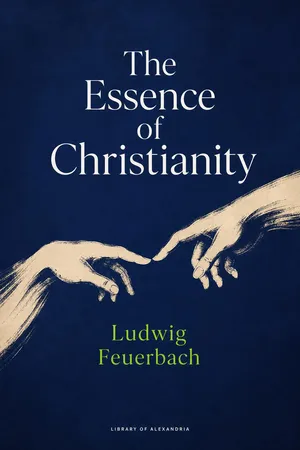
The Essence of Christianity: Philosophy of Religion and Human Nature
eBook - ePub

The Essence of Christianity: Philosophy of Religion and Human Nature

God as a Mirror of Humanity

  1. English
  2. ePUB (mobile friendly)
  3. Available on iOS & Android
eBook - ePub

The Essence of Christianity: Philosophy of Religion and Human Nature

God as a Mirror of Humanity

About this book

What if our ideas about God reveal more about humanity than about heaven? Ludwig Feuerbach turns that question into a searching examination of religious belief.

First published in 1841, The Essence of Christianity argues that the qualities attributed to God-love, reason, and will-are human qualities understood as divine. For Feuerbach, theology is ultimately anthropology: a way of expressing human nature while imagining its highest powers as belonging to a being beyond humanity. His argument asks readers to look again at familiar beliefs and recognize the hopes and needs they contain.

The inquiry moves from the human truth Feuerbach finds within religion to the contradictions he sees in a theology that separates God from humanity. The Trinity, the Incarnation, prayer, faith, and the sacraments become subjects of philosophical investigation. Rather than dismissing religious feeling as meaningless, he takes its emotional and moral force seriously, placing love at the heart of his account. The book's influence on Marx, Engels, and humanist thought makes it an important encounter for readers tracing the development of modern secular philosophy.

What readers find inside:

  • Religion as projection - Divine attributes are examined as expressions of human capacities and aspirations.
  • Christian doctrine - The Trinity and the Incarnation become ways to investigate the relationship between humanity and divinity.
  • Prayer and faith - Religious practices reveal the desires and emotional needs that Feuerbach places at the center of belief.
  • Love and human connection - Love emerges as a central truth within religion and a challenge to theological separation.
  • Theology's contradictions - Feuerbach questions what happens when human ideals are assigned to a God conceived as separate from human life.

This work will appeal to readers of philosophy of religion, students of nineteenth-century thought, and anyone interested in the intellectual roots of secular humanism. It offers a sustained argument to engage with, whether one approaches it through belief, doubt, or historical curiosity.

Begin an inquiry into what humanity discovers about itself when it speaks of God.

Table of contents

  1. Introduction
  2. Preface by the Author
  3. Chapter 1 · Introduction
  4. Part 1 · The True or Anthropological Essence of Religion
  5. Chapter 2 · God as a Being of the Understanding
  6. Chapter 3 · God as a Moral Being, or Law
  7. Chapter 4 · The Mystery of the Incarnation; Or, God as Love, as a Being of the Heart
  8. Chapter 5 · The Mystery of the Suffering God
  9. Chapter 6 · The Mystery of the Trinity and the Mother of God
  10. Chapter 7 · The Mystery of the Logos and Divine Image
  11. Chapter 8 · The Mystery of the Cosmogonic Principle in God
  12. Chapter 9 · The Mystery of Mysticism, or of Nature in God
  13. Chapter 10 · The Mystery of Providence and Creation from Nothing
  14. Chapter 11 · The Meaning of Creation in Judaism
  15. Chapter 12 · The Omnipotence of Feeling, or the Mystery of Prayer
  16. Chapter 13 · The Mystery of Faith—The Mystery of Miracle
  17. Chapter 14 · The Mystery of the Resurrection and the Miraculous Conception
  18. Chapter 15 · The Mystery of the Christian Christ, or the Personal God
  19. Chapter 16 · The Difference Between Christianity and Heathenism
  20. Chapter 17 · The Christian Significance of Voluntary Celibacy and Monasticism
  21. Chapter 18 · The Christian Heaven, or Personal Immortality
  22. Part 2 · The False, or Theological, Essence of Religion
  23. Chapter 19 · The Essential Standpoint of Religion
  24. Chapter 20 · The Contradiction in the Existence of God
  25. Chapter 21 · The Contradiction in the Revelation of God
  26. Chapter 22 · The Contradiction in the Nature of God in General
  27. Chapter 23 · The Contradiction in the Speculative Doctrine of God
  28. Chapter 24 · The Contradiction in the Trinity
  29. Chapter 25 · The Contradiction in the Sacraments
  30. Chapter 26 · The Conflict Between Faith and Love
  31. Chapter 27 · Concluding Application
  32. Explanations—Remarks—Illustrative Citations · § 1
  33. § 2 · God Is Feeling Freed from Limits
  34. § 3 · God Is the Highest Feeling of Self
  35. § 4 · The Difference Between the Pantheistic and Personal God
  36. § 5 · Nature Holds No Interest for Christians
  37. § 6 · In God, Man Is His Own Object
  38. § 7 · Christianity, the Religion of Suffering
  39. § 8 · The Mystery of the Trinity
  40. § 9 · Creation Out of Nothing
  41. § 10 · The Egoism of the Israelite Religion
  42. § 11 · The Idea of Providence
  43. § 12 · The Contradiction Between Faith and Reason
  44. § 13 · The Resurrection of Christ
  45. § 14 · The Christian as a Supermundane Being
  46. § 15 · Celibacy and Monasticism
  47. § 16 · The Christian Heaven
  48. § 17 · What Faith Denies on Earth, It Affirms in Heaven
  49. § 18 · Contradictions in the Sacraments
  50. § 19 · The Contradiction Between Faith and Love
  51. § 20 · Results of the Principle of Faith
  52. § 21 · The Contradiction of the God-Man
  53. § 22 · Anthropology, the Mystery of Theology

Trusted by 375,005 students

Access to over 1.5 million titles for a fair monthly price.

Study more efficiently using our study tools.

Information

Edition
1
Year
2026
eBook ISBN
9781808303593

Frequently asked questions

Yes, you can cancel anytime from the Subscription tab in your account settings on the Perlego website. Your subscription will stay active until the end of your current billing period. Learn how to cancel your subscription
No, books cannot be downloaded as external files, such as PDFs, for use outside of Perlego. However, you can download books within the Perlego app for offline reading on mobile or tablet. Learn how to download books offline
Perlego offers two plans: Essential and Complete
  • Essential is ideal for learners and professionals who enjoy exploring a wide range of subjects. Access the Essential Library with 800,000+ trusted titles and best-sellers across business, personal growth, and the humanities. Includes unlimited reading time and Standard Read Aloud voice.
  • Complete: Perfect for advanced learners and researchers needing full, unrestricted access. Unlock 1.5M+ books across hundreds of subjects, including academic and specialized titles. The Complete Plan also includes advanced features like Premium Read Aloud and Research Assistant.
Both plans are available with monthly, semester, or annual billing cycles.
We are an online textbook subscription service, where you can get access to an entire online library for less than the price of a single book per month. With over 1.5 million books across 990+ topics, we’ve got you covered! Learn about our mission
Look out for the read-aloud symbol on your next book to see if you can listen to it. The read-aloud tool reads text aloud for you, highlighting the text as it is being read. You can pause it, speed it up and slow it down. Learn more about Read Aloud
Yes! You can use the Perlego app on both iOS and Android devices to read anytime, anywhere — even offline. Perfect for commutes or when you’re on the go.
Please note we cannot support devices running on iOS 13 and Android 7 or earlier. Learn more about using the app
Yes, you can access The Essence of Christianity: Philosophy of Religion and Human Nature by Ludwig Feuerbach in PDF and/or ePUB format, as well as other popular books in Teologia e religione & Umanesimo in filosofia. We have over 1.5 million books available in our catalogue for you to explore.