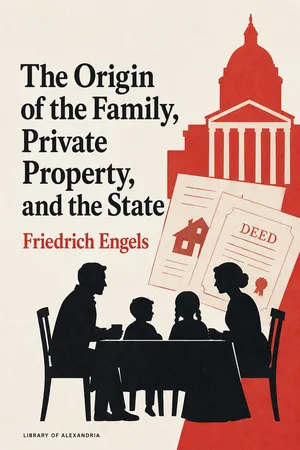
Are the institutions we take for granted natural facts-or products of history? Friedrich Engels asks how economic change reshaped kinship, gender relations, and political power.
First published in 1884, The Origin of the Family, Private Property, and the State draws on the research of anthropologist Lewis H. Morgan to develop a materialist account of social development. Engels connects changing forms of marriage and inheritance with the accumulation of wealth, the emergence of social classes, and the growth of institutions that defend unequal ownership. At the heart of his argument is a provocative claim: domestic life cannot be understood apart from the economic order around it.
Engels examines early communal societies, matrilineal kinship, and the rise of patriarchal authority, arguing that the transmission of wealth helped transform relations between women and men. He also presents the state not as a neutral institution standing above society, but as an expression of class conflict. Rooted in nineteenth-century anthropology, his account is best approached as an influential historical argument rather than a settled account of human origins. Its questions continue to animate socialist thought, feminist criticism, and debates about inequality.
What readers find inside:
- Historical materialism - Economic arrangements provide the framework for Engels's explanation of social change.
- Kinship and inheritance - Changing rules of descent and ownership reveal connections between household life and wealth.
- Patriarchal power - Engels links women's subordination to transformations in property relations and marriage.
- Class and government - The state emerges in his argument as a means of managing conflict while sustaining class rule.
- Anthropological foundations - Morgan's research supplies a starting point for a wide-ranging theory of human social development.
This book will engage readers of Marxist political theory, those exploring the intellectual history of feminism, and anyone interested in how economic systems shape everyday relationships.
Begin with Engels's challenge to familiar institutions, and consider anew the relationship between wealth, authority, and social life.