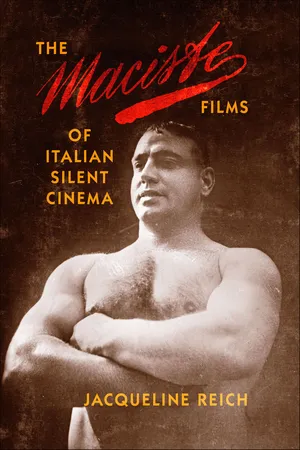
Italian film star Bartolomeo Pagano's "Maciste" played a key role in his nation's narratives of identity during World War I and after. Jacqueline Reich traces the racial, class, and national transformations undergone by this Italian strongman from African slave in Cabiria (1914), his first film, to bourgeois gentleman, to Alpine soldier of the Great War, to colonial officer in Italy's African adventures. Reich reveals Maciste as a figure who both reflected classical ideals of masculine beauty and virility (later taken up by Mussolini and used for political purposes) and embodied the model Italian citizen. The 12 films at the center of the book, recently restored and newly accessible to a wider public, together with relevant extra-cinematic materials, provide a rich resource for understanding the spread of discourses on masculinity, and national and racial identities during a turbulent period in Italian history. The volume includes an illustrated appendix documenting the restoration and preservation of these cinematic treasures.
- 432 pages
- English
- ePUB (mobile friendly)
- Available on iOS & Android
eBook - ePub
The Maciste Films of Italian Silent Cinema
About this book
Trusted by 375,005 students
Access to over 1.5 million titles for a fair monthly price.
Study more efficiently using our study tools.
Information
Subtopic
Film History & CriticismNotes
Introduction
1. Throughout this study I have adopted the following procedure to present English-language translations of Italian film titles: I use the American title under which known U.S.-distributed Italian films appeared in the United States in italics; e.g., La caduta di Troia (The Fall of Troy, Itala Film, 1910), unless the two titles coincide, as in the case of Cabiria (Itala Film, 1914). When no American title is available, I have included a literal translation of the title in roman; e.g., L’ultima battaglia (The Last Battle, 1914). My source for the American titles of Italian films is Aldo Bernardini, ed., Archivio del cinema italiano, vol. 1, Il cinema muto, 1905–1931 (Rome: ANICA: 1991), as well as newspapers, trade journals, and archival sources.
2. See part 3 of the appendix for a detailed filmography of all of Maciste’s films.
3. My research is indebted to previous work on the Maciste films, and I draw upon these works throughout the book. Gian Piero Brunetta, Storia del cinema italiano, vol. 1, Il cinema muto, 1895–1929 (Rome: Riuniti, 1993), 87–89, 317–319. Brunetta has written frequently on the silent period in many different venues and languages. The recently released Il cinema muto italiano (Bari: Laterza, 2008) is a synthesized, revised edition of his previous work on this subject. See also the entry “Cinema muto italiano” in Storia del cinema mondiale, vol. 3, L’europa. Le cinematografie nazionali, ed. Gian Piero Brunetta (Torino: Einaudi, 2000), 31–60; Cent’anni di cinema italiano (Roma-Bari: Laterza, 1991); Buio in sala: 100 anni di passione dello spettatore cinematografico (Venezia: Marsilio, 1989); and Cinema italiano fra le due guerre (Milano: Mursia, 1975). For English speakers, the long-awaited translation of Brunetta’s work is now available, The History of Italian Cinema: A Guide to Italian Film from its Origins to the Twenty-first Century (Princeton, NJ: Princeton University Press, 2009). See also Monica Dall’Asta, Un cinéma musclé. Le surhomme dans le cinéma muet italien (1913–1926) (Crisnée: Yellow Now, 1992); “La diffusione del film a episodi in Europa,” in Storia del cinema mondiale, vol. 1, L’europa. Miti, luoghi, divi, ed. Gian Piero Brunetta (Turin: Einaudi, 1999), 277–323; and “Italian Film Serials and (Inter)National-Popular Culture,” in Italian Silent Cinema: A Reader, ed. Giorgio Bertellini (New Baret, UK: John Libbey, 2013), 195–202. Also see Richard Dyer, White (London: Routledge, 1997), 145–183; Alberto Farassino, “Maciste e il paradigma divistico,” in Cabiria e il suo tempo, ed. Paolo Bertetto and Gianni Rondolino (Milan: Il Castoro, 1998), 223–232; Alberto Farassino and Tatti Sanguineti, eds., Gli uomini forti (Milano: Mazzotta, 1983); Michele Giordano, Giganti buoni. Da Ercole a Piedone (e oltre) il mito dell’uomo forte nel cinema italiano (Rome: Gremese, 1998); Cristina Jandelli, Breve storia del divismo cinematografico (Venezia: Marsilio, 2007), 47–53; Marcia Landy, Stardom, Italian Style: Screen Performance and Personality in Italian Cinema (Bloomington: Indiana University Press, 2008), 7–15; Vittorio Martinelli and Mario Quargnolo, Maciste & Co. I giganti buoni del muto italiano (Gemona del Friuli: Cinepopolare Edizioni, 1981); Vittorio Martinelli, “Lasciate fare a noi, siamo forti,” in Farassino and Sanguineti, Gli uomini forti, 9–28; Steven Ricci, Cinema & Fascism: Italian Film and Society, 1922–1943 (Berkeley: University of California Press, 2008), 81–87; Irmbert Schenk, “The Cinematic Support to National(istic) Mythology: The Italian Peplum, 1910–1930,” in Globalization, Cultural Identities, and Media Representations, ed. Natascha Gentz and Stefan Kramer (Albany: State University of New York Press, 2006), 153–168; and Mario Verdone, “Il film atletico e acrobatico,” Centrofilm 17 (1961): 3–36. Denis Lotti has shed new light on Pagano and the Maciste films in “Il divismo maschile nel cinema muto italiano: protagonisti, film, stereotipi, 1910–1929” (PhD diss., Università degli Studi di Padova, 2011). I graciously thank Denis for sharing his research with me.
4. See the introduction and essays by Adrian Lyttelton, as well as Paul Corner, “State and Society, 1901–1922,” in Liberal and Fascist Italy, 1900–1945, ed. Adrian Lyttelton (Oxford: Oxford University Press, 2002), 1–16 and 17–43 respectively. See also Martin Clark, Modern Italy, 1871 to the Present, 3rd ed. (London: Longman, 2008), and Jonathan Dunnage, Twentieth-Century Italy: A Social History (London: Routledge, 2002). For more on the notion of nation and character, see Silvana Patriarca, Italian Vices: Nation and Character from the Risorgimento to the Republic (Cambridge: Cambridge University Press, 2010).
5. Suzanne Stewart-Steinberg, The Pinocchio Effect: On Making Italians (1860–1920) (Chicago: University of Chicago Press, 2007), 1–20, here 1.
6. The first scholar to examine Maciste’s racial transformation was Giorgio Bertellini, and my work owes a tremendous debt to his initial observations and to much of his subsequent work on race and Italian and American cinema. Giorgio Bertellini, “Colonial Autism: Whitened Heroes, Auditory Rhetoric, and National Identity in Interwar Italian Cinema,” in A Place in the Sun: Africa in Italian Colonial Culture from Post-Unification to the Present, ed. Patrizia Palumbo (Berkeley: University of California Press, 2003), 255–278, esp. 256–257.
7. I pay homage to the work of Modris Eksteins, who stated: “Coincidence is our term for concurrence that is not consciously willed and that we cannot explain in any definitive sense. However, if we retreat from the restrictive world of linear causality and think in terms of context and confluence rather than cause, then it is undeniable that there were many influences . . . at work in the imaginations.” Modris Eksteins, Rites of Spring: The Great War and the Birth of the Modern Age (Boston: Houghton Mifflin, 1989), 3.
8. Geoff Eley, “Culture, Nation, Gender,” in Gendered Nations: Nationalisms and Gender Order in the Long Nineteenth Century, ed. Ida Blom et al. (Oxford: Berg, 2000): 27–40, here 29. For the Italian case, see Ronald S. Cunsolo, Italian Nationalism: From Its Origins to World War II (Malabar, FL: Robert E. Krieger, 1990); and Nicholas Doumanis, Italy (London: Arnold, 2001).
9. Emilio Gentile, The Struggle for Modernity: Nationalism, Futurism, and Fascism (Westport, CT: Praeger, 2003), 2.
10. George L. Mosse, Nationalism and Sexuality: Middle-Class Morality and Sexual Norms in Modern Europe (Madison: University of Wisconsin Press, 1985), 1–22.
11. George L. Mosse, The Image of Man: The Creation of Modern Masculinity (New York: Oxford University Press, 1996), 5. Similarly, Max Nordau’s concept of regenerate “Muscle Jewry,” as Todd Samuel Presner has argued, “was not only consistent with the national goals of the Zionist movement. . . . It was also the crystallization of these goals on the individual body of the Jew” with the goal of achieving “Jewish national goals through corporeal means.” Todd Samuel Presner, “‘Clear Heads, Solid Stomachs, and Hard Muscles’: Max Nordau and the Aesthetics of Jewish Regeneration,” Modernism/Modernity 10, no. 2 (2003): 269–296, here 269–70.
12. George L. Mosse, Nationalism and Sexuality: Respectability and Abnormal Sexuality in Modern Europe (New York: Howard Fertig, 1985), 9–19.
13. Federico Boni, “Sport, mascolinità e media,” in Mascolinità all’italiana. Construzioni, narrazioni, mutamenti, ed. Elena dell’Agnese and Elisabetta Ruspini (Turin: UTET, 2007), 79–102.
14. Dyer, White, 145–183.
15. Maria Wyke, Projecting the Past: Ancient Rome, Cinema, and History (London: Routledge, 1997), 25–26.
16. Ibid.
17. Christopher E. Forth, Masculinity in the Modern West: Gender, Civilization, and the Body (New York: Palgrave Macmillan, 2008), 117–138, 164.
18. Alberto Abruzzese, “Gli uomini forti e le maestre pedani,” in Farassino and Sanguineti, Gli uomini forti, 56–66. This emphasis on strength and might found its way into popular literature as well, particularly in Eduardo De Amicis’s novel Amore e ginnastica and the popular tales of Emilio Salgari. See Giuseppe Valperga, “Mitologie popolari dell’uomo forte,” in Farassino and Sanguineti, Gli uomini forti, 67–70; and Stewart-Steinberg, Pinocchio Effect, 171–176. For more on Salgari, see chapter 2’s discussion of his works in relation to Cabiria.
19. Charles Hirschman, “The Origins and Demise of the Concept of Race,” Population and Development Review 30, no. 3 (2004): 385–415. See also George Stocking, “The Turn-of-the-Century Concept of Race,” Modernism/ Modernity 1, no. 1 (1994): 4–16.
20. John Dickie, Darkest Italy: The Nation and Stereotypes of the Mezzogiorno, 1860–1900 (New York: Palgrave Macmillan, 1999), 2–5; Giuseppe Sergi, The M...
Table of contents
- Cover
- Half title
- Title
- Copyright
- Dedication
- Contents
- Acknowledgments
- Introduction: Why Maciste?
- The Birth of the Strongman: Italian Silent Cinema, Stardom, and Genre
- From Slave to Master: Cabiria (1914) and Maciste (1915)
- Maciste Goes to War: Maciste alpino (1916)
- Over There: The Maciste Series, World War I, and American Film Culture
- Love, Labor, and Leadership: The Maciste Series and Modernity, 1919–1922
- Muscling the Nation: Benito Mussolini and the Maciste Films of the 1920s
- Conclusion: The Giant of the Dolomites and Beyond
- Appendix by Claudia Gianetto and Stella Dagna, translated by Maria Elena D’Amelio
- Notes
- Bibliography
- Index
Frequently asked questions
Yes, you can cancel anytime from the Subscription tab in your account settings on the Perlego website. Your subscription will stay active until the end of your current billing period. Learn how to cancel your subscription
No, books cannot be downloaded as external files, such as PDFs, for use outside of Perlego. However, you can download books within the Perlego app for offline reading on mobile or tablet. Learn how to download books offline
Perlego offers two plans: Essential and Complete
- Essential is ideal for learners and professionals who enjoy exploring a wide range of subjects. Access the Essential Library with 800,000+ trusted titles and best-sellers across business, personal growth, and the humanities. Includes unlimited reading time and Standard Read Aloud voice.
- Complete: Perfect for advanced learners and researchers needing full, unrestricted access. Unlock 1.5M+ books across hundreds of subjects, including academic and specialized titles. The Complete Plan also includes advanced features like Premium Read Aloud and Research Assistant.
We are an online textbook subscription service, where you can get access to an entire online library for less than the price of a single book per month. With over 1.5 million books across 990+ topics, we’ve got you covered! Learn about our mission
Look out for the read-aloud symbol on your next book to see if you can listen to it. The read-aloud tool reads text aloud for you, highlighting the text as it is being read. You can pause it, speed it up and slow it down. Learn more about Read Aloud
Yes! You can use the Perlego app on both iOS and Android devices to read anytime, anywhere — even offline. Perfect for commutes or when you’re on the go.
Please note we cannot support devices running on iOS 13 and Android 7 or earlier. Learn more about using the app
Please note we cannot support devices running on iOS 13 and Android 7 or earlier. Learn more about using the app
Yes, you can access The Maciste Films of Italian Silent Cinema by Jacqueline Reich in PDF and/or ePUB format, as well as other popular books in Media & Performing Arts & Film History & Criticism. We have over 1.5 million books available in our catalogue for you to explore.