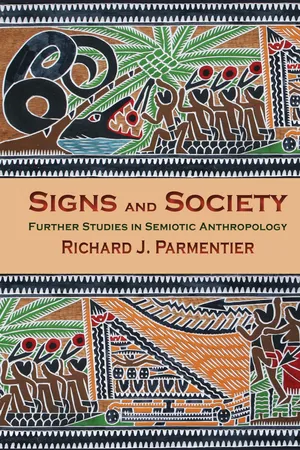
A major voice in contemporary semiotic theory offers a new perspective on potent intersections of semiotic and linguistic anthropology.
In Signs and Society, noted anthropologist Richard J. Parmentier demonstrates how an appreciation of signs helps us better understand human agency, meaning, and creativity. Inspired by the foundational work of C. S. Peirce and Ferdinand de Saussure, and drawing upon key insights from neighboring scholarly fields, Parmentier develops an array of innovative conceptual tools for ethnographic, historical, and literary research.
Parmentier's concepts of "transactional value," "metapragmatic interpretant," and "circle of semiosis," for example, illuminate the foundations and effects of such diverse cultural forms and practices as economic exchanges on the Pacific island of Palau, Pindar's Victory Odes in ancient Greece, and material representations of transcendence in ancient Egypt and medieval Christianity.
Other studies complicate the separation of emic and etic analytical models for such cultural domains as religion, economic value, and semiotic ideology. Provocative and absorbing, these fifteen pioneering essays blaze a trail into anthropology's future while remaining firmly rooted in its celebrated past.
- 280 pages
- English
- ePUB (mobile friendly)
- Available on iOS & Android
eBook - ePub
About this book
Trusted by 375,005 students
Access to over 1.5 million titles for a fair monthly price.
Study more efficiently using our study tools.
Information
PART I
FOUNDATIONS OF PEIRCEAN SEMIOTICS
1 | Semiotic Anthropology |
Fields of Signs
The domain of semiotic anthropology is considered to be the results of empirical research carried out by anthropologists (in all subfields) that makes use of concepts and methods associated with the tradition of scholarship labeled “semiotics” or “semiology.” Semiotic anthropology is not a formal subdiscipline of anthropology; it is not a “school” of anthropological thought; and it is not confined to researchers affiliated with particular academic institutions or national traditions. To some degree semiotic anthropology emerged as a correction and refinement of symbolic or interpretive anthropology or structural anthropology (Mertz 1985). In addition to the study of linguistic and written codes, anthropologists have employed semiotic notions in the analysis of cultural signs, such as pictorial representations and images, dress and bodily adornment, gesture and dance, spatial organization and the built environment, ritualized behaviors (taboo, divination, and performance), exchange valuables, and food and cuisine. Although anthropology has played a relatively minor role in the development of the larger discipline of semiotics, which is dominated by literary studies, it was an anthropologist, Margaret Mead, who coined the modern label at an interdisciplinary conference at Indiana University in 1962. In her summary comments Mead discussed the possibility of a new term:
Which in time will include the study of all patterned communication in all modalities, of which linguistics is the most technically advanced. If we had a word for patterned communication modalities, it would be useful. I am not enough of a specialist in this field to know what word to use, but many people here, who have looked as if they were on opposite sides of the fence, have used the word “semiotics.” It seems to me the one word, in some form or other, that has been used by people arguing from quite different positions. (Mead 1964, 275)
Like all aspects of contemporary research in semiotics, semiotic anthropology is heir to two dominant intellectual strands stemming from the work of American scientist and mathematician Charles S. Peirce (1839–1914) and Swiss linguist Ferdinand de Saussure (1857–1913). Peirce and Saussure did not know of each other; much of their writing on semiotics or semiology is fragmentary and took decades to become widely available, and neither discussed strictly anthropological topics with any specificity.
Peirce developed an innovative reformulation of valid scientific reasoning by viewing both human thought and natural processes as following the inferential logic of signs, or “semeiotic.” For Peirce, the universe was perfused with signs that stand for or represent their objects and that determine further interpretant signs, which in turn represent the relationship between signs and their objects. Refusing to take natural language as the model semiotic system but recognizing the special character of conventional linguistic forms (which he called, following Aristotle, symbols), Peirce subdivided the opposed traditional category of natural signs (Greek semeion) into icons, which resemble their objects in some formal way, and indexes, which are spatially or temporally contiguous with their objects.
A sign endeavors to represent, in part at least, an Object, which is therefore in a sense the cause, or determinant, of the sign even if the sign represents its object falsely. But to say that it represents its Object implies that it affects a mind, and so affects it as, in some respect, to determine in that mind something that is mediately due to the Object. That determination of which the immediate cause, or determinant, is the Sign, and of which the mediate cause is the Object may be termed the Interpretant. (Peirce CP 6.347)
Of the three Peircean grounds relating signs and objects, only symbolic conventionality requires the interpretant to supply the linkage between sign and object, although nothing actually functions as a sign unless it is interpreted to be a sign of some sort. Peircean symbols are, thus, irreducibly triadic; but symbols can communicate information about their objects only by embodying icons and can successfully point to the external world by embodying indexes, which anchor the contextual flow of signs (or semiosis) so that potential interpreters can bring their collateral knowledge to bear on the objects being represented. A scientist of international stature and a strong exponent of the pragmatic theory of truth, Peirce was not at all sensitive to the imperfections and limitations of cultural sign systems, even preferring to employ as a calculus for reasoning his own artificial system of existential graphs. In thinking about both the linguistic and graphic diagrammatization of inferential thought, Peirce insisted that the particular form of symbolization is irrelevant to the constitution of meaning and that a language is usable to the degree that its system of formal representation transparently mirrors the process of valid logical inference (Parmentier 1994c, 42–43). Of considerable impact in contemporary semiotic anthropology are passages in which Peirce suggests that, since all thought is in signs, a thinking person is not very different from a sign and, furthermore, that the interior process of thought does not differ in principle from dialogical communication between people.
There is no element whatever of man’s consciousness which has not something corresponding to it in the word; and the reason is obvious. It is that the word or sign which man uses is the man himself. For, as the fact that every thought is a sign, taken in conjunction with the fact that life is a train of thought, provides that man is a sign; so, that every thought in an external sign, proves that man is an external sign. . . . Thus my language is the sum total of myself; for the man is the thought. (Peirce CP 5.314)
Saussure continued the classical and medieval tradition of viewing the linguistic sign (signe) as a dual entity, conjoining a perceptible expression or “signifier” (significant) with an intelligible concept or “signified” (signifié). The signifying relationships that bind the two levels of the sign fall along a continuum from radical arbitrariness, where there are no external constraints on the linkage between expression and conception, to relative motivation, where the relational, systemic complexity or the value of the linguistic forms—considered either in terms of linear sequence (the syntagmatic axis) or in terms of associative sets (the paradigmatic axis) —imposes a limitation on arbitrariness. In order to uncover the dynamic relationship between continuity and change in linguistic signs, Saussure adopted the methodological principle of separating actual events of speaking (parole) from the social conventions that stipulate the meaning of signs for members of a community (langue). Although his primary focus was on language as a semiological system, Saussure mentioned in passing a number of other cultural systems, such as maritime signals, religious icons, and gestural codes, where the component units that do not display the radical arbitrariness of linguistic signs are better called symbols. By replacing the view of language as nomenclature with the proto-structuralist notion that oppositional relations among signs constitute the system of langue, Saussure recognized that languages, and by extension other semiological systems, do not slice up conceptual space in the same ways.
A detailed comparison of Peirce and Saussure cannot be attempted here, but three points need to be made briefly. First, anthropological research following either Peirce or Saussure needs to take into consideration the terminological confusion stemming from the fact that the Peircean “symbol” correlates with the Saussurean signe, and that the Saussurean symbole is defined by the presence of iconic and indexical linkages. Second, there is a fundamental divergence between Peirce’s keen attention to the token-level instantiation of general signs and to the contextual rootedness of semiosis and Saussure’s omission of the referent from his basic notion of the sign and of events of speaking from his model of the linguistic system. And third, research in semiotic anthropology has begun to demonstrate clearly that Peircean and Saussurean approaches are in fact complementary, in the sense that the strengths of one theorist are matched by correlative weaknesses in the other (Parmentier 1994c, xiii–xv).
Foundations of Semiotic Anthropology
The Russian-born linguist Roman Jakobson (1896–1982) is certainly the pivotal figure in the development of semiotic anthropology. During summer holidays as a young student, Jakobson collected folklore (especially proverbs and epic tales) and recorded dialect data; with student friends (including the slightly older folklorist Petr Bogatyrev) he went on fieldwork expeditions in 1915 and 1916 in the Vereja region near Moscow. Jakobson’s close association with Bogatyrev continued during their years together as members of the Prague Linguistic Circle, and in 1929 they published a short paper on creativity in folklore and literary language. Citing the Saussurean distinction between particular speech events (parole) and the set of conventions accepted by a community (langue), the authors noted that “like langue, the work of folklore is extra-personal and has only a potential existence. It is only a complex of certain norms and impulses, a canvas of living tradition, which the performers animate with the embellishments of individual creativity, just as the creators of parole do in relationship to langue” (Bogatyrev and Jakobson 1982, 38). But they then go on to point out an important distinction between oral and written traditions: A “work” appears as langue to the performers of folklore, that is, as extra-personal, whereas the author of a literary “work” regards it as parole. They warn, however, against the naive view that folklore can only be produced by a homogeneous society with a singular collective personality and that literary culture is totally isolated from the influence of legends, superstitions, and myth-making.
Bogatyrev continued his fieldwork among the Carpathian Ukranians (1923–1926) and his engagement as a scholar and performer of contemporary theater. In a series of papers written in the 1930s, he sought to synthesize Karl Bühler’s functional approach to language and V. N. Vološinov’s semiotic approach to language and material culture in arguing that tangible things become signs when they acquire meaning beyond the bounds of their existence as a practical thing, just as speech confers meaning on the phonemes of a language: “Some objects can be used equally as material things and signs; for instance costume with its several functions is a material thing and a sign at the same time. . . . Cases where costume is only a sign are quite rare. Even the Chinese actor’s paper costume, which functions predominantly to signify that the actor is playing the role of a Chinese, is, after all, not only a sign but also something that covers the actor’s body” (Bogatyrev 1976a, 14). Bogatyrev noted this same multifunctionality in the language of the stage: “In some cases, the dominant function of the speech of a dramatic character may lie not in the content of the speech as such but in those verbal signs that characterize the nationality, the class, and so forth, of the speaker. . . . A speech that is full of mistakes may designate not only a foreigner but usually also a comic character” (Bogatyrev 1976b, 36–37). From the point of view of the audience, then, the actor is a “system of signs” (Bogatyrev 1976b, 48). Bogatyrev was one of the first to apply semiotic and structural methods to cultural data beyond language, and his monograph on folk costume, which introduced the notion of the “function of the structure of functions,” anticipated both French and British versions of structuralism in anthropology (Bogatyrev 1971, 96).
At the International Congress of Slavic Philologists in Prague in 1929, a steering committee from the Prague Linguistic Circle presented a unified text expressing its views on the nature of language and verbal art. A key point in these “Theses” is the definition of the “aesthetic function” (adding to the three functions identified by Bühler) as the focus on the level of signs or expression (also called the “message” in later formulations):
From the thesis that poetic speech is directed at expression itself it follows that all the levels of a system of language that play only an ancillary role in communicative speech acquire a greater or lesser autonomous value in poetic speech. The linguistic devices grouped in these levels and the interrelation among the levels, often automatized in communicative speech, tend to become deautomatized in poetic speech. (Jakobson et al. 1982, 15)
A second influential idea involves the systemic nature of cultural phenomena:
There can be no doubt that poetry is a self-contained entity set apart by its own signs and determined as an entity by its own dominant feature: poeticity. But it is also a part of higher entities, a component part of culture and the overall system of social values. Each of these autonomous yet integral parts is regulated by immanent laws of self-propulsion, while at the same time depending upon the other parts of the system to which it belongs; if one component changes, its relationship to the other component changes, thereby changing the components themselves. With the invention of photography, the goals and structures of painting changed; with the invention of the motion picture, the goals and structure of the theater changed. (Jakobson 1976, 180)
This broader ideological context can be a matter of a culture’s semiotic ideology, as Jakobson notes in an analysis of the Hussites’ rationalistic attack on the mystical symbolism of the medieval Gothic period: In challenging the symbolic nature of religious icons and liturgical rites, the Hussites rejected the “dialectical unity of form and content, of image and thing, of sign and object signified—the dialectical unity that forms the basis of medieval art and philosophy” (Jakobson 1976, 181). And a third idea is that Saussure’s strict separation of synchrony and diachrony needs to be overcome by the recognition that language changes reflect the “needs of the system” and that phenomena such as stylistic archaism and unproductive forms are evidence of diachrony within synchrony.
Jakobson’s extensive research on parallelism in both verse and prose has proven highly influential for comparative studies in linguistics and semiotics (see Fox 1977). Reflecting on his days as a student hearing a famous female storyteller recite epic verse and on his subsequent analyses of parallelism in syntactic constructions, grammatical forms, lexical identities, and prosodic schemes, Jakobson confessed, “Apparently there has been no other subject during my entire scholarly life that has captured me as persistently as have questions of parallelism” (Jakobson and Pomorska 1983, 100). These contributions exemplify his effort to take Saussurean concepts (here, the axes of selection and combination) and project them into veritable anthropological analyses of events of speaking and complex aesthetic constructions.
Anthropology Meets Semiotics
An early conjuncture of British anthropology and semiotics occurred in The Meaning of Meaning by C. K. Ogden and I. A. Richards, first published in 1923. The book includes an appendix containing extended excerpts from several of Peirce’s published papers (1868–1906) and from his unpublished correspondence with Lady Victoria Welby (1904–1909) and a supplementary essay by Bronislaw Malinowski titled “The problem of meaning in primitive languages.” This book, which went through five editions, is the first place that Peirce’s ideas about semiotics received wide attention. Although it does not appear that Malinowski was aware of the Peirce texts when composing his essay (and he does not employ Peircean terminology), there are several points of convergence between Malinowski’s view of the “essentially pragmatic character” (1938, 316) of language and Peircean semiotics, including the focus on the contextual grounding of linguistic signs, the multiple functions of acts of speaking, and the refusal to reify meaning as the inherent property of lexemes.
A much more direct and productive conjuncture of anthropology and semiotics occurred in 1942–1943 when Claude Lévi-Strauss and Roman Jakobson attended each other’s lectures at the Free School of Advanced Studies in New York City. Lévi-Strauss’s lectures dealt with comparative study of kinship systems, and Jakobson presented six lectures on sound and meaning and another series of lectures on Saussure. From his later reflections on these contacts, it is clear that it was the structural approach of Jakobson’s phonological theory more than the general semiotic orientation that inspired Lévi-Strauss to found structural anthropology.
I...
Table of contents
- Cover
- Half title
- Title
- Copyright
- Dedication
- Contents
- Acknowledgments
- Part I: Foundations of Peircean Semiotics
- Part II: Critical Commentaries and Reviews
- Part III: Comparative Perspectives on Semiosis
- References
- Index
Frequently asked questions
Yes, you can cancel anytime from the Subscription tab in your account settings on the Perlego website. Your subscription will stay active until the end of your current billing period. Learn how to cancel your subscription
No, books cannot be downloaded as external files, such as PDFs, for use outside of Perlego. However, you can download books within the Perlego app for offline reading on mobile or tablet. Learn how to download books offline
Perlego offers two plans: Essential and Complete
- Essential is ideal for learners and professionals who enjoy exploring a wide range of subjects. Access the Essential Library with 800,000+ trusted titles and best-sellers across business, personal growth, and the humanities. Includes unlimited reading time and Standard Read Aloud voice.
- Complete: Perfect for advanced learners and researchers needing full, unrestricted access. Unlock 1.5M+ books across hundreds of subjects, including academic and specialized titles. The Complete Plan also includes advanced features like Premium Read Aloud and Research Assistant.
We are an online textbook subscription service, where you can get access to an entire online library for less than the price of a single book per month. With over 1.5 million books across 990+ topics, we’ve got you covered! Learn about our mission
Look out for the read-aloud symbol on your next book to see if you can listen to it. The read-aloud tool reads text aloud for you, highlighting the text as it is being read. You can pause it, speed it up and slow it down. Learn more about Read Aloud
Yes! You can use the Perlego app on both iOS and Android devices to read anytime, anywhere — even offline. Perfect for commutes or when you’re on the go.
Please note we cannot support devices running on iOS 13 and Android 7 or earlier. Learn more about using the app
Please note we cannot support devices running on iOS 13 and Android 7 or earlier. Learn more about using the app
Yes, you can access Signs and Society by Richard J. Parmentier in PDF and/or ePUB format, as well as other popular books in Social Sciences & Literary Criticism Theory. We have over 1.5 million books available in our catalogue for you to explore.