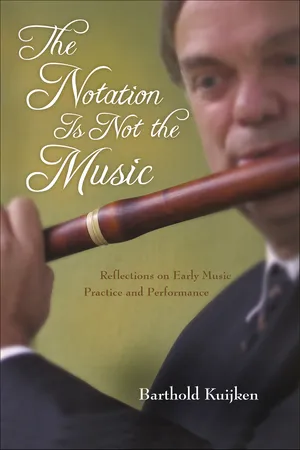
Written by a leading authority and artist of the historical transverse flute, The Notation Is Not the Music offers invaluable insight into the issues of historically informed performance and the parameters—and limitations—of notation-dependent performance. As Barthold Kuijken illustrates, performers of historical music should consider what is written on the page as a mere steppingstone for performance. Only by continual examination and reexamination of the sources to discover original intent can an early music practitioner come close to authentic performance.
Trusted by 375,005 students
Access to over 1.5 million titles for a fair monthly price.
When reading most twentieth- or twenty-first-century scores, trained musicians can hear them quite precisely in their “mind’s ear.” The exact instrumentation is given; the characteristics of the instruments are familiar; standard modern pitch and equal temperament are presupposed; tempo is prescribed by metronome markings; rhythm, phrasing, articulation and dynamics are clearly indicated; the realization of the few ornament signs is obvious; even the playing techniques and sound colors are accurately notated. Except in pieces that include aleatoric composition techniques or improvisation, performers do not have much room for adding individual accents or textual changes. This adherence to the written text is exactly what many composers wanted. Consequently, this kind of traditionally notated composition can be studied quite accurately from the score.
In earlier compositions, one easily notices that some notational parameters seem to be absent, whereas others have a less compelling or altogether different meaning that is dependent upon the time or place of composition. Their “correct” performance cannot be documented through personal acquaintance with the composer or his contemporaneous performers, nor by studying original sound recordings. This is the repertoire I shall address as “Early Music.” However, Early Music is not only a particular repertoire, but it is also understood as including Historically Informed Performance. In my eyes, this should not be a goal in itself. It is rather an attitude, a way of reading and rendering a score, striving for historical authenticity and at the same time taking up one’s full responsibility as a performer. It certainly does not consist of easy-to-learn fixed sets of rules.
We should bear in mind that in actual performance musicians were often required to add their own unique layer of interpretation, which could or even should be different each time the work was played. Without this essential and creative performer-provided contribution, the audience would hear an incomplete piece. Thus, studying an Early Music score according to present-day reading conventions, without mentally including the performer’s layer of interpretation, means studying an incomplete and thus different piece and coming to incomplete and thus different conclusions. This danger is encountered in musicology as well as in performance.
The fact that in Early Music there is no longer direct access to the composer’s original creative concept can lead to absolute arbitrariness and neglect of even the most obvious historical information about topics such as instrumentation, ornamentation, tempo, rubato, et cetera. The composition is then often used as a pretext for displaying the performers’ own ideas, emotions, and virtuosity. Regrettably, this also sometimes happens under the commercially successful label of “authentic Early Music on Historical Instruments.” The (mostly) non-specialist audience is generally not able to detect the degree of conscious or unconscious manipulation involved, and sure enough, the performance can be very captivating. Alternatively, the wealth of historical documentation about the performance of Early Music can be studied, integrated, and put into practice. Such performances need not be less captivating for being better informed. However, it will be immediately clear that we shall never know, for example, exactly how J. S. Bach played (on which day?). All we can aspire to do is to fall reasonably well within the limits of probability and good taste.
The great artistry, charisma, pedagogical authority, and commercial success of some Early Music performers can be dangerous as well. Audiences, colleagues, and students all too readily accept that these “stars” know all about Early Music, and so their performance is taken as a model to unthinkingly imitate. Needless to say, we thus create a new performance tradition that is based on the personal choice of some historical facts plus a strong dose of individual genius. In doing so, we remove ourselves one step away from the historical documentation itself. Students of these “stars” will tend to imitate them, rather than study the facts that shaped the teachers’ decision—and so it goes to the third generation and the students beyond. This evolution is clearly visible and audible. It is the price we pay for the success of Early Music in concerts, publications, and recordings, the price we pay for having Early Music courses in most major conservatories. I think this can never be completely avoided; imitation is, at least temporarily, a part of the artistic learning process, but I consider it the teacher’s task to leave this developmental stage as soon as possible.
These two problems, arbitrariness and alienation from the sources themselves, usually go hand in hand and can become fashion; indeed, some Early Music performers are proud to “emancipate” themselves from the sources. I would call this the “modern” Early Music tradition. Interestingly, in many cases this approach uses successful recipes of late-romantic performance practice, such as extended crescendos and diminuendos, upbeat phrasing, continuous vibrato, and modern rubato. Compositions are often subjected to re-instrumentation and arrangement in order to make them more “interesting” or to blow up their length. What I call the “Bolero effect” has become very popular. The formula is as follows: start with a percussion instrument solo, then add the bass, then one more voice, until everybody is playing, and, if desired, do the same in reverse order at the end. All these devices are easy to apply and do not require much specialized knowledge or technique. They benefit from being familiar or easy to understand for today’s average listener, which also explains the success of this kind of performance. In itself this is not a problem; every performer is free to do as he wishes. However, when these performances are being advertised under the false label of “authentic Early Music,” either explicitly or implicitly, I perceive this as some kind of intellectual and artistic fraud.
What might be an alternative? We cannot go back to the situation in the 1950s and 1960s, where one was virtually obliged to be self-taught, because formal instruction in Early Music was rarely available. I do not wish to turn the clock back, but rather desire to profit from the immense availability of information, which then needs to be taken seriously, studied, digested, and applied. There is also a need for diversification—the more we study the old sources, the more it becomes obvious that there is not a unique historical truth, valid for all times, places, styles, genres, and composers.
In my own teaching, I feel responsible for having my students focus on the historical source material itself: the scores, instruments, iconography, and treatises, rather than modern editions, replicas, translations, studies, and comments. Indeed, why should my students accept my interpretations of the historical material? Even with my best intentions, the information I hand them will be paraphrased, truncated, manipulated, chosen, neglected, or combined, and anyway subjected to my own biases, (in)capacities, experiences, blind spots, temperament, and taste. Students must be taught to view all information, be it from their music teachers or from musicology, with a critical eye and a healthy dose of skepticism. In my opinion, and not only in the field of Early Music, any teacher’s goal is to make himself superfluous and train his students to become autodidacts. As artists, teachers as well as students need to acquire and maintain their instrumental or vocal mastery and simultaneously become and stay well informed, and let these two areas of study fruitfully interact with each other. I realize this is not the fast and easy way, neither for students nor for teachers, but it is certainly most rewarding for both. The benefit will be for their audiences, who will not be fooled by the Emperor’s new clothes.
2
MY WAY TOWARD RESEARCH
My passion for Early Music developed in the 1960s. I played the recorder in childhood and continue to play it, with much pleasure, as a secondary instrument next to the transverse flute. Contrary to the opinion of my flute teacher at music school, who saw the recorder as a mere toy or penny whistle, I could not help but consider it as a real instrument. Since there was nobody around to teach me the recorder on a regular basis, I had to proceed alone. This autodidactic approach became second nature, and I profoundly enjoyed inventing every next move myself. In this I was greatly supported by the general family spirit of curiosity and independent thinking, also (especially?) when this went against institutions and authorities such as school or tradition. As children we were encouraged to follow our own path but were reminded by our parents of the risk of doing so. In other words, if you were convinced, go ahead, but do not complain afterward about the consequences.
I was stimulated by the presence of my two older musician brothers, Wieland and Sigiswald, who were then having their first experiences with early string instruments. Unlike them, I had chosen wind instruments, and this gave me a field of my own to cultivate. I am very grateful to them for not having pushed me in any particular direction. At that time we were discovering and discussing the revolutionary recordings of musicians such as Alfred Deller, Nikolaus Harnoncourt, and Gustav Leonhardt. I remember I received Johann Joachim Quantz’s famous Versuch einer Anweisung, die Flöte traversiere zu spielen (1752), one of the most influential eighteenth-century treatises, for my thirteenth birthday. I read it eagerly, learning German language and Gothic print along the way. I consider this to be the start of my (now already more than fifty years long) Early Music adventure. Quantz’s book opened up a new world for me, and I was impatient to know more. Soon after, I was to become acquainted with other important treatises.
Just before entering the Brussels Royal Conservatory, I found my first “baroque” one-keyed flute (eventually I found out that it had been made in the mid-nineteenth century as a cheap model and constructed only partly according to eighteenth-century principles). It was not very good, but good enough to guide my first steps, and it made me hungry for more. I had already noticed that much of the flute repertoire before ca. 1750 sounded more appropriate to me on the recorder than on the modern flute, and now, even with this mediocre instrument, things fell into place, and felt natural (whatever that means). While studying at the Brussels Royal Conservatory, I discovered that its library was full of highly interesting scores and theoretical books, most of them then not yet republished, and I spent as much time as possible in this gold mine. This occurred parallel to, and independently of, my regular Boehm (modern) flute studies, which I enjoyed very much as well.
A decisive event happened during my first year at the conservatory; I found a splendid original flute—an incredible piece of luck for a boy of eighteen!—made in Brussels around 1750 by Godefroy Adrien Rottenburgh, one of the great woodwind instrument makers of the eighteenth century. Again, I had to proceed as an autodidact, since nobody was around to teach me the baroque flute. This proved to be a blessing—I had to make all mistakes myself and to discover by myself that (and why) they were mistakes. It was a slow learning process, but my good old flute was to become the best teacher I ever had. As really good instruments do, it showed me how it wanted (or did not want) to be played. Of course I continued my Boehm flute studies, simultaneously taking two years of art history at Ghent University. Following that, I studied for one year in Holland, focusing on contemporary Boehm flute repertoire. This should hardly be a surprise as contemporary music, just like music before Bach or Handel, was largely ignored (or ridiculed) at the conservatory, and this greatly stimulated my interest. In contemporary, often experimental, music, as in Early Music, and more than in the typical conservatory repertoire, the active and creative participation of the performer is required, and in the sixties and seventies many colleagues were simultaneously focusing on old and very new music, both left and right from the mainstream repertoire. But I felt that Early Music was my real passion, and during the following years, modern flute and contemporary repertoire gradually receded into the background.
My interest in research was prompted by those areas of my musical training (both at an early stage and at an advanced level) that seemed to contradict each other. Some examples:
• We were more or less explicitly expected to have perfect pitch, officially based on a1 = 440 Hz, but modern orchestras played much higher, and old instruments could deviate from this by as much as a whole tone up and down.
• We learned that the major second consisted of the chromatic semitone (such as F—F
), five commas wide, plus the diatonic semitone (F
—G) of four commas, but in actual playing we had to make all semitones equal, as on the modern piano. However, treatises such as Quantz’s Versuch einer Anweisung (1752) showed that in the seventeenth and eighteenth centuries the diatonic semitone was mostly considered to be wider than the chromatic, and that keyboards were seldom tuned with twelve equal semitones to the octave.
• In theory lessons we were shown the metrical realization of appoggiaturas (it was, astonishingly, basically the same theory as formulated in most of the eighteenth century), but in playing Bach or Mozart, we were not expected to apply these rules.
• All trills were to be started on the main note, but eighteenth-century treatises taught to start them from the upper note.
• Solfège and instrumental technique aimed at a literal, precise reading and rendering of the notation. Rhythmic freedom was not encouraged; I suppose this was judged too romantic for the post–World War II neue Sachlichkeit (New Objectivity). Historical treatises such as Quantz or Hotteterre, on the contrary, showed that the shortest note values in a given piece were frequently treated with considerable freedom and that rubato did not have the same meaning as today.
• I wondered why we did not analyze baroque or classical music according to eighteenth-century principles rather than using uniformly Schenkerean theory or functional harmony.
Further, the information I had begun to glean from historical treatises and instruments showed me how much standards and traditions changed over time. However, I did not hear or learn a substantially different approach in sound production, phrasing, or articulation according to different eras or countries: Vivaldi, Bach, Mozart, Beethoven, Wagner, Brahms, Debussy, Hindemith, Prokofiev, or Britten were all subjected to a rather uniform post-romantic interpretation. This was illustrated by many “modern” editions of, for example, J. S. Bach’s music—they were freely annotated by well-known and well-meaning virtuosos, without specifying how the original text read. On the other hand, the existence of several different Urtext editions of one and the same work demonstrated the necessity of seeing the original sources myself, in order to make up my mind autonomously. In some cases, this later led me to publishing one more—again different—Urtext edition.
I could not understand how baroque music, as it was frequently played before the Early Music revival, could be so mechanical, straightforward, unemotional, even simplistic, compared with baroque paintings, statues, literature, or architecture. I wondered which role music played in the different layers of society, and how its features would vary according to its function. I also felt the need to examine the positioning of the performer between the composer and the audience, varying according to the nature of the piece to be performed. It became increasingly easy to find historical recordings by famous singers and actors, conductors, pianists, violinists, flautists, from the first half of the twentieth century. Many were reissued, first on LP, later on CD; YouTube and the Library of Congress’s “National Jukebox” now make an overwhelming amount of historical sound and/or image information readily available for study. These recordings showed me how fast aesthetics, style, and fashion can change. I discove...
Table of contents
Cover
Half title
Title
Copyright
Dedication
Contents
Preface
1 The Underlying Philosophy
2 My Way Toward Research
3 The Limits of Notation
4 The Notation, Its Perception, and Rendering
5 Outlook
Sources of Inspiration
Bibliography
Selective Index
Frequently asked questions
Yes, you can cancel anytime from the Subscription tab in your account settings on the Perlego website. Your subscription will stay active until the end of your current billing period. Learn how to cancel your subscription
No, books cannot be downloaded as external files, such as PDFs, for use outside of Perlego. However, you can download books within the Perlego app for offline reading on mobile or tablet. Learn how to download books offline
We are an online textbook subscription service, where you can get access to an entire online library for less than the price of a single book per month. With over 1.5 million books across 990+ topics, we’ve got you covered! Learn about our mission
Look out for the read-aloud symbol on your next book to see if you can listen to it. The read-aloud tool reads text aloud for you, highlighting the text as it is being read. You can pause it, speed it up and slow it down. Learn more about Read Aloud
Yes! You can use the Perlego app on both iOS and Android devices to read anytime, anywhere — even offline. Perfect for commutes or when you’re on the go. Please note we cannot support devices running on iOS 13 and Android 7 or earlier. Learn more about using the app
Yes, you can access The Notation Is Not the Music by Barthold Kuijken in PDF and/or ePUB format, as well as other popular books in Media & Performing Arts & Music. We have over 1.5 million books available in our catalogue for you to explore.