Treating such issues as animal sex, species politics, environmental justice, lesbian space and "gay" ghettos, AIDS literatures, and queer nationalities, this lively collection asks important questions at the intersections of sexuality and environmental studies. Contributors from a wide range of disciplines present a focused engagement with the critical, philosophical, and political dimensions of sex and nature. These discussions are particularly relevant to current debates in many disciplines, including environmental studies, queer theory, critical race theory, philosophy, literary criticism, and politics. As a whole, Queer Ecologies stands as a powerful corrective to views that equate "natural" with "straight" while "queer" is held to be against nature.
eBook - ePub
Queer Ecologies
Sex, Nature, Politics, Desire
- 410 pages
- English
- ePUB (mobile friendly)
- Available on iOS & Android
eBook - ePub
About this book
Information
Topic
PhilosophySubtopic
Ethics & Moral PhilosophyPART
1
Against Nature? Queer Sex, Queer Animality
CHAPTER 1
Eluding Capture: The Science, Culture, and Pleasure of “Queer” Animals
We’re Deer. We’re Queer. Get Used to It. A new exhibit in Norway outs the animal kingdom.
—Alisa Opar
Biological Exuberance is, above all, an affirmation of life’s vitality and infinite possibilities: a worldview that is at once primordial and futuristic, in which gender is kaleidoscopic, sexualities are multiple, and the categories of male and female are fluid and transmutable. A world, in short, exactly like the one we inhabit.
—Bruce Bagemihl
[W]e are acting with the best intentions in the world, we want to add reality to scientific objects, but, inevitably, through a sort of tragic bias, we seem always to be subtracting some bit from it. Like a clumsy waiter setting plates on a slanted table, every nice dish slides down and crashes on the ground. Why can we never discover the same stubbornness, the same solid realism by bringing out the obviously webby, “thingy” qualities of matters of concern?
—Bruno Latour
“Nature” and the “natural” have long been waged against homosexuals, as well as women, people of color, and indigenous peoples. Just as the pernicious histories of Social Darwinism, colonialism, primitivism, and other forms of scientifically infused racism have incited indispensable critiques of the intermingling of “race” and nature,1 much queer theory has bracketed, expelled, or distanced the volatile categories of nature and the natural, situating queer desire within an entirely social, and very human, habitat. This now compulsory sort of segregation of queer from nature is hardly appealing to those who seek queer green places, or, in other words, an environmentalism allied with gay affirmation, and a gay politics that is also environmentalist. Moreover, the question of whether nonhuman nature can be queer provokes larger questions within interdisciplinary theory regarding the relations between discourse and materiality, human and more-than-human worlds, as well as between cultural theory and science. In short, we need more robust, complex ways of productively engaging with materiality—ways that account for the diversity and “exuberance” of a multitude of naturecultures, ways that can engage with science as well as science studies. Queer animals—“matters of concern” for queer, green, human cultures—may foster such formulations.
Recent popular science books, such as Bruce Bagemihl’s monumental Biological Exuberance: Animal Homosexuality and Natural Diversity (1999) and Joan Roughgarden’s Evolution’s Rainbow: Diversity, Gender, and Sexuality in Nature and People (2004), as well as the work of Myra J. Hird, present possibilities for radically rethinking nature as queer, by documenting the vast range of same-sex acts, same-sex childrearing pairs, intersex animals, multiple “genders,” “transvestism,” and transsexuality existing throughout the more-than-human world. Bagemihl’s 750-page volume, two-thirds of which is “A Wondrous Bestiary” of “Portraits of Homosexual, Bisexual, and Transgendered Wildlife,” astounds with its vast compilation of species “in which same sex activities have been scientifically documented” (1999, 265). Bagemihl restricts himself to mammals and birds, but even so, he discusses nearly three hundred species and “more than two centuries of scientific research” (1999, 1–2). Rich not only with scientific data, but also with photos, illustrations, and charts, Bagemihl’s exhaustively researched volume renders any sense of normative heterosexuality within nature an absurd impossibility. Joan Roughgarden’s book, Evolution’s Rainbow: Diversity, Gender, and Sexuality in Nature and People (2004), which consists of three sections, “Animal Rainbows,” “Human Rainbows,” and “Cultural Rainbows,” paints an expanse of sexual diversity across both animal and human worlds. In October 2006, the Naturhistorisk Museum in Oslo, Norway, opened “the first-ever museum exhibition dedicated to gay animals.” “Against Nature?” sought to “reject the all too well known argument that homosexual behavior is a crime against nature” by displaying species known to engage in homosexual acts. The exhibit “outs” these animals by telling a “fascinating story of the animals’ secret life . . . by means of models, photos, texts, and specimens” (Against Nature 2007). Ironically, the patriarchal diorama of the early twentieth century that served, as Donna Haraway argues, as a “prophylactic” against “decadence” (1990, 26), is followed by an exhibition that unveils sexual diversity in the world of animals. Queer animals have also gained notoriety with the controversy over a German zoo’s plan “to test the sexual orientation of six male penguins which have displayed homosexual traits” and set them up with female penguins because they want “the rare Humboldt penguins to breed” (Gay Outrage 2005). After the public outcry, zoo director Heike Kueke reassured people that they would not forcibly break up the homosexual penguin couples, saying, “Everyone can live here as they please” (Ananova 2005). Dr. Tatiana’s Sex Advice to All Creation: The Definitive Guide to the Evolutionary Biology of Sex, includes a letter from a manatee worried that their son “keeps kissing other males,” signed “Don’t Want No Homo in the Florida Keys.” Dr. Tatiana replies: “It’s not your son who needs straightening out. It’s you. Some Homosexual activity is common for animals of all kinds” (Judson 2003, 143). More surprising, perhaps, the television sex show host Dr. Susan Block, with her explicit website replete with porn videos and sex toys, promotes a peaceful philosophy of “ethical hedonism,” based on “the Bonobo Way.” “The Bonobo Way,” which includes a great deal of “lesbian” sex, “supports the repression of violence and the free, exuberant, erotic, raunchy, loving, peaceful, adventurous, consensual expression of pleasure” (Block 2007).2
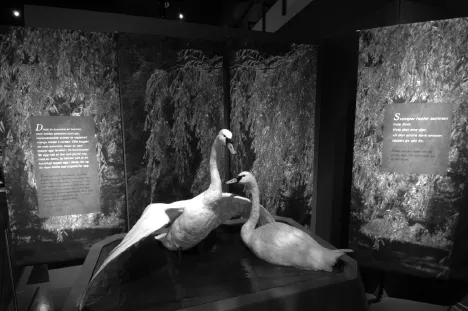
FIGURE 1.1. “Gay Animals: Swans,” from “Against Nature?” exhibit, Per E. Aas, Natural History Museum, University of Oslo, Norway.
According to the website for the “Against Nature?” exhibit (2007), “Homosexuality has been observed in most vertebrate groups, and also from insects, spiders, crustaceans, octopi and parasitic worms. The phenomenon has been reported from more than 1,500 animal species, and is well documented for 500 of them, but the real extent is probably much higher” (Against Nature 2007). Notwithstanding the sheer delight of dwelling within a queer bestiary that supplants the dusty, heteronormative Book of Nature, the recognition of the sexual diversity of animals has several significant benefits. Most obviously, scientific accounts of queer animals insist that heteronormativity has damaged and diminished scientific knowledge in biology, anthropology, and other fields. Roughgarden charges that “the scientific silence on homosexuality in animals amounts to a cover-up, deliberate or not,” thus scientists “are professionally responsible for refuting claims that homosexuality is unnatural” (2004, 128). Bruce Bagemihl (1999) and Myra J. Hird (2004b) document how the majority of scientists have ignored, refused to acknowledge, closeted, or explained away their observations of same-sex behavior in animals, for fear of risking their reputations, scholarly credibility, academic positions, or heterosexual identity. Most notably, Bagemihl includes a candid reflection of biologist Valerius Geist, who “still cringe[s] at the memory of seeing old D-ram mount S-ram repeatedly”: “I called these actions of the rams aggrosexual behavior, for to state that the males had evolved a homosexual society was emotionally beyond me. To conceive of those magnificent beasts as ‘queers’—Oh God!” (Bagemihl 1999, 107). A queer-science-studies stance parallel to that of feminist empiricism would insist that the critique and eradication of heteronormative bias will result in a better, more accurate account of the world—simply getting the facts (not-so) straight. Although Margaret Cuonzo warns of the possibility for homosexist, anthropocentric, “or even egocentric” bias in accounts of queer animals (2003, 231), these possibilities seem highly unlikely given the pervasive heteronormativity not only in science, but in the wider culture.3 Moreover, as Catriona Mortimer-Sandilands argues, citing the case in which ecologists assumed that the lesbian behavior of seagulls “must be evidence of some major environmental catastrophe” (and it wasn’t), “the assumption that heterosexuality is the only natural sexual form is clearly not an appropriate benchmark for ecological research” (2005). In short, environmental sciences require better accounts of the sexual diversity of natural creatures; otherwise heteronormative bias may render it even more difficult to understand the effects of various toxicants. Giovanna Di Chiro’s essay in this collection demonstrates the vital need for environmental sciences and environmental politics that are not propelled by homophobia or misogyny. Endocrine disruptors alone demand an extraordinarily complex and nuanced understanding of the “mangling” (in Pickering’s [1995] terms) of environmental science, health, and politics, with misogyny, homophobia, and other cultural forces.
From a cultural studies perspective that focuses on discursive contestation, it is easy to see queer animals as countering the pernicious and persistent articulation of homosexuality with what is unnatural. The multitude of examples given by Bagemihl (1999) and Roughgarden (2004), not to mention the explicit photos and illustrations, strongly articulate “queer” with “animal,” making sexual diversity part of a larger biodiversity. This cultural studies model of political-discursive contestation, however, may, by definition, bracket all that which is not purely discursive—ironically, of course, the animals themselves—and thus limit the possibilities for imagining a queer ethics and politics that is also environmentalist. (This difficulty is part of a larger problem within cultural theory of finding ways of allowing matter to matter.) But even within the paradigm of discursive contestation, trouble arises, since the normative meanings of nature and the natural have long coexisted with their inverse: nature as blank, dumb, or even debased materiality. In other words, if conservatives are hell-bent on damning homosexuals, they will, no doubt, simply see all this queer animal sex as shocking depravity and consign those of us who are already outside of the Family of Man to the howling wilderness of bestial perversions. No doubt the rather sweet-looking illustrations of say, female hedgehog “courtship” and cunnilingus included in Bagemihl’s book, which would delight many a gay-affirmative viewer, would disgust others (Bagemihl 1999, 471).
Rather than simply toss queer animals into the ring of public opinion to battle the still pervasive sense that homosexuality is unnatural, we need to embrace the possibilities for the sexual diversity of animal behavior to help us continue to transform our most basic sense of what nature and culture mean. For many cultural critics, who fear that any engagement with nature, science, or materiality is too perilous to pursue, queer animals are segregated into a universe of irrelevance. But it is possible, I think, to look to queer animals, not as a moral model or embodiment of some static universal law, but in order to find, in this astounding biological exuberance, a sense of vast diversity, deviance (in the way that Ladelle McWhorter [1999] recasts the term),4 and a proliferation of astonishing differences that make nonsense of biological reductionism. Moreover, it is crucial that we see animals not as genetically driven machines but as creatures embedded within and creating other “worlds” or naturecultures, as Haraway (2003) puts it.
Epistemology of the Zoological Closet
Eve Sedgwick’s paradigm of the “open secret” captures the way in which nonhuman animals have been fixed within a zoological closet: many people have witnessed some sort of same-sex activity between animals and yet still imagine the natural world as unrelentingly straight. Such determined ignorance emerges from a heteronormative epistemology. As Sedgwick explains, ignorance—as well as knowledge—has power: “These ignorances, far from being pieces of the originary dark, are produced by and correspond to particular knowledges and circulate as part of particular regimes of truth” (1990, 8). Decades ago, when my brother was young, my mother bought him a pair of hamsters. Fearing we would be overrun by a proliferation of tiny mammals, she chose two females. My brother was baffled and my mother stunned to discover the spectacle of their seemingly nonstop oral sex. Despite this family memory, I must admit that I was rather astonished by Hird’s, Roughgarden’s, and Bagemihl’s accounts of the enormous variety of sexual diversity throughout the nonhuman world. Who knew? This sense of astonishment, as I will discuss, below, can rouse a queer-green, ethical/epistemological/aesthetic response, even as it may be implicated in regimes of closeted knowledges.
The sexual diversity of animals, I contend, matters. Predominant modes of social theory, however, which still assume a radical separation of nature and culture, tend to minimize the significance of queer animals. Just as most feminist theory has engaged in a “flight from nature” (see Alaimo 2000), most cultural critics have cast out queer animals from the field of cultural relevance. Jonathan Marks, for example, in What it Means to Be 98% Chimpanzee: Apes, People, and Their Genes (2002) takes his place in a long line of people who have attempted to clearly demarcate human from animal by seizing upon some key difference: “One of the outstanding hallmarks of human evolution is the extent to which our species has divorced sexuality from reproduction. Most sexuality in other primates is directly associated with reproduction” (2002, 110). Just as language, tool use, and other supposed keys to the Human Kingdom have been usurped by evidence of similar accomplishments across a range of species, the deluge of evidence of same-sex sex among animals collapses this claim. Marks, however, contends that the female “same-sex genital stimulation” of the bonobo is exceptional, arguing that “virtually all primates are sexually active principally as a reproductive activity” (111). Paul Vasey’s extensive studies of Japanese macaques, discussed below, as well as the accounts of hundreds of other species that engage in same-sex pleasures, counter Marks’s assertion. More generally, however, Marks criticizes the way in which we, as humans, look to other primates, especially chimps, as the key to understanding our “true” selves: “They are us, minus something. They are supposed to be our pure biology, unfettered by the trappings of civilization and its discontents. They are humans without humanity. They are nature without culture” (165). On this point, Marks offers a demystifying critique, especially of the way in which the cultural framework of the scientists may be mistaken as “a contribution of the chimps, rather than for our own input” (ibid.). Even as it is useful to expose the popular pursuit of seeking the primal truth of the human within the animal, and even as it is likewise important to wrestle with the thorny epistemological problems that animal ethology poses, I would argue that it is also crucial to critique the narrow evolutionary narrative of progress inherent in the notion that “they” are “nature without culture.” Nonhuman animals are also cultural creatures, with their own sometimes complex systems of (often nonreproductive) sex. The overall effect of Marks’s debunking—when unaccompanied by any attempt to formulate productive ways of engaging with scientific accounts of animals—is to banish animals to a wilderness of irrelevance, where they serve as the backdrop for the erection of human achievement.
Jennifer Terry offers an incisive discursive critique of “the scientific fascination with queer animals,” in which “animals provide models for scientists seeking to determine a biological substrate of sexual orientatio...
Table of contents
- Cover
- Title
- Copyright
- Contents
- Acknowledgments
- Introduction: A Genealogy of Queer Ecologies
- Part 1 Against Nature? Queer Sex, Queer Animality
- Part 2 Green, Pink, and Public: Queering Environmental Politics
- Part 3 Desiring Nature? Queer Attachments
- List of Contributors
- Index
Trusted by 375,005 students
Access to over 1.5 million titles for a fair monthly price.
Study more efficiently using our study tools.
Frequently asked questions
Yes, you can cancel anytime from the Subscription tab in your account settings on the Perlego website. Your subscription will stay active until the end of your current billing period. Learn how to cancel your subscription
No, books cannot be downloaded as external files, such as PDFs, for use outside of Perlego. However, you can download books within the Perlego app for offline reading on mobile or tablet. Learn how to download books offline
Perlego offers two plans: Essential and Complete
- Essential is ideal for learners and professionals who enjoy exploring a wide range of subjects. Access the Essential Library with 800,000+ trusted titles and best-sellers across business, personal growth, and the humanities. Includes unlimited reading time and Standard Read Aloud voice.
- Complete: Perfect for advanced learners and researchers needing full, unrestricted access. Unlock 1.5M+ books across hundreds of subjects, including academic and specialized titles. The Complete Plan also includes advanced features like Premium Read Aloud and Research Assistant.
We are an online textbook subscription service, where you can get access to an entire online library for less than the price of a single book per month. With over 1.5 million books across 990+ topics, we’ve got you covered! Learn about our mission
Look out for the read-aloud symbol on your next book to see if you can listen to it. The read-aloud tool reads text aloud for you, highlighting the text as it is being read. You can pause it, speed it up and slow it down. Learn more about Read Aloud
Yes! You can use the Perlego app on both iOS and Android devices to read anytime, anywhere — even offline. Perfect for commutes or when you’re on the go.
Please note we cannot support devices running on iOS 13 and Android 7 or earlier. Learn more about using the app
Please note we cannot support devices running on iOS 13 and Android 7 or earlier. Learn more about using the app
Yes, you can access Queer Ecologies by Catriona Mortimer-Sandilands,Bruce Erickson in PDF and/or ePUB format, as well as other popular books in Philosophy & Ethics & Moral Philosophy. We have over 1.5 million books available in our catalogue for you to explore.