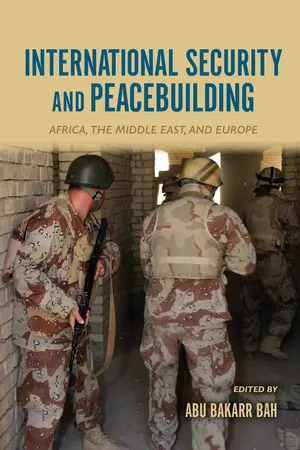
The end of the Cold War was to usher in an era of peace based on flourishing democracies and free market economies worldwide. Instead, new wars, including the war on terrorism, have threatened international, regional, and individual security and sparked a major refugee crisis. This volume of essays on international humanitarian interventions focuses on what interests are promoted through these interventions and how efforts to build liberal democracies are carried out in failing states. Focusing on Africa, the Middle East, and Europe, an international group of contributors shows that best practices of protection and international state-building have not been applied uniformly. Together the essays provide a theoretical and empirical critique of global liberal governance and, as they note challenges to regional and international cooperation, they reveal that global liberal governance may threaten fragile governments and endanger human security at all levels.
eBook - ePub
International Security and Peacebuilding
Africa, the Middle East, and Europe
- 212 pages
- English
- ePUB (mobile friendly)
- Available on iOS & Android
eBook - ePub
About this book
Trusted by 375,005 students
Access to over 1.5 million titles for a fair monthly price.
Study more efficiently using our study tools.
Information
1Negotiating Narratives
R2P and the Conundrum of the Monopoly of Legitimized Use of Force
VIOLENCE IS CONDEMNED as the dark side of humanity. Containing violence is deemed one of the most important achievements of our modern times. Limiting violence, particularly the state monopoly over the legitimate use of force, by democratic means is considered a successful and ongoing task of the evolving process of civilization and modernity.1 However, the path to modernization has often been marked by conflicts and wars. The twentieth century witnessed two world wars and nuclear armament worldwide as well as an increasing occurrence of intrastate conflicts. This reality conflicts with the idea of containing international violence through international law, most notably the Charter of the United Nations (UN). The fundamental principles of the prohibition of violence and nonintervention in the affairs of states and the provision for limited intervention in exceptional cases, as respectively outlined in the UN Charter, were particularly challenged by the violent conflicts in Iraq (1991), Somalia (1992–1995), Rwanda (1994), and Bosnia-Herzegovina (1995). However, there have been increasing international interventions. As Alex Bellamy stated, “By the mid-1990s, therefore, there was widespread recognition of the legitimacy of humanitarian intervention sanctioned by the Security Council.”2 When the violence moved closer to Western Europe with the 1999 Kosovo conflict in former Yugoslavia, the legitimization of international intervention shifted. Until the Kosovo conflict, interventions were primarily justified under international law. In the case of Iraq in 1991, for example, the intervention could not be explicitly justified on the grounds of protecting a persecuted minority. Based on UN Security Council resolution 688 (S/RES/0688 [1991]), the UN actually intervened in the affairs of Iraq. The UN determined that the conflict in Iraq constituted a threat to international peace and security under Chapter VII of the UN Charter, thus circumventing the nonintervention rule. In contrast, the mission in Kosovo took place without a mandate from the UN Security Council. The justification was based not on the UN Charter, but on the moral claims of protecting and helping persecuted and threatened ethnic and religious minorities.3 Under these conditions it is particularly remarkable that the Kosovo conflict was the first mission that the German Bundeswehr had participated in since World War II. In Germany, the pressure to legitimize German participation for the public was enormous. For most of Western Europe, the Kosovo conflict was an important juncture in post–Cold War international intervention.
Since the first decade of the twenty-first century, which has been characterized by narratives of insecurities and uncertainties, the international security principles of the UN have been significantly challenged. In addition to terrorism, weapons of mass destruction, and radical Islamism, aggressive-interventionist and unilateral foreign policies have been adopted and made part of the narrative of uncertainty. At the same time, the discourse of a new humanitarianism has been constituted by the narratives of international intervention, responsibility to protect (R2P), development, and human security. As Abu Bakarr Bah notes, new humanitarianism “is a radical outgrowth of extant post–Cold War humanitarian intervention policies for dealing with the security challenges of new wars.”4 These new policies with their specific patterns of narratives have been confronted by the prevailing principles of international relations. Thus, the principles as well as the narratives have been put up for renegotiating, in order to be integrated in a reasonable way into the discourse.5 This renegotiation has led to a discursive bifurcation of insecurities and threat on the one hand and humanitarian motifs on the other.
Similarly, orthodox theories of modernization, which focus on the inherent connectivity between violence and the modern state, have become less persuasive.6 These perspectives isolate instances of violence—such as the Holocaust, atrocities, and genocides—as historical singularities and irregularities of modernity.7 By focusing on universal laws (such as increasing modernization leads to a decrease in violence), they programmatically ignore specific historical constellations and antecedent conditions of violence as if there were no connection between historical processes and the use of violence. However, the empirical observations of the last decades indicate that “all in all, the overall non-violent character of modern civilization is an illusion. More exactly, it is an integral part of its self-apology and self-apotheosis; in short, of its legitimizing myth.”8 In reality, any kind of order—even a modern, democratic one—is created by violence. The link between order and violence is inextricable.9 Therefore, explaining the development of a new global order following the 1990s, which was characterized by critical junctures and cleavages in the context of post–Cold War international relations, entails explaining the order of violence that is also on the move. What can be observed is that the order of violence is determined by negotiation between the good and the evil, the legal and the illegal, and the legitimate and the illegitimate. It is a question of the distribution of power for which the attribution of meaning prevails. As Mahmood Mamdani points out, “Counter-insurgency and inter-state violence is after all what states do. It is genocide that is violence run amok, amoral, evil. The former is normal violence, only the latter is bad violence.”10 By renegotiating this order, new trajectories of using violence as well as new inequalities emerge.
Between Good and Evil: The Order of Violence in New Humanitarianism
Based on the sequencing of historical developments, George Kubler argues that “the important clue is that any solution points to the existence of some problem to which there have been other solutions, and that other solutions to this same problem will most likely be invented to follow the one now in view.”11 The core of the post–Cold War conundrum lies in the order of violence, which entails maintaining the stability and the destruction of the system of international order based on notions of the good and the evil. The Latin terms potentia/potestas and vis/violentia can be etymologically distinguished to describe this aspect of good and evil.12 The question of what is considered good violence (potestas) or evil violence (violentia) is answered by attributing meanings to social actions during negotiations, which are determined by the distribution of power.
In this sense, one of the most important historical events for international order was the founding of the UN following two world wars. The dramatic experience of violence during the world wars demanded political entities that can prevent conflicts of similar scale. The UN can be regarded as the solution to the historical problem of untrammeled force. With the UN and the establishment of its principles of peace and use of violence, the relationship between violentia and potestas was clearly sharpened. The use of violence between states and the use of military force as a political means were condemned in international relations. At the domestic level, potestas was defined as state monopoly over the use of force. Conversely, violentia denotes situations where states use military force against other states, which makes them perpetrators. The only permitted violence was either self-defense or international intervention authorized by the UN Security Council under Chapter VII of the UN Charter. Under this system of international order, state sovereignty is of utmost importance.
Since the founding of the UN in 1945, however, the international system has changed profoundly. The demands on the UN have changed as the discrepancy between the previous authority of the UN Security Council and the current spate of conflicts has become apparent.13 The complete inability to act during serious crimes against humanity, such as those committed in Srebrenica and Rwanda, can be understood as the unintended consequence of actions that took place within the limits of state sovereignty. These cases have challenged the international community to resolve the dilemma between preserving national sovereignty and the necessity to intervene in severe humanitarian crimes. The UN Security Council has extended its corresponding responsibilities and focused its attention on the disregard of minority and human rights, the disruption of state order, and the violent suppression of democracy. In the course of these developments, the boundaries of new humanitarianism are negotiated, thereby redefining international interventions, security, human rights, sovereignty, and human development.14 At the same time, apprehensions about the misuse of the tenets of international security and R2P (e.g., the 2003 US invasion of Iraq) in order to enforce political power interests and the fear of being a silent and passive witness to atrocities have grown.
Although the order of violence is still determined by the categories of good and evil, they are increasingly losing their categorical clarity. The interpretive framework of the order of violence has expanded, while the relationship between the use of force and its legitimization has been maintained. Consequently, while the parameters of international interventions are expanding, every government is under increased pressure to legitimize every deployment of troops at both the national and international levels. James Gow and Milena Michalski argue that “destructive brute force, to a considerable extent, might be able to secure victory in warfare through combat—and indeed, might lead to the control of territory and the physical subjugation of the people on that territory, but success in the modern world is only possible with legitimacy.”15 This indicates that victory in warfare and the power of states are determined by the order of violence. Apart from the control of territory and the physical subjugation of people, it is legitimacy that frames violence and force as potestas to establish an intended good order. Thus, legitimacy—more precisely, the legitimacy of using force—decides the binary between good violence and evil violence as well as the images of the protagonists and antagonists in the post–Cold War international security system.
Legal Violence and Legitimate Violence: Two Sides of the Same Coin
At first glance, common sense may be challenged by the distinction between legal and legitimate violence. However, the notion of legitimacy unfolds two entangled dimensions of justification: legal and social motifs. An act of violence can be clearly deemed either legal or illegal by the UN Security Council and the International Criminal Court (ICC) under international law. However, that legal judgment may not necessarily overlap with social judgment of that act of violence, which can be viewed as either violentia or potestas. Though legal and legitimate violence need not lead to the same conclusion, they are nonetheless inextricably intertwined. For example, the Independent International Commission on Kosovo sta...
Table of contents
- Cover
- Half title
- Title
- Copyright
- Contents
- Introduction: The Conundrums of Global Liberal Governance
- 1 Negotiating Narratives: R2P and the Conundrum of the Monopoly of Legitimized Use of Force
- 2 Responsibility to Protect: The Paradox of International Intervention in Africa
- 3 Dancing Boys and the Moral Dilemmas of Military Missions: The Practice of Bacha Bazi in Afghanistan
- 4 Managerial Capacity in Peacekeeping Operations: The Case of EUFOR
- 5 Personalized Mediations and Interventions in the Ivoirian Conflict
- 6 African Agency in New Humanitarianism and Responsible Governance
- 7 Regime Change: Neoliberal State Building and Its Collapse on Iraqi Society
- About the Contributors
- Index
Frequently asked questions
Yes, you can cancel anytime from the Subscription tab in your account settings on the Perlego website. Your subscription will stay active until the end of your current billing period. Learn how to cancel your subscription
No, books cannot be downloaded as external files, such as PDFs, for use outside of Perlego. However, you can download books within the Perlego app for offline reading on mobile or tablet. Learn how to download books offline
Perlego offers two plans: Essential and Complete
- Essential is ideal for learners and professionals who enjoy exploring a wide range of subjects. Access the Essential Library with 800,000+ trusted titles and best-sellers across business, personal growth, and the humanities. Includes unlimited reading time and Standard Read Aloud voice.
- Complete: Perfect for advanced learners and researchers needing full, unrestricted access. Unlock 1.5M+ books across hundreds of subjects, including academic and specialized titles. The Complete Plan also includes advanced features like Premium Read Aloud and Research Assistant.
We are an online textbook subscription service, where you can get access to an entire online library for less than the price of a single book per month. With over 1.5 million books across 990+ topics, we’ve got you covered! Learn about our mission
Look out for the read-aloud symbol on your next book to see if you can listen to it. The read-aloud tool reads text aloud for you, highlighting the text as it is being read. You can pause it, speed it up and slow it down. Learn more about Read Aloud
Yes! You can use the Perlego app on both iOS and Android devices to read anytime, anywhere — even offline. Perfect for commutes or when you’re on the go.
Please note we cannot support devices running on iOS 13 and Android 7 or earlier. Learn more about using the app
Please note we cannot support devices running on iOS 13 and Android 7 or earlier. Learn more about using the app
Yes, you can access International Security and Peacebuilding by Abu Bakarr Bah in PDF and/or ePUB format, as well as other popular books in Politics & International Relations & International Relations. We have over 1.5 million books available in our catalogue for you to explore.