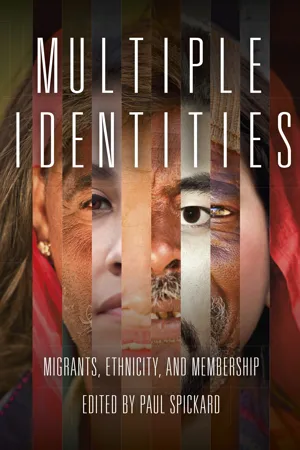
In recent years, Europeans have engaged in sharp debates about migrants and minority groups as social problems. The discussions usually neglect who these people are, how they live their lives, and how they identify themselves. Multiple Identities describes how migrants and minorities of all age groups experience their lives and manage complex, often multiple, identities, which alter with time and changing circumstances. The contributors consider minorities who have received a lot of attention, such as Turkish Germans, and some who have received little, such as Kashubians and Tartars in Poland and Chinese in Switzerland. They also examine international adoption and cross-cultural relationships and discuss some models for multicultural success.
- 344 pages
- English
- ePUB (mobile friendly)
- Available on iOS & Android
eBook - ePub
About this book
Information
PART ONE
Orientations
ONE
Many Multiplicities: Identity in an Age of Movement
PAUL SPICKARD
The face of europe is changing. People who are not supposed to be there are there in abundance. Each nation of Europe has its own story, but each imagines itself as a naturally ethnically homogeneous place. Yet each contains large numbers of people who do not fit that ethnic self-definition. Some are migrants (see Table 1.1), some domestic minorities of long standing. Despite the fond wishes of some members of the dominant ethnic group in each country, the migrants are not going back where they came from. In many cases, they are already two or three generations resident in their European host country. The degree to which they have succeeded in making places for themselves in their host societies – and, conversely, the amount of discrimination they experience – varies widely.
Over the past several years, the peoples of most European nations and their leaders have engaged in sharp debates about migrants, less so about domestic minorities. Such discussions have focused on migrants as social problems, as people with deficits that need to be measured and remediated, and, all too often, as people who ought to go away. The discussions have in most cases missed who the migrants and minorities are, how they live their lives, and what the content of their identities may be. Simply put, policy makers and the educated public in Europe need to know more about migrants and minorities, how they conceive of themselves, and how they actually live their lives.
The scholars who wrote this book are all students of the lived experiences of migrants and minorities in Europe. It turns out that migrants and minority group members have complex identities, often multiple identities at one time, and that those identities shift and change over the course of time and changing circumstance. This book is about how those migrants and minorities experience their lives and manage their multiple identities. It addresses the situations of migrants and minorities in some powerful European nations like Germany and the United Kingdom and also in Finland, Sweden, Poland, Italy, Switzerland, and Kazakhstan. It looks at minorities who have received a lot of attention, like Turkish Germans, and also at some who have received little notice, such as Kashubians and Tatars in Poland and Chinese in Switzerland. It explores the lives and social locations of children, young adults, and mature people. It examines international adoption and cross-cultural love. Finally, it describes a few situations that may provide models for multicultural success.
MIGRANTS AND MINORITIES: A PROBLEM FOR EUROPEANS
Every modern European nation is founded on an idea of ethnic homogeneity that is thought to reach deep into its past. The idea can be summed easily in this equation:
One Nation = One Ethnic Group= One Religion= One Language= One Territory= One Government
This is the way it is supposed to be. For most Europeans, as for scholars who study nationalism, it is taken for granted that each nation is founded on a single ethnic group – a specific people from a specific place, with a shared history, language, and ancestry.1 For many such people, like the Czech philosopher Ernest Gellner, multiethnic states are conceptually incoherent and inherently unstable. Such people see an intimate connection between the formation of particular ethnic groups and particular nations. In the words of the British sociologist Anthony D. Smith, “modern nations – a fusion of premodern ethnic identities and modern ‘civic’ elements – require the symbols, myths and memories of ethnic cores if they are to generate a sense of solidarity and purpose. . . . there is . . . [an] inner ‘antiquity’ of many modern nations.” The essence of nationalism is the assumption of the existence of a founding race.2
Table 1.1. Immigrants as Percentage of 2010 Population, Europe
Luxembourg | 35.2 | Sources: United Nations, Department of Economic and Social Affairs, “Trends in International Migrant Stock: Migrants by Age and Sex,” country profiles, http://esa.un.org/MigAge/p2k0data.asp, retrieved October 21, 2011. See also United Nations, Department of Economic and Social Affairs, Population Division, “International Migration 2006” (March 2006); Apolonija Oblak Flander, “Immigration to EU Member States down by 6% and emigration up by 13% in 2008,” Eurostat: Statistics in Focus. Population and Social Conditions, 1/2011, http://epp.eurostat.ec.europa.eu/cache/ITY_OFFPUB/KS-SF-11-001/EN/KS-SF-11-001-EN.PDF, last accessed October 21, 2011; Katya Vasileva, “Foreigners living in the EU are diverse and largely younger than the nationals of the EU Member States,” Eurostat: Statistics in Focus. Population and Social Conditions, 45/2010, http://epp.eurostat.ec.europa.eu/cache/ITY_OFFPUB/KS-SF-10-045/EN/KS-SF-10-045-EN.PDF, retrieved October 21, 2011; and “Migration and migrant population statistics,” Eurostat: Statistics Explained, http://epp.eurostat.ec.europa.eu/statistics_explained/index.php/Migration_and_migrant_population_statistics, last accessed October 21, 2011. |
Switzerland | 23.2 | |
Ireland | 19.6 | |
Croatia | 15.9 | |
Austria | 15.6 | |
Latvia | 15.0 | |
Spain | 14.1 | |
Sweden | 14.1 | |
Estonia | 13.6 | |
Ukraine | 11.6 | |
Iceland | 11.3 | |
France | 10.7 | |
Netherlands | 10.5 | |
United Kingdom | 10.4 | |
Greece | 10.1 | |
Norway | 10.0 | |
Belgium | 9.1 |
Denmark | 8.8 | Katya Vasileva, “Foreigners living in the EU are diverse and largely younger than the nationals of the EU Member States,” Eurostat: Statistics in Focus. Population and Social Conditions, 45/2010, http://epp.eurostat.ec.europa.eu/cache/ITY_OFFPUB/KS-SF-10-045/EN/KS-SF-10-045-EN.PDF, retrieved October 21, 2011; and “Migration and migrant population statistics,” Eurostat: Statistics Explained, http://epp.eurostat.ec.europa.eu/statistics_explained/index.php/Migration_and_migrant_population_statistics, last accessed October 21, 2011. |
Russia | 8.7 | |
Portugal | 8.6 | |
Slovenia | 8.1 | |
Italy | 7.4 | |
Montenegro | 6.8 | |
Serbia | 5.3 | |
Czech Republic | 4.4 | |
Finland | 4.2 | |
Lithuania | 4.0 | |
Hungary | 3.7 | |
Slovakia | 2.4 | |
Poland | 2.2 |
These are powerful ideas. They have attended the making of every modern nation, and they lie at the root of many ethnic groups’ yearnings for nation-states of their own.3 For Germans, the racial or ethnic foundation of the nation is an idea – which can be found in the writings of J. G. Herder, J. G. Fichte, Friedrich Nietzsche, and Arthur Schopenhauer, as well as in the soaring imagination of Richard Wagner – that the German Volk were a mystical entity that existed in germ form many centuries prior to the predestined establishment of a German state. In this construction, all people who speak some language that may be called Germanic are necessarily Germans (no matter that they live in the Czech Republic or Ukraine), and all people who stand outside that historical, spiritual (dare one say biological?) essence are not true Germans and cannot become Germans. Never mind that a state called Germany did not exist throughout most of human history, nor that a very substantial portion of the supposedly Germanic peoples have never been part of that polity, nor indeed that the population of German territory always included many non-Germanic peoples. The Germanic-speaking peoples are supposed to be its grounding, and wherever they are, they are natural Germans, while others are not, even if they live within German borders and carry German passports.4
We can see the artificial (though undeniably powerful) quality of nationalism alive in the history of every modern state. Throughout the Middle Ages, there was, of course, a political entity called France, but the affiliation of people in outlying provinces like Aquitaine or Burgundy was often nominal at best. Then, at the dawn of the modern era, Kings Henry IV and Louis XIII unified the state, centralized control with a modern bureaucracy loyal to the king rather than the nobility, drew a corps of bureaucrats from the rising middle class, built a large standing army that was loyal to its king rather than to feudal lords, imposed the Parisian dialect (more or less) on the rest of the country, and created a unified (and largely fictional) ethnic history for modern France. The rhetoric of French citizenship changed radically with the revolution, but the idea of the ethnic origin of France never wavered.5
In Turkey, in the wake of World War I and the decline of the Ottoman Empire, an Ottoman elite defined by class and religion shaped themselves and the people around them into a nation defined by a mostly fictional ethnicity they created: the Turks. They imposed a centralized language and created a fictional history that told a tale of long-standing ethnic and national unity for the Turkish people in Anatolia, as one of the grounds for their nation-building enterprise.6
Among the Kurds of modern Iraq and Turkey, it is widely assumed that they, who have never in modern history had a state of their own, are ethnically qualified – in fact, destined – to govern themselves in an ethnically homogeneous Kurdish state. Similar claims have been made in recent decades by Basques in Spain and France, by Hawaiians, Timorese, Biafrans, Kosovars, Sikhs, and many others.7
So ethnic commonality is widely assumed to be the ground upon which the modern nation-state is built. Yet every European country is today in fact home to a variety of peoples who are not part of that unifying imagined history. In Germany, France, and Denmark today, about 20 percent of the people are either immigrants or their children. In Sweden and Ireland, immigrants and their children make up a quarter of the population. In Austria and Switzerland, the percentage tops 30.8 This is largely due to the increasing scope and velocity of late twentieth- and early twenty-first-century people movements. But the reader should not suppose that international migration is a new thing, or that it was until recently directed only to places like Australia, Canada, and the United States. Since the dawn of the industrial age, workers have been moving all over the northwestern quarter of the Eurasian land mass: from Ireland and Scotland to England and then beyond; from southern Italy to the industrial North, and some then on to France and Germany, others to the Americas; from Poland into Germany and Russia; back and forth throughout the Austro-Hungarian Empire, and then on to other points in Europe and the Americas; and so on.9
Every European country faces a deep demographic dilemma that strikes at the core of its national identity. I do not know if demography is destiny, but you could make a good case that it may be so in Europe these days. The problem is that Europeans are insufficiently fecund. In order to maintain a stable population without taking in immigrants, each country must average 2.1 children born per woman. Every European nation falls below that replacement level. France has the highest fertility rate in Europe at 1.98; Italy and Spain stand at 1.31; the Czech Republic is lowest at 1.24. Recognizing this problem, several European governments have offered incentives to their citizens who give birth – sometimes in the form of extended, paid maternity leave and sometimes as a grant (ranging as high as $4,000 in Spain) for each child born. But even such extreme inducements have failed to nudge the birthrate upwards significantly.10
The bottom line is that every European nation must take in immigrants, most of them quite different racially and culturally from the current citizenry, in order for its economy to survive, now and as far into the future as anyone can see. The problem is that no European country has developed a language to talk about, or institutions to accommodate, this phenomenon.11 Several countries have taken up the issue over the past decade, but none has yet met success in the attempt to understand this manifest multiplicity.
The European response to the election of Barack Obama to the United States presidency provided a snapshot of the problem of integrating multiple peoples into supposedly homogeneous nations. Europeans were wildly enthusiastic in the wake of the 2008 American election.12 Witness these headlines that covered the front pages of European newspapers on November 6: Die Welt said, “Obama schreibt Geschichte” – Obama writes history. Neue Ruhr Zeitung added, “Willkommen, neues Amerika!” (Welcome, new America!). The Guardian of England echoed, “Obama’s new America.” De Volkskrant of the Netherlands declared, “With Obama cynicism is past.” Bild chanted, “Yes, we can Freunde sein!” (Yes we can be friends!). Berliner Kurier simply showed a picture of Barack Obama, tall, thin, and agile ag...
Table of contents
- Cover
- Title
- Copyright
- Dedication
- Contents
- Acknowledgments
- Part 1. Orientations
- Part 2. The Complexities of Identities
- Part 3. Family Matters
- Part 4. Modes Of Multicultural Success?
- Bibliography
- Contributors
- Index
Trusted by 375,005 students
Access to over 1.5 million titles for a fair monthly price.
Study more efficiently using our study tools.
Frequently asked questions
Yes, you can cancel anytime from the Subscription tab in your account settings on the Perlego website. Your subscription will stay active until the end of your current billing period. Learn how to cancel your subscription
No, books cannot be downloaded as external files, such as PDFs, for use outside of Perlego. However, you can download books within the Perlego app for offline reading on mobile or tablet. Learn how to download books offline
Perlego offers two plans: Essential and Complete
- Essential is ideal for learners and professionals who enjoy exploring a wide range of subjects. Access the Essential Library with 800,000+ trusted titles and best-sellers across business, personal growth, and the humanities. Includes unlimited reading time and Standard Read Aloud voice.
- Complete: Perfect for advanced learners and researchers needing full, unrestricted access. Unlock 1.5M+ books across hundreds of subjects, including academic and specialized titles. The Complete Plan also includes advanced features like Premium Read Aloud and Research Assistant.
We are an online textbook subscription service, where you can get access to an entire online library for less than the price of a single book per month. With over 1.5 million books across 990+ topics, we’ve got you covered! Learn about our mission
Look out for the read-aloud symbol on your next book to see if you can listen to it. The read-aloud tool reads text aloud for you, highlighting the text as it is being read. You can pause it, speed it up and slow it down. Learn more about Read Aloud
Yes! You can use the Perlego app on both iOS and Android devices to read anytime, anywhere — even offline. Perfect for commutes or when you’re on the go.
Please note we cannot support devices running on iOS 13 and Android 7 or earlier. Learn more about using the app
Please note we cannot support devices running on iOS 13 and Android 7 or earlier. Learn more about using the app
Yes, you can access Multiple Identities by Paul Spickard in PDF and/or ePUB format, as well as other popular books in Social Sciences & Discrimination & Race Relations. We have over 1.5 million books available in our catalogue for you to explore.