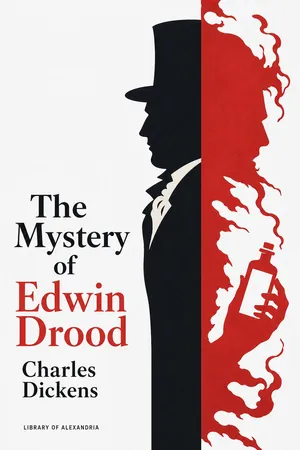
A young man vanishes, a cathedral town harbors secrets, and suspicion falls across the boundary between devotion and obsession.
In The Mystery of Edwin Drood, Charles Dickens brings his gift for memorable characters and unsettling atmosphere to the disappearance of Edwin, a young man whose uncle, John Jasper, leads a double life. A respected choirmaster in the fictional town of Cloisterham, Jasper is also an opium user consumed by hidden desires. His attachment to Rosa Bud, Edwin's intended bride, casts a disturbing shadow over the relationships at the novel's heart.
Cathedral precincts, private rivalries, and the disorienting world of the opium den give this Victorian crime story its Gothic intensity. Dickens died before finishing the novel, leaving its central puzzle unresolved-not by design, but through circumstance. What survives is both a compelling narrative and an invitation to look closely: at a gesture, an accusation, or the distance between a person's public face and private thoughts. Its uncertainty continues to draw readers into debate about guilt, identity, and the meaning of its clues.
What readers find inside:
- A troubling disappearance - Edwin's vanishing transforms personal tensions into questions of possible crime.
- John Jasper's divided life - The choirmaster's respectable position contrasts with his opium use and consuming obsession.
- Gothic Cloisterham - A cathedral town becomes an atmospheric setting for secrecy, suspicion, and concealed motives.
- Rosa Bud's predicament - Edwin's intended bride stands at the center of relationships shaped by desire and unease.
- An unresolved puzzle - The unfinished narrative leaves readers to weigh evidence without the certainty of a final revelation.
This novel will appeal to readers of Victorian crime fiction, lovers of Gothic atmosphere, and Dickens admirers curious about the direction of his final work. Read it for the mystery, but also for its sharp attention to the fears and desires beneath ordinary social life.
Enter Cloisterham and follow the clues as far as Dickens left them.