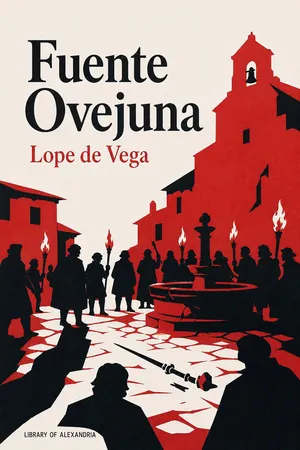
When a ruler turns his power against the people, who will dare to resist? In this Spanish Golden Age drama, the answer is an entire village.
Set in fifteenth-century Spain and based on a historical uprising, Lope de Vega's Fuente Ovejuna follows a community living under the abusive authority of Fernán Gómez, Commander of the Order of Calatrava. His attacks on the villagers' dignity bring private suffering into the public square, turning fear and anger into collective resistance. At the heart of the conflict are Laurencia and Frondoso, whose love is threatened by the commander's violence.
The revolt leads to one of the play's defining tests: a royal investigation in which the townspeople refuse, even under torture, to identify an individual culprit. Against the wider political backdrop of Fernando and Isabel, the drama weighs local oppression, royal authority, and the claims of justice. Its lasting force lies in the tension between personal courage and shared responsibility-and in Laurencia's fierce insistence that humiliation must not go unanswered.
What readers find inside:
- A community under pressure - The village becomes the central force in a struggle against the commander's abuse.
- Laurencia's defiance - Her forceful voice challenges the townspeople to confront violence and defend their dignity.
- Love amid conflict - Laurencia and Frondoso's relationship gives the public crisis an intimate human stake.
- A test of solidarity - The interrogation scenes turn the villagers' shared answer into an act of resistance.
- Power and justice - The intervention of the Catholic Monarchs places the uprising within the politics of fifteenth-century Spain.
A compelling choice for readers of classic Spanish literature, theater lovers drawn to morally charged conflict, and anyone interested in stories of collective resistance.
Enter a village where the demand for justice becomes a shared act of courage.