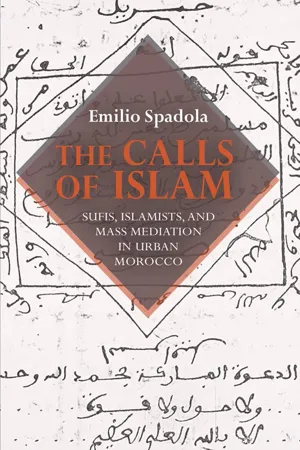
"A theoretically sophisticated reading of the mediation of social and spiritual relationships in Fez." —Gregory Starrett, University of North Carolina at Charlotte
The sacred calls that summon believers are the focus of this study of religion and power in Fez, Morocco. Focusing on how dissemination of the call through mass media has transformed understandings of piety and authority, Emilio Spadola details the new importance of once-marginal Sufi practices such as spirit trance and exorcism for ordinary believers, the state, and Islamist movements.
The Calls of Islam offers new ethnographic perspectives on ritual, performance, and media in the Muslim world.
"A superb demonstration of anthropological analysis at its best. A major contribution to our understanding of the complicated nexus of religion, nationalism, and technology." —Charles Hirschkind, author of
The Feeling of History "An instructive contribution to the literature on Morocco's socio-cultural and political idiosyncrasies." —
Review of Middle East Studies "Spadola's dense but short study . . . manages admirably well to deal with a complex topic, skillfully balancing ethnographic and analytic elements." —
American Ethnologist "[The] tension between social classes is subtly drawn out throughout this exemplary book, and Spadola also does a magnificent job tying local, national, and transnational contexts together. Although writing about a very specific place and time, he manages to capture post-millennial anxieties about Islam and belonging that are far reaching in their scope." —
Contemporary Islam "Spadola's book is theoretically sophisticated, skillfully constructed, and rich in detail." —
Journal of Religion
They see you, he [Shaytan] and his tribe, from where you do not see them.
—Qur
an 7:27
MUCH COLONIAL AND postcolonial scholarship on Islam in Morocco emphasizes “Moroccan Islam,” a national veneration of Sufi authorities and pious exemplars (Geertz 1968; Michaux-Bellaire 1926; Eickelman 1976). Historically, Sufi “saints” or “friends of God” (awliya
, sing. wali; in colonial literature, marabouts) have ranged from urban and rural bearers of divine blessing (baraka), juridical science (
ilm), or mystical knowledge (ma
rifa) to holy warriors and wise fools. But from the late fifteenth century to present, the dominant political culture now figured as “Moroccan” has been a “sharifian” tradition of Sufism, in which sacred inviolability and sovereignty are attributed to the prophet Mohammed’s descendants, shurafa
(sing. sharif) (Cornell 1998; Kugle 2006).1 In this tradition, the city of Fez marks the axis mundi. Established in the late eighth and early ninth centuries and by shurafa
Idris I and his son Idris II, Fez remained a regional economic, religious, and political capital of Muslim dynasties in North Africa and al-Andalus for the next millennium. The fifteenth-century discovery of Idriss II’s tomb, in particular, marked the regional rise of sharifian dominance in the Muslim world’s “Far West” (al-Maghrib al-aqsa) (Kugle 2006, 85–89). From the subsequent sharifian revolution in 1465, to the sharifian Sa
dian dynasty’s control of Fez in 1549, and through the twenty-first century
Alawite monarchy, shurafa
have formed every ruling dynasty of what is now modern-day Morocco.
From precolonial sultanate to postcolonial monarchy, Morocco’s dominant sharifian Sufi hierarchies in Fez and other urban centers (such as Meknes, Salé, Tetouan, Marrakech, and Madagh) have supported the ruling regime and infused the social order and religious life in explicit and subtle ways. Hundreds of saints’ shrines and Sufi zawiyas, or meeting houses, dot Fez. Fas al-Bali, the “old city” or “medina”—distinct from Fas al-Jadid (Fez Jadid, or New Fez, c. 1300s) and from the twentieth-century French Ville Nouvelle and twenty-first-century urban sprawl—is occasionally described as a single zawiya (Skali 2007). More broadly, different sharifian lineages have developed Sufi “orders” (turuq; sing. tariqa) of devoted adepts and peripheral followers, with different ritual practices appealing to different socioeconomic strata. In private homes and public meetings, elite and middle-class Sufi orders follow weekly and annual meditative dhikr rites (remembrance of God) of textual recitation and particular prayers (wird), which induce mild ecstasy and a sense of closeness (qurba) to God. In annual public rituals around saints’ tombs, adepts and followers of underclass orders, protected by the blessing (baraka) of the saint, perform spectacular jinn trances and (less common) acts of self-mortification—self-cutting, swallowing glass and boiling water, and devouring raw and bloody meat (Crapanzano 1973, 1977, 1980; Zillinger 2010). In private homes, men and women of these same groups perform more frequent curing rites for themselves and clients, summoning tutelary jinns to appease them with trance, tribute, and sacrifice.
Observers of “Moroccan Islam,” not surprisingly, have discerned in these ritual differences and social distinctions the durable structures and processes—that is to say, the media—of political hierarchy (Combs-Schilling 1989; Geertz 1968; Hammoudi 1997; Maarouf 2007; Tozy 1999). Social distinctions have not merely found ritual expression; rather, political cultural elites and subordinates have reproduced social difference by way of ritual expression and its multiple media. Thus, historically, as sharifian lineages retained power through material signs of recognition (ritual protocols, monetary gifts, legal exceptions, closely guarded scribal decrees from the sultan [Laroui 1977, 92–97]), so too did the material ritual practices of underclass Sufi orders reproduce sharifian hierarchy from below (Crapanzano 1973; Maarouf 2007).
For sharifian elites, material media of distinction marked the divine presence of baraka (among other spiritual qualities), along with the capacity to transmit its effects to adepts and followers (Clancy-Smith 1994; Geertz 1968; cf. Cornell 1998, intro.) But among the marginal folk especially, as Edward Westermarck’s exquisitely detailed preand early colonial observations show, baraka’s sacrality evoked the mysterious workings of jinns (Westermarck 1968, I, chaps. 1–6).2 Sufi trance rites offer a case in point: conceived as the presencing of jinns summoned and controlled by the baraka of the shurafa
, possession itself distinguished the vulgar commoners (
amma)—a disdained and feared source of disorder (Laroui 1977)—from the cultural, religious, political, and economic urban elites. Indeed, within the relatively stable “plural society” of Fez (Furnivall 1956), the rites demonstrated the blessed power of these latter by staging and also domesticating the madness of subaltern bodies (one Arabic term for madness, majnun, derives from jinns).3 If baraka was a sign of distinction, it also named a power to summon up the distinguishing marks (jinns) of the subaltern bodies—and to control them as signs of difference and deference. What would come to be known as “Moroccan Islam” encompassed trance rites not as madness pure and simple, but rather as rituals of underclass Muslims’ receptivity to baraka’s call.
The early twentieth-century emergence of national consciousness witnessed symbolic continuity as well as material changes in sharifian rituals. Indeed, nationalization of Islam meant shifting controls of social difference itself. Colonial and postcolonial-era technological stagings of trance as national culture attended the formation of baraka’s mass dissemination in new royal audiences (see Chapters 2 and 3). In the late twentieth century, state and sharifian elites capitalized on the global culture market, sponsoring older saints’ pilgrimages, televising Sufi performances, and developing mass-market Sufi-themed “festivals” for both Moroccan and foreign tourist markets, among them the Fez Sacred World Music Festival, and the Essaouira Gnawa and Trance Festival (Kapchan 2000, 2007; Zillinger 2008, 2010). Taking the throne in 1999, Mohammed VI soon built on these efforts, replacing Hassan II’s minister of religious affairs with Ahmed Tawfiq, a noted Sufi leader of the growing middle- and upper-class Boutchichiyya order. This trend found further impetus following the May 16, 2003, militant Islamist bombings in Casablanca. With the “spiritual security of the nation” at stake (Arif 2008; Kaitouni 2010), Mohammed VI and sharifian allies added the Sufi Cultural Festival of Fez (like the Fez Sacred Music Festival, developed by a Fassi sharif); a renovation of the Sufi shrine to Sidi Ahmed Tijani (d. 1815) in Fez was completed in 2007, its opening celebration publicly sponsored by Mohammed VI, who also offered a keynote message highlighting the “close ties” that Tijaniyya followers faithfully maintained toward the sharifian throne.4 The purpose of these events, like the monarchy’s new “tolerance festivals,” was unambiguous: to call underclass and middle-class Moroccan Muslims to proper (sharifian Sufi) Islam and (mass) social order.5
These newly national (and transnational) Sufi revivalist practices symptomatize the far broader transformations of public religion, ritual practice, and ritual media. The state’s appropriation and redeployment of signifying practices and bodily dispositions in technological media signals the importance of mass social formations, both public and private—broadcast audiences, anonymous urban spaces, digital media producers and consumers—as objects of national politics and statecraft. Staging historically marginal cultural practices attempts to discipline participants as specifically national subjects. Indeed, for a segment of the middle-class population in particular—those who can afford to consume these novel media—“trance” and “reception” take on both the corporeal sense of receiving jinns and the technological sense of receiving and interpreting state-sponsored and mass-market signals. To be in trance means demonstrating one’s interpellation as the subject of a technologically and socially modern nation-state. It is to enter a communicative domain supported by the throne: to maintain baraka’s call and its differentiating effects as a national force—as the call of the nation—rather than as that of a particular saint and sharifian lineage.
As a state and upper-class ideal, at least—one largely adopted by middle classes in Fez—the current slate of Sufi and trance festivals, as well as sponsorship of older popular saints’ festivals, evidences the technological and discursive conditions of a national community in which rituals, whether performed in public or private, circulate through a (putatively) uniform homogeneous time and interconnected space of culture (B. Anderson 2006; Thongchai 1994; Pemberton 1994; Morris 2000). More pointedly Sufi revivalism speaks to the political necessity of summoning urban Moroccans as mass-mediated subjects. Through mass-mediated ritual, the state, sharifian elites, and middle-class aspirants imagine differences controlled—a mass public as one people, wholly attuned to and distinguished by one call. At its origin stands Fez medina, the renewed beacon of Morocco’s disciplined and modern Sufi social order.
But the medina’s status as ritual staging ground encounters the social and political realities of the underclass rural migrants and lower-middle-class families that now occupy its once splendid mansions. This new social makeup—of largely anonymous and struggling people, rather than elites—exemplifies the broad obstacles to visions of mass unity and, more importantly, to the risks of communication that such unity demands. For elites and middle classes, the reality of mass circulation means that ritual mediations of one group, and the kinds of Muslims they produce can affect everyone. The social distinctions that once marked elites (khassa) from commoners (
amma) are more porous within a mass-mediated national culture and society. Indeed, the kind of social order and consciousness to which middle-class urban Moroccans aspire is put at risk by the very technological mediations that would make it possible.
Different calls of Islam may produce a coherent “counterpublic” (Warner 2002; Hirschkind 2006). But where calls summon the urban margins by way of jinns, another possibility comes to mind among Moroccan Muslims: a contagion of proliferating calls, a network of dispersed but hidden differences, only momentarily and never finally exposed (cf. Newcomb 2009, chap. 1). Put otherwise, if Sufi saints and other elite bearers of baraka summoned and controlled jinns, and by extension, the social margins, jinns remain a force of difference—different consciousness, different status—that both defines the margins and threatens to extend their influence and presence. This difference remains one brought out by mediation, but not only by older Sufi rituals. The mass mediation of jinns takes place on national television, in mass market curing manuals, cassettes, CDs, DVDs, in new rituals and videos of Islamic exorcism, and in endemic conversations and ritual apparitions to which these give rise. Jinns are the sign of difference, not as a stable object, but rather as a possibility to be triggered—a possibility of difference waiting to be made in the act of the call.
May 2003: The Rising Stakes of Religious Calls
The state’s Sufi revivalism that started under Mohammed VI, May 16, 2003, expanded the national significance of the call, as Islamist members of al-Qaeda-affiliated Salafiyya Jihadiyya carried out multiple suicide bombings in Casablanca. The attentats dyal Casa quickly raised the stakes of religious opposition for the monarchy and the stat...
Table of contents
Cover
Half title
Title
Copyright
Contents
Acknowledgments
Note on Transliteration
Introduction
1 Competing Calls in Urban Morocco
2 Nationalizing the Call: Trance, Technology, and Control
3 Our Master’s Call: The Apotheosis of Moroccan Islam
4 Summoning in Secret: Mute Letters and Veiled Writing
5 Rites of Reception
6 Trance-Nationalism, or, the Call of Moroccan Islam
7 “To Eliminate the Ghostly Element Between People”: The Call as Exorcism
Epilogue
Notes
References
Index
Trusted by 375,005 students
Access to over 1.5 million titles for a fair monthly price.
Study more efficiently using our study tools.
Frequently asked questions
Yes, you can cancel anytime from the Subscription tab in your account settings on the Perlego website. Your subscription will stay active until the end of your current billing period. Learn how to cancel your subscription
No, books cannot be downloaded as external files, such as PDFs, for use outside of Perlego. However, you can download books within the Perlego app for offline reading on mobile or tablet. Learn how to download books offline
Perlego offers two plans: Essential and Complete
Essential is ideal for learners and professionals who enjoy exploring a wide range of subjects. Access the Essential Library with 800,000+ trusted titles and best-sellers across business, personal growth, and the humanities. Includes unlimited reading time and Standard Read Aloud voice.
Complete: Perfect for advanced learners and researchers needing full, unrestricted access. Unlock 1.5M+ books across hundreds of subjects, including academic and specialized titles. The Complete Plan also includes advanced features like Premium Read Aloud and Research Assistant.
Both plans are available with monthly, semester, or annual billing cycles.
We are an online textbook subscription service, where you can get access to an entire online library for less than the price of a single book per month. With over 1.5 million books across 990+ topics, we’ve got you covered! Learn about our mission
Look out for the read-aloud symbol on your next book to see if you can listen to it. The read-aloud tool reads text aloud for you, highlighting the text as it is being read. You can pause it, speed it up and slow it down. Learn more about Read Aloud
Yes! You can use the Perlego app on both iOS and Android devices to read anytime, anywhere — even offline. Perfect for commutes or when you’re on the go. Please note we cannot support devices running on iOS 13 and Android 7 or earlier. Learn more about using the app
Yes, you can access The Calls of Islam by Emilio Spadola in PDF and/or ePUB format, as well as other popular books in Social Sciences & African History. We have over 1.5 million books available in our catalogue for you to explore.