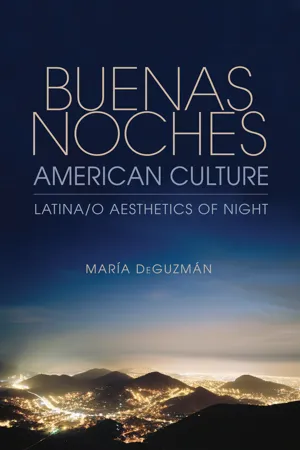
Often treated like night itself—both visible and invisible, feared and romanticized—Latina/os make up the largest minority group in the US. In her newest work, María DeGuzmán explores representations of night in art and literature from the Caribbean, Colombia, Central and South America, and the US, calling into question night's effect on the formation of identity for Latina/os in and outside of the US. She takes as her subject novels, short stories, poetry, essays, non-fiction, photo-fictions, photography, and film, and examines these texts through the lenses of nationhood, sexuality, human rights, exoticism, among others.
- 326 pages
- English
- ePUB (mobile friendly)
- Available on iOS & Android
eBook - ePub
About this book
Information
CHAPTER ONE
DREADED NON-IDENTITIES OF NIGHT: NIGHT AND SHADOWS IN CHICANA/O CULTURAL PRODUCTION

How do you make the invisible visible? You take it away.
—Lila Rodriguez in A Day Without a Mexican
The Nighttime of a Day without a Mexican
Of the more than fifty million Latina/os currently within the continental borders of the United States, Mexican Americans have had a long borderlands history—defined by military battles and treaties in the name of U.S. national expansion, by laws, and by daily discriminatory practices—of being treated as the other Americans, los otros americanos. They became aliens in their own land with the 1848 Treaty of Guadalupe Hidalgo that officially concluded the Mexican-American War and in the years subsequent to that treaty, which involved an Anglo landgrab of previously Mexican areas. In 1971, Chicano attorney, writer, and political activist Oscar “Zeta” Acosta pointedly summed up the situation:
The American government took our country away from us in 1848, when the government of Mexico sold us out. They sold not only the land, but they basically sold us as slaves in the sense that our labor and our land was [sic] being expropriated. The governments never gave us a choice about whether to be American citizens. One night we were Mexican and the next day we were American. This historical relationship is the most important part of the present day relationships, but it’s totally ignored or unknown or rejected by the Anglo society. [emphasis mine]1
As Chicano critic Raymund A. Paredes observed over a quarter of a century ago, “According to Guadalupe Hidalgo and succeeding documents, Spanish and Mexican land grants were to be honored by the American government, but after the war, Mexican Americans were systematically stripped of their property.”2 They were not only dispossessed of their property; they were (and still are) systematically discriminated against in terms of education, employment, the law, health services, and many other areas of daily experience. This systematic discrimination is described in great detail and without apology in Julián Segura Camacho’s 2005 manifesto The Chicano Treatise.3 Traces of this alienation can be found everywhere in Mexican American and explicitly politicized Chicana/o cultural production, from early- to mid-nineteenth-century corridos (or narrative ballads that serve as a musical form of news) to the latest comic strips. Those traces are composed of a proliferating network of signs that denote or connote socioeconomic and psychosocial marginalization, erasure, and invisibility, ranging from masks to utter darkness. Night is the ur-sign, the penumbral trope, for this repressive Othering. Night is also a response to the Othering that challenges it with a dissolution of the terms and conditions of containment and subordination encapsulated by the concept of “illegal alien.”
Contemporary Mexican visual artist and political cartoonist Sergio Arau’s 2004 mockumentary A Day Without a Mexican (co-written with Sergio Guerrero and Yareli Arizmendi) demonstrates the extent to which Mexicans in the United States have been turned into aliens, non-citizens, and hardly residents in the United States generally and in land once Mexican (such as California) specifically. In response to the alienation, “illegalization,” and dehumanization of Mexicans and Mexican Americans, the film depicts the massive disappearance of Mexican and other workers from the United States one dark, foggy night and examines how U.S. society would be helpless without the presence of the Mexicans and other Others whose labor thoroughly supports it. The film renders meaningless nativist claims of insider status in contrast to the supposed alien status of Mexicans, dissolving these claims in the nightmarish reality of having no more Mexican and Latin American labor on the highways, in the kitchens, in the factories, in the vineyards, or anywhere else in the infrastructure of Gringolandia. The dominant metaphor for this suspension of business as usual is a dense wall of fog that arises one night and surrounds California, cutting it off from telephone, internet, and radio communications and thus “isolating the population from the rest of the world,” as one reporter observes during one of the film’s news reports. Inside the state, more and more people with “Hispanic background” (largely Mexicans but also Guatemalans, Hondurans, and Salvadorans) disappear, bringing the system to a halt and making California feel like a ghost town. The film deploys California, the fifth-largest economy in the world, to displace the functioning of the United States. It implicitly argues for the centrality of Hispanics, who made up a third of the population of California in 2004, to the very existence of California and the United States by literalizing the logical conclusions of the disappearance of Mexicans and other Hispanics: widespread panic and malfunction of the U.S. socioeconomic system. An intense curtain of fog that begins one night and disastrously raptures a Hispanic reporter, Joe Velasquez Diaz of the “Buenos Diaz Report” (a homophonous play on the phrase “buenos días,” meaning “good day”), hangs around the edges of the film’s action as a reminder of the crippling obfuscation of an isolationist, anti-immigrant ideology and its laws and policies. The dense pink fog becomes like the toxic event in Don DeLillo’s 1985 novel White Noise. The confusion brought on by the fog is symptomatic of the confusion of values in a culture that wants cheap labor but refuses to be responsible for the source of that labor, human beings, in any way other than punitively. The film’s association of the fog with a selective bomb that searches out the L-factor (“the Latino factor”) and destroys targeted people without a trace is remindful of the concept and development of the neutron bomb, circa 1958, that was designed to destroy tissue but minimize damage to property. Black-humor spoofs of this horrific concept and invention are numerous, among them Kurt Vonnegut’s novel Deadeye Dick (1982) featuring Midland City, Ohio, a town depopulated when a neutron bomb detonates on a freeway. Not so funny is the parallel between this imagined night and fog disappearance of Latina/os in A Day Without a Mexican and an actual 1941 Night and Fog Decree issued by the Nazis. Sociologist Avery F. Gordon writes about this decree, which pertained to Germany’s western occupied territories, in her 1997 book Ghostly Matters: Haunting and the Sociological Imagination, which illuminates the relationships among ghosts, historical trauma, and the persistent drive to face and address social injustice (a legacy of slavery, racism, state-sponsored terrorism, etc.):
The Night and Fog Decree “ordered that, with the exception of those cases where guilt could be established beyond a doubt, everyone arrested for suspicion of ‘endangering German security’ was to be transferred [secretly] to Germany under ‘cover of night’.” . . . Secret arrest, transportation under cover of darkness, the refusal to give information “‘as to [the prisoners’] whereabouts or their fate,’” and the belief that “deterring” resistance could be best accomplished by people vanishing “without leaving a trace” are the elements that prefigure the system of repression known as disappearance.4
Gordon mentions this 1941 Night and Fog Decree in her chapter on the practice and effect of disappearance in Argentina during the military government’s so-called Dirty War of 1976–1983 and on the political resistance of the Mothers of the Plaza de Mayo, who refused to let the disappeared be forgotten and swept out of sight. She observes that disappearance is not unique to Argentina but is “a worldwide phenomenon that may have a history antedating this name” (72). The night and fog and the disappearance of California’s Latina/os in A Day Without a Mexican seem to take their cue from landmark disappearances in the history of the twentieth century, including those that occurred during the Nazi regime in Germany and those of an estimated thirty thousand people during the Dirty War in Argentina. A Day Without a Mexican implicates the United States of America in the same totalitarian tactics, and yet the film enacts disappearance to make the invisible blatantly visible. The film takes as a given the invisibility of Latina/os in California and particularly the invisibility (to the dominant culture) of Latina/o labor. It seeks to re-appropriate disappearance as a technique of state-sponsored terrorism and political repression, using this disappearance instead to materialize what is painfully missing: a socio-political, economic, and ethical acknowledgment of the existence of Latina/os in the United States and of their vital contributions to U.S. economy and society. In this regard, the film’s tactics resonate with Gordon’s analysis of the function of spectrality and ghosts in her study Ghostly Matters. She writes at the beginning of chapter 3 of her book on the desaparecidos, those who disappeared “under the auspices of state-sponsored terror in Argentina” (63):
I have also emphasized that the ghost is primarily a symptom of what is missing . . . Finally, I have suggested that the ghost is alive, so to speak. We are in relation to it and it has designs on us such that we must reckon with it graciously, attempting to offer it a hospitable memory out of a concern for justice. (63–64)
The disappearance of Latina/os in this film aims to compel the recognition, the ethical acknowledgment, of their crucial existence. That it should have to mimic state-sponsored terrorism to do so signals the depth of the socio-political disconnection in the United States at the beginning of the twenty-first century.
The 2004 film A Day Without a Mexican exposes the dependence of the United States on Latina/o labor. While it does not seem to do so centrally through the trope of night, it does through a related one: an obscuring veil of fog. It also does so through the idea of the inversion of the ordinary daytime order of things—hence, a day without a Mexican. Though at first glance, night does not seem like the main trope, many of the film’s newscasts take place at night. These newscasts document Immigration and Naturalization Service (INS) migra raids on people crossing the border at night, house fires occasioned by votive candles burning unattended, nighttime candlelight vigils for the disappeared Latina/os, an improvised tribal nocturnal slam-dance for the disappeared, the waxing of the full moon, and the rotting of unpicked fruit in the warm California night. In the wake of the disappearance, the film portrays the growth of conspiracy theories that associate undocumented workers with aliens from outer space, reinforcing the association of Mexicans with the enigmas of the night sky. In its own way, A Day Without a Mexican deploys the trope of night and some of its related associations, including fog, a common element of horror and noir films. This film deploys these tropes in a mock-epic way, parodying contemporary TV shows trading in the scary and the strange, such as The X-Files.
For all its ironic levity, the film does pose a serious philosophical question through the lips of its one surviving supposed Latina, anchorwoman Lila Rodriguez, who turns out to be Armenian, Eastern European, by birth and not Mexican. Yet her biological heritage matters to her less than her cultural heritage and ethnic identification growing up. She was raised Mexican; she has suffered the discrimination and tokenism experienced by U.S.-based Mexicans. After finding out that she is Armenian by “blood,” she counters: “Love is thicker than blood. My heart is Mexican.” In a nighttime newscast seen as if on a black-and-white TV, she asks: “How do you make the invisible visible? You take it away. And I think that is why they left. So, tonight, at—what time is it?—at 7:09 pm I am going to cross into the fog hoping that, on the other side, there is an answer. I am doing this of my own free will, totally conscious of the risk involved.” Then this Lila Rodriguez, at great risk to herself since INS border patrol agents have shown up pointing guns at her, proceeds to try to scale the wall between the United States and Mexico, a wall “twelve feet high” made of “recycled Gulf War landing plates.” The scene is both nerve-racking and ridiculous, as is much real-time TV, but the purpose of this film’s massive disappearing act has been succinctly articulated nonetheless: How do you make the invisible visible? You take it away.
Introduction to Night and Shadows in Chicana/o Cultural Production
This double negative space that involves making visible the invisible through a vanishing trick worthy of a thousand David Copperfields opens onto the heart of this chapter’s subject matter, Dreaded Non-Identities of Night: Night and Shadows in Chicana/o Cultural Production. Chicana/o cultural production is replete with images of night, shadows, masks, and veils, all discernible signs of the invisible and that which both eludes and has been denied ready identity and identification. As Chicana/o cultural production is a hybrid mixture of the production of many other cultures—Mexican, Native, Spanish, and Anglo— it contains within it traces of the histories of these motifs in those cultures, traces transmuted by the concerns of Chicana/o history and culture. Masks, for instance, have long been considered a salient part of Mexican culture. Octavio Paz famously insisted that masks and labyrinths constitute an essential part of Mexican identity. Such arguments that seek to explain a “core” aspect of any given culture are essentializing in the ways that they reify culture through the assumption of certain ahistoricized patterns. They do not do justice to the plasticity of culture as a matrix of shifting identities and identifications over time. Thus, I would point out that transhistorical, transcultural elements such as night, shadows, masks, and veils carry a particular historical and cultural charge at a particular time in the history of any given culture, where culture is understood not as a closed circuit but as permeated by other cultures.
The use of images of and references to shadow and night has a long trajectory in Mexican poetics reaching back to colonial times. Some of its extensive historical roots are the poetry of Spanish mystics and heretics, such as St. John of the Cross (1542–1591) with his treatise on “The Dark Night of the Soul” and his famous poem “En una noche oscura” or “During a Dark Night.” The predominance of night and shadows might be attributable, in part, to the confluence of Spanish baroque aesthetics; Mesoamerican, especially Aztec, mythologies with their goddesses and gods of the night and darkness; and the experience of class-caste stratification in colonial and neocolonial Mexican society.5 Chicana/os, politicized Mexican Americans, have inherited confluences of Spanish and Mesoamerican cultures. Or, if they have not inherited these cultures, they have, as in the case of cultural producers, such as Ana Castillo (see the “Introduction” to her Massacre of the Dreamers, 7–9), actively worked on acquiring, through research and study, knowledge of the complex strands of culture that fall under the rubric “Indo-Hispanic.” Scholars debate whether the term “Chicana/o” should be applied to cultural production prior to the emergence of Chicana/o pride and the Chicana/o civil rights movement in the 1950s. However one chooses to apply the designation, one thing is certain. Shadows and night have been as pivotal to Mexican articulations of identity as masks have been. In fact, it is not especially difficult to find all three elements—shadows, night, and partly invisible social identities—occurring together, as in the nocturnal poetry of the homosexual Mexican poet Xavier Villaurrutia (1903–1950).6 Mexican articulations of shadow and night received new life and historical granularity with the emergence of a Chicana/o consciousness—a double consciousness of in-between-ness, of not being either fully Mexican or fully American to the extent that “American” was and still is arrogated by Anglos to themselves.
From the late sixteenth century into the seventeenth century, “the dark night of the soul” that was featured in the meditative practices and writings of the sixteenth-century Spanish mystics St. John of the Cross and Santa Teresa de Ávila crystallized, focused, and projected a thick plaited filament of Catholic Reformationist Baroque sensibility. Though not always orthodox by any means, this sensibility represented a threat to the authority and control of the Catholic Church. The sensibility involved, among other contradictory characteristics, a critical involution away from the worldly entanglements of empire, religious and secular—including the institution of the Catholic Church and the exploration, genocide, conquest, and colonization of the New World and other areas of the globe. It was a sensibility that sometimes clashed with the conformist authority of the Inquisition on account of its heretical mysticism, which was sometimes akin to the dissenting night rhetoric of witchcraft.7 If this trope of “the dark night of the soul” begins to show up in U.S. Latina/o writing of the post-war and contemporary period, this is not because Latina/os have a culturally over-determined connection on account of some vague Hispanidad shared with the Spanish mystics of the sixteenth century. Rather, it would seem that a more conscious historical and cultural recovery project is under way among Latina/o cultural workers. A trope of Catholic Reformationist Baroque sensibility gets re-coded as part of a contemporary critique of colonization, neocolonialism, and a discourse of civil and human rights confined within a hyper-capitalist mode that systematically exploits certain segments of the population for the benefit of other segments. The uses of night in Chicana/o cultural production are not limited to this particular manifestation of a historical cultural recovery project. On the contrary, the notable role played by night and shadows has its sources in numerous cultures, including various Mesoamerican ones that feed into Mexican American and Chicana/o cultural production. Furthermore, instances of the uses of night resonate with specific historical moments or movements.
Américo Paredes and Gloria Anzaldúa: Collectors and Practitioners of Night
Consciously contributing to Chicana/o civil rights and a cultural self-awareness movement, Américo Paredes and Gloria Anzaldúa were both collectors and practitioners of the uses of night and related tropes of darkness in Mexican American and, specifically, Chicana/o cultures. As ethnographers and creative writers, they gathered and distilled the political, socioeconomic, and cultural alienation of U.S.-based Mexicans in their writings. The alienation of Mexicans in the United States is documented and illustrated in Anzaldúa’s well-known collection of essays and poems Borderlands/La Frontera: The New Mestiza (1987) and in Chicano scholar and writer Américo Paredes’s vas...
Table of contents
- Cover
- Title
- Copyright
- Contents
- Preface
- Acknowledgments
- Introduction: Critically Inhabiting the Night
- 1. Dreaded Non-Identities of Night: Night and Shadows in Chicana/o Cultural Production
- 2. Queer “Tropics” of Night and the Caribe of “American” (Post) Modernism
- 3. Postcolonial Pre-Columbian Cosmologies of Night in Contemporary U.S.-Based Central American Texts
- 4. Transcultural Night Work of U.S.-Based South American Cultural Producers
- Conclusion: Two Homelands Have I: “America” and the Night
- Notes
- Bibliography
- Index
Trusted by 375,005 students
Access to over 1.5 million titles for a fair monthly price.
Study more efficiently using our study tools.
Frequently asked questions
Yes, you can cancel anytime from the Subscription tab in your account settings on the Perlego website. Your subscription will stay active until the end of your current billing period. Learn how to cancel your subscription
No, books cannot be downloaded as external files, such as PDFs, for use outside of Perlego. However, you can download books within the Perlego app for offline reading on mobile or tablet. Learn how to download books offline
Perlego offers two plans: Essential and Complete
- Essential is ideal for learners and professionals who enjoy exploring a wide range of subjects. Access the Essential Library with 800,000+ trusted titles and best-sellers across business, personal growth, and the humanities. Includes unlimited reading time and Standard Read Aloud voice.
- Complete: Perfect for advanced learners and researchers needing full, unrestricted access. Unlock 1.5M+ books across hundreds of subjects, including academic and specialized titles. The Complete Plan also includes advanced features like Premium Read Aloud and Research Assistant.
We are an online textbook subscription service, where you can get access to an entire online library for less than the price of a single book per month. With over 1.5 million books across 990+ topics, we’ve got you covered! Learn about our mission
Look out for the read-aloud symbol on your next book to see if you can listen to it. The read-aloud tool reads text aloud for you, highlighting the text as it is being read. You can pause it, speed it up and slow it down. Learn more about Read Aloud
Yes! You can use the Perlego app on both iOS and Android devices to read anytime, anywhere — even offline. Perfect for commutes or when you’re on the go.
Please note we cannot support devices running on iOS 13 and Android 7 or earlier. Learn more about using the app
Please note we cannot support devices running on iOS 13 and Android 7 or earlier. Learn more about using the app
Yes, you can access Buenas Noches, American Culture by María DeGuzmán in PDF and/or ePUB format, as well as other popular books in Literature & Literary Collections. We have over 1.5 million books available in our catalogue for you to explore.